
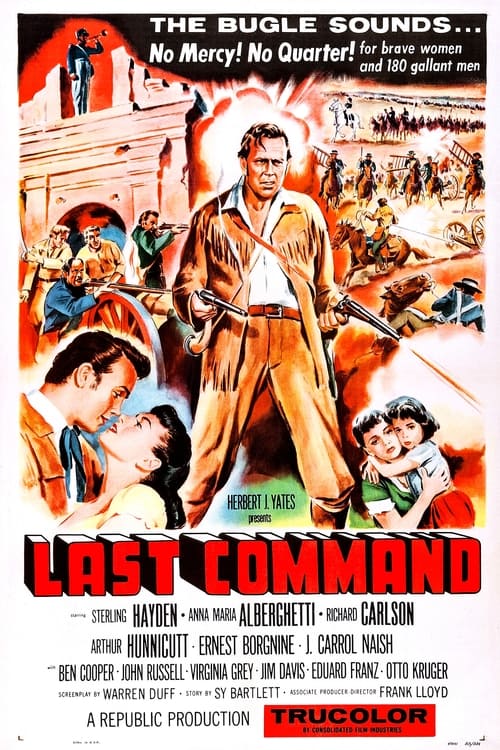


Popular
What motivates General Vasquez to betray his own men in The Last Command?
How does the character of Captain John W. 'Johnny' McCoy evolve throughout the film?
What role does the character of the Mexican revolutionary leader play in the plot?
How does the film depict the relationship between General Vasquez and Captain McCoy?
What is the significance of the final battle scene in The Last Command?
Should I watch it?
Ask Your Own Question

What is the plot?
In 1834 and 1835, in Mexican-owned Texas, Jim Bowie lives as a respected frontiersman trying to keep a fragile peace while resentment swells among American settlers who feel betrayed by General Santa Anna's tightening rule. He has lived on both sides of the political divide, married into Mexican society, and even fought beside Santa Anna in the past, so at first he refuses to throw himself into rebellion. But the land around him is shifting fast: Mexican authorities are arresting suspected dissidents, including Stephen F. Austin, and the settlers are beginning to believe that any hope of compromise is slipping away.
Bowie first appears at a gathering of Texian malcontents, a noisy, anger-charged meeting where men like William Travis and Mike Radin are already talking about secession and armed resistance. Bowie, older in spirit and more cautious than the others, urges patience instead of bloodshed. He tells them in effect that rash violence will only make things worse, and his plea is meant to cool the room, not inflame it. But the scene already makes clear that he is standing in the middle of a collapsing bridge: his loyalty to the Mexican government is strained by his sympathy for the settlers, while his old friendship with Santa Anna makes him suspicious in the eyes of the radicals. The atmosphere is tense, full of muttered accusations and hard stares, and Bowie feels the first pull of a conflict that will eventually swallow him whole.
Not long after that meeting, Bowie is seized by Mexican soldiers while on his way home and brought before Santa Anna. The arrest is humiliating and sudden, a reminder that the Mexican authorities are no longer interested in persuasion. When Bowie stands before Santa Anna, he appeals to him not as an enemy but as an old friend and political equal. He urges him to release the prisoners and honor the spirit of the 1824 Constitution of Mexico, presenting the constitution as the lawful basis for peace and legitimate rule. Santa Anna listens, but he refuses to retreat. The exchange is not yet a shouting match; it is colder than that, a fatal disappointment between men who once trusted each other. The room around them, the military authority, the stiff uniforms, the sense of power gathered into one person, all make clear that the old relationship is now almost meaningless.
Then comes the emotional blow that changes everything. Santa Anna reveals the real reason Bowie has been pulled aside: Bowie's wife and children have died of cholera while he has been away. The revelation is devastating because it is not merely sorrowful; it feels like the final theft of the life Bowie was still trying to preserve. In an instant, the last anchor holding him to restraint breaks loose. The film lingers on the aftermath of that moment in Bowie's face and body, on the stunned silence and then the collapse into drinking and drifting. He does not immediately become a fighter; instead he becomes a hollow man moving through the Texas landscape like someone walking out of his own life. The grief is so absolute that it wipes away the last traces of the earlier Bowie who believed he could stand apart from the storm.
For a time he wanders, isolated and unsteady, and the countryside itself seems to mirror his state: open, empty, and charged with the sense that history is rushing toward him anyway. Then Stephen Austin reaches him and makes the political reality plain. Pacifism, Austin tells him in effect, is no longer possible. The Mexican crackdown has gone too far, and the settlers are moving toward armed resistance whether Bowie likes it or not. This meeting matters because it transforms Bowie's grief into purpose. He is no longer simply a bereaved man retreating from politics. He is becoming a man who understands that his choices have narrowed to one direction.
Bowie now joins the Texian resistance and begins fighting against Mexican forces. One of the first important demonstrations of his renewed commitment comes at the Grass Fight, where he leads a mounted force to victory against Mexican dragoons. The fight is brisk and sharp, a classic frontier skirmish rather than a grand battlefield set piece, but it matters because it restores Bowie's reputation. He is no longer the uncertain mediator of the opening scenes. He is now a capable commander and a symbol of defiance. The victory also tightens the story's momentum: each success by the Texans only deepens the inevitability of a larger confrontation.
As the political and military situation worsens, Bowie and his men reach San Antonio de Bexar, where the coming siege begins to take shape. The city becomes the immediate staging ground for the final resistance, but the real center of gravity is the old mission fortress of the Alamo. The film treats the Alamo as more than a location; it becomes a container for everything the story has been building toward. It is an abandoned mission turned fortress, a place where weapons, supplies, and desperate men gather for a stand that already feels doomed. The visual contrast is strong: the ancient stone of the mission against the swelling pressure of Santa Anna's army, the cramped defenses against the vast open force outside, the fragile hope of the defenders against the certainty of Mexican numbers.
Before the siege fully closes in, the Texans are divided by personality as much as politics. Bowie clashes physically with Mike Radin, and their knife fight becomes one of the film's key early confrontations. The scene is not just about personal dislike; it dramatizes the volatile masculinity of the frontier and the way rivalries among the Texans threaten to undermine the resistance from within. Bowie and Radin's conflict does not become the story's central duel in the way Bowie and Santa Anna's ideological conflict does, but it is a vivid reminder that the Texians are not a unified body yet. They argue, posture, and test one another as much as they prepare for the Mexican army.
Bowie also clashes with William Travis, who initially stands as a more openly aggressive figure among the settlers. Travis wants resistance, while Bowie at first wants caution, and the difference creates tension between them. Yet the film carefully turns that tension into mutual respect. As the crisis deepens and the reality of war becomes unavoidable, Bowie and Travis come to recognize each other's resolve. Their early disagreement gives way to shared purpose. This is one of the story's quieter but most important transitions, because it turns former rivals into comrades, and it allows the defense of the Alamo to feel like a hard-won unity rather than a simple gathering of like-minded men.
The emotional middle of the story sharpens further with the introduction of Consuelo de Quesada, a Mexican girl closely tied to Bowie. She is one of the film's most important bridges between the Mexican and Texian worlds. She warns Bowie that Santa Anna's men are planning to invade, and her warning carries both practical and emotional weight. She is not simply a messenger; she is a reminder that the conflict cuts across personal loyalties and not just political lines. Through her, Bowie receives confirmation that the danger is immediate and unavoidable. The warning strips away any last possibility that events might still settle into compromise. Santa Anna's intent is now clear: the crackdown will become an invasion.
The film then drives Bowie toward full commitment. He learns more clearly how deep the repression has become, how badly Americans in Texas are being mistreated, and how little room remains for negotiation. The sense of betrayal becomes complete. Bowie's previous loyalty to Santa Anna, built out of friendship and shared history, cannot survive the reality in front of him. He understands at last that the old bonds are broken beyond repair. He joins the men at the Alamo not as a reluctant observer but as a man who has chosen his side with finality.
During the preparations for the coming siege, Bowie performs the action that seals both his bravery and his fate: he seizes a Mexican cannon and brings it back to the Alamo. It is a dangerous, physical act, the kind of frontier feat that earns legend precisely because it is reckless. But the cost is severe. He is badly injured in the process, and the injury weakens him as the final battle approaches. This moment is crucial because it marks the shift from active participation to tragic decline. Bowie has entered the final phase of his life in the story, and his body is beginning to fail even as his resolve hardens.
Because of that injury, Bowie hands full command to William Travis. The transfer is not staged as humiliation but as necessity. Bowie knows he cannot lead from a weakened state, and Travis is now the clear military head of the defense. This handoff carries emotional force because it completes their earlier transition from conflict to partnership. Bowie, the man who once urged patience, now yields command to the man who has pushed hardest toward resistance. The change feels earned, and it also underscores how much the defense depends on each man accepting his role.
Outside the mission, Santa Anna gathers overwhelming force. The film makes the imbalance brutally clear: the defenders at the Alamo are tiny in number compared with the vast Mexican army preparing to crush them. The days and hours leading to the assault are filled with the sound of fortifications being strengthened, weapons being checked, and men trying to steady their nerves. The mission becomes a place of compressed time, where every conversation seems sharpened by the knowledge that death is near. Bowie's weakened condition, Travis's command, Crockett's presence, and the other Texans' grim determination all converge into a single tense waiting period.
As the siege tightens, the film keeps the emotional pressure high. Santa Anna's role is no longer that of an old friend or political adversary; he is now the embodiment of imperial force. His army surrounds the mission, and the defenders understand that no relief is likely to come in time. The Alamo becomes a crucible. Every earlier revelation now points here: Bowie's family dead of cholera, his collapse and return, the warnings, the arrests, the broken promises, the knife fight, the gradual tightening of the noose. All of it has been marching toward this one place.
Then the final assault begins. Santa Anna launches the overwhelming attack on the Alamo, and the battle explodes into violent close-quarters combat. The defenders fight with desperate courage, but they are hopelessly outnumbered. The stone walls that once gave them security now merely trap them in a fatal enclosure. The film's tension turns into horror as wave after wave of Mexican soldiers pour in, and the Texans are forced back room by room, wall by wall. Bowie, already injured and too weak to command, fights as best he can in the chaos, while Travis and the others continue the defense with the knowledge that the end is already certain.
The deaths come quickly and definitively. Bowie is killed during the fall of the Alamo, with the story indicating that he is bayoneted to death in battle by Mexican soldiers. Travis dies in the same final struggle, and Davy Crockett is also killed. The film does not spare the rest of the defenders either: all of the Texans at the Alamo are overwhelmed and slain as the mission is overrun. The total destruction of the garrison is the climax the entire film has been preparing for. There is no rescue, no last-minute reversal, no retreat. The outnumbered defenders die where they stand, and the mission falls under the weight of Santa Anna's assault.
The ending lands not as a surprise but as a solemn completion. Bowie's story closes in tragedy, but the film frames that tragedy as transformation. He begins as a man trying to keep the peace, a man split between old loyalties and new realities. He becomes a broken widower, then a reluctant rebel, then a fighter, then a commander, and finally a martyr at the Alamo. The final scenes seal that journey with the image of complete defeat: the mission taken, the defenders dead, and the cause of Texas independence left to carry on through the memory of their sacrifice. The last command of the title becomes, in effect, the command to stand and die, and Bowie fulfills it to the end.








What is the ending?
In the ending of "The Last Command," General Vasquez, who has been struggling with his past and the weight of his decisions, faces a final confrontation. The film culminates in a battle where the Mexican revolutionaries clash with the forces of the oppressive regime. Vasquez ultimately sacrifices himself to save the revolutionaries, and the film closes with a sense of bittersweet victory for the cause he fought for.
As the final act unfolds, the tension escalates in the dusty, sun-baked landscape of Mexico. The air is thick with anticipation as the revolutionaries prepare for their last stand against the oppressive forces. General Vasquez, portrayed with a deep sense of conflict, stands at the forefront, grappling with his memories of the past and the choices that have led him to this moment. His face is lined with the weight of his experiences, and his eyes reflect a mixture of determination and sorrow.
The scene shifts to the battlefield, where the revolutionaries, emboldened by their cause, gather in a makeshift camp. They are a ragtag group, filled with hope yet aware of the dangers that lie ahead. Vasquez, now fully committed to their fight, rallies the men with a passionate speech, igniting their spirits. He speaks of freedom and the sacrifices that must be made, his voice resonating with the fervor of a man who has seen too much bloodshed.
As the battle begins, the camera captures the chaos of gunfire and the cries of men. Vasquez leads the charge, his heart pounding with adrenaline and a sense of purpose. The cinematography highlights the stark contrast between the dusty terrain and the vibrant colors of the revolutionaries' flags, symbolizing their struggle against oppression. The sound of gunfire echoes, and the air is filled with the acrid smell of gunpowder.
In the midst of the battle, Vasquez encounters his former comrades, now turned enemies. The emotional weight of their shared history hangs heavy in the air as they face off. Each character is driven by their own motivations--some seeking power, others fighting for their lives. The tension is palpable as old loyalties are tested, and the stakes become increasingly personal.
As the fight rages on, Vasquez finds himself in a critical moment where he must choose between his own survival and the lives of the men he has come to lead. In a moment of clarity, he decides to sacrifice himself, pushing forward to draw fire away from his comrades. The camera lingers on his face, capturing the resolve and acceptance of his fate. He knows that his actions may lead to his demise, but he is willing to pay the ultimate price for the cause he believes in.
In the final moments, as Vasquez falls, the camera pulls back to reveal the aftermath of the battle. The revolutionaries, inspired by his bravery, rally together and push forward, gaining ground against the oppressive forces. The sound of victory mingles with the cries of the fallen, creating a haunting yet triumphant atmosphere.
The film concludes with a poignant scene that reflects on the cost of freedom. The surviving revolutionaries stand together, their faces marked by exhaustion yet filled with a newfound hope. They honor Vasquez's sacrifice, understanding that his legacy will live on in their fight for justice. The screen fades to black, leaving the audience with a sense of bittersweet resolution, as the struggle for freedom continues, echoing the themes of sacrifice, loyalty, and the enduring spirit of those who fight for what they believe in.
Is there a post-credit scene?
The Last Command, produced in 1955, does not have a post-credit scene. The film concludes with its final moments, focusing on the resolution of the main narrative and the fates of the characters involved. The story wraps up without any additional scenes or content after the credits roll. The film's emphasis is on the dramatic events leading up to the climax, rather than any extended or additional material following the main storyline.
What motivates General Vasquez to betray his own men in The Last Command?
General Vasquez, played by Sterling Hayden, is driven by a complex mix of ambition and fear. He is portrayed as a man who has seen the futility of war and is desperate to survive in a changing political landscape. His betrayal stems from a desire to align himself with the winning side, believing that by doing so, he can secure his own safety and position.
How does the character of Captain John W. 'Johnny' McCoy evolve throughout the film?
Captain Johnny McCoy, portrayed by Arthur Kennedy, begins as a loyal officer who is deeply committed to his men and the cause. However, as the story unfolds, he grapples with the harsh realities of war and the moral ambiguities of leadership. His internal conflict intensifies as he witnesses the consequences of Vasquez's betrayal, leading him to question his own values and ultimately seek redemption.
What role does the character of the Mexican revolutionary leader play in the plot?
The Mexican revolutionary leader, played by Pedro Armendáriz, serves as a pivotal figure in the narrative, representing the struggle for freedom against oppression. His character embodies the hopes and dreams of the Mexican people, and his interactions with Vasquez and McCoy highlight the complexities of loyalty and betrayal. His presence in the film adds depth to the conflict, illustrating the personal stakes involved in the larger political struggle.
How does the film depict the relationship between General Vasquez and Captain McCoy?
The relationship between General Vasquez and Captain McCoy is fraught with tension and conflict. Initially, there is a sense of camaraderie and mutual respect, but as Vasquez's true motivations are revealed, McCoy's disillusionment grows. This dynamic is marked by a power struggle, with McCoy increasingly questioning Vasquez's decisions and ultimately leading to a confrontation that underscores the themes of loyalty and betrayal.
What is the significance of the final battle scene in The Last Command?
The final battle scene is a climactic moment that encapsulates the film's themes of sacrifice and the harsh realities of war. It is visually striking, filled with chaos and emotional intensity as characters face their fates. This scene serves as a culmination of the characters' arcs, particularly for McCoy and Vasquez, as they confront the consequences of their choices and the impact of their actions on their men and the broader conflict.
Is this family friendly?
The Last Command, produced in 1955, is a historical drama that contains several elements that may be considered objectionable or upsetting for children or sensitive viewers. Here are some aspects to consider:
-
Violence and Warfare: The film depicts scenes of battle and conflict, including gunfire and the chaos of war, which may be intense for younger audiences.
-
Death and Suffering: Characters experience loss and suffering, with moments that portray the harsh realities of war, including the emotional toll on soldiers and civilians.
-
Emotional Turmoil: The film explores themes of betrayal, loyalty, and the psychological impact of war, which may be heavy for sensitive viewers.
-
Historical Context: The backdrop of the Mexican Revolution and the portrayal of conflict may include elements that could be distressing, such as oppression and the struggle for power.
-
Mature Themes: The film touches on themes of honor, sacrifice, and the moral complexities of leadership in wartime, which may be difficult for younger viewers to fully grasp.
Overall, while the film is a classic and offers a rich narrative, its themes and depictions of war may not be suitable for all children or sensitive individuals.