






Should I watch it?
Ask Your Own Question

What is the plot?
The story opens in 1995 as a weak morning light filters into a suburban house where four‑year‑old Kevin is injured in an incident his six‑year‑old sister Kaylee interprets as sleepwalking. The children's father drives Kevin to a hospital; medical staff examine him and the siblings are brought back to their home that same day. They spend the afternoon in the house, and as night arrives they awaken to find their father gone. The siblings notice that ordinary fixtures and portals--windows, doors and other items around the house--are absent or beginning to vanish. Kevin suggests they move to the downstairs living area for the night; they arrange cushions and blankets and turn on cartoons on the television to pass the time.
During the night, a heavy thumping sound echoes through the dark house. The children investigate and discover a chair affixed upside down to the ceiling in the living room. Kevin proposes that their father "went with mom," but Kaylee asks him not to speak of their mother. The downstairs toilet, already in disrepair, suddenly ceases to exist; the porcelain and plumbing appear to dissolve. When Kaylee and Kevin attempt to reach an upstairs bathroom, Kaylee notices a doll positioned on a bedroom ceiling, a toy balanced in a disturbing way. Kevin, frightened at the idea of using a toilet that has disappeared, requests that they place two buckets in the downstairs bathroom and they comply.
A malevolent voice calls Kaylee from the shadows, urging her to come upstairs. She ascends and finds their father sitting in a bedroom. He tells her to look beneath the bed; Kaylee does so and finds no one. Their mother materializes on the bed, tells Kaylee that she and their father love both children, instructs Kaylee to close her eyes, and then vanishes again. After the disappearance Kaylee notices the closet door ajar and hears her mother's voice--whispered words advising that "there's someone here." From within the dark closet come sounds of anguish: wet moans, the cracking of bones and cries that indicate someone in severe pain. A hand suddenly protrudes around a corner, grasping blindly, and Kaylee recoils in terror.
Kaylee flees down the stairs and Kevin helps her push a couch into the hallway, using it as a barricade against the corridor from which the voice has been calling. The siblings wait; Kevin eventually falls asleep. While he sleeps the voice speaks to Kaylee once more. When Kevin awakens he finds Kaylee gone. Along the wall where she had stood, toys and household objects are embedded, suspended as if glued to the surface.
The voice turns its attention to Kevin and beckons him into the basement. He follows and discovers Kaylee sitting motionless; her face is altered--her eyes and mouth have been removed. The ephemeral voice speaks to Kevin, saying it wants to play. As it makes that demand small objects and toys begin to disappear in front of Kevin's eyes. In the kitchen a drawer slides open and, responding to the voice's instruction, Kevin takes a knife and drives it into one of his own eyes. The action is committed under coercion: the entity instructs him and he obeys. After injuring himself he dials 9‑1‑1 on a phone and whispers to the operator that he is hurt and feels sick. The operator tells him to remain on the line and assures him that adults are on the way. Kevin reports that the doors have disappeared; while he speaks the telephone slips from his hand and the handset transforms into a child's Chatter Telephone toy.
The voice declares that it can "do anything" and explains that Kaylee disobeyed its command to remain quiet; because she demanded to see their parents it took her mouth as a punishment. The voice then orders Kevin to come upstairs. Kevin retrieves a flashlight and, when he climbs the steps, he finds himself walking on the ceiling. He moves through a bedroom space that fractures into a void, the architecture dissolving around him. A hallway that seems to extend without limit unfolds; along it toys and objects rest against the walls and a massive pile of playthings supports a large dollhouse atop a mound.
On a television screen or as text in the space a numeric message appears: "572 days." Kevin walks past images and relics: photographs pinned to surfaces show faces that are either missing, smeared or otherwise distorted. He sees a woman lying on a bed whose body gradually fades until only her head remains visible, and then even that head diminishes. In one moment blood appears on the floor in a scattered blot, then recedes, only to splatter again seconds later; the blood's presence alternates between vivid and absent.
Alone in the disintegrating bedroom, Kevin pleads with the voice for something that will make him happy. In response an illusory door forms in the darkness. A large, indistinct face manifests above him in his bed and speaks to him, bidding him to "go to sleep." Kevin asks the face for its name twice; the face remains silent and provides no answer. The room closes in, lights dim, and the figure watches over Kevin as the scene falls into darkness.
Throughout these events the parents remain absent: the father disappears early and is not located, the mother appears only briefly to speak to Kaylee before vanishing. The voice claims responsibility for the removal of the children's family members' accessibility and for taking Kaylee's mouth as punishment; it demonstrates the capacity to alter the house's physical structure and the children's bodies. Kaylee's mutilation--her missing eyes and mouth--is visible to Kevin in the basement, and later Kaylee's fading body and head indicate that she ceases to occupy the house physically. Kevin's eye is injured by his own hand when he follows the voice's command and inserts the knife. The final visual shows Kevin alone under the enormous, unnamed face telling him to go to sleep; when he asks its name it does not respond, and the film's final images hold on the child in the encroaching dark.








What is the ending?
At the end of Skinamarink (2023), Kevin, a young boy trapped in a surreal, dark, and shifting house, loses his sister Kaylee to a sinister force. Following her disappearance and apparent death, Kevin is left alone, increasingly isolated in a void-like space where doors and windows vanish. Ultimately, Kevin succumbs to the darkness, stabbing himself in the eye as commanded by the entity, and the film closes on his fading consciousness, suggesting he is dying or slipping into death or a coma-like state.
The ending unfolds in a series of haunting, disorienting scenes:
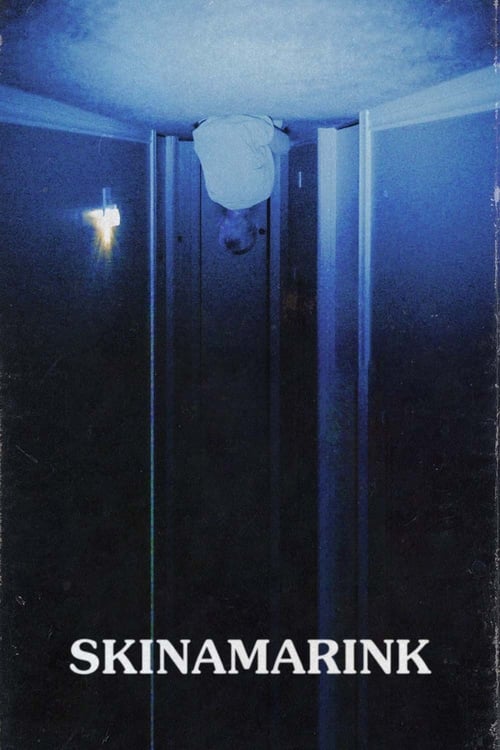
Kevin's toys begin to defy gravity, moving from the floor to the ceiling, and Kevin himself is shown upside down on the ceiling, signaling a breakdown of physical reality. He wanders through familiar hallways that now feel alien and empty, with the house losing its normal structure--doors and windows disappear, leaving only darkness beyond. This visual motif of vanishing exits emphasizes Kevin's entrapment in an otherworldly or liminal space.
The phrase "572 Days" appears over an upside-down room filled with toys, hinting at the possible length of Kevin's unconscious state or coma, though its exact meaning is left ambiguous.
Earlier, Kaylee is instructed by a sinister voice to harm herself by putting a knife in her eye. Though this act is not shown directly, her anguished cries and the aftermath are heard, indicating her death or disappearance. A voice explains that Kaylee "didn't do as she was told" and that the entity "took her mouth away," symbolizing her silencing and removal from the world.
After Kaylee's loss, Kevin is left utterly alone, both physically and spiritually. He attempts to call for help, but the phone calls are futile, and the presence of a shadowy, demonic figure--interpreted by some as the mother or a death figure--looms over him. This figure may represent Kevin's mother in the afterlife or the darkness of death itself.
In the final moments, Kevin stabs himself in the eye, following the entity's command. This act parallels Kaylee's fate and signifies Kevin's surrender to the darkness. His screams echo as blood splatters, and the film ends with Kevin's consciousness fading into the void.
The fate of the main characters is thus:
- Kaylee: She is the first to die or be taken by the entity, her death implied through sounds and narrative clues rather than shown explicitly.
- Kevin: He follows Kaylee into death or unconsciousness, trapped in a nightmarish limbo where reality dissolves, ultimately succumbing to the darkness by self-harm.
The ending portrays a descent into oblivion, with the house and its shifting spaces symbolizing Kevin's fading mind or life. The film closes on a bleak note, with Kevin and Kaylee lost to the darkness, their fates sealed in a surreal, dreamlike void.
Is there a post-credit scene?
The movie Skinamarink (2023) does not have a post-credits scene. After the film ends, there are no additional scenes or extras during or after the credits.
The film's ending itself is ambiguous and unsettling, featuring Kevin alone in a surreal, shifting house environment, with the entity's face appearing and telling him to go to sleep. The final visuals include the cryptic text "572 days," which is open to interpretation but often thought to represent the length of Kevin's coma or nightmare state. However, once the credits start rolling, the film concludes without any further scenes or post-credit content.
Is this family friendly?
The 2023 movie Skinamarink is not family friendly and is generally recommended for mature audiences, typically 16 years and older, due to its disturbing and unsettling content.
Potentially objectionable or upsetting aspects for children or sensitive viewers include:
- Psychological horror and supernatural themes involving a mysterious entity that isolates and torments children in a surreal, disorienting environment.
- Scenes of darkness and silence that create intense anxiety and fear, which may be overwhelming for younger viewers.
- Implied child abuse and trauma, including emotional and possibly physical abuse, which is a central metaphor in the film and can be deeply distressing.
- Disturbing imagery, such as a character having their mouth removed, symbolizing silencing and helplessness.
- Themes of death, betrayal, and loss, explored in a bleak and abstract manner that can be emotionally heavy.
- No explicit sexual content or graphic violence is detailed in the sources, but the film's tone and themes are mature and unsettling.
Overall, Skinamarink is a slow, atmospheric horror film that uses minimal conventional scares but relies heavily on psychological dread, darkness, and abstract horror elements that are not suitable for children or sensitive viewers.