












Popular
What motivates Areski to take Julia hostage during the negotiation with the police chief Moss?
Why does Rez order Yuri to kill Areski, and what is the significance of the money Areski took?
How does Lino's relationship with Areski evolve, considering Lino's past with Charas?
What role does the sabotage of Areski's motorbike play in the plot?
How does the film depict the final chase involving Julia, Lino, and Sarah, and what vehicle do they use?
Should I watch it?
Ask Your Own Question

What is the plot?
Lino Alban Lenoir opens the story by engineering an improbable plan: he converts an old Renault Clio into an armored battering ram, reinforcing the front with welded steel and mounting heavy bullbars. He designs the car to smash through a storefront and drive into a jewelry boutique so that his foster brother Quentin can collect a cache of goods to pay off a dangerous debt. In the predawn hours Lino slams the modified Clio into the shop's glass and masonry, shredding the display cases and scattering diamonds and watches across the floor as alarms blare. The noise draws police; Quentin manages to flee on foot through an alley while Lino drives the Clio straight into the head of the response, accepting capture to protect his brother. Police taser him and cuff him amid the wreckage. Quentin escapes the immediate pressure but the robbery's fallout lands Lino behind bars.
Charas, a hard-edged narcotics detective played by Ramzy Bedia, notices Lino's mechanical skill and takes a personal interest. Charas engineers an uneasy bargain: he secures Lino day release from custody and recruits him into a covert police unit that Charas runs unofficially. The unit's modus operandi is brutal and improvised--officers modify unmarked police cars so that they can ram "go-fast" drug couriers off the road. Charas puts Lino to work retooling the fleet, welding reinforcements and calibrating bumpers so the cars can strike at high speed without losing control. Lino works in a cramped garage under Charas' supervision; in return Charas uses his influence to push for a pardon and to obtain a modest garage where Lino can live and ply his trade once he is cleared.
Charas and Lino begin to probe a ring of drug runners who use souped-up vehicles to ferry narcotics across the border. The investigation moves into Quentin's orbit when evidence suggests Quentin has been drawn into the go-fast crew. Charas takes the lead, intent on breaking the operation and protecting the young men under his charge. One night, while Charas drives his Renault 21 to a meeting, two members of the unit--Areski and Marco--confront him. Areski Nicolas Duvauchelle and Marco Sébastien Lalanne, both nominally part of the squad, ambush Charas at a roadside stop. They open fire; Charas slumps over the wheel as gunshots perforate the car's driver side. The ambush is quick and brutal: Areski and Marco execute Charas in a hail of bullets, then disable and burn the car to erase traces. Lino, who hears news of Charas' death, improvises a desperate escape from an unfolding trap and disappears into the city.
Police investigators recover a charred vehicle at the ambush site, but it is not Charas' Renault 21; that misidentification becomes an early clue that someone is staging evidence. Still, higher-ups move quickly to find a scapegoat. Areski and Marco, who are working for and protecting a corrupt hierarchy inside narcotics, begin to frame Lino. Police interrogators drag Lino from his bed, punch him in the ribs, and interrogate him about Charas' murder. Areski leans in during the questioning to pressure Lino into confessing or implicating others, but Lino refuses to lie. When Lino will not cooperate they intensify the sculpted narrative: they claim eyewitnesses put him at the scene, that his armored Clio was seen nearby, and that the burned car ties him to a murder he does not remember committing. Lino breaks the interrogation and runs. He butts through a gauntlet of officers, breaks a glass door, and leaps over a low wall, driving a stolen city bus briefly to flee--he crashes the bus and then ditches it, sprinting into the metro tunnels. He is shot at and chased by a dozen officers as he flees through service corridors and basement stairwells. He kills a pursuing dog by closing a heavy security gate on it to stall his capture, and he makes his way back to the outskirts where he holes up.
With Charas dead and Lino a fugitive under suspicion, Lino seeks Julia Stéfi Celma, a policewoman and Charas' trusted colleague who is also Lino's lover. Julia confronts him in a near-empty parking lot, breathless and furious. She slaps him and demands answers; Lino tells her what he knows about the ambush--that Charas' car was sabotaged, that the burnt wreck found by traffic cops is not Charas', and that officers within the squad were acting strangely. Julia listens and then, despite her duty, helps him by falsifying a surveillance log to provide Lino a window to disappear from a compromised police dragnet. Their relationship becomes strained and complicated: they argue heatedly about whether to put themselves at risk to pursue the truth, but they continue to exchange information and cover for one another in the weeks that follow. Julia keeps a radio on and a bag of tools hidden in the trunk of her personal car; Lino keeps watch from his garage.
As Lino reconstructs the clues, he realizes the burnt car misidentification means someone intended to mislead the inquiry. He and Quentin, who has been uneasy since the jewelry job, assault one of the drug runners' safe houses in an effort to find the missing Renault that might tie the conspiracy together. They break into a farmhouse that serves as a holding yard and fight a small squad of armed runners. The house contains spare engines and a red Renault turbo that Quentin recognizes: its chassis, bolted bumpers, and telltale welding match the cars used by the go-fast crew. They shoot two men who try to bottle them in a stairwell. Lino sustains a shrapnel wound in his forearm when a pipe bursts under gunfire, and Quentin suffers a graze to his cheek. After killing two of the runners and tying up a third to interrogate him, they pull a tarp off the Renault and find a stash of weapons and a ledger of payments linking the go-fast network to a higher-up in narcotics.
They form an uneasy team: Lino, Quentin, and a mechanic named Marco who works at Charas' garage--a different man from Inspector Marco, but to avoid confusion Lino calls him "Marco the machinist." Marco the machinist helps them identify the hidden Renault's location from a pattern of tires and GPS coordinates found in the ledger. They press Julia to trust Lino; she uses her badge to pull rank inside a compromised station long enough to give Lino an evening shift where he can slip away from a watching, compromised unit. The trio uses night-time to recover the red Renault parked in a farm hideout. Under a full moon they cut the padlock, drive the Renault out through rutted dirt roads, and head for the city with headlights off.
Their success is short-lived. Areski, who survived the Charas ambush and who has been consolidating his own position inside the narcotics network, hears of the theft and mobilizes corrupt officers. He orders a stop: Marco the machinist and Quentin try to hold off a pursuing squad while Lino drives the Renault. In the confrontation a corrupted officer--Marco Sébastien Lalanne, the one who had taken part in Charas' ambush--appears with two other men and shots ring out. Marco raises his pistol and fires point-blank into Quentin's chest as Quentin reaches to swing a crate of car parts at him; Quentin collapses to the ground, coughing blood, and dies on the dirt track before Lino can get to him. Quentin, with his dying breath, gurgles the location of where the Renault's engine block conceals a single, smoking bullet that will prove who killed Charas. Quentin's last act is to point toward the engine bay, and Lino pries the hood open as Quentin goes still.
Areski intensifies his effort to crush Lino. He rallies the corrupt brigade to intercept Lino before he can take the Renault or the bullet to an impartial lab. Lino straps into the red Renault, now rigged by Marco the machinist with a reinforced front and a hidden alcove where the bullet is slipped into a zippered pouch. Lino drives with reckless speed, plowing through makeshift barricades, smashing through a line of patrol cars at a blockade on a secondary highway as he attempts to reach Charas' old garage where sympathetic technicians can perform forensic work. Officers on the road wedge against him, using spike strips and heavy trucks to force him off course, yet Lino maintains velocity--he uses the Renault's bullbars to push a squad SUV toward the median, splitting the pursuit into two groups. At one stage a pursuing car clips the Renault's rear quarter and spins it into a concrete barrier; the turbo overheats and grease ignites. Flames lick the wheel wells, and the Renault's interior fills with smoke as the clutch slips and the engine screams.
Areski closes in and doors the road with two squad cars. In a final desperate maneuver Lino drives the burning Renault through a police roadblock, smashing into the lead squad car. The impact shears off a wheel and throws both cars into a twisted heap. Lino wrestles the steering column and aims the smoldering vehicle toward the garage where Charas had once kept his tools. The Renault bursts through the garage's shutter and careens to a stop amid a cloud of steam. Flames crawl along the hood. Technicians from Charas' old team--men and women who have not yet been fully bought by Resz and the corrupt chain--wrench open the door and haul Lino from the cabin moments before the fuel line ruptures in a thunderous explosion. As the structure trembles from the blast technicians lift the engine block and disassemble it on a steel table. They extract a deformed, soot-black bullet from between warped metal petals and slip it into evidence trays. Forensic analysis in the station lab will later match the bullet's wound characteristics and rifling to a weapon traced to a supply chain run by the head of narcotics, a man named Alexander Resz.
With the recovered bullet and ledger, Lino and Julia now hold concrete proof tying high-ranking officers and a trafficker's network to Charas' murder. Areski, whose hand is implicated by the ballistic match and eyewitness testimonies that begin to coalesce, flees the city to avoid arrest. He disappears into the night.
Two years pass. Areski has sought refuge across the border. Under the alias Joris he now works in a small timber factory in a German village and shares an apartment with Mathilde, a woman from the town whom he has begun dating seriously. He tries to build a quiet life of sawing boards and fixing a rickety motorcycle in the corner of a woodshop. He also continues to moonlight; at night he transports drugs and weapons for a network run by Commander Alexander Resz, who occupies an increasingly powerful position as the corrupt head of the French Narcotics Department. On a weapons run Areski discovers his motorbike has been sabotaged: a brake line has been deliberately frayed. He loses control in a slick turn and crashes on the shoulder of a rural road. As he staggers to his feet he realizes his pursuers are not rival couriers but men sent from inside the trafficking ring. He evades them and returns to his apartment, only to find the timber factory boss at the door. The boss bursts in, grabs a kitchen knife, and without warning slashes Mathilde across the throat, killing her instantly in the cramped living room. The boss takes a swing at Areski who staggers backward, narrowly avoiding the blade, and Areski kills the boss in a struggle. The incident confirms Areski's worst fear: Resz has betrayed him to protect himself from scrutiny into Charas' death. Fearing for his life, Areski flees Germany and returns to France to prepare an escape plan and to seek out fragments of truth.
Back in France Resz tightens his grip. He orchestrates a deal with the Spanish police to exchange Alvaro, a kidnapped Spanish drug enforcement officer, for custody of Lino. Resz's men set up a handoff. At the exchange Resz's men massacre the Spanish police detail--gunfire rakes the rendezvous point; officers fall beneath volley after volley. Resz watches as the Spanish team collapses, then coldly threatens Lino before dropping him off at the border. Lino stumbles back into France wounded and furious; he meets Julia and for a while plans to leave the country for Spain to create a new life. He changes his mind when he learns Areski has returned to France and is on the run.
Areski reaches out to his estranged wife, Stella, by phone. She pleads with him not to come near his family; she begs him to renounce contact for their children's safety. Despite Stella's pleas, Areski's situation deteriorates. Yuri, a ruthless henchman whom Resz has deployed to recover money Areski stole from the operation, tracks him to the city and pursues him through streets and trams. Yuri chases Areski into a crowded tram car; passengers scream as Yuri aims a pistol. Lino, following a tip, leaps onto the tram and throws himself between Yuri and Areski. He disarms Yuri in a scuffle; Yuri flees into the rain. Areski, desperate and cornered, takes Julia hostage in the middle of a narrow alleyway and radioes the police chief Moss, who has been investigating Resz for years but who also has private ambitions. Areski tells Moss that he will exchange Julia for proof that will implicate Resz; he demands safe passage to an airfield so he can flee to Germany and testify to German authorities about the corruption.
Lino and Julia reach an agreement: they will help Areski reach the airfield in exchange for his testimony that names higher-ups. They enlist Sarah, a young mechanic and friend of Julia's, who outfits three vehicles with reinforced bumpers and makeshift armor to withstand attacks: a small delivery van for cover, a blue station wagon for Lino, and a rented cargo truck to shield the convoy. Moss, meanwhile, secretly meets with Resz and bargains a promotion: she agrees to hand Areski over if Resz will help her secure a high-ranking position within a restructured department. Cole, Resz's adviser, warns Resz to eliminate Yuri, whom he considers a loose end. Resz orders a hit on Yuri, but the attempt fails; Yuri survives and harbors a plan for revenge.
On the day of the handoff the airfield becomes a tinderbox. Areski, Lino, and Julia arrive in a three-car convoy while dawn is gray over the tarmac. Resz's men have eliminated the German police officers who were supposed to extradite Areski, and Resz himself appears at the far end of the runway in a tailored overcoat. He steps forward into a corridor of personnel and reveals, to the stunned crowd of officers and pilots, evidence of Moss's corruption--files she had thought secure. The scene erupts. Resz raises a pistol and shoots Julia in the shoulder as he accuses her of collusion; she topples but remains conscious, bleeding and gasping. Lino lunges for Resz, but Resz moves back and takes a widening stance, intending to create chaos. At that moment Yuri, who has crept up behind a stack of wooden pallets, fires a single shot that slams into Resz's head. Resz collapses to the tarmac, dead, a neat crimson bloom under him. Yuri steps out, gun smoking, and then fires again into the air to scatter the crowd.
A firefight flares. Resz's men try to maintain the perimeter; police return fire. Julia, clutching her wound, tells Lino to keep Areski under control and to secure his hands with zip-ties she has pulled from her sleeve. She orders Lino to arrest Areski. Lino pursues Areski through the airfield's service roads as helicopters beat over the field. Areski solos a battered sedan and bolts onto the access highway; Lino drives a pursuit car, tires squealing at high speed. The chase ends when Areski loses control rounding a cloverleaf, hits a concrete barrier, and his car flips into a ditch. He climbs out with his hands raised, blood streaking from a gash along his brow, and surrenders to Lino at gunpoint.
Moss signs a contract with Cole that will secure her the promotion she sought, but the signature ceremony is interrupted when word arrives that Resz is dead and that Lino and Julia survived the airfield confrontation. Moss tries to distance herself, but Julia, using phone records and the evidence gathered at the Renault and the bullet recovered earlier, confronts her. Julia walks into the precinct and places a stack of documents and the ballistic report on Moss's desk. She reads the chain of custody and the chain of orders aloud to the room; prosecutors and honest officers watch as Julia has Moss placed under arrest on charges of conspiracy and obstruction of justice.
In the days that follow Cole attempts to flee the country. He boards a private transfer at a small airstrip, carrying a duffel bag with cash and passports. Yuri, who has not been bought off and who wants to tie up loose ends, tracks Cole to the airstrip. When Cole tries to board a waiting plane Yuri shoots him dead; Cole collapses in the dust, a single bullet through the skull. Police later find Cole's body under the plane's wing. The killing marks the end of one chain of corruption and the brutal settling of another.
Areski is brought to the police station and booked. From a holding cell he watches as Stella and their children collect their belongings and walk away under the watch of a social worker; Areski's eyes follow them through the glass as doors close behind his former life. His daughters peer at him through the partition and then look away when told not to make a scene. He understands he has lost everything he tried to protect.
At a later hearing Julia confronts Moss in front of assembled officers and prosecutors. Moss is handcuffed and read her rights. She is led out of the precinct to a waiting van and driven to custody. Areski's testimony, combined with the ballistics from the burnt Renault's engine and financial ledgers seized from Resz's accounts, gives prosecutors enough to charge multiple officers and traffickers. Areski sits at counsel's table with a ghastly look; he has made deals and has his own crimes to answer for, but he has given the keys to the corruption's structure.
In the immediate aftermath Yuri comes to the attention of investigators for two murders--Resz and Cole--but he has vanished into the urban sprawl. Some officers want to capture him; others quietly file his sightings and move on. Lino, Julia, and Sarah walk the precinct corridors after the arrests. They exchange a quick, tired embrace in the parking lot. Sarah, who built the armored reinforcement on the cars that got them to the airfield, stands beside them and refuses any reward beyond a tired nod and the knowledge that they are alive. Lino and Julia thank her and leave together.
The final scene shows Lino and Julia driving away from the city. They ride in a modest car with the trunk full of tools and the seats worn soft from long nights. Lino takes Julia's hand in the passenger seat as gray clouds break over the highway. Behind them sirens fade, and in front of them the road stretches toward an uncertain but law-abiding life. They do not speak; they only drive, step by step, out of the shadow of the go-fast network and the corruption that cost Charas his life, Quentin his last breath, and Mathilde and Cole their lives. Areski sits in a holding cell, Resz lies dead on the runway, and Moss is booked--evidence, testimony, and the extracted bullet have rewritten the ledger of who is guilty. Lino and Julia cross a provincial bridge into sunlight as the case file moves through prosecutors' hands and the city behind them returns to its daily rhythms. The story closes with them leaving together, hands clasped, the last bullet secured in evidence and the chains of the conspiracy beginning to be dismantled.
More Movies Like This
Browse All Movies →


What is the ending?
Lino finally brings Areski back in, and the corrupt chain around the murder is exposed. Julia survives, Moss is arrested for her role, and the story ends with Lino and Julia walking away together while Sarah joins their circle.
The ending, in a short narrative form, is this: after the last chase and the last betrayal, Areski is caught, the truth that has been buried for years starts to surface, and the people who helped hide it lose control of the situation. Lino does not lose his target again. Julia remains alive, Moss is taken into custody, and Lino leaves the conflict behind with Julia, with Sarah now part of their team.
In the final stretch of the story, Areski tries to save himself by running again, but Lino keeps after him. The pursuit ends with Lino successfully nabbing Areski and bringing him back to the police station.
Before that capture, the story reaches a point where the people around Areski and Resz turn on one another. Resz has already been exposed as corrupt, and Moss's involvement has also been compromised. During the final confrontation, Resz is killed by Yuri after Resz betrays him.
Julia's fate is direct and immediate in the climax: she is shot by Resz after Moss's involvement is exposed. The sources do not indicate that Julia dies, and the ending described in the results places her alive at the close, walking away with Lino.
Moss's fate is also clear. She is captured for her involvement after the collapse of Resz's side of the operation.
Areski's end is the most important criminal resolution in the film. He spends the final portion of the story trying to escape, but Lino catches him and brings him in. The film's ending leaves him no longer free and no longer able to control the story around Charas's murder.
Lino's fate is the opposite of the film's villains. He survives the final conflict, completes the pursuit, and ends the story with Julia beside him. Sarah's fate is also simple: she is welcomed into the group at the end, as the final shot has Julia and Lino walking off together while Sarah joins their team.
Is there a post-credit scene?
There is no post-credit scene in the movie Last Bullet (2025) .
The film serves as the third and final installment in the Lost Bullet (Balle Perdue) trilogy, concluding the vendetta of car genius Lino against Areski and the corrupt commander . While some online discussions about the franchise mention confusion or self-destructed clips regarding post-credit content, official confirmations and reviews for this specific 2025 installment indicate there are no mid-credit or post-credit scenes . The story wraps up with Lino's journey for justice, ending without any additional scenes after the credits roll . Any mention of an "end credit scene" in forum posts appears to be either a misinterpretation or a reference to unrelated content within the franchise discussions, as verified reviews do not list such a scene for Last Bullet .
Therefore, viewers do not need to stay after the credits to see a post-credit scene, as none exists for this film .
What motivates Areski to take Julia hostage during the negotiation with the police chief Moss?
Areski takes Julia hostage to hold negotiation talks with police chief Moss, aiming to cut a deal to protect himself after being pursued by his former boss Rez and his men.
Why does Rez order Yuri to kill Areski, and what is the significance of the money Areski took?
Rez orders Yuri to kill Areski because Areski escaped with money that originally belonged to Rez's drug ring, posing a threat to Rez's operations and loose ends in the police investigation.
How does Lino's relationship with Areski evolve, considering Lino's past with Charas?
Lino is initially reluctant to team up with Areski because Areski killed Lino's mentor Charas, but eventually agrees to help Julia and Areski, showing a complex dynamic influenced by personal grievances and shared goals.
What role does the sabotage of Areski's motorbike play in the plot?
The sabotage of Areski's motorbike triggers a chain of events where Areski escapes an assassination attempt, leading to his girlfriend's murder and his decision to flee Germany and prepare an escape plan in France.
How does the film depict the final chase involving Julia, Lino, and Sarah, and what vehicle do they use?
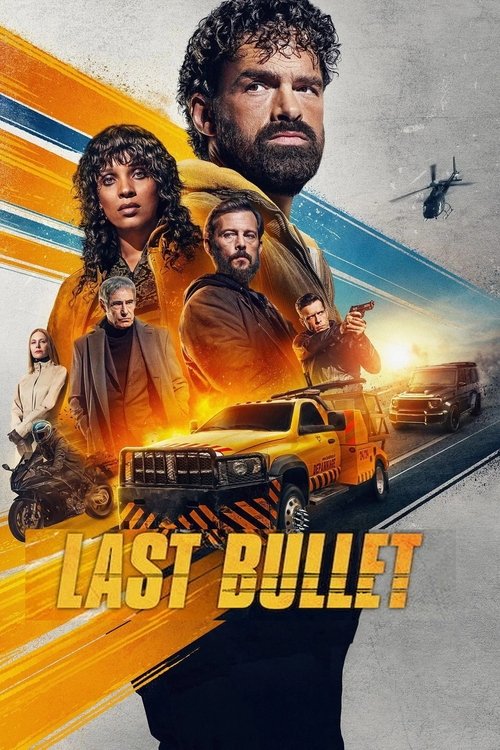
Julia, Lino, and Sarah prepare a high-stakes chase using a heavily modified armored tow truck equipped with spiked hubcaps and firework cannons, racing against time to get Areski to an airfield for extraction.
Is this family friendly?
No, it is not especially family friendly. Last Bullet is rated TV-MA on Netflix, and IMDb's parents guide flags severe violence and gore, severe frightening/intense scenes, and moderate profanity.
Potentially objectionable or upsetting elements for children or sensitive viewers include: - Strong bloody violence and action-heavy brutality, including gunfights, fights, and bloody injuries. - Intense chase and danger scenes that are meant to feel high-stress and suspenseful. - Frequent strong language, including about 15 F-bombs in French according to IMDb's guide. - Mild alcohol, drug, or smoking content.
There is no reported sex or nudity in the parents' guide, but the film is still likely too intense for younger children because of the violence and overall tension.








