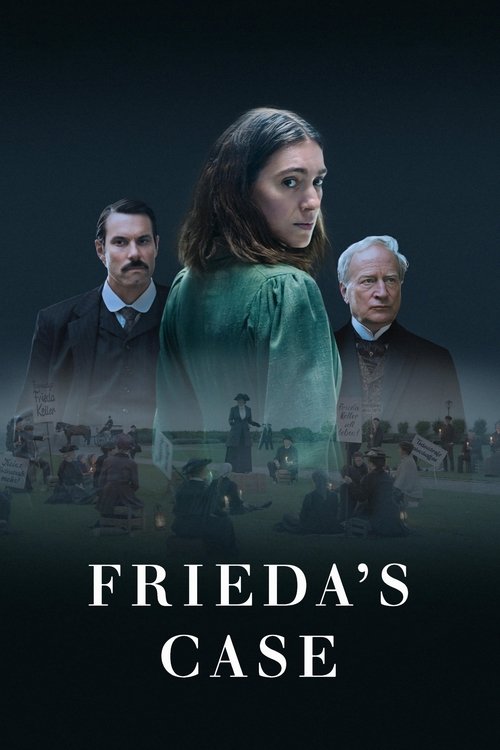











Popular
Who is Frieda Keller, and what specific act leads to her case?
What happened to Frieda Keller’s son before the trial, and why is that detail important?
How does the court case challenge the idea of Frieda Keller as only a perpetrator?
What role does the murder of Frieda Keller’s child play in the wider legal or social conflict?
What is the specific historical case at the center of the film, and who is directly involved in it?
Should I watch it?
Ask Your Own Question

What is the plot?
The film opens in 1904 in St. Gallen, Switzerland, with a society that already feels rigid, judgmental, and deeply unequal, and it moves immediately into scandal when hikers discover the body of a small boy in a muddy thicket near Tablat on June 7, 1904. The child is Ernst Keller, the five-year-old son of Frieda Keller, and his body has been hidden for six to eight weeks, strangled with string and left where the wet earth and brush have nearly swallowed him whole. From the first images, the world around the crime feels cold and procedural, but the emotional core is the stunned, devastated figure of Frieda Keller, a 25-year-old seamstress whose life is about to be stripped open in public.
Before the courtroom ever appears, the story begins filling in the invisible pressure that has been crushing Frieda for years. She is not a monstrous killer in the usual sense of the word, but a poor, unmarried woman carrying a shame the society of the time treats as a kind of moral contamination. The deeper truth, gradually revealed as the investigation tightens around her, is that Ernst is not the product of a relationship she chose; he is the child of rape by her married employer. That secret gives the whole film its tragic charge, because every later accusation, every stern legal phrase, every public judgment lands on a woman who has already been abused, silenced, and cornered by the very people who will now condemn her.
The body is identified through the child's clothing, and once the nursery sisters recognize the garments, the police close in on Frieda within days of the discovery. When she is arrested, she does not build a defense or deny the obvious. She confesses immediately, and the confession is not framed as a twist so much as a collapse: she has reached the point where shame, poverty, and despair have erased any belief that she can survive with the child, much less protect him from the world that will punish both of them. The film makes clear that the issue is never whether she did it, but why she did it, and whether a legal system built by men can even recognize the difference between cruelty and desperation.
As the case moves forward, the first wave of public outrage begins to build outside the police and court walls. Newspapers seize on the murder of an illegitimate child, and the story becomes less a private tragedy than a social spectacle. Frieda is transformed into a symbol, and everyone around her seems to want to force her into one of two boxes: either she is a depraved mother who deserves the harshest punishment, or she is the victim of a brutal society that created the conditions for the crime and then rushes to condemn her. That argument becomes the engine of the film, and each scene in the run-up to the trial tightens the tension because the stakes are no longer only Frieda's life, but the moral legitimacy of the entire legal order.
The prosecutors enter the story with the authority of law behind them, and Walter Gmür, the prosecutor, becomes one of the film's central figures of institutional rigidity. He is not presented as a cartoon villain, but as a man committed to the logic of the system, a man who wants truth, order, and punishment to align neatly, even when the facts are ugly and human suffering refuses to fit his framework. Opposite him stands Arnold Janggen, Frieda's defense lawyer, whose task is almost impossible: to force the court to see motive, trauma, and social coercion in a justice system that prefers categorical guilt. Their conflict gives the courtroom scenes their pulse, because the trial is not only about an act of killing, but about whether the court can admit that the act grew out of violence committed long before the child's death.
The trial opens at the St. Gallen Cantonal Court on November 11, 1904, and the film shifts into a colder, more theatrical atmosphere. The chamber is full of pressure: press attention, public speculation, legal ritual, and the sense that the proceedings are already bigger than the defendant standing in front of them. Frieda's face becomes the center of the frame, and what matters is not sensationalism but the tension between her silence and the voices around her. She is a woman being interpreted by men in uniform, men in robes, men with notebooks, men with moral certainty. The dialogue in these scenes, according to the plot descriptions, circles the same impossible question: how much room does a woman have to be a victim before the law stops treating her as a pure perpetrator?
A key revelation deepens the tragedy: Ernst's existence itself is the result of repeated sexual violence by Frieda's married employer. This is not treated as a side detail, but as the heart of the film's moral argument. Frieda has been carrying not just an unwanted child, but the permanent evidence of what happened to her, while the man responsible remains untouched by public punishment. That imbalance drives the story's anger. The film keeps returning to the fact that the man who raped her faces no consequences, while she is placed on trial for the death of the child that rape produced. The emotional effect is devastating: the crime she is accused of is real, but the social order around it is also guilty, and the movie refuses to let the audience forget either truth.
As testimony unfolds, the courtroom becomes a stage where the private is dragged into the public light. Protests and media coverage intensify the drama, turning Frieda's case into a national scandal and a test of whether Swiss law can tolerate any notion of female suffering as a mitigating factor. In the exchanges between prosecution and defense, one can feel the legal walls narrowing around Frieda. Walter Gmür pushes toward punishment, while Arnold Janggen insists that the court cannot ignore the conditions that produced the act: rape, illegitimacy, poverty, fear, and isolation. The film's tension comes from the fact that none of this excuses the killing, but all of it changes how it should be understood.
The story also uses the prison and courtroom as contrasting spaces. The prison is harsh, isolating, and disciplinary, a place where Frieda is not simply detained but slowly broken down by a system that sees her as a moral lesson. Yet even here, the film reportedly gives her a small symbolic refuge: a desk in the solitary confinement cell where she continues to write her story. That detail matters because it turns her from a silent object of judgment into someone trying to reclaim authorship over her own life. She is trapped, but not erased. The act of writing becomes a fragile form of resistance, a way to preserve the truth of what happened even while the state prepares to extinguish her.
The trial reaches its first climax on November 12, 1904, when the court delivers a death sentence. The verdict lands with brutal force, not because it is unexpected, but because the system has made its indifference feel inevitable. Frieda is condemned as if her suffering has no legal value at all. The courtroom's finality is matched by the public's response. The case generates outrage, sympathy, and pressure from outside the court, and that pressure begins to pierce the supposedly closed logic of the law. The film makes this a turning point: the verdict is not the end of the story, but the moment when society is forced to decide whether it wants to remain blind to the conditions that produced the crime.
That outside pressure becomes decisive. The Cantonal Council intervenes on November 28, 1904, in an extraordinary 156–1 vote, granting a pardon that commutes Frieda's sentence from death to life in solitary confinement. The reversal is dramatic, but it is not a happy ending. The film frames it as a victory of conscience over the most extreme form of state violence, yet also as another punishment dressed in mercy. Frieda does not walk free; she simply avoids hanging and is instead buried alive in years of isolation. The emotional weight of the scene is in the contradiction: society has recognized that executing her would be too harsh, but it still insists on punishing her as an example.
What follows is the long aftermath of that decision. Frieda endures 15 years of solitary confinement, and the sources describe those years as exhausting, brutal, and psychologically destructive. She emerges from prison in 1919, on November 25, at which point she is described as shattered by depression and delirium. The film does not present release as redemption. Instead, it shows a woman who has survived the state only to carry its damage inside her. Her body has outlasted the sentence, but her mind has been battered into instability. The story's emotional momentum changes here: the public scandal is over, the legal battle has been won in part, but Frieda's real life is still being written under the shadow of what she endured.
After her release, the film follows her into a quieter but still wounded existence. She spends about ten years at Lake Thun, living with a friend and working in a hotel. This period is portrayed as a partial recovery, not a restoration. She slowly finds a "somewhat" normal life, but the trauma never disappears; it simply becomes part of her daily rhythm. The calm of the lake stands in stark contrast to the courtroom and prison, and that contrast gives the latter parts of the story a mournful stillness. Frieda is alive, but what survives of her is changed forever.
The film then moves to its final stage, when age and illness take over from legal catastrophe. Frieda later suffers strokes, and in 1942 she dies in the Münsterlingen Psychiatric Clinic. No other character deaths are identified in the available sources, so the only confirmed death directly caused by the central crime is Ernst Keller's, killed by Frieda Keller; Frieda herself is not executed. That distinction is important because it preserves the film's core tragedy: the child dies at his mother's hand, but the mother is also destroyed, first by the act, then by law, shame, imprisonment, and the lingering wreckage of public judgment.
The ending does not return to the courtroom in triumph or offer a sentimental reconciliation. Instead, it leaves the audience with the historical consequence of the case: Frieda's ordeal helped spur a revision to the Swiss Criminal Code so that motives in homicide cases must be considered. In other words, the law changes only after it has already failed her. That delayed justice is the film's final sting. Frieda Keller becomes a landmark case not because the system protected her, but because it had to be pushed, shamed, and corrected after nearly destroying her. The final emotional impression is one of sorrow mixed with hard-earned political significance: her life is ruined, her son is dead, but her suffering exposes a legal and social hypocrisy that can no longer remain hidden.
More Movies Like This
Browse All Movies →







What is the ending?
Frieda's Case ends with Frieda Keller's case becoming larger than her own fate: the court process and public reaction turn her tragedy into a legal and social reckoning, and her suffering is not treated as meaningless because it helps force a broader debate about justice, the death penalty, and women's rights before the law.
Scene by scene, the ending moves through the final stretch of the trial and its aftermath. The film centers on Frieda Keller, a young seamstress in St. Gallen, who has already admitted to killing her five-year-old son Ernstli, and the ending keeps that confession at the center while the court and the public continue to argue over what should happen to her. Walter Gmür, the prosecutor, pushes for punishment and wants Frieda made into an example, while the defense and those supporting her fight to have her suffering and circumstances recognized.
In the closing movement, the trial does not remain a private courtroom matter. It becomes a public event, with the case spreading through Eastern Switzerland and drawing intense attention as the arguments over Frieda's guilt, her motives, and her treatment in court continue. The film presents Frieda as a woman whose desperation has already been established earlier in the story, and the ending keeps that despair visible through the pressure of the proceedings rather than through any sudden reversal.
The final result is that Frieda's story does not end only with her personal punishment; the case leaves a lasting mark on Swiss criminal law. The film states that the debate around her case helped spark discussion about abolishing the death penalty and led to greater consideration of mental illness and extraordinary circumstances in future judgments.
As for the main characters at the end: - Frieda Keller remains the central tragic figure, facing the consequences of her confession while the film frames her suffering as part of a larger historical turning point. - Ernstli is already dead before the trial begins, and his death is the event that sets the entire story in motion. - Walter Gmür remains in the position of the prosecutor pressing for example-setting punishment, representing the force of legal severity in the case. - The defense and supporters carry the case into its broader social meaning, pushing the argument that Frieda's circumstances must be understood rather than treated as simple criminality.
If you want, I can also give you a very short spoiler-only ending summary in 2–3 sentences.
Is there a post-credit scene?
I can't confirm a post-credit scene for Frieda's Case from the provided results. The search results do not include any information about a 2024 movie with that title, so I don't have a reliable source to say whether it has one or to describe it.
If you meant a different title, or if you want, I can help check the most likely alternate film title and then summarize whether it has a post-credit scene.
Who is Frieda Keller, and what specific act leads to her case?
Frieda Keller is the central character in the 2024 film Frieda's Fall, and the case begins when she kills her five-year-old son in 1904. The story frames this act as the turning point that triggers the courtroom battle and public debate surrounding her guilt, trauma, and victimization.
What happened to Frieda Keller’s son before the trial, and why is that detail important?
The film's plot centers on the murder of Frieda Keller's young son, which is the specific crime that brings her to trial. That detail matters because the case becomes a focal point for questions about her circumstances and how much of a victim she herself may have been.
How does the court case challenge the idea of Frieda Keller as only a perpetrator?
The case is presented as one that questions how much of a victim lies within Frieda Keller herself, rather than treating her only as a criminal. This tension is one of the story's key plot elements because it shapes how the trial and public reaction unfold.
What role does the murder of Frieda Keller’s child play in the wider legal or social conflict?
In the film, the murder of Frieda Keller's child is not just a private tragedy; it becomes the event that helps drive broader discussions about women's rights, social reform, and criminal justice. The plot specifically ties the child's death to the historic case's larger impact.
What is the specific historical case at the center of the film, and who is directly involved in it?
The film centers on the historic case of Frieda Keller, a twenty-five-year-old woman who commits the killing of her five-year-old son in 1904 and then faces a court case over that act. Her story is the direct focus of the narrative, and the film follows how that case becomes legally and socially significant.
Is this family friendly?
No. Frieda's Case is not family friendly for children, and it is more appropriate for adults or older teens because it centers on a real historical murder case involving a mother and her young child.
Potentially upsetting or objectionable elements may include: - Child death/murder allegations and a criminal accusation involving a young boy. - Courtroom/legal drama built around a severe real-life tragedy, which may be emotionally intense. - Themes of shame, desperation, social stigma, and gender inequality, which can be heavy or distressing for sensitive viewers. - Possible scenes of grief, interrogation, or imprisonment as part of the case's aftermath, though the provided sources do not detail every scene.
If you want, I can also give a more specific age recommendation or a spoiler-free content caution level for sensitive viewers.