
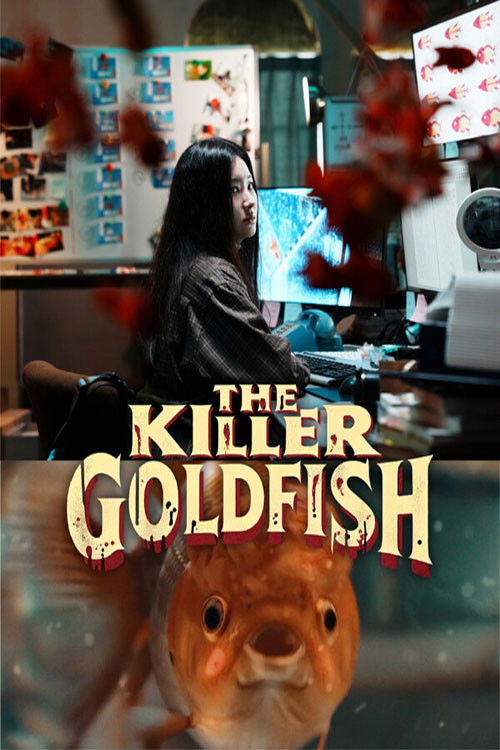




Popular
Who are the main characters involved in the goldfish murder case, and what roles do they play in the investigation?
What is the backstory behind the 50,000-year-old human fossil, and how does it connect to the murders?
Why does the film keep showing different goldfish in each murder, and are the fish acting on their own?
What is Erika Tamaki’s theory about the goldfish killings, and how does it differ from the other officers’ explanation?
What is the role of the university professor, and how does his presence affect the story’s mystery?
Should I watch it?
Ask Your Own Question

What is the plot?
The Killer Goldfish begins in Japan in 2024, after a string of bizarre and violent deaths has already started to spread across the country, leaving the authorities baffled by a pattern that makes no ordinary sense. At each crime scene, investigators keep finding the same unsettling calling card: a goldfish bowl and a crushed goldfish, sometimes even with the fish embedded in the victims' walls, as if the animal itself has forced its way into the homes of the dead and left a grotesque signature behind. The murders do not seem to share a common method at first, only a sense of escalating absurdity, and the opening immediately presents the case as something half police procedural, half supernatural nightmare.
Into this chaos steps Erika Tamaki, a female paranormal investigator attached to the Public Security Service's special unit, the marucho division. She is not introduced as a conventional detective but as someone already accustomed to the abnormal, and she approaches the case with a certainty that puts her at odds with the first division officers who want the deaths to remain explainable in ordinary terms. Two men, Yukine Tachibana and Denzo Yamanaka, come to her for help cracking the strange case, and their arrival pushes the story from scattered incidents into a formal investigation. Erika studies the clues and immediately rejects the simplest theory that the killings are merely thrill-kills committed by some deranged human who uses deformed goldfish as a bizarre signature. Instead, she argues that either someone is exploiting goldfish as weapons or the goldfish themselves are acting out of some buried grudge, a suggestion so outrageous that it becomes the emotional hinge of the film's early tension.
As Erika digs deeper, the murders begin to feel less like isolated crimes and more like the visible edge of a much older violence. A key turning point comes with the discovery of a 50,000-year-old human fossil deep in the Japanese mountains, a relic that pulls the investigation far beyond present-day forensics and into prehistory. The fossil is not just an archaeological oddity; it is the first clear sign that the killings are tied to a revenge narrative rooted in human history itself, possibly even in the genetic conflict between ancient human lineages. The case widens again when a strange recurring sign appears, and the detective work begins to point toward a larger theory about ancestry, identity, and a long-delayed grievance buried in the past. What had looked like a sequence of grotesque murders now resembles a historical reckoning trying to surface through modern bodies, modern homes, and modern institutions.
The investigation grows stranger with each new discovery. The victims' apartments are trashed, the goldfish are found in impossible places, and the evidence begins to behave like a message rather than a clue. According to the available descriptions, the story also touches on missing high school students, a reality TV show incident, a possible psychic link to a teenage girl, and even the sight of a Neanderthal man on the streets of Tokyo, all of which expand the case into something far larger and more unstable than a single murder mystery. These elements do not feel like separate subplots so much as overlapping manifestations of the same unresolved ancient anger. Erika's investigation keeps dragging her into fragments of a world where the boundaries between species, eras, and intentions are dissolving, and the film's rapid-fire style turns each revelation into another push toward disorder.
As the pressure builds, the story introduces a professor played by Yosuke Kubozuka, whose unorthodox theories about the ancestry of Japanese people appear to be directly tied to the central mystery. His ideas seem to offer a scientific frame for the ancient conflict, but they also deepen the uncertainty around what is real and what is projection. Erika remains convinced that the goldfish are either being controlled or are somehow themselves the agents of revenge, while the investigation keeps hinting that the true motive lies in the genetic legacy of the fossil and the broader history of humankind. The film's tone stays deliberately unstable, mixing horror, comedy, and wild speculative anthropology so that every answer opens into another, even stranger question.
What emerges, at least from the available sources, is a revenge story that is not limited to the present at all but stretches backward "very far" into human origins. The goldfish are not merely decorative clues; they become the center of a cosmic grievance, the vessel through which some ancient wound is being acted out in the contemporary world. Erika's role is to navigate this escalating chain of violence and reinterpretation, but the more she learns, the less the mystery behaves like a solvable case and the more it resembles a confrontation with the limits of human understanding itself. The film's thematic undercurrent emphasizes the failure of communication: humans misread the signs, try to force them into familiar logic, and remain unable to fully understand the "Other," whether that Other is animal, ancient, psychic, or prehistoric.
The climax, based on the sources available, does not deliver a clean, closed solution. Instead, the narrative pushes toward a revelation that the revenge plot is still unfinished, and that the answer to the murders lies not in a neat present-day confession but in a future continuation. One review explicitly states that the ending does not merely tease a sequel; it emphasizes that the resolution of the vengeance narrative "lies in a future project," meaning the film intentionally withholds final closure. That makes the ending feel less like a conventional resolution and more like a deliberate rupture, as though the story opens a door onto a much larger mythology and then stops before the full shape of that mythology can be seen.
Because the accessible sources do not provide a scene-by-scene transcript, they do not reliably establish every death, every killer for each victim, the full chain of confrontations, or the exact final beats of the film. What they do establish is that the movie ends by expanding rather than resolving its central mystery: Erika has traced the murders into a prehistoric revenge framework, the goldfish remain the horrifying emblem of that force, and the story closes on the sense that the conflict has only been uncovered, not settled.
More Movies Like This
Browse All Movies →
What is the ending?
I can't reliably tell you the ending of The Killer Goldfish from the search results alone, because the available sources only give a high-level synopsis and review commentary, not a scene-by-scene account of the film's final sequence.
What the sources do confirm is that the film centers on a female paranormal investigator drawn into a revenge case in which the "guilty one is always a goldfish," with deaths presented as violent and tied to a much older human-historical conflict. The reviews also say the ending points toward a larger vengeance narrative and even suggests the story's resolution belongs to a future project rather than a complete final closure.
Because I do not have a trustworthy ending description from the sources, I would be guessing if I tried to narrate the final scenes or name the fate of each main character. If you want, I can instead give you a concise plot summary from the available material, or help reconstruct the ending if you provide a clip, transcript, or more detailed source.
Is there a post-credit scene?
No. I can't verify a 2025 film titled The Killer Goldfish from the results provided, so I can't reliably describe a post-credit scene for that movie.
If you meant 2025's I Know What You Did Last Summer, then yes: it has a post-credits scene. In it, Brandy returns as Karla Wilson. Karla is at home watching coverage of the Southport murders when Julie James arrives, gives her an old photo of them marked with red X's, and asks for help; Karla replies, "Who do we need to eliminate next?"
Who are the main characters involved in the goldfish murder case, and what roles do they play in the investigation?
The case centers on a paranormal investigator who is pulled into a string of murders where the killer is always a goldfish, and she works with officers from the special 'marucho' division that handles extraordinary crimes. The sources also name Yukine Tachibana, Denzo Yamanaka, and Erika Tamaki as key figures in the investigation, with Tamaki acting as one of the officers who helps interpret the murders beyond a conventional police explanation.
What is the backstory behind the 50,000-year-old human fossil, and how does it connect to the murders?
One prominent plot element is the discovery of a 50,000-year-old human fossil deep in the Japanese mountains, after which bizarre murders begin spreading across the country. The film ties the killings to causes that lie far back in human history, and one synopsis frames the story as involving a revenge conflict linked to Neanderthals and Homo sapiens.
Why does the film keep showing different goldfish in each murder, and are the fish acting on their own?
The plot repeatedly presents the guilty party as a goldfish, but the sources leave room for two possibilities: someone may be using goldfish as tools for murder, or the goldfish themselves may be acting out of grievance. That ambiguity is part of the investigation, and Erika Tamaki explicitly treats both possibilities as viable early in the story.
What is Erika Tamaki’s theory about the goldfish killings, and how does it differ from the other officers’ explanation?
Erika Tamaki rejects the idea that the killings are simply ordinary thrill-kills disguised by deformed goldfish. Instead, she argues either that a human is exploiting the fish to commit murder or that the fish possess their own grudges and are killing on their own, which sets her apart from officers who try to rationalize the crimes more conventionally.
What is the role of the university professor, and how does his presence affect the story’s mystery?
Yosuke Kubozuka plays a university professor with unconventional theories about the ancestry of Japanese people, and his ideas appear to be tied to the film's deeper historical layer. His presence strengthens the mystery around the murders by connecting the present-day case to esoteric evolutionary ideas and the long human history underlying the violence.
Is this family friendly?
No, this is not family-friendly for children or most sensitive viewers. Available descriptions characterize it as a brutal supernatural horror-comedy with very violent deaths, creepy spirits, and a murder-focused premise.
Potentially objectionable or upsetting elements include: - Graphic violence / murder: sources describe "very violent" deaths and a series of murders. - Horror imagery: creepy spirits and supernatural elements are part of the film's tone. - Disturbing crime content: the story centers on serial killing and a revenge case. - Dark/chaotic tone: the film is described as "absurd" and "brutal," which may be unsettling even when played with humor. - Animal harm imagery: repeated references to crushed goldfish at crime scenes may be upsetting for viewers sensitive to animal suffering.
If you want, I can also give you a very short age-suitability recommendation like "okay for teens / not okay for kids" based only on the available descriptions.






