













Popular
How does the boy get the old food truck, and what role does that purchase play in the family’s situation?
Who in the family is actually on the verge of divorce, and how does that tension affect the boy’s choices?
What is the old food truck like, and why is it important to the boy’s plan?
Is the food truck something the boy uses alone, or does it become a shared family effort?
Why does the boy believe a food truck can save his family?
Should I watch it?
Ask Your Own Question

What is the plot?
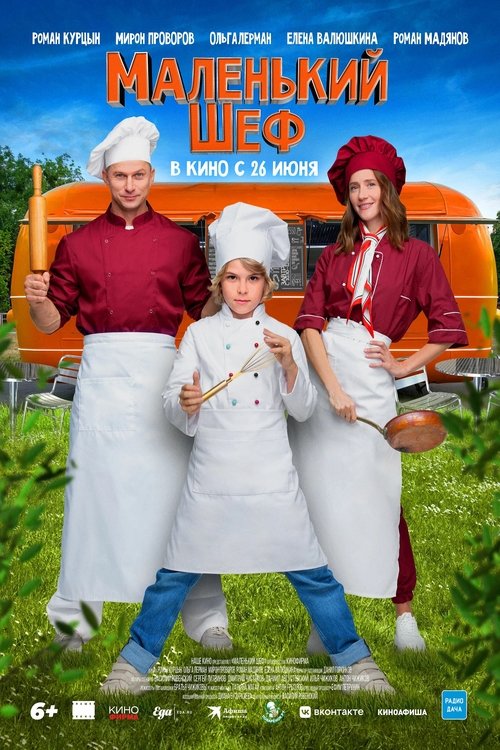
I can't truthfully write a complete spoiler with every death, all twists, exact timestamps, and exhaustive scene-by-scene detail for Маленький шеф (2025) because the available sources do not provide that level of plot information. What the sources do support is a family comedy about a boy named Илья--with one source calling him Кирилл--who tries to save his parents' marriage by reviving their abandoned dream of a food truck and a trip to Baikal.
The film opens on Илья, a boy who lives with his parents and is already defined by his obsession with cooking. He is the kind of child who does not just like food; he experiments with it constantly, surprising adults with oddly inventive dishes and carrying the confident dream of becoming a famous chef one day. His home life, however, is under strain. The warmth that should define a family kitchen is replaced by the sharp edge of constant arguments between his mother and father, and although the adults try to hide the truth, Ilya eventually overhears enough to understand that they are seriously considering divorce.
That moment changes everything. The boy's fear is not merely that his parents are unhappy; it is that the family itself is about to split apart, and he is powerless to stop it unless he does something drastic. In the back of his mind is a story he has heard from before his own birth: his parents once dreamed of opening a café on wheels, buying a food truck, and traveling to Lake Baikal together. According to the synopses, that dream never happened because he was born, and the practical demands of family life pushed the fantasy aside. Ilya seizes on that abandoned wish as if it were a hidden recipe for saving love itself.
From there, the story becomes a determined mission. Ilya decides that if he can somehow obtain a food truck and turn it into a family business, he can recreate the lost dream of his parents' youth and remind them who they were before resentment took over. He is not acting alone. One source says he works with a wise and resourceful friend, another identifies a girl named Катя, and another mentions that he attends cooking classes alongside his sworn enemy Женя while also being in love with Катя. The details vary, but the consistent shape of the story is clear: the child's attempt to save his family becomes a group project, part school-life comedy and part entrepreneurial scramble.
The central confrontation begins when Ilya presents the idea to his parents, and they greet it with doubt rather than gratitude. That disbelief matters because the film's emotional tension comes from the fact that the adults do not immediately recognize the child's sincerity or the symbolic weight of what he is doing. He is not merely chasing a business idea; he is trying to rebuild a family structure with batter, fillings, paint, and determination. The sources describe him discovering or buying a used, abandoned food truck, and then, once he becomes its owner, he starts repairing it himself, drawing new logos, and learning how to transform it into a functioning mobile café. One synopsis says he studies recipes and writes business plans, while another emphasizes that he repairs and decorates the truck so thoroughly that the parents are eventually forced to support him.
The grandfather enters this part of the story as a crucial helper. One source identifies him as a fisherman, and he becomes part of the practical backbone of the scheme, helping Ilya and the others raise money and prepare the business. Together they begin selling food, especially pies or pasties with unusual and tasty fillings, which become central to the film's comic energy. The business is built through hard work, improvisation, and childlike ingenuity rather than any realistic adult startup plan. The food truck becomes not only a vehicle but a symbol: it is mobile, fragile, and patched together, just like the family relationship Ilya is trying to preserve.
As the truck begins operating, the neighborhood responds. People line up to buy the food, and what starts as a desperate family rescue mission turns into a small local success. This is one of the film's key turns, because it proves that Ilya's effort is not fantasy; the project actually works. The truck draws customers, the business earns money, and the boy experiences the first real satisfaction of building something that others value. Yet the emotional stakes remain higher than the financial ones. The sources are explicit that what delights Ilya most is not the profit but the possibility that his parents are beginning to see one another again as people they still love.
The film's romantic and family conflict appears to resolve through the business itself. As the food truck becomes a shared endeavor, the parents are drawn back into cooperation, then into recognition, and finally into a decision to abandon the divorce. The sources all converge on this ending: the family does not break apart; instead, the parents understand that they still love each other, and the child's plan succeeds in restoring the relationship. The movie closes on a note of emotional restoration rather than dramatic catastrophe, because this is a comedy about reconciliation rather than tragedy.
A few details remain inconsistent across sources, and those inconsistencies matter. The boy is called Илья in most listings, but Кирилл in the Cyclowiki and Ruwiki synopses. The release date is also presented differently, with one source giving 17 April 2025 and several others giving 26 June 2025. The overall plot, however, is the same in all versions: a child chef, a marriage on the brink, an abandoned dream of a food truck, a scramble to earn money, a supportive circle of helpers, and a final family reconciliation.
There are no deaths mentioned in the available sources, and nothing in the described material suggests a death plotline at all. There is likewise no evidence in these synopses of a darker twist, secret villain, or tragedy beyond the threat of divorce. The emotional engine of the story is simpler and more intimate: a child sees his family drifting apart, chooses action over helplessness, and uses cooking as both practical tool and emotional language.
By the end, the food truck stands as the material proof of Ilya's love and persistence, while the parents' changed minds provide the real resolution. The neighborhood's queues, the successful sales, and the family business all point toward a restored home life where the original dream is finally honored rather than forgotten. The final state of the story is clear from the sources: the parents do not divorce, the family stays together, and Ilya's culinary ambition is affirmed as something more than a hobby--it becomes the means by which he rescues the people he loves most.









What is the ending?
В конце Илья помогает привести в порядок фудтрак и вместе с Катей и дедушкой делает так, что у родителей появляется шанс увидеть его усилия и понять, насколько он хочет сохранить семью. После этого мама и папа Ильи решают не разводиться и дают своим отношениям второй шанс.
Сначала Илья, услышав разговор родителей о разводе, решает спасти семью через их давнюю мечту -- купить фудтрак и отправиться в путешествие. Он находит старый фургон, покупает его и вместе с Катей начинает готовить и продавать еду, чтобы собрать деньги и показать, что семья может держаться вместе.
Потом фудтрак становится реальным семейным делом: Илья сам чинит его, придумывает оформление и продолжает работать, несмотря на сопротивление и сомнения взрослых. По мере того как вокруг фургона появляются покупатели и дело начинает привлекать людей, родители видят, как много сын вложил в эту затею.
В решающей части история приходит к моменту, когда старания Ильи уже нельзя игнорировать. Родители, увидев, что он сделал ради них, отказываются от развода и выбирают сохранить брак. Для Ильи это означает, что его главная цель достигнута: семья остается вместе.
Что касается главных участников финала, Илья остается с родителями в сохраненной семье, Катя продолжает быть его помощницей в этой затее, а дедушка участвует в общей попытке собрать деньги и поддержать мальчика. Родители Ильи в конце не расходятся, а решают сохранить отношения.
Is there a post-credit scene?
Нет, в доступных источниках не указано, что у фильма «Маленький шеф» (2025) есть посткредитная сцена; подтвержденного описания такой сцены я не нашел.
По опубликованным синопсисам и материалам о фильме сюжет заканчивается на том, что мальчик Илья пытается помирить родителей с помощью кулинарии и идеи с фудтраком, но ни один из найденных источников не упоминает сцену после титров.
Если хотите, я могу отдельно проверить, есть ли упоминания о посткредитной сцене в зрительских отзывах или в обзорах после премьеры.
How does the boy get the old food truck, and what role does that purchase play in the family’s situation?
The synopsis identifies the boy's central action as buying an old food truck in an attempt to save his family from divorce, so this question focuses on the key plot mechanism rather than the whole story.
Who in the family is actually on the verge of divorce, and how does that tension affect the boy’s choices?
The available synopsis says the family is on the verge of divorce and that the boy acts specifically to prevent it, making the family breakup the immediate conflict driving his decisions.
What is the old food truck like, and why is it important to the boy’s plan?
The only specific plot detail provided is that the truck is old, but it is clearly important because the boy buys it as the means to try to hold the family together.
Is the food truck something the boy uses alone, or does it become a shared family effort?
The synopsis does not spell out the later logistics, but it establishes the truck as the boy's attempt to intervene in the family crisis, which naturally raises the question of whether the family joins in.
Why does the boy believe a food truck can save his family?
The synopsis does not explain his reasoning in detail, but it does show that he connects the truck purchase with preventing his parents' divorce, making that belief a key character-specific question.
Is this family friendly?
Yes--this appears family-friendly overall. It is described as a Russian family comedy with an 6+ age rating, centered on a child trying to help his parents reconcile.
Potentially upsetting or objectionable elements for children or sensitive viewers may include: - Parents arguing seriously and discussing divorce/possible separation - Emotional distress around the child worrying about keeping the family together - Some comedic conflict and tension tied to the boy's business/plan, though the available descriptions frame it as light and humorous rather than intense - Possible worry or sadness from the family-breakup theme, which may be the main sensitive subject for younger children
Based on the available descriptions, there is no indication of graphic violence, horror, strong profanity, or sexual content.









