





















Popular
What is Tom Reagan's relationship with Leo O'Bannon?
How does Tom Reagan navigate the conflict between the Irish and Italian mobs?
What role does Verna play in Tom's decisions throughout the film?
What is the significance of the character Bernie Bernbaum in the story?
How does the film depict the theme of loyalty and betrayal through its characters?
Should I watch it?
Ask Your Own Question

What is the plot?
Miller's Crossing opens in 1929, in an unnamed American city dressed in the hard glamour of Prohibition: smoke, liquor, money, menace, and men who think they can keep the whole machine running with nerves and leverage. At the center of that machine is Leo O'Bannon, an Irish mob boss and political power broker who rules the city with restraint rather than spectacle, and beside him is Tom Reagan, his right-hand man, adviser, and quiet fixer, a man so emotionally sealed that everyone around him suspects he is always calculating three moves ahead.
The trouble begins when Johnny Caspar, the ambitious Italian gangster who wants a larger cut of the city's underworld, demands that Leo hand over Bernie Bernbaum, a crooked bookie who has been skimming information from Caspar's fixed-fight operation. Bernie is not just any liability, though: he is Verna Bernbaum's brother, and Verna is Leo O'Bannon's lover. That personal connection makes Leo refuse Caspar's demand, even though Tom immediately sees the danger. Tom tells Leo, in effect, that protecting Bernie is unnecessary sentiment and that Caspar is being provoked into war, but Leo will not sacrifice Verna's brother.
The refusal sets the city on a slow-burn collision course. In the opening stretch, almost everything happens in rooms, through warnings, bargaining, and the thinly veiled language of gang politics rather than outright gunfire. Tom is established as the one man who can move between factions, but the film also makes clear that he is not simply loyal or disloyal; he is a survivor, and he is already entangled in the very mess he is trying to control because he is secretly involved with Verna himself. Leo does not know this at first, which means Tom is helping his boss protect one lover while sleeping with the other, and the situation is already poisoned before the shooting starts.
Leo's trust in the city's political order is tested when he begins pressuring Caspar's rackets in response to the threat. Tom tries to keep the peace, but the war escalates faster than he can contain it. Leo suspects that Caspar is moving against him, and he has Rug Daniels, one of his men, watch Verna, partly out of suspicion and partly out of jealousy or instinct. Rug Daniels is then murdered, one of the story's first major deaths, and the sources indicate that Leo immediately blames Caspar for it. The killing sharpens the conflict from negotiation to retaliation, and the city's underworld begins to feel less like an organized hierarchy than a chain of jealousies, betrayals, and preemptive strikes.
Tom attempts to steer the situation back toward control, but his personal life keeps dragging the war into deeper emotional terrain. He tries to persuade Verna to leave Leo, which would remove one pressure point and perhaps create room for an exit, but that only folds another private motive into the criminal one. Verna is not a passive figure in this story; she understands the men around her well enough to weaponize ambiguity, and the film repeatedly uses her as the hinge between tenderness and manipulation. Bernie also becomes more than a simple target because he possesses information that matters to the war. According to the plot summaries, Bernie has details about Caspar's next fixed fight, and he gets them through Mink, who is connected to Caspar's lieutenant Eddie Dane. That means Bernie can expose the machinery of the racket, and once he starts knowing too much, he becomes both a bargaining chip and a death sentence waiting to happen.
Caspar tries to bribe Tom directly, offering to pay off Tom's considerable gambling debts if Tom will simply hand Bernie over. The offer is practical, almost mundane in its corruption, and that is what makes it frightening: this is a world where loyalty can be measured against debt, and debt can be turned into murder. Tom refuses, but the refusal does not make him heroic or clean. It only confirms that he is still maneuvering, still weighing his options, still trying to preserve a position inside the storm rather than stepping outside it. In the background, the city itself remains a chessboard of protection rackets, fixed fights, and political leverage, with Leo's power resting on influence and Caspar's on force.
Then the story turns more violent and more intimate at the same time. Leo eventually discovers that Tom has been sleeping with Verna, and the revelation detonates the personal structure beneath the gang war. The betrayal matters because Leo is not just losing an adviser; he is being made a fool in his own house, in his own love affair, and in the middle of an already unstable power struggle. Furious and humiliated, Leo throws Tom out. This is one of the film's major emotional breaks, and it shifts Tom from trusted insider to exile almost instantly. The men around him no longer see a loyal strategist; they see a compromised operator who has been playing both sides and the woman in the middle.
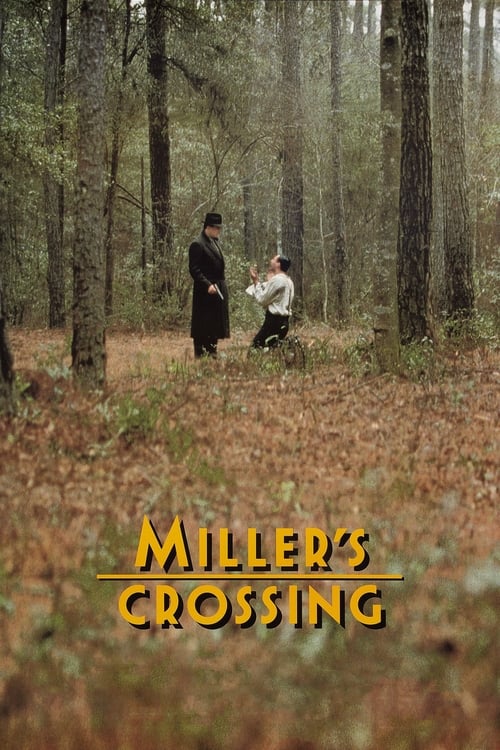
With nowhere else to stand, Tom turns toward Caspar. Caspar, however, is not interested in trust so much as proof. He demands that Tom demonstrate his allegiance by killing Bernie, and this demand is especially cruel because Bernie is tied to Verna and therefore to the whole emotional disaster already engulfing Tom. The request also comes with Caspar's own enforcer structure in the background, especially Eddie Dane, whose cold ruthlessness makes every instruction feel like an execution order. Tom is told to take Bernie into the woods at Miller's Crossing, a remote, forested execution ground whose name becomes one of the film's most famous and ominous images.
The journey to Miller's Crossing is one of the film's great suspense sequences because it is built almost entirely on dread. Tom takes Bernie into the trees, and Bernie is terrified, pleading, sniffling, and fully aware that he is being led to his death. The setting strips away the city's social theater. There are no clubs, no offices, no political allies, just damp woods and the sound of feet in leaves, the kind of place where a man disappears and the world can pretend it never happened. At the crucial moment, Tom spares Bernie and lets him run. This is the story's central false resolution: Tom appears to have betrayed Caspar while still not fully returning to Leo, and the act can be read either as mercy or as strategy. The film's power lies in refusing to simplify it. Tom's decision is both moral and tactical, and possibly both are incomplete.
Bernie vanishes into hiding, and the consequences of Tom's mercy spread out in all directions. Caspar is left with the impression that Tom has failed him, Leo still believes Tom has betrayed him, and Tom himself has created a live problem that will return later with interest. The war continues through confrontations, shifting loyalties, and layers of deception that make nearly every meeting feel like a trap in progress. Tom's relationship with Verna also remains active and combustible, and the emotional geometry of the film keeps tightening: Leo loves Verna, Tom loves Verna, Bernie's life is tied to Verna, and every man's decision is both political and personal.
In the aftermath of the Miller's Crossing sequence, the deeper structure of the plot starts to reveal itself. Tom is not simply trying to please whichever gangster is most likely to win. He is positioning himself to survive the collapse that he knows is coming, and he uses whatever information he can gather to do that. Bernie, meanwhile, proves that mercy does not end the problem. He remains a dangerous witness, because he knows what Caspar's operation is doing and because his knowledge can be traded to the highest bidder. The film's violence now begins to loop back on itself: people are not dying only because they are threats, but because they are loose ends.
Caspar's authority begins to erode as the war worsens. One source states that Caspar is eventually killed by his own men, after being exposed as weak and manipulated. Even where the exact chain of events is not spelled out in every summary, the broad outcome is clear: Caspar loses control, and his own side turns on him rather than rallying behind him. This collapse matters because Caspar has represented one kind of criminal order throughout the film: impatient, direct, and violent, but also vulnerable to the same betrayals he encourages in others. His downfall is not a triumphant victory for justice; it is just the implosion of a faction that mistook aggression for stability.
Before that collapse fully resolves itself, Tom is forced back into the problem he created by sparing Bernie. Bernie eventually comes back out of hiding and blackmails Tom, effectively turning Tom's act of mercy into a trap that threatens to expose everything Tom has done. The earlier choice at Miller's Crossing now becomes unbearable: if Tom had killed Bernie, he might have preserved a cleaner position, but because he let him go, Bernie becomes a live wire dragging the whole story toward its final reckoning. Tom learns, too, that Bernie's information about Caspar's fixed-fight operation is still circulating through the underworld, connected to Mink and Eddie Dane, which means the evidence of corruption is still active and still dangerous.
The last major emotional and violent turn comes when Tom decides that the game has gone too far for sentiment. He kills Bernie Bernbaum himself. This is the murder that most clearly belongs to Tom in the available summaries, and it is the moment when his earlier mercy is replaced by a colder understanding of how this world works. Bernie's death is not presented as an act of rage so much as a grim correction, the final removal of a liability that Tom can no longer afford to keep alive. That change is devastating because it shows Tom becoming what the city has been trying to make him from the start: not a man who can stay above the violence, but one who eventually has to speak its language fluently.
At roughly the same time, Tom uses Caspar's money to place a bet on the fixed fight, a practical move that allows him to clear his gambling debts. The detail matters because it ties the whole story back to the machinery of corruption rather than to personal vendetta alone. Betting, debt, fight-fixing, extortion, and murder are all part of one continuous economic system. In Miller's world, money does not merely motivate violence; it records it and launders it and keeps it moving.
The ending then returns to the survivors and the question of whether any of this was worth it. Leo survives Caspar's collapse and is restored to a position of control, but it is a hollow restoration, the kind that happens when one faction disappears and another is still standing rather than because anything has truly been healed. At Bernie's funeral, Verna Bernbaum ignores Tom, refusing to give him the emotional closure he may be hoping for or pretending not to want. That refusal lands like a final judgment on Tom's actions: he has saved Bernie once, destroyed him later, and in the process lost the woman whose attachment helped drive the entire tragedy.
Leo then offers Tom a way back in. According to the summaries, he offers him the role of adviser again and forgives him for his relationship with Verna. The gesture is significant because Leo understands what is left after the war: he needs competence, and Tom is still the best mind in the room, even if he is also the most treacherous. The offer is also emotionally complex, because Leo's forgiveness is not clean forgiveness; it is political forgiveness, a pragmatic decision dressed up as reconciliation. Tom refuses and walks away. He does not reclaim the family he damaged, nor does he cling to Caspar's now-collapsed world. He simply exits, leaving the city's power structure to continue without him.
The final image is striking and unresolved in a way that fits the whole film. Leo walks away framed by the trees, a visual echo of Miller's Crossing itself, while Tom's refusal leaves the ending open to interpretation without actually softening it. The city remains in the grip of its own systems, the dead are still dead, and the living have only rearranged the hierarchy that produced the bloodshed in the first place. Rug Daniels is dead, Bernie Bernbaum is dead, and Johnny Caspar's power has collapsed into death at the hands of his own men, while Tom Reagan survives but leaves diminished, detached, and outside the circle he once helped control. Leo O'Bannon survives too, but his victory is shadowed by all the compromises that got him there, and by the knowledge that his right-hand man walked away instead of returning to the fold.
What lingers most is the sense that everyone in the film has been tested by the same brutal logic: loyalty is temporary, love is leverage, and mercy is dangerous because it creates debts that the underworld always collects later. Miller's Crossing ends not with a moral triumph but with a man walking away from a ruined alliance, while the rest of the city keeps breathing under Prohibition, corruption, and the soft crunch of leaves in the woods where people disappear.




What is the ending?
In the ending of Miller's Crossing, Tom Reagan confronts the consequences of his choices. He ultimately decides to betray his boss, Leo, to save himself and his own interests. Tom's actions lead to a violent confrontation, resulting in Leo's death. Tom then meets with Verna, Leo's love interest, and they share a moment of connection, but it is clear that Tom is left alone with the weight of his decisions.
As the film approaches its climax, Tom Reagan finds himself at a crossroads, both literally and metaphorically. The tension in the air is palpable as he navigates the treacherous waters of loyalty and betrayal.
In a dimly lit room, Tom meets with Johnny Caspar, the ruthless mobster who has been seeking revenge for the death of his associate, Bernie. Tom, having played both sides, is now caught in a web of deceit. He knows that Caspar is intent on eliminating Leo, his boss, and friend. The stakes are high, and Tom's internal conflict is evident; he is torn between his loyalty to Leo and his desire for self-preservation.
The scene shifts to a secluded area in the woods, where Tom and Leo have a tense conversation. Leo, unaware of Tom's duplicity, expresses his trust in him. Tom's face is a mask of conflict as he listens to Leo's heartfelt words. The weight of betrayal hangs heavy in the air, and Tom's internal struggle is mirrored in the shadows that dance around them.
As the night deepens, the inevitable confrontation occurs. Tom, having made his choice, leads Leo into a trap set by Caspar's men. The atmosphere is thick with tension as they approach the meeting point. The moment is fraught with danger, and Tom's heart races as he grapples with the consequences of his actions.
In a brutal showdown, Leo is ambushed, and the violence erupts. Tom watches as his friend is gunned down, the betrayal cutting deeper than any bullet. The camera lingers on Tom's face, capturing the mix of regret and relief that washes over him. He has survived, but at what cost?
After the chaos subsides, Tom finds himself alone, grappling with the aftermath of his choices. He seeks out Verna, Leo's lover, in a dimly lit bar. Their conversation is charged with unspoken emotions, and the weight of their shared history hangs heavily between them. Tom's demeanor is one of resignation; he has lost not only Leo but also a part of himself in the process.
As they sit together, the camera captures the distance that now exists between them. Verna's eyes reflect a mix of sadness and understanding, while Tom's expression reveals the burden of his decisions. The connection they once shared is now tainted by betrayal and loss.
In the final moments, Tom walks away from the bar, leaving Verna behind. The streets are empty, and the night is silent, echoing the solitude that now envelops him. He has chosen survival over loyalty, but the victory feels hollow. The film closes on Tom's solitary figure, a man forever changed by the choices he has made, embodying the moral complexities of loyalty, betrayal, and the harsh realities of the world he inhabits.
In summary, Tom Reagan's fate is one of isolation and regret, having sacrificed his relationships for self-preservation. Leo's death marks the end of an era, and Verna is left to navigate her own path, forever altered by the events that transpired. The film concludes with a haunting sense of loss, leaving the audience to ponder the true cost of loyalty in a world rife with betrayal.
Is there a post-credit scene?
Miller's Crossing does not have a post-credit scene. The film concludes with a final scene that encapsulates the themes of loyalty, betrayal, and the moral ambiguity of its characters. After a series of intense confrontations and a complex web of deceit, the story ends on a note that leaves the audience contemplating the fates of the characters and the choices they made throughout the film. The absence of a post-credit scene aligns with the film's tone, focusing on the weight of the narrative rather than providing additional content after the credits.
What is Tom Reagan's relationship with Leo O'Bannon?
Tom Reagan is a close associate and confidant of Leo O'Bannon, the head of the Irish mob. Their relationship is complex; Tom is loyal to Leo but also finds himself caught in a web of conflicting loyalties and moral dilemmas as the power struggle between the Irish and Italian mobs intensifies. Tom's internal conflict is heightened by his romantic involvement with Verna, Leo's girlfriend, which complicates his allegiance.
How does Tom Reagan navigate the conflict between the Irish and Italian mobs?
Tom Reagan plays a pivotal role in the escalating conflict between the Irish and Italian mobs. Initially, he supports Leo O'Bannon, but as tensions rise, he becomes a double agent, working with the Italian mob led by Johnny Caspar. Tom's motivations are driven by self-preservation and a desire to manipulate the situation to his advantage, showcasing his cunning and strategic thinking.
What role does Verna play in Tom's decisions throughout the film?
Verna is a significant influence on Tom Reagan's decisions. As Leo O'Bannon's girlfriend, she becomes a point of contention between the two men. Tom's feelings for Verna complicate his loyalties, as he is torn between his affection for her and his loyalty to Leo. Verna's own motivations are ambiguous, as she seeks to protect herself and navigate the dangerous world of organized crime.
What is the significance of the character Bernie Bernbaum in the story?
Bernie Bernbaum is a pivotal character whose actions drive much of the plot's tension. He is a con artist who manipulates those around him, including Tom Reagan. Bernie's duplicity and charm create a web of deceit that entangles Tom, leading to critical decisions that affect the outcome of the mob war. His fate becomes a reflection of the moral ambiguity that permeates the film.
How does the film depict the theme of loyalty and betrayal through its characters?
Loyalty and betrayal are central themes in 'Miller's Crossing,' illustrated through the actions and decisions of characters like Tom Reagan, Leo O'Bannon, and Bernie Bernbaum. Tom's shifting allegiances highlight the precarious nature of loyalty in the criminal underworld, as he navigates betrayals from both sides. The film's climax reveals the consequences of these betrayals, ultimately questioning the nature of trust and survival in a violent environment.
Is this family friendly?
"Miller's Crossing," directed by the Coen Brothers, is not considered family-friendly due to its mature themes and content. Here are some potentially objectionable or upsetting aspects that may affect children or sensitive viewers:
-
Violence: The film contains several scenes of graphic violence, including shootings and physical confrontations that are depicted in a stark and realistic manner.
-
Murder: The plot revolves around organized crime, leading to multiple murders that are central to the story, which may be disturbing for younger audiences.
-
Strong Language: The dialogue includes frequent use of profanity and harsh language, which may not be suitable for children.
-
Adult Themes: The film explores complex themes such as betrayal, loyalty, and moral ambiguity, which may be difficult for younger viewers to understand.
-
Substance Abuse: There are scenes depicting alcohol consumption and the effects of drinking, which may be inappropriate for children.
-
Emotional Manipulation: Characters experience intense emotional turmoil, including betrayal and loss, which could be upsetting for sensitive viewers.
Overall, the film's tone and content are geared towards an adult audience, making it unsuitable for children.









