
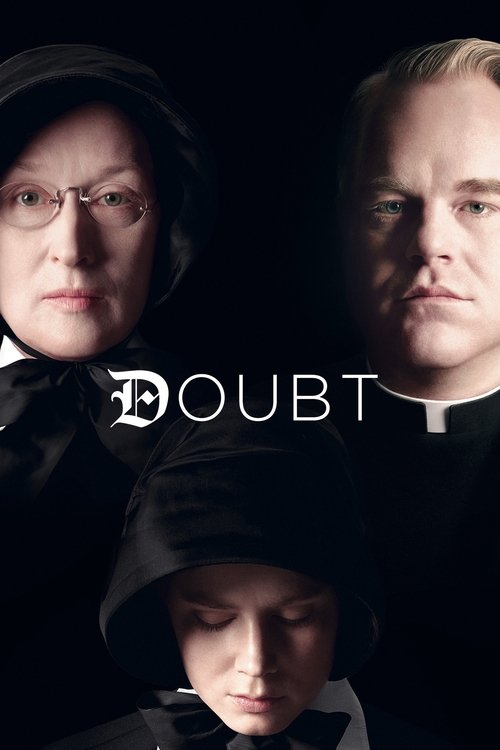






























Popular
What is Sister Aloysius Beauvier's main motivation in confronting Father Flynn?
How does Father Flynn respond to the accusations made against him?
What evidence does Sister Aloysius gather to support her suspicions about Father Flynn?
What role does Sister James play in the conflict between Sister Aloysius and Father Flynn?
How does the character of Donald Muller influence the story's tension?
Should I watch it?
Ask Your Own Question

What is the plot?
Sorry, we aren't able to watch and write up a full detailed plot yet. Check back in a few days.









What is the ending?
In the ending of the movie "Doubt," Sister Aloysius Beauvier confronts Father Flynn about her suspicions regarding his inappropriate relationship with a student. After a tense exchange, Father Flynn denies the allegations and suggests that Sister Aloysius is acting out of personal bias. The film concludes ambiguously, leaving the audience questioning the truth of the accusations and the moral certainties of the characters.
As the final scenes unfold, we find Sister Aloysius in her office, grappling with the weight of her convictions. She has summoned Father Flynn to confront him directly about her suspicions regarding his relationship with the young student, Donald. The atmosphere is thick with tension as she lays out her concerns, her voice steady but laced with an undercurrent of fear and determination. Father Flynn, portrayed with a calm demeanor, counters her accusations with a mix of indignation and charm, insisting that her suspicions are unfounded and rooted in her own biases against him.
The dialogue is sharp and revealing, showcasing the deep ideological divide between the two characters. Sister Aloysius embodies a strict moral absolutism, while Father Flynn represents a more progressive, nuanced approach to faith and community. As they exchange words, the stakes rise; Sister Aloysius reveals that she has no concrete evidence, only her intuition and the unsettling feelings that have taken root in her heart.
In a pivotal moment, Father Flynn, feeling cornered, shifts the conversation to his own vulnerabilities, suggesting that Sister Aloysius's relentless pursuit of him is driven by her own fears and insecurities. He challenges her to consider the consequences of her actions, hinting at the potential damage to his reputation and the community. Sister Aloysius, however, remains resolute, her conviction unwavering despite the emotional toll it takes on her.
The confrontation reaches its climax when Sister Aloysius declares that she has spoken to the boy's mother, who is oblivious to the situation. This revelation seems to shake Father Flynn, and for a moment, the audience is left to wonder if he is truly guilty or if Sister Aloysius is simply a woman on a crusade against perceived injustice. The ambiguity of the truth hangs heavily in the air.
In the final moments, Sister Aloysius, visibly shaken, confesses to her own doubts. She admits to Father Flynn that she has lost her certainty, a moment of vulnerability that contrasts sharply with her earlier steadfastness. Father Flynn, sensing victory, offers a final, chilling reassurance that he will not be leaving the parish, leaving Sister Aloysius in a state of despair.
The film closes with Sister Aloysius alone in her office, her face a mask of turmoil as she grapples with the implications of her actions. The audience is left with a haunting sense of uncertainty, reflecting the film's central themes of doubt, morality, and the complexities of human relationships. The fates of the main characters remain unresolved; Sister Aloysius is left to wrestle with her conscience, while Father Flynn continues his role in the community, shrouded in ambiguity. The film ends, leaving viewers to ponder the nature of truth and the weight of suspicion.
Is there a post-credit scene?
The movie "Doubt," produced in 2008, does not have a post-credit scene. The film concludes with a powerful and tense final exchange between Sister Aloysius Beauvier and Father Flynn, leaving viewers with lingering questions about faith, certainty, and moral ambiguity. The absence of a post-credit scene aligns with the film's themes of doubt and uncertainty, emphasizing the unresolved nature of the story and the characters' internal struggles.
What is Sister Aloysius Beauvier's main motivation in confronting Father Flynn?
Sister Aloysius Beauvier is driven by a deep sense of duty and moral conviction. She believes that Father Flynn poses a threat to the students, particularly to the young African American boy, Donald. Her motivation stems from her strict adherence to the rules of the church and her desire to protect the innocence of the children under her care. She is determined to expose what she perceives as inappropriate behavior, fueled by her own experiences and a strong sense of justice.
How does Father Flynn respond to the accusations made against him?
Father Flynn initially responds to Sister Aloysius's accusations with calmness and confidence. He attempts to defend himself by emphasizing his dedication to the church and the children. He portrays himself as a caring and progressive priest, arguing that Sister Aloysius's traditional views are outdated. However, as the tension escalates, he becomes increasingly defensive and agitated, revealing his vulnerability and desperation to maintain his position and reputation.
What evidence does Sister Aloysius gather to support her suspicions about Father Flynn?
Sister Aloysius gathers circumstantial evidence to support her suspicions, including her observations of Father Flynn's interactions with Donald. She notes the closeness of their relationship, particularly when she discovers that Father Flynn had given Donald special attention and a gift, which she interprets as inappropriate. Additionally, she speaks with other staff members, including Sister James, to gather their perspectives, but her evidence remains largely based on her intuition and moral certainty rather than concrete proof.
What role does Sister James play in the conflict between Sister Aloysius and Father Flynn?
Sister James serves as a conflicted intermediary between Sister Aloysius and Father Flynn. She is more sympathetic and open-minded, often expressing doubt about Sister Aloysius's harsh methods and conclusions. Sister James admires Father Flynn and is troubled by the accusations, which puts her in a difficult position. Her internal struggle reflects the broader themes of doubt and uncertainty, as she grapples with her loyalty to Sister Aloysius and her respect for Father Flynn.
How does the character of Donald Muller influence the story's tension?
Donald Muller, the young student at the center of the conflict, serves as a catalyst for the tension between Sister Aloysius and Father Flynn. His character embodies innocence and vulnerability, and his experiences are pivotal in shaping the narrative. The ambiguity surrounding his relationship with Father Flynn raises questions about trust and protection. Donald's presence amplifies Sister Aloysius's fears and motivations, as she believes she must act in his best interest, even as the truth about his situation remains elusive.
Is this family friendly?
"Doubt," produced in 2008, is not considered family-friendly due to its heavy themes and mature content. Here are some potentially objectionable or upsetting aspects that may affect children or sensitive viewers:
-
Themes of Abuse: The film deals with the serious subject of child abuse within a religious context, which may be distressing for some viewers.
-
Religious Conflict: There are intense discussions and confrontations regarding faith, morality, and authority, which may be challenging for younger audiences to understand.
-
Emotional Tension: The film is filled with moments of high emotional tension, including confrontations that can be uncomfortable and unsettling.
-
Character Struggles: Characters experience deep internal conflicts, guilt, and suspicion, which may evoke strong emotional responses.
-
Language: There are instances of strong language that may not be suitable for younger viewers.
Overall, the film's exploration of doubt, morality, and the complexities of human behavior makes it more appropriate for mature audiences.