
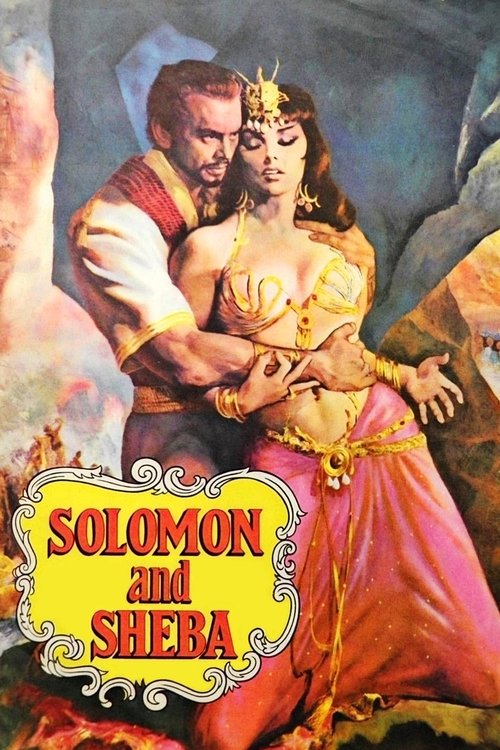


Popular
What motivates King Solomon to seek a marriage alliance with Sheba?
How does Queen Sheba's character evolve throughout the film?
What role does the conflict between Solomon and his half-brother Adonijah play in the story?
How does the film depict the relationship between Solomon and God?
What is the significance of the final confrontation between Solomon and Sheba?
Should I watch it?
Ask Your Own Question

What is the plot?
In ancient Israel, around 1010 BCE, King David lies dying while the future of the kingdom hangs in the balance. The opening mood is solemn and ominous: David is old, the court is tense, and the question of succession is not merely a family matter but a struggle over the soul of Israel. As David nears death, he receives a vision from God telling him that Israel will prosper under a ruler of peace rather than war, and that his younger son Solomon should succeed him as king. The revelation immediately sharpens the conflict in the royal household, because David's older son, Prince Adonijah, is a proud warrior who believes the throne should be his by right of age and temperament. Furious and humiliated, Adonijah leaves the court swearing that he will become king anyway, and from that moment the story moves with the force of a political thriller wrapped in biblical grandeur.
David's death comes as the first great turning point, though the film treats it less as an act of violence than as the natural close of a prophetic age. Once Solomon is recognized as heir, the old order begins to fracture. Solomon is presented as thoughtful, wise, and spiritually inclined, the kind of ruler who values judgment over conquest, while Adonijah remains the embodiment of force, impatience, and resentment. This contrast matters immediately, because the film frames Solomon's reign as a threat not only to internal ambition but to neighboring powers that depend on brutality and division. Egypt in particular is alarmed by the rise of a wise king whose monotheism and benevolent rule could destabilize tyrannical and polytheistic kingdoms throughout the region.
The Egyptian Pharaoh Siamun becomes the chief external architect of the plot against Solomon. Rather than attack Israel directly at first, he chooses manipulation. He agrees to grant the Queen of Sheba a Red Sea port if she can find a way to destroy Solomon and undermine his rule. She is introduced not as a sincere envoy but as a dazzling political weapon: a foreign ruler whose beauty, intelligence, and self-possession make her a formidable agent of intrigue. Her mission is clear from the outset, even if her motives later change: she is to enter Jerusalem under the guise of diplomacy, seduce Solomon, and introduce pagan influence into the center of Israel's faith.
Before Sheba fully enters the story, the film deepens the tension inside Solomon's own house. Adonijah remains a dangerous rival, and his resentment does not stay private for long. One of the early power struggles leads him to align himself with the conspiracy against Solomon, making him useful to those who want Israel divided from within. In Jerusalem, Solomon begins to establish himself as king, but his authority is still fragile. The palace and the court are filled with competing loyalties, and every major choice he makes carries political meaning. The city itself becomes more than a setting: Jerusalem is the story's center of gravity, the place where sovereignty, faith, and temptation collide.
Sheba's arrival in Jerusalem is staged as a brilliant intrusion. She comes ostensibly as a diplomatic guest, but everything about her presence announces danger. The moment she appears, the air changes: she is powerful, composed, and openly aware of her effect on men, and her introduction is visually and emotionally charged. In the film's logic, Sheba is not merely a seductress; she is an intelligence officer of sorts, a ruler using charisma as a weapon. At first, she plays the role assigned to her by Egypt and by Adonijah's circle. She is there to test Solomon's wisdom, draw him into desire, and weaken his standing among the tribes. Yet the plan begins to unravel almost as soon as she starts seeing him clearly.
Solomon does not respond to her as a fool or a brute. He meets her with calm authority and a confidence that is not rooted in vanity but in conviction. The famous judgment of the two mothers and one child becomes a central revelation in this process. In that episode, Solomon's wisdom is made visible in public, and Sheba watches him separate truth from performance with devastating precision. Her mission is still to corrupt him, but now she sees that the man she came to destroy is not simply a political obstacle; he is a ruler of rare moral intelligence. The judgment scene shifts the emotional center of the film, because Sheba's contempt turns to fascination, and fascination begins to become love.
As Sheba spends more time in Solomon's palace, the relationship between them grows into the film's most unstable and seductive force. They begin living together under the appearance of a diplomatic alliance, and the palace becomes a place of intimacy, argument, and growing vulnerability. Their conversations are charged with the tension between duty and desire. Sheba is still performing, but the performance no longer feels entirely false. Solomon, for his part, is drawn to her not just as a woman but as an equal mind, someone capable of challenging him, provoking him, and reflecting his own power back at him. The political threat becomes personal, and the personal relationship begins to reshape the politics.
The film carefully tracks the collapse of Sheba's original mission. What begins as a conspiracy to divide Israel turns into a genuine emotional conflict inside Sheba herself. She is supposed to weaken Solomon's public authority and introduce pagan worship into Jerusalem, but she increasingly finds herself unable to treat him as an enemy. Her admiration for his wisdom becomes love, and her love becomes guilt. This is one of the story's major twists: the agent of corruption becomes the one most deeply changed by contact with the king she was sent to destroy.
That change, however, does not prevent the catastrophe that follows. Sheba asks Solomon to allow a festival in Jerusalem devoted to her god Almaqah, and Solomon, trusting her and perhaps believing that tolerance can absorb difference without consequence, agrees. This is the story's great political and spiritual mistake. The celebration that follows is not a harmless diplomatic event but a full pagan ritual that turns into a love orgy and public scandal, with Solomon himself drawn into the spectacle. The court and the religious establishment are horrified. The king who was supposed to strengthen the faith has instead allowed the sacred center of Israel to become a stage for foreign indulgence and idolatry. The visual tone turns from splendor to moral rupture: music, dance, desire, and ritual collapse into a chaos that makes Solomon's rule look compromised and unclean.
The divine response is immediate and terrifying. Lightning strikes the temple and the Sheban idol, a dramatic sign that God rejects the intrusion of pagan worship into Jerusalem. The image is one of judgment rather than simple destruction: the temple glows with sacred force, and the foreign idol is broken under heaven's anger. The moment functions as a public verdict on Solomon's error. He has traded spiritual integrity for sensual and political compromise, and now the kingdom is exposed to the consequences. The crisis emboldens his enemies, especially Egypt, which has been waiting for exactly this kind of disorder.
The Egyptian forces move against Israel while Solomon is weakened by scandal and divided loyalties. The war sequence is one of the film's biggest action set pieces, set against a cliff or embankment where Solomon's forces meet the attacking Egyptians. Solomon proves himself not only a thinker but a commander. In a tactical maneuver, his soldiers use reflective shields to catch the sun and blind the enemy charge, turning the battlefield into a field of glare and confusion. The attack breaks apart in chaos, and many Egyptian and allied soldiers are sent to their deaths when the line collapses over the steep ground below. The battle is both a military victory and a symbolic reversal: the wisdom that had seemed vulnerable becomes the very instrument of survival.
While Solomon is away in battle, Adonijah seizes his chance to strike at Sheba. He steps into the vacuum of power in Jerusalem and turns the crowd against her, denouncing her as the pagan corrupter who has led Solomon into disgrace. The public hostility that has been building now erupts into violence. Adonijah's speech is the final act of a bitter, resentful man who would rather see the kingdom torn apart than accept his brother's rule. The crowd, inflamed by fear and outrage, stones Sheba in the streets and public square of Jerusalem. She is not killed, but she is brutally wounded and left near death, a victim of the city's fury and of Adonijah's calculated cruelty.
The stoning is one of the film's most anguished sequences because it destroys the illusion that love and diplomacy can soften political hatred. Sheba, who came to Jerusalem as an instrument of corruption, is now literally broken by the city she tried to manipulate. Her body lies battered near the temple, and the sacred center of the nation becomes the place where her suffering is most visible. The scene also completes her moral transformation. By the time she is left for dead, her loyalty to Solomon is no longer a matter of tactic or attraction. She has truly turned against the mission that brought her there.
Solomon returns from battle victorious, and the film drives toward its climax with great momentum. He enters Jerusalem not as the compromised ruler who let the festival happen, but as the king who has saved his people from Egypt's attack. Yet victory does not bring peace. His first great confrontation is with Adonijah, who has used the city's outrage to deepen the wound between throne and people. The final duel between the brothers is direct, personal, and fatal. Solomon kills Adonijah in the confrontation, ending the long succession struggle with blood rather than debate. Adonijah's death is the film's clearest act of human justice: the man who would never stop fighting for power is defeated by the brother who had tried to rule by wisdom.
After Adonijah falls, Solomon finds Sheba's shattered body and discovers the cost of the choices they both have made. Sheba is still alive, but barely. The temple setting now carries a double meaning: it is the place where judgment has fallen, and it becomes the place where mercy may yet be found. Solomon prays before the Ark of the Covenant, turning away from political calculation and returning to the spiritual center he abandoned when he allowed the pagan rites to proceed. This prayer is the film's emotional and theological pivot. He asks not for victory, which he has already won, but for restoration. In response, a divine voice declares that Sheba is pure of heart and will be restored to life, but that she cannot remain with Solomon.
The miracle is simple and overwhelming. Sheba is healed of her wounds, and the scene makes clear that the same God who judged the kingdom also judges her sincerity. Her conversion is not presented as a superficial change of allegiance but as a genuine turn toward monotheism and repentance. She tells Solomon she is carrying his child, and this revelation transforms the ending from tragedy into a legacy story. Solomon, in the moment of restored clarity, tells her she will go back to her own land, where she will continue her life and raise the child who bridges two realms. The film's closing emotional register is bittersweet rather than romantic in the conventional sense. Love survives, but it does not conquer geography, religion, or political destiny.
Sheba's final departure is one of the film's quietest and most consequential moments. She leaves Jerusalem pregnant, carrying Solomon's child back to her own kingdom. The film suggests that the child will become a future ruler, continuing the line and linking Israel and Sheba in a historical bond that outlives the immediate conflict. What began as a mission to corrupt Solomon ends in a transformed woman returning home under divine approval, no longer a seductress sent by Egypt but a believer who has chosen a different path. Solomon remains in Jerusalem as king, chastened by loss and judgment, while the future passes into the care of the woman who once arrived as his enemy.
The ending does not pretend that all consequences are erased. Adonijah is dead, the Egyptian plot has failed, and the idol has been destroyed, but the kingdom has been wounded by compromise, and the memory of the festival, the stoning, and the war cannot be undone. Still, the final image carries a sense of restored order. The sacred and the political have been brought back into a precarious alignment, and the miracle at the Ark suggests that mercy can follow judgment when repentance is real. Sheba's departure closes the story with both loss and promise: she leaves Solomon, but not empty-handed, and the child she carries becomes the lasting sign that their union has changed history rather than merely disrupting it.









What is the ending?
In the ending of "Solomon and Sheba," King Solomon faces a tragic conflict with Sheba, who has come to Jerusalem to confront him. Their relationship, once filled with passion and mutual respect, deteriorates as political tensions rise. Solomon ultimately chooses his kingdom over his love for Sheba, leading to her departure. The film concludes with Solomon reflecting on his choices, burdened by the weight of his responsibilities as a ruler.
As the final act unfolds, the tension between Solomon and Sheba escalates. The scene opens in the grand palace of Jerusalem, where Solomon, portrayed by Yul Brynner, is seated on his throne, surrounded by advisors. The atmosphere is heavy with the impending threat of war, as Sheba, played by Gina Lollobrigida, arrives with her own retinue. She is regal and fierce, her eyes filled with determination and a hint of sorrow as she approaches Solomon.
In a tense exchange, Sheba confronts Solomon about his decisions regarding their kingdoms. She expresses her deep love for him but also her frustration with his prioritization of political alliances over their relationship. Solomon, torn between his duty as a king and his feelings for Sheba, struggles to articulate his emotions. He knows that the fate of his kingdom hangs in the balance, and he feels the weight of his responsibilities pressing down on him.
As the conversation intensifies, Solomon's advisors urge him to consider the implications of an alliance with Sheba. They remind him of the potential threat from neighboring kingdoms, and Solomon's internal conflict becomes palpable. He loves Sheba, yet he cannot ignore the political realities that demand his attention. The camera captures the anguish on his face, reflecting his inner turmoil.
In a moment of desperation, Sheba pleads with Solomon to choose love over power. She believes that together they could unite their kingdoms and create a lasting peace. However, Solomon, feeling the pressure of his advisors and the looming threat of war, ultimately decides to reject her proposal. He tells her that he must prioritize the safety and stability of his people, a decision that visibly shatters Sheba.
Heartbroken, Sheba turns away, her eyes glistening with unshed tears. She knows that their love cannot survive in the shadow of political ambition. As she departs from the palace, the camera lingers on her face, capturing the pain of lost love and the weight of her decision to leave. Solomon watches her go, a mixture of regret and resolve etched on his features. He understands that he has chosen his kingdom over his heart, and the burden of that choice weighs heavily on him.
The final scenes depict Solomon alone in his palace, surrounded by the trappings of power but devoid of personal happiness. He gazes out over his kingdom, reflecting on the sacrifices he has made. The once vibrant relationship with Sheba now feels like a distant memory, a poignant reminder of what he has lost in the pursuit of his duties. The film closes with Solomon's somber realization that the path of a king is often lonely, and the choices he has made have irrevocably altered the course of his life.
In the end, Solomon remains a powerful ruler, but he is also a man burdened by the weight of his decisions. Sheba, having returned to her own kingdom, is left to navigate her own path, forever changed by her love for Solomon. Their destinies are now separate, marked by the choices they made in the name of duty and honor.
Is there a post-credit scene?
The movie "Solomon and Sheba," produced in 1959, does not have a post-credit scene. The film concludes with the resolution of the central conflict between King Solomon and Queen Sheba, focusing on their tumultuous relationship and the political and personal stakes involved. The ending emphasizes the themes of love, power, and sacrifice, leaving the audience with a sense of closure regarding the characters' journeys without any additional scenes after the credits.
What motivates King Solomon to seek a marriage alliance with Sheba?
King Solomon, portrayed by Yul Brynner, is motivated by both political strategy and personal desire. He sees a marriage alliance with the Queen of Sheba as a way to strengthen his kingdom and secure peace with neighboring territories. However, he is also drawn to Sheba's beauty and intelligence, which complicates his feelings as he grapples with his responsibilities as a ruler.
How does Queen Sheba's character evolve throughout the film?
Queen Sheba, played by Gina Lollobrigida, begins as a strong and independent ruler who is skeptical of Solomon's intentions. As the story progresses, she becomes torn between her duty to her own kingdom and her growing affection for Solomon. Her character evolves from a wary diplomat to a woman deeply affected by love, ultimately leading her to question her own values and the implications of her choices.
What role does the conflict between Solomon and his half-brother Adonijah play in the story?
The conflict between Solomon and his half-brother Adonijah is central to the plot, as Adonijah, portrayed by George Sanders, seeks to usurp Solomon's throne. This rivalry not only creates tension within the royal family but also serves as a backdrop for Solomon's leadership challenges. Adonijah's ambition and betrayal force Solomon to confront his own insecurities and the burdens of kingship, ultimately shaping his character and decisions.
How does the film depict the relationship between Solomon and God?
The film portrays Solomon's relationship with God as one of both reverence and struggle. Initially, Solomon is depicted as a wise and faithful king, seeking divine guidance in his decisions. However, as he becomes enamored with Sheba and faces the temptations of power, he wrestles with his faith and the consequences of his actions. This internal conflict highlights the tension between his earthly desires and his spiritual responsibilities.
What is the significance of the final confrontation between Solomon and Sheba?
The final confrontation between Solomon and Sheba is significant as it encapsulates the emotional and political stakes of their relationship. In this climactic moment, both characters must confront their feelings for each other and the implications of their choices. Solomon's desire to unite their kingdoms clashes with Sheba's loyalty to her own people, leading to a poignant moment of realization about love, duty, and sacrifice.
Is this family friendly?
"Solomon and Sheba," produced in 1959, contains several elements that may be considered objectionable or upsetting for children or sensitive viewers. Here are some aspects to consider:
-
Violence and Warfare: The film features scenes of battle and conflict, including sword fighting and the aftermath of war, which may be intense for younger audiences.
-
Death and Betrayal: Themes of betrayal and the consequences of power struggles are present, leading to moments of emotional distress and the depiction of death.
-
Romantic Tension: The relationship between Solomon and Sheba includes romantic tension and implications of seduction, which may not be suitable for all viewers.
-
Cultural and Religious Themes: The film explores themes related to ancient cultures and religions, which may be complex or confusing for younger viewers.
-
Emotional Turmoil: Characters experience significant emotional struggles, including jealousy, ambition, and loss, which may be heavy for sensitive audiences.
These elements contribute to a narrative that, while rich in storytelling, may not be entirely family-friendly.





