





















Popular
Should I watch it?
Ask Your Own Question

What is the plot?
The film begins in orbit above Earth, where a Space Shuttle hangs in black space and its bay doors swing open to release a 1960 Corvette with an astronaut behind the wheel, as if the car itself has been launched into the heavens and is now falling back to Earth. The descent is surreal and serene at first, the Corvette drifting through the atmosphere before it finally drops into a desert canyon, a strange, almost comic image that establishes the movie's blend of pulp fantasy, science fiction, and menace. That opening is only the first hint that this world runs on absurdity laced with violence, because the real force guiding everything is already present: the green crystalline sphere called the Loc-Nar, the "sum of all evils," which serves as the film's unifying intelligence and corrupting presence.
The story then shifts into the frame narrative at the home of Astronaut Grimaldi, who arrives carrying a case and is greeted by his young daughter inside a quiet house. He tells her he has something to show her, and when he opens the container, the green orb rises out of it with an eerie, floating life of its own. The moment the Loc-Nar reveals itself, the atmosphere changes from curiosity to dread: it glows, hovers, and then melts Grimaldi before the girl's eyes, killing him in a grotesque burst of supernatural power. The daughter is left terrified and alone, but the Loc-Nar does not simply destroy; it speaks, identifying itself as the evil force behind everything she is about to see and forcing her into a sequence of stories showing how it spreads corruption across time and space.
The first of these stories is "Harry Canyon," which drops into a bleak, filthy New York City in 2031 where the city feels exhausted, predatory, and permanently under fluorescent grime. Harry Canyon is a hard-bitten taxi driver who narrates his life in a dry noir voice, complaining, muttering, and moving through the city with weary confidence. He has already learned how dangerous his world is, and when robbers try to hold him up, he survives by using a disintegrator mounted in the back of his seat, casually vaporizing attackers who mistake him for easy prey. The scene establishes Harry as a man who has adapted to a corrupt world by becoming just as ruthless as the people around him, but with more style and better timing.
His routine shifts when he rescues a young red-haired woman who is fleeing from a gangster named Rudnick. In the confusion, Harry learns that the woman's father, an archaeologist, was murdered after discovering the Loc-Nar, and now Rudnick and other men are hunting her because she knows where the object is hidden. This is the first major revelation in the segment: the girl is not just a damsel in distress but a link to the same evil force that has already destroyed Grimaldi and now binds the anthology together. Harry brings her back to his apartment, and the mood turns from danger to seduction. They sleep together, and the scene briefly becomes intimate, even tender in a cynical, damaged way, as if the two lonely survivors have recognized each other as temporary allies in a rotten city.
But the alliance is never sincere for long. The woman soon proposes that they use the Loc-Nar as bait, sell it to Rudnick, and split the money, turning the evil object into a payday. Harry agrees, and the deal seems like one more example of his survival instinct winning out over principle. At the exchange, however, the Loc-Nar asserts its own lethal will: Rudnick reaches for what he thinks is his prize, only to be disintegrated by the orb in a flash of supernatural punishment. The twist is brutal and instantaneous, and before Harry can relax, the woman reveals that she never intended to remain loyal to him either. She pulls a gun and tries to double-cross him, gambling that she can take the money and leave him behind. Harry is faster. He uses the seat-mounted disintegrator and kills her, ending the story with the same cold practicality with which he started it. He keeps the money and delivers the segment's final joke with a deadpan shrug, calling it a "two-day ride with one hell of a tip." The Loc-Nar has not only manipulated greed and betrayal; it has turned every surviving character into either prey or predator, and Harry's victory is tainted because he is now just another beneficiary of the same evil he helped navigate.
The next vignette, "Den," shifts radically in tone and genre, moving from noir crime to surreal heroic fantasy. A shy, nerdy teenager named David Ellis Norman discovers what he thinks is a harmless green meteorite in his yard. He brings it inside, ignorant of its true nature, and the object's corruption begins to work on him at once. In the world of Heavy Metal, even the accidental touch of the Loc-Nar is enough to alter destiny, and David is suddenly catapulted out of ordinary life and into the fantasy realm of Neverwhere. There, he is transformed into the muscular, confident hero known as Den, a body-swapped avatar of adolescent wish fulfillment.
The transformation is itself a revelation: the meek boy's idealized heroic body is not an independent fantasy but another stage in the Loc-Nar's ongoing trail of manipulation. In Neverwhere, Den becomes involved in a conflict revolving around possession of the orb, and his new world fills with danger, desire, and power struggles that mirror the same corruption seen in the previous story. The segment emphasizes that the Loc-Nar doesn't merely destroy people; it reshapes them, exposes hidden desires, and throws them into circumstances where those desires become weapons. Den's adventure is less about winning a clean victory than about discovering that the object driving his fate is the same evil force haunting the rest of the film. The story's details are less tightly connected in the plot data than the other segments, but the essential revelation is clear: what looked like a random fantasy adventure is another expression of the Loc-Nar's reach.
The film then cuts to "Captain Sternn," a comedic courtroom farce set on a space station. Captain Lincoln Sternn is introduced as a handsome, slick, and utterly untrustworthy criminal who is on trial for serious crimes. He is smug because he believes he has already bribed the key witness, Mr. Hanover Fiste, to lie on his behalf. Sternn's confidence is the confidence of a man who thinks corruption always works in his favor, and for a moment the audience is invited to see him as just another charming scoundrel in the anthology's gallery of rogues. But the Loc-Nar is not interested in letting him keep control. When the orb becomes involved in the proceedings, the courtroom erupts into chaos, and Sternn's carefully managed scheme starts to collapse under the weight of its own dishonesty.
The trial unravels as the Loc-Nar exposes the criminal rot at the center of the case. Sternn's image as a polished villain gives way to the reality of a man who has built his life on manipulation, and the courtroom becomes a microcosm of the film's larger universe: institutions buckle, witnesses become unstable, and the evil sphere turns order into spectacle. The segment's dark comedy comes from watching Sternn's confidence evaporate when confronted by forces even more chaotic than he is, and the result is not redemption but exposure. The orb does not reform anyone; it simply strips away the masks.
From there the anthology plunges into one of its darkest visions, "B-17." A World War II bomber, specifically a B-17, limps home after a bombing mission, battered and exhausted, its crew straining to survive the long return flight. The plane itself becomes the entire world of the story, a metal coffin suspended in the sky, where every sound and movement matters. Then the Loc-Nar strikes the bomber, and the dead crew members are revived as murderous zombies. What should have been a return to safety becomes a nightmare trap, because death inside the aircraft is no longer an ending but the beginning of a new kind of violence.
The horror of the segment lies in its claustrophobic reversal: the men who should have stayed dead now stalk the living from within the same sealed machine that was supposed to carry them home. The bomber becomes both battlefield and tomb, and the revived crew embody the Loc-Nar's ability to corrupt even the dead into instruments of slaughter. The story's tension is driven by the knowledge that escape is nearly impossible inside the airframe, and the plane's limited space amplifies every attack. Even without a long list of named casualties, the implication is unmistakable: the bomber's crew is wiped out or transformed by the orb's intervention, and the innocent hope of survival is swallowed by undead violence.
The anthology briefly expands into "So Beautiful and So Dangerous," a lighter seriocomic excursion involving goofy alien abductors and a robot, with a woman who ends up wearing the Loc-Nar as jewelry. That segment, while important to the film's structure, serves mainly as another demonstration of the orb's recurring presence rather than the main emotional culmination of the story. The object passes from hand to hand, world to world, mutating the people who encounter it and ensuring that no setting remains untouched. By this point, the pattern is unmistakable: the Loc-Nar is not merely a cursed relic but an active force moving through history, attaching itself to greed, desire, violence, and curiosity.
The final and longest movement, "Taarna," shifts the film from episodic adventure into mythic apocalypse. On a future Earth, the Loc-Nar reaches a peaceful people and corrupts them into a barbaric horde driven by murderous, genocidal frenzy. This is the anthology's grandest expression of the orb's power: it does not just tempt one thief, one taxi driver, or one witness. It can deform an entire civilization. The peaceful society is broken from within, and the destruction becomes so total that a new champion is needed to oppose it.
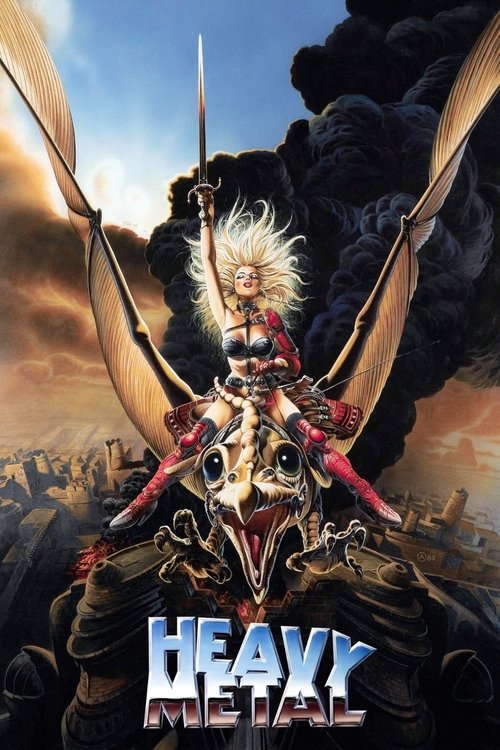
That champion is Taarna, a warrior of almost legendary presence, who rides a winged creature and is tasked with confronting the evil unleashed by the Loc-Nar. Her story carries the film toward its spiritual center, because she is framed not just as a fighter but as a kind of elemental answer to the corruption the orb represents. She moves through the film's final act with ritual seriousness, embodying the possibility that evil can be met with force equal to its scale. The conflict builds toward an all-out confrontation, and as the monstrous violence spreads, the tone becomes one of siege and sacrifice.
The culmination is devastating and decisive. Taarna ultimately sacrifices herself to destroy the Loc-Nar. The orb's apparent invincibility is finally broken, and its destruction is followed by the explosion that obliterates the house where the girl has been trapped by its stories. This is the climax that unites the frame story with the anthology's mythic violence: the same force that killed Grimaldi and tormented his daughter now detonates in a final act of self-consuming defeat. The house destruction is not just visual punctuation; it is the moment when the girl's passive witnessing ends and her own transformation begins.
As the smoke clears, the girl escapes outside and discovers Taarna's flying creature waiting for her. This is the final revelation of the film's structure: the terrified child is not merely a bystander but the next inheritor of Taarna's role. The film confirms this through the girl's appearance--her hair turns white, and a Taarakian mark appears on her neck, signaling that Taarna's soul has been reincarnated in her. The transformation is complete and silent but loaded with meaning. The girl who began as a frightened witness to her father's death now becomes the successor to the warrior who destroyed the evil orb. She mounts the creature and flies away, no longer trapped in the house or in innocence, but carrying forward the power needed to resist the Loc-Nar's legacy.
The final scene closes the circle begun by the opening space descent and Grimaldi's death. The Loc-Nar's claim to be the sum of all evil is challenged not by a single victory, but by the emergence of a new protector shaped from the very victim it sought to terrify. The movie ends with the girl's escape into the sky, a visual echo of the opening that now carries different emotional weight: where the film began with an astronaut falling from space into Earthly danger, it ends with a transformed child rising into the future as the next guardian against that danger.

What is the ending?
In the ending of Heavy Metal, the character of the Loc-Nar is defeated when it is thrown into a fiery pit by a heroic figure, leading to its destruction. The film concludes with a sense of resolution as the various stories intertwine, and the Loc-Nar's influence is finally eradicated.
As the film approaches its climax, we find ourselves back in the present, where the Loc-Nar, a glowing green orb of malevolence, has been the central antagonist throughout the various stories. The Loc-Nar's influence has caused chaos and destruction across different timelines and worlds, and it is now confronted by a heroic figure, a soldier who embodies courage and determination.
In a dramatic scene, the soldier, having traversed through the various narratives and faced numerous challenges, finally confronts the Loc-Nar. The setting is dark and foreboding, filled with the remnants of the chaos the Loc-Nar has wrought. The soldier, fueled by a sense of justice and the desire to end the Loc-Nar's reign of terror, approaches the orb with a fierce resolve.
As the soldier reaches the Loc-Nar, a fierce battle ensues. The orb retaliates with bursts of energy, but the soldier, undeterred, fights back with all his might. The tension builds as the soldier dodges the Loc-Nar's attacks, showcasing his agility and determination. The visuals are striking, with vibrant colors contrasting against the dark backdrop, emphasizing the struggle between good and evil.
In a pivotal moment, the soldier manages to grasp the Loc-Nar and, with a powerful heave, throws it into a fiery pit that symbolizes destruction and the end of its evil influence. The orb screams in agony as it is consumed by the flames, its power dissipating into nothingness. The fiery pit erupts with a brilliant light, signifying the triumph of good over evil.
As the dust settles, the soldier stands victorious, breathing heavily but filled with a sense of accomplishment. The camera pans out, revealing the aftermath of the battle. The worlds that had been affected by the Loc-Nar's chaos begin to heal, and a sense of peace returns to the universe.
In the final moments, the film shifts back to the original setting where the story began. The young girl who had been the initial recipient of the Loc-Nar's influence is now safe, and the ominous presence of the orb has been vanquished. The film closes with a sense of closure, leaving the audience with the impression that while darkness may always exist, there are those who will rise to confront it.
The fates of the main characters are intertwined with the Loc-Nar's defeat. The soldier, having faced his fears and emerged victorious, symbolizes hope and resilience. The young girl, who was once a victim of the Loc-Nar's power, is now free from its grasp, representing the possibility of redemption and the restoration of innocence. The Loc-Nar itself, a representation of chaos and evil, meets its end, reinforcing the film's overarching theme of the struggle between light and darkness.
Is there a post-credit scene?
The movie "Heavy Metal," produced in 1981, does not have a post-credit scene. The film concludes with the final segment of its anthology, which features a powerful and climactic resolution to the stories presented throughout the film. After the last story, the credits roll without any additional scenes or content following them. The focus remains on the vibrant animation and the heavy metal soundtrack that encapsulates the film's themes of adventure, fantasy, and the struggle between good and evil.
What is the significance of the Loc-Nar in Heavy Metal?
The Loc-Nar is a powerful, malevolent green orb that serves as the central antagonist throughout the film. It represents pure evil and corruption, influencing various characters and stories within the anthology. Each segment of the film showcases the Loc-Nar's ability to manipulate and destroy, highlighting its role as a catalyst for chaos and despair.
Who is the character of Taarna and what is her journey?
Taarna is a fierce warrior woman who becomes the film's iconic hero. Her journey begins when she is summoned to avenge the destruction of her people by the Loc-Nar. Taarna's emotional state shifts from a sense of duty to a deep-seated rage as she confronts the evil forces. Her transformation into a powerful avenger culminates in a climactic battle, showcasing her strength and determination.
What happens in the segment featuring the soldier and the alien?
In this segment, a soldier named Grimaldi encounters a mysterious green orb, the Loc-Nar, which grants him visions of power and destruction. He becomes obsessed with the orb, leading to a series of events where he is transformed into a monstrous creature. The emotional turmoil of his greed and the consequences of his choices are depicted through his descent into madness and eventual demise.
How does the story of the 'Den' character unfold?
Den is a young man who is transported to a fantastical world after encountering the Loc-Nar. In this new realm, he transforms into a muscular warrior, navigating through various challenges and adventures. His internal conflict revolves around his desire for power and acceptance, as he grapples with his identity and the responsibilities that come with his newfound strength.
What role does the character of the cab driver play in the film?
The cab driver serves as a narrative bridge between the different segments of the film. He is a cynical character who provides commentary on the events unfolding around him. His interactions with the various characters and his reactions to the bizarre situations highlight the absurdity and chaos of the world influenced by the Loc-Nar, adding a layer of dark humor to the overall narrative.
Is this family friendly?
The movie "Heavy Metal," produced in 1981, is not considered family-friendly and contains several potentially objectionable or upsetting scenes and aspects that may be inappropriate for children or sensitive viewers. Here are some of the key elements:
-
Graphic Violence: The film features intense and graphic violence, including battles, deaths, and scenes of brutality that may be disturbing.
-
Sexual Content: There are multiple scenes that depict nudity, sexual situations, and suggestive themes, which are explicit and may be inappropriate for younger audiences.
-
Substance Use: The film includes depictions of drug use and intoxication, which may be unsettling for some viewers.
-
Dark Themes: The overarching narrative involves themes of corruption, power, and existential dread, which can be heavy and unsettling.
-
Horror Elements: Some segments contain horror elements, including grotesque imagery and frightening scenarios that could be distressing.
These aspects contribute to the film's mature rating and make it unsuitable for children or those who are sensitive to such content.







