


























Popular
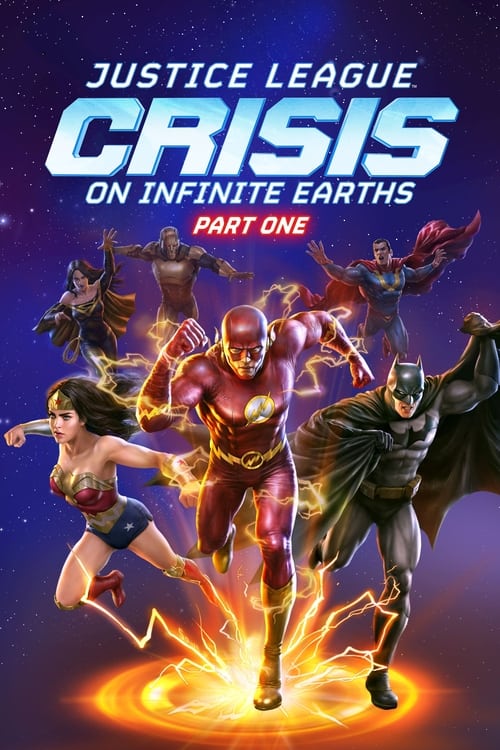
How does Barry Allen’s time-tripping work in Justice League: Crisis on Infinite Earths Part One, and which key moments in his life does it connect to?
Who are the members of the Crime Syndicate Barry meets on Earth-3, and what role do they play in the story?
What exactly happens with Amazo in Part One, and why is he such a major threat to the Justice League?
Which heroes are recruited into the early Justice League, and how is the team formed in the film?
What happens between Barry Allen and the Monitor/Harbinger in Part One, and what is their role in the Crisis?
Should I watch it?
Ask Your Own Question

What is the plot?
The film opens in catastrophe, with Barry Allen / The Flash hurtling through collapsing realities as the multiverse begins to die around him, and the structure immediately tells the story as a series of fractured memories rather than a straight line. Barry keeps being thrown into pivotal moments from his own life and the Tomorrowverse's history, as if the Crisis is dragging him backward and forward at once, forcing him to relive the events that made him who he is while the end of everything closes in.
One of the first moments Barry lands in is the accident at S.T.A.R. Labs, where a lightning strike hits a vat of chemicals and creates the freak event that gives him his powers. The scene matters not just because it explains his origin, but because it establishes the film's central idea: Barry is not remembering the past, he is being thrown through it by a multiversal disaster he does not yet understand. He then appears at a local diner, where he meets Iris West for the first time, and the film briefly slows down to let their connection breathe before the timeline jerks again. Even here, though, there is unease, because Barry is being shadowed by a mysterious man whose significance is not yet revealed in the early part of the story.
The next major leap takes Barry into the battle with Amazo, the android created by Professor Ivo. This is one of the decisive historical moments in the Tomorrowverse, because it is the event that leads to the formation of the first Justice League. Barry arrives in the middle of the fight and sees the world's greatest heroes struggling against a machine that can copy and drain their powers, making brute force useless. The film's first-team roster is identified as Superman, Batman, Martian Manhunter, Green Arrow, Vixen, and The Flash himself. The battle is chaotic and visually overwhelming: Superman is injured, the League is forced to improvise, and Barry realizes that the people he knows as established heroes were once strangers thrown together by crisis.
In the midst of these time fractures, Barry keeps reconnecting with Iris West, and the film uses those emotional returns to contrast intimacy with apocalypse. Their relationship becomes one of the anchors of the story, and the audience sees how deeply the multiversal collapse is intertwined with Barry's own life. That connection reaches a key moment on the day of Barry and Iris's wedding, when Harbinger suddenly appears and interrupts the ceremony. The wedding is not just romantic staging; it is a temporal landmark, a moment the Crisis literally tears Barry away from, converting a private commitment into part of the war for all reality.
Harbinger's arrival is the first direct sign that the disaster is much larger than Barry's personal timeline. She is acting on behalf of Mar Novu / the Monitor, who is assembling heroes across the multiverse to respond to the destruction spreading through infinite Earths. The heroes are gathered not as a ceremonial alliance but as a desperate emergency coalition, a think-tank built to find any plan capable of stopping the Anti-Monitor and his antimatter wave. The scale of the threat becomes clear: this is not a local catastrophe, but the systematic erasure of every Earth in existence.
Before that larger strategy can fully develop, the film returns to the conflict with Amazo and reveals the corruption hidden beneath the Justice League's shining public debut. At the unveiling of Justice League headquarters, the celebration is shattered when Amazo attacks again, but the deeper shock is that Lex Luthor has secretly altered the building's main function from "improving human life" into a machine designed to kill anyone who is not human. The headquarters, meant to symbolize unity and hope, is revealed as a murder weapon waiting to be triggered. The betrayal lands hard because Luthor is not merely opposing the League from the outside; he has infiltrated and poisoned its very foundation.
The fight that follows becomes one of the film's most important moral confrontations. The League cannot defeat Amazo through ordinary means because the android's power-copying ability gives it access to everything the heroes can do, making every attack a mirror of their own strength turned against them. Professor Ivo, who created Amazo, is dragged into the final solution and makes the film's clearest sacrifice: he gives his life to depower the android. This is the film's major death, and it is caused by Ivo himself, who chooses self-sacrifice to shut down the monster he brought into the world. The moment is tragic because it is also redemptive; he dies to stop the destruction he helped unleash.
After Ivo's sacrifice, Batman pieces together the truth behind the entire scheme: Lex Luthor gave Ivo the disease that pushed him toward creating Amazo in the first place. This revelation reframes the conflict completely. Luthor is not just exploiting evil; he is engineering it, nudging brilliant minds into catastrophe and then positioning himself to benefit from the fallout. When Amazo hears that truth, it turns on Luthor in fury. The android is no longer simply a weapon copying heroes; it becomes a judge passed over a manipulator who has poisoned every system around him.
The climax of that arc is surprisingly restrained. The Flash steps in and prevents Amazo from killing Luthor outright, and the android ultimately chooses justice over vengeance. Luthor is arrested, the immediate crisis is defused, and Amazo restores the stolen abilities to the heroes before shutting down. The sequence resolves the League's origin story, but it also leaves behind a residue of corruption: the heroes have saved the day, yet they have done so while learning how fragile their institutions really are.
The story then swerves back into Barry's emotional life, and the film's time structure keeps tightening the link between his personal history and the collapse of reality. His wedding with Iris West is still a luminous memory in the narrative, but it has been interrupted by cosmic duty, and that interruption becomes one of the film's defining emotional wounds. Barry is repeatedly forced to leave the life he wants in order to survive the larger crisis consuming everything around him.
The multiverse itself then opens up in a darker way when Barry is sent to Earth-Three by the mysterious man who has been nudging him through time, though another source frames this as a move connected to Pariah. Either way, the result is the same: Barry is dropped into a morally inverted world ruled by the Crime Syndicate, evil counterparts of Earth's heroes who dominate their planet as conquerors rather than protectors. The world is a perverse reflection of Barry's own, and the sight of it turns the film outward from internal hero history toward multiversal horror.
On Earth-Three, Barry is captured by the Syndicate and forced into direct confrontation with their worldview. He reveals his identity, and the villains react with surprise at the existence of parallel realities, immediately recognizing the implication that if one Earth exists beyond their own, then many more may be open to conquest. That exchange is a crucial revelation: the multiverse is not just a cosmic abstraction but an arena of expansion, domination, and war. The Crime Syndicate's response makes clear that knowledge itself is dangerous here, because once villains understand the scale of existence, they begin to imagine it as territory to take.
While Barry is being displaced through these realities, Harbinger and the Monitor continue assembling heroes from across the multiverse. The film presents the Monitor's base as the strategic center of resistance, where heroes from different Earths are gathered into a single planning effort. Their purpose is not vague inspiration but practical survival: they must find a way to stop the antimatter wave from destroying one universe after another. The heroes' meetings are tense and urgent, full of warnings, briefings, and the growing sense that they are always one step behind the apocalypse.
The movie's sense of impending doom deepens as Barry's time-trips keep exposing how little control anyone truly has. The narrative structure itself mimics disintegration, because Barry keeps landing in pivotal scenes only long enough to understand that they are fragments of a much larger pattern. The result is a story that feels like a memory under siege, where every emotional beat is shadowed by the knowledge that an entire cosmos is being erased in the background.
As the crisis accelerates, the film moves toward its final attempt to save Earth from the antimatter wave, and the emotional center of the story becomes Barry and Iris's ability to cling to each other while time itself collapses around them. The sources indicate that the heroes build massive protective structures, including towers and a vibrational system meant to let the wave pass harmlessly, while Barry and Iris experience what amounts to a compressed lifetime together inside a time pocket. In that trapped pocket, Barry and Iris build, survive, and love in miniature, turning the end of the world into an impossible private universe of their own.
That intimacy is shattered by tragedy. One source reports that Iris West dies during this final stretch, though the broader set of plot summaries around Part One is inconsistent about the exact mechanism and even the timing of that death. Because the sources conflict here, the safest reading is that Iris's death belongs to the ending material associated with the film's climax in some accounts, but the precise on-screen presentation in Part One is not uniformly described across the available material. What is consistent is the emotional effect: Barry is devastated, and grief becomes part of the machinery he uses to keep moving.
The film's closing stretch also introduces a major temporal violation: a chronal anomaly. According to one account, Barry's time-spanning actions create a distortion severe enough that Brainiac 5 from the 30th century identifies it as a serious fracture in history, and the result is the disintegration of Brainiac 5, Dawnstar, and other figures connected to the story's future threads. Another source says the first part ends with The Flash disintegrating as well, suggesting the film closes on a catastrophic cliffhanger where victory is immediately undercut by temporal collapse. The exact mechanics are described differently in different sources, but they agree on the essential point: the apparent success of the heroes is poisoned by a deeper failure in time itself.
The ending therefore plays like a cruel inversion of triumph. The heroes manage to construct a way to resist the antimatter wave, and for a brief moment it seems as if they have found a solution. Barry's accelerated existence and the time-pocket logic of the narrative let him and Iris build what they need to survive long enough to carry out the plan. But the victory is unstable, because it is immediately followed by the chronal collapse that begins erasing people who should not be lost yet. The film does not resolve the larger Anti-Monitor crisis; instead, it ends by showing how even the act of saving one world may be causing damage elsewhere in time and reality.
The final feeling is one of forward motion into catastrophe. Lex Luthor is arrested, Professor Ivo is dead, Amazo has shut down after returning the stolen powers, and Barry has been thrust further into the multiverse, including Earth-Three, where the next stage of danger is waiting. Harbinger has successfully gathered the heroes, Mar Novu / the Monitor has begun his resistance plan, and the Anti-Monitor remains the unseen but overwhelming force driving the destruction of infinite Earths. The last images leave Barry isolated in a story that keeps splitting around him, with the multiverse burning, the timeline fraying, and the coming conflict clearly too large for Part One to contain.
More Movies Like This
Browse All Movies →



What is the ending?
The ending of Justice League: Crisis on Infinite Earths Part One is a grim victory. The heroes stop the antimatter wave, but Barry Allen is pulled into the Speed Force, and several characters are erased from existence, leaving the story on a cliffhanger.
Barry and Iris finish assembling the vibrational generators across the Earths, and Iris dies in Barry's arms after their long struggle together. Barry then returns to the normal flow of time, rides the cosmic treadmill one last time, and powers the generators all at once so the antimatter wave is pushed back and the multiverse is saved for the moment. Amazo is destroyed in the process, though it fulfills its programmed purpose before the end. Shortly afterward, the Spectre appears and tells Barry that the Speed Force will take him because of the transgressions he committed in order to give the multiverse another chance. Barry is then sent back through time, sees that the mysterious stranger from his accident was himself, and finally vanishes into the Speed Force. After that, Barry appears in the Warlord's universe for a moment and is then erased from existence.
At the same time, Kara watches in horror on Monitor's spaceship as Dawnstar is erased from existence, along with Brainiac-5, her love interest from the far future. The ending leaves the survivors facing a reality that has been saved for the moment but clearly remains unstable, with the film closing on a cliffhanger rather than a full resolution.
Barry Allen's fate is to be taken by the Speed Force and then erased from existence, after briefly reappearing in the Warlord's universe. Iris West dies in Barry's arms after helping complete the generators. Amazo is destroyed after serving as the power source for the final defense. Dawnstar is erased from existence. Brainiac-5 is erased from existence. Kara survives the ending scene, but she is left in shock as she watches the disappearances happen around her. Monitor remains alive at the point where the ending turns into the next chapter, and the Spectre is the one who delivers Barry's final cosmic punishment.
Is there a post-credit scene?
No. Justice League: Crisis on Infinite Earths – Part One does not have a post-credits scene in the usual sense; the movie ends on a cliffhanger instead. The story concludes with the heroes thinking they have won, only for the Anti-Monitor's crisis to escalate and the Flash and other heroes to begin disappearing, which sets up the next installment rather than a separate stinger.
If you were expecting an extra scene after the credits, the available film summaries and recaps do not describe one for Part One.
How does Barry Allen’s time-tripping work in Justice League: Crisis on Infinite Earths Part One, and which key moments in his life does it connect to?
Barry Allen's repeated time shifts are a central plot device in Part One, with the story jumping through major moments in his life rather than unfolding linearly. The film shows him being pulled from one reality to another through the Speed Force, including an early fight with Amazo, moments tied to the forming of the Justice League, and other turning-point events that gradually reveal the scale of the Crisis.
Who are the members of the Crime Syndicate Barry meets on Earth-3, and what role do they play in the story?
Barry is sent to Earth-3, where he encounters the Crime Syndicate, villainous counterparts of the Justice League who rule their world as tyrants. The group includes Ultraman, Owlman, Superwoman, Johnny Quick, and Power Ring, and their scene functions as one of the film's major alternate-universe reveals.
What exactly happens with Amazo in Part One, and why is he such a major threat to the Justice League?
Amazo appears both in Barry's earlier time-shifted memory and later at the unveiling of the Justice League headquarters. In the latter event, Lex Luthor has altered Amazo's purpose so that he is no longer meant to improve human life but to kill anyone who is not human, and his ability to steal powers leaves the newly formed Justice League unable to stop him directly.
Which heroes are recruited into the early Justice League, and how is the team formed in the film?
Barry helps shape the first version of the team by suggesting that Bruce Wayne, Clark Kent, Green Arrow, Mari McCabe, and J'onn J'onzz unite as a team. The film frames this as a formative step toward the official Justice League, with Barry's experience of the Crisis pushing the heroes toward cooperation.
What happens between Barry Allen and the Monitor/Harbinger in Part One, and what is their role in the Crisis?
The film presents the Monitor, Mar Novu, as the cosmic figure trying to assemble heroes across the Multiverse to resist the Anti-Monitor's destruction. Harbinger rescues Superman, Batman, and Wonder Woman, and the larger mission is to gather allies before the Anti-Monitor's antimatter assault wipes out more Earths.
Is this family friendly?
No, it is not especially family-friendly for young children. It is rated PG-13 for some violence and brief strong language, and multiple guides describe fantasy/comic-book violence, threat, and emotionally heavy destruction scenes.
Potentially upsetting or objectionable elements include: - Animated violence: fights with weapons, explosions, stabbings, and other superhero combat. - Mass destruction and peril: cities and civilians are shown being wiped out or erased by a multiverse-level threat, which several guides describe as dark and sad. - Brief blood or injury detail: some sources note short shots of blood, bruising, or lingering injuries. - Strong language: mild profanity such as "shit," "goddamn," and similar terms. - Intense or frightening moments: the overall tone is described as dark, sad, and threatening, with repeated danger to major characters. - Photosensitive concern: the BBFC notes flashing images that may affect viewers sensitive to epilepsy.
If you want, I can also give a simple "safe for ages X?" recommendation based on these ratings and content notes.








