
Popular
Should I watch it?
Ask Your Own Question

What is the plot?
Sorry, we aren't able to watch and write up a full detailed plot yet. Check back in a few days.
More Movies Like This
Browse All Movies →
What is the ending?
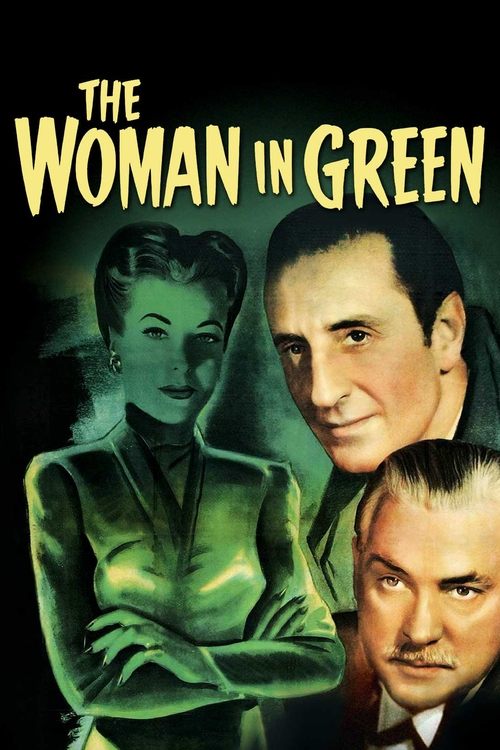
In the ending of "The Woman in Green," Sherlock Holmes and Dr. Watson confront the villain, who is revealed to be the mastermind behind the murders. Holmes successfully deduces the truth and saves the day, but not without a tense confrontation. The film concludes with the resolution of the case and the restoration of order.
Now, let's delve into the ending in a more detailed narrative fashion.
As the climax of the film unfolds, Sherlock Holmes, portrayed by Basil Rathbone, and Dr. John Watson, played by Nigel Bruce, find themselves in a dimly lit room, the atmosphere thick with tension. Holmes, having pieced together the clues surrounding the mysterious murders of women with their fingers severed, realizes that the key to solving the case lies with the enigmatic woman in green, who has been both a victim and a perpetrator.
In a pivotal scene, Holmes and Watson confront the true villain, a man named Professor Moriarty, who has been orchestrating the gruesome events from the shadows. Moriarty, played by Henry Daniell, is revealed to be the mastermind behind the murders, using the woman in green as a pawn in his sinister game. The confrontation is fraught with danger, as Moriarty attempts to escape the clutches of justice.
Holmes, with his keen intellect and unwavering determination, engages in a battle of wits with Moriarty. The tension escalates as Moriarty tries to manipulate the situation, but Holmes remains steadfast, using his deductive reasoning to outsmart the villain. The stakes are high, and the emotional weight of the moment is palpable, as Holmes fights not just for justice, but for the lives of those affected by Moriarty's cruel machinations.
As the confrontation reaches its peak, Watson, ever the loyal companion, stands by Holmes, ready to assist in any way possible. The two men work in tandem, showcasing their deep bond and mutual respect. The scene is charged with urgency as they close in on Moriarty, who realizes that his plans are unraveling.
In a dramatic turn of events, Moriarty attempts to flee but is ultimately cornered. The tension culminates in a physical struggle, where Holmes's intellect and Watson's bravery shine through. Moriarty's fate is sealed as he is apprehended, and the threat he posed is finally neutralized.
With the case resolved, the film draws to a close. Holmes and Watson share a moment of relief, their camaraderie evident as they reflect on the harrowing events they have just endured. The emotional weight of the case lingers, but there is a sense of closure as justice is served.
In the final scenes, the woman in green, who had been a victim of Moriarty's manipulation, is freed from the shadows of her past. Her fate is one of redemption, as she is no longer a pawn in Moriarty's game but a survivor who can now reclaim her life.
The film concludes with Holmes and Watson walking away from the scene, their friendship stronger than ever, having faced danger together and emerged victorious. The resolution of the case not only restores order but also reinforces the themes of loyalty, intellect, and the triumph of good over evil.
Is there a post-credit scene?
The Woman in Green, produced in 1945, does not have a post-credit scene. The film concludes without any additional scenes or content after the credits roll. The story wraps up with the resolution of the central mystery involving Sherlock Holmes and Dr. Watson as they confront the villain and solve the case surrounding the mysterious murders linked to the titular character, the Woman in Green. The film ends on a note of closure, typical of the era's cinematic style, leaving no further narrative to explore after the credits.
Who is the main antagonist in The Woman in Green?
The main antagonist in The Woman in Green is the sinister criminal mastermind, Professor Moriarty, portrayed by Henry Daniell. Moriarty is depicted as a cunning and ruthless figure, orchestrating a series of murders to further his nefarious plans.
What role does Sherlock Holmes play in the investigation?
Sherlock Holmes, played by Basil Rathbone, takes on the role of the brilliant detective who is drawn into the case when a series of mysterious murders occur. His keen intellect and observational skills drive the investigation, as he seeks to uncover the truth behind the murders linked to the enigmatic Woman in Green.
How does the character of the Woman in Green influence the plot?
The Woman in Green, portrayed by Hedy Lamarr, is a pivotal character whose allure and mystery captivate both Holmes and the audience. She is initially seen as a femme fatale, leading men to their doom, and her connection to the murders propels the narrative forward, creating tension and intrigue.
What is the significance of the green color in the film?
The green color in The Woman in Green symbolizes danger and seduction, particularly associated with the character of the Woman in Green herself. It serves as a visual motif that highlights the perilous allure she represents, drawing characters into a web of deceit and murder.
How does Dr. Watson contribute to the investigation?
Dr. John Watson, portrayed by Nigel Bruce, serves as Sherlock Holmes' loyal companion and confidant. Throughout the investigation, Watson provides support and comic relief, while also assisting Holmes in piecing together clues. His unwavering faith in Holmes' abilities underscores their partnership and adds depth to the narrative.
Is this family friendly?
"The Woman in Green," produced in 1945, is a Sherlock Holmes mystery that contains some elements that may not be suitable for younger audiences or sensitive viewers. Here are some potentially objectionable or upsetting aspects:
-
Murder and Violence: The film involves themes of murder, with scenes depicting crime and the aftermath of violent acts. The portrayal of dead bodies and the investigation into these crimes may be unsettling.
-
Dark Themes: The narrative explores darker themes such as obsession, manipulation, and the psychological impact of crime, which may be intense for children.
-
Suspenseful Moments: There are several suspenseful scenes that may evoke fear or anxiety, particularly those involving the antagonist and the threat to the main characters.
-
Mysterious Disappearances: The plot includes elements of mystery surrounding the disappearance of women, which could be distressing for some viewers.
-
Mature Situations: There are subtle implications of danger and seduction, particularly in the interactions between characters, which may not be appropriate for younger audiences.
Overall, while the film is a classic detective story, its themes and content may require parental discretion for younger viewers.