
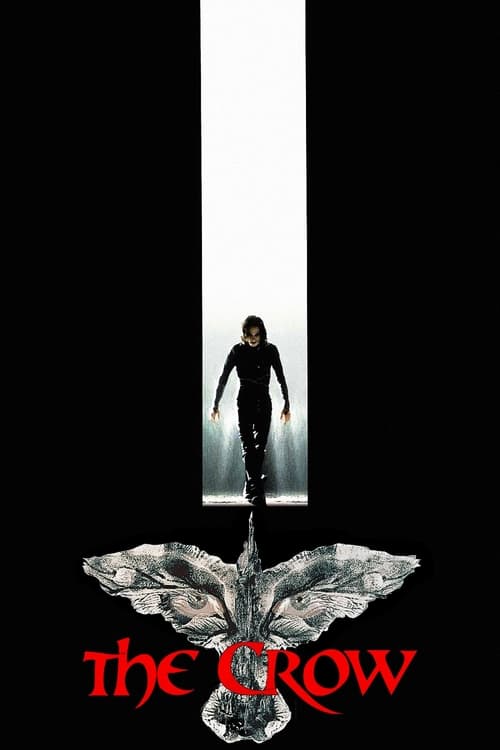
















Popular
Should I watch it?
Ask Your Own Question

What is the plot?
On October 30, Devil's Night in Detroit, the city burns.
Black smoke climbs into the sky as entire blocks crackle and collapse, flames licking out of the broken teeth of windows. Sirens wail and echo through the concrete canyons. Above the burning roofs, a black shape circles and glides: a crow, silhouetted against the orange glare. A teenage girl's voice cuts through the roar of fire and sirens, calm, resigned, a child shaped by this city.
"People once believed," Sarah says, "that when someone dies, a crow carries their soul to the land of the dead. But sometimes… something so bad happens, that a terrible sadness is carried with it, and the soul can't rest. Then sometimes… just sometimes… the crow can bring that soul back… to put the wrong things right."
The camera of the story descends into a specific building, charred on one side from earlier fires. Police lights strobe red and blue across wet asphalt. It is late on Devil's Night, the night before Halloween, sometime close to midnight. The address is an old, decaying building in a crime‑ravaged part of Detroit.
On the street below, a man's body lies twisted on the pavement. This is Eric Draven, a rock musician, face pale under blood, long dark hair matted, dead eyes staring at the burning sky. A few stories above, one of the loft windows is shattered outward, glass dust glittering in the beams of flashlights. Inside that sixth‑floor loft, paramedics work frantically over a woman. This is Shelly Webster, Eric's fiancée, brutalized, clothes torn, body broken from a sustained beating and gang rape. The paramedics call out vitals; they say she has a pulse. She is barely holding on.
Sergeant Daryl Albrecht stands in the doorway, his trench coat damp from rain and smoke, taking it all in--broken furniture, blood on the floor, signs of struggle scrawled into the walls. He is tired but thorough, a decent man in a city that's forgotten what that means. He watches as Shelly is loaded onto a gurney, her face barely visible under oxygen mask and blood and bruises. As they wheel her out, he walks alongside, already committing himself to her in the only way he knows--by staying with her.
On the street, he glances once at Eric's broken body being zipped into a black bag. Someone mutters that the couple was supposed to get married tomorrow--Halloween. A cop adds that they were fighting a forced eviction and had crossed the wrong people. Albrecht files it away. He follows the ambulance toward the hospital, leaving behind the crime scene tape fluttering in the wind and the shattered window bleeding light out into the darkness.
Eric Draven dies on the street, sometime around midnight, Devil's Night. Shelly Webster does not die that night. She clings to life in the hospital for thirty agonizing hours, suffering through multiple surgeries and unrelenting pain, finally dying sometime on November 1. Albrecht is there; he sees how long she takes to let go. That detail will burn itself deep into his memory.
The gang who did this are already gone, laughing their way into the neon‑streaked wet streets: Tin Tin, the knife‑happy thug with a trench coat and a cruel grin; Funboy, a junkie hitman with a revolver always close by; T‑Bird, the swaggering driver and street‑level leader; and Skank, twitchy, excitable, the runt of the pack. They did not act alone. Far above them in the city's criminal hierarchy sits Top Dollar, the crime lord who orchestrates Devil's Night arson and "evictions," a man who believes the city is his to burn.
Time slides forward.
The fires of that Devil's Night burn out. Winter comes, then spring, then summer. The city rots a little more. And then it is October again. Another Devil's Night.
One year has passed.
Rain falls in the cemetery, slanting across rows of tombstones. It is the evening of October 30 again, just after dusk. Sarah, now a little older but still with the same wary eyes, rides her skateboard between the graves and stops in front of a double headstone: ERIC DRAVEN, SHELLY WEBSTER. She squats there, talking to Shelly like she always does.
"You know, they were supposed to get married," she reminds herself and the unseen dead. "Halloween. One year ago. The day after… everything." She complains about her mother, Darla, who is still lost to drugs and to Funboy's apartment, and she confesses that Eric and Shelly were the only adults who really cared about her. Her voice cracks, but she keeps it tough. When she finally leaves, skateboard wheels rattling over cracked paths, the cemetery is empty again.
A black crow lands on Eric Draven's headstone.
It cocks its head, intelligent, ancient. It taps its beak on the stone once, twice, again. Thunder rumbles low. The earth over Eric's grave trembles; rainwater trickles into newly forming cracks. Then a hand, pale and dirty, claws out of the wet earth, fingers digging into the grass. Eric Draven drags himself up from the grave, gasping, choking on soil and rain.
He stands, shivering, wearing the shredded burial clothes he was put in, confused and horrified. His skin is cold. His muscles remember pain, but he is no longer truly alive. The crow caws and launches into the air, circling him once before flying off toward the city. Eric staggers after it, pulled by an instinct he doesn't understand.
Detroit at night is all wet asphalt and rusty metal. The crow leads him across rooftops slick with rain, past chimneys belching smoke, through the glow of industrial fires burning for Devil's Night again. He moves with surprising agility despite his shock, jumping gaps he shouldn't be able to clear, climbing like a cat. Somewhere in that movement, he begins to sense that he is different.
The crow guides him back to the sixth‑floor loft he once called home. The building looks worse now: another year of neglect, more graffiti, more broken glass. Eric climbs in through the shattered window he was thrown from a year ago. Inside, time has not healed anything. The place is trashed, vandalized. Spray‑painted curses stain the walls. Furniture is broken where it fell. A wedding dress lies filthy and crushed in a corner, the white fabric gray with dust. The fractured remains of their life together fill the room: musical instruments, scattered records, Shelly's books and pamphlets for causes she believed in, wedding invitations that never went out.
He touches things with numb fingers, and the past hits him like lightning.
Flash: Tin Tin crashing through the door, knives glinting.
Flash: T‑Bird barking orders, ordering Eric to "get the hell out" as they drag Shelly away.
Flash: Funboy's gun going off, the impact of bullets in his chest.
Flash: Skank laughing, Shelly screaming, glass exploding as hands grab him, shove him toward the window.
The crow seems to channel these memories into him. Eric doubles over as images of Shelly's rape and beating slam through his mind. Her screams echo in his skull. He sees himself dragged, punched, stabbed, finally hurled backwards through the loft window, falling six stories to the street below, his last sight Shelly's desperate hand reaching out for him and not quite reaching.
He staggers to a cracked mirror. In the dirty reflection, a pale corpse stares back. In confusion and rage, Eric smashes the glass with his bare hand. Shards slice into his skin. Blood wells for a moment--and then, before his eyes, the cuts close, knitting together, leaving unmarred flesh. He stares, horrified and fascinated. His body will not hold wounds.
He presses a shard of glass into his palm deliberately, watching the skin split and then mend. He is invulnerable. Dead, and yet not. A scream from his soul rises, but he swallows it.
Later, in the same room, he finds a porcelain harlequin mask and Shelly's makeup. He paints his face as if he is burying the last of the human man under a new persona: skin ghost‑white, lips black, dark lines drawn from mouth and eyes like a macabre grin that never quite smiles. The face in the mirror becomes the Crow--the avenger the legend promised. He pulls on black clothes and, at some point, Tin Tin's black trench coat. He slides Shelly's memory onto his fingers in the form of an engagement ring once he finds it. He steps back out into the night.
The crow leads him to his first target.
In a trash‑strewn back street, Tin Tin is prowling, knives strapped across his chest. He thinks he owns these alleys. He is mumbling nasty jokes to himself, high on the grime of the city, when a dark figure drops down from a fire escape, long leather coat swirling, face white and terrible. Tin Tin squints.
"Hey, man, Halloween ain't 'til tomorrow," he sneers.
Eric doesn't blink. "I know you," he says softly. "I know you murdered Shelly Webster."
Tin Tin laughs, drawing a knife. "I don't remember names. We put a lot of people out of their misery. Who the fuck are you supposed to be?"
"Eric Draven."
Tin Tin falters. That name belongs to a corpse. "You're dead, man."
Eric steps closer. Tin Tin slashes, driving a blade into Eric's chest. Eric looks down at the handle sticking out of his body, then back up, entirely unhurt. Tin Tin's bravado slips into panic. Eric disarms him in a blur, and then repays the violence in a methodical storm of blades, stabbing Tin Tin with his own knives, one after another, each thrust deliberate. Tin Tin screams, pinned to the wall by steel, blood painting the bricks. Eric arranges those wounds in a shape that will later resemble a crow. Tin Tin dies there, impaled, his life leaving in ragged gasps. His killer is Eric Draven.
From Tin Tin's dying mind, Eric touches blood and sees memories: the pawn shop where Shelly's engagement ring was pawned, the leering owner, the address. Guided now by both the crow and stolen recollections, he goes to Gideon's Pawn Shop.
Gideon's Pawn Shop squats on a busy yet rotten street, choked with neon and rain. Inside, Gideon--a heavyset, greasy man--sorts through stolen watches and rings, fencing the city's misery for cash. The door bursts inward as Eric enters like a gust of wind. Gideon's hand goes for the shotgun under the counter, but Eric is already there, yanking him over by his shirtfront and slamming him into glass.
"Tin Tin," Eric says, voice low, "sold you a ring. Shelly Webster's ring."
"I got lots of rings," Gideon protests, sweating. "You want a ring, pick a ring."
Eric's eyes are cold. "Her ring."
He hauls Gideon around, forcing him to empty drawers, dump boxes. In a small cardboard box, mixed with dozens of other stolen lives, Eric's fingers close around a familiar silver band: Shelly's engagement ring. For a moment his invulnerable façade cracks; he sees her face when he put it on her finger, the hope in her eyes. He closes his fist around it.
Gideon tries to bluster. Eric slams him again, then suddenly becomes very calm.
"I'm going to let you live," he says. "I want you to tell your boss that death is coming for him. I want you to tell him the Crow is coming."
Then he douses the counters and shelves with gasoline, splashing it over piles of junk and stolen goods. He loads a shotgun with other rings, shells clinking with tiny metal circles, and fires into the drenched counters. The impact ignites the fumes in a roaring fireball. The pawn shop erupts in flames behind him as he walks out, Shelly's ring in his pocket. Gideon survives--Eric's deliberate choice--stumbling out later amid the blaze, a living message to Top Dollar.
In another part of the city, up a flight of stairs that smells of urine and despair, Funboy's apartment glows with sickly yellow light. Inside, Funboy lounges on a stained mattress, heroin kit spread out on the table. Beside him is Darla, Sarah's mother, skin sallow, eyes glassy, another junkie orbiting his world. They exchange lazy, cruel jokes. He loads a needle; she watches numbly.
The door opens of its own accord.
Eric steps inside, silent, and closes it behind him. Darla giggles, thinking it a trick, a Halloween gag. Funboy, half‑amused, pulls his gun.
"Take your best shot," Eric says, arms outstretched.
Funboy fires. Bullets slam into Eric's chest and wrists, driving him back against the wall. Darla screams. Eric slumps--then straightens, wounds knitting closed in seconds, blood flowing backwards. Funboy's grin disintegrates.
"You're not allowed to do that," Funboy whispers, terrified.
Eric moves in, disarming him with fluid ease. In the scuffle, Funboy's own gun goes off, blowing through his leg. He howls. Eric picks up a syringe loaded with heroin, holds it up.
"You like this, don't you?" he says. "You put this in others. You made Darla forget she has a daughter."
Funboy tries to crawl away. Eric grabs his arm and plunges the needle in, then another, and another, forcing massive doses into Funboy's veins. Funboy convulses, eyes bulging with chemical terror. He collapses on the mattress, shaking, foam at his mouth. In moments, his heart gives out. Funboy dies from the fatal overdose Eric forces on him. His killer is Eric Draven.
Darla stares, paralyzed. Eric turns to her. He places his hands on her face, thumbs brushing over the bruised skin under her eyes. Something passes from him into her--a reversal of poison. Her veins burn; she gasps as if waking up from a long coma. The haze clears, replaced by shock and shame.
"Your daughter is out there," Eric tells her. "Her name is Sarah. She waits for you. Go home."
He leaves her sobbing on the floor, the heroin craving broken, the responsibility shoved back onto her shoulders.
Elsewhere, Sergeant Daryl Albrecht has started noticing patterns: dead gang members, explosions, unnatural disturbances. He follows the trail to the loft where Eric once lived, now ominously lit by candles and memories. It is late; rain taps on the broken glass. As Albrecht pokes around, Eric appears behind him like a ghost.
They talk in a room flickering with candlelight and old photographs. Albrecht points his gun but lowers it when he sees the impossibility of the man in front of him.
"Eric Draven," Albrecht says slowly. "You died. I was there."
"I know," Eric replies. His voice is quiet but it holds the tremor of centuries of rage. He lays hands on Albrecht's temples, and in a rush, he sees through Albrecht's memories: Shelly being rushed into the hospital, the doctors working on her, the slow tick of hours as she fights and fails, the final flatline. Albrecht's impotent anger.
"She was with me for thirty hours," Albrecht says aloud, the pain fresh even now. "Twenty hours in surgery, ten on a ventilator. She died on the operating table. I stayed with her. Somebody should have."
Eric's eyes fill with tears that cannot fall. Now he knows exactly how long she suffered: thirty hours of pain, thirty hours of innocence dying in a fluorescent hospital room. He takes that knowledge into himself; it will become his final weapon later.
Albrecht, shaken, realizes what he is dealing with: not a regular vigilante, but something resurrected, something that should not be. Nonetheless, his basic morality pushes him to help. He won't stand in Eric's way.
Meanwhile, Sarah wakes up the next morning to find Darla home, making eggs badly, trying to be a mother. The drugs are gone from her system. The guilt is not, but it is now a chance at redemption. Sarah senses Eric's touch in this change.
That day, Sarah wanders back to the burned‑out street where the loft stands and goes up the stairs. In the familiar doorway, she sees the figure in black and white, sitting amid candles and relics of a life stolen. For a heartbeat she thinks she's seeing a ghost.
"Eric?" she whispers.
He turns, the harsh paint around his eyes somehow not hiding the familiar kindness. "Little girl," he says softly. He tells her he can't stay. He is here for something that has to be finished, and then he must go. She wants to hug him; she wants him to come back for good. But she feels the chill around him, the sense that he is borrowed time.
"To me, you're still the same," she says. "You and Shelly. You're all that was ever good to me."
He touches her hair, affection and sorrow in the gesture. Then he sends her away, back to a mother he has forced into sobriety, because this path he walks is not for the living.
High above street level, in a luxurious penthouse that doubles as a club, Top Dollar holds court. The room is heavy with incense, velvet, and shadow. Gothic statues line the walls. Weapons--swords, katanas, antique guns--are displayed like trophies. Top Dollar, thin, sharp‑featured, hair long and sleek, lounges with predatory ease. Beside him is Myca, his half‑sister and lover, a dark‑eyed occultist who burns candles and reads omens. They have just finished with another victim: a young woman whose body lies on the bed, her eyes removed by Myca for some morbid ritual. For Top Dollar, life and death are amusements.
He convenes a meeting with his lieutenants around a large round table. It is Devil's Night again, and he wants the city to burn like never before. He slams a sword into the table to make his point. "You're all going soft," he accuses them. "Fire is our calling card. Tonight, we burn every block, every building we can. I want the sky on fire."
Around the table, men nod--T‑Bird, Skank, assorted lieutenants. Only Skank fidgets nervously, hearing rumors of a ghost killing his friends.
Eric is already moving toward them.
Before he gets to the boardroom, he has one more death to deliver: T‑Bird, the street captain who drove the car the night they invaded Shelly and Eric's home. T‑Bird is in his car again now, revving the engine, unaware of the shadow in the backseat. Eric rises up behind him like a nightmare, gun in hand.
"Who the hell are you?" T‑Bird snarls, trying to jerk the wheel, to throw him off.
"Remember?" Eric says. "Devil's Night, one year ago. Forced eviction. You laughed while she screamed."
He forces T‑Bird to drive, gun against his neck, speeding through the industrial outskirts and past skeletal piers. Rain streaks across the windshield. Eric's words are knives, forcing memory down T‑Bird's throat. At a deserted industrial site, Eric binds T‑Bird to the driver's seat with duct tape, rigging explosives and gasoline around the vehicle.
T‑Bird's bravado cracks. "You can't do this! You're dead!"
"Can't rain all the time," Eric murmurs, a phrase Shelly once said. Then he walks away, coat flaring. The car explodes behind him in a tower of orange, a man screaming inside as fire devours him. T‑Bird dies in his own muscle car, killed by Eric Draven. The explosion lights up the night; the silhouette of Eric against the flames becomes part of his legend.
By the time T‑Bird's ashes settle, Top Dollar is furious. Tin Tin dead, Funboy dead, now T‑Bird. He demands answers. Gideon, hauled in front of him, tries to explain between panicked babbles: a guy, looks like some dead rockstar, shot full of holes and just keeps coming, blew up the pawn shop, said he was coming for Top Dollar. Top Dollar listens, intrigued rather than frightened. Then, bored with Gideon's fear, he pulls a gun and shoots Gideon in the head, killing him casually as punctuation. Gideon dies at Top Dollar's hand, his usefulness ended.
Myca, fascinated, starts to stitch the pattern together. She has heard legends of the crow: a death‑spirit guide, bringing back the wronged to exact vengeance. She studies the black bird that always seems to be in the background of these events. "He's not a man," she tells Top Dollar later, in the sultry shadows of their bedroom. "He's a spirit. The crow is his link. Kill the crow, and you make the spirit mortal."
Top Dollar smiles. A weakness. Every legend has one.
Down below, in the streets, Eric continues his march toward the heart of the organization. Devil's Night arcs toward midnight. Fires bloom across Detroit as Top Dollar's arson crews go to work, but something else burns too--fear, rumors of an invincible specter in black.
Eventually, Eric walks straight into Top Dollar's world.
In the crowded, noisy club below Top Dollar's penthouse, music pounds and bodies sway. Above, in the boardroom, Top Dollar assembles his lieutenants to finalize the night's mayhem. Skank is there, twitching, mumbling to himself, terrified of being the last man left. Talk of a ghost is in the air, muttered at the edges of the table.
The elevator doors slide open. Eric Draven steps into the room.
He walks down the length of the table, his boots echoing on the wood. Men draw guns. Top Dollar watches, amused, curious. Eric's eyes find Skank, who tries to sink into his chair.
"I'm looking for a man named Skank," Eric says.
Skank shoots to his feet, panicked. "Skank? Skank's dead! He died! He fell out of a window!" He points at another man. "I'm not Skank!"
Eric's painted face doesn't change. "You're Skank." He glances at the pistols lining the table. "And you've all been very… naughty."
Someone fires. Bullets slam into Eric's chest, shoulders, back, staggering him. He falls across the table. The room erupts into chaos. Then Eric rises, bullet holes already closing, and the boardroom becomes a slaughterhouse.
He moves with inhuman grace, leaping onto the table, grabbing guns mid‑air, turning them back on their owners. Glass explodes, chairs topple. Men scream as their bullets do nothing to stop the walking corpse in their midst. Eric dives, rolls, fires, each shot precise, each target a man who helped burn the city and destroy lives. He snaps limbs, slams heads into walls, uses their own weapons against them. Blood sprays across neon‑lit walls. This confrontation is one‑sided. One by one, the lieutenants fall--killed by gunfire or close‑quarters violence, their deaths all at Eric's hands.
Skank tries to escape, scrambling over chairs, shouting incoherently. Eric stalks him, inexorable. Finally he corners him near a broken window overlooking the rain‑slick street far below.
"Please, man, I didn't mean it, I was just there, I didn't…" Skank babbles.
Eric grabs him by the coat, hoists him up.
"Victims," Eric says coldly, echoing words he spoke long ago with Shelly, "aren't we all?"
He hurls Skank out through the shattered glass. Skank plummets, screaming, to the pavement, his body striking with a sickening thud. Skank dies from the fall, killed by Eric Draven.
In the chaos, Top Dollar, Myca, and their right‑hand man Grange slip away. They are the final layer, the core of the rot. Eric has cut away the limbs; now he must take the head.
But they have learned about the crow.
Top Dollar and Myca retreat to a church, an old cathedral that rises above surrounding tenements, a relic of faith in a godless city. It is night, still Devil's Night sliding toward dawn. They choose it as their lair for the last act because it is high, defensible, symbolic. There, in the shadow of stained glass saints, they plan to trap a demon.
To force the confrontation, Grange abducts Sarah. She is grabbed in the street near the cemetery, bundled into a car, and taken, kicking and cursing, to the church. Top Dollar knows Eric cares about her; he has seen that much humanity left in the avenger's eyes. Sarah becomes bait, another victim dangled in front of a man who cannot abide innocent blood.
Eric feels it. Through the crow's eyes, he sees Sarah bound in the cathedral, Top Dollar's men waiting in the pews, Myca stalking the shadows with her occult paraphernalia. He follows the bird to the church.
Sergeant Albrecht, having pieced together enough, also heads there, determined to help Eric despite the insanity of it all. He is wounded by then--from earlier exchanges with gang members, from the city itself--but he pulls himself up those stone steps anyway.
The church doors groan as Eric pushes them open.
Inside, candles burn along the altar. Pews lie in disarray. Sarah is tied up, gagged, eyes wide. Grange lurks on the balcony with a rifle, watching the crow. Myca stands near the altar, fingers tracing sigils in the air, eyes hungry. Top Dollar waits in the shadows, sword within reach.
The crow swoops in ahead of Eric, its feathers catching candlelight, its caw echoing through the rafters. Grange takes careful aim and fires. The bullet hits the crow; black feathers spin in the air as the bird tumbles to the ground, wounded. It flaps weakly, cawing in pain.
Eric stumbles as if shot. The link is real. For the first time since he clawed out of the grave, he feels a hot, tearing pain that does not fade. Blood from a grazing bullet wound earlier doesn't close up. The crow is his power, his immortality. Hurt the crow, hurt him. Myca smiles triumphantly; her theory was right.
Grange and other gunmen step out, opening fire. This time, bullets bite deep into Eric's flesh and stay there. He dives behind pillars, ducking as stone explodes around him. He is still stronger and faster than a normal man, but now he is mortal, can be killed. The odds have shifted.
Albrecht bursts in, gun drawn, firing at the men shooting at Eric. A bullet slams into Albrecht's shoulder; he cries out but keeps going, laying down covering fire. Eric uses the chaos to close the distance, disarming one thug, breaking another's neck, shooting a third. The nave fills with gun smoke and stained glass dust.
Grange, the loyal right hand, lines up another shot--but Eric is already moving. In a violent, up‑close exchange, Eric's bullets tear through Grange's chest. Grange stumbles, drops his rifle, and falls from the balcony to the floor below, dead. Grange dies in the church, killed by Eric Draven.
As Sarah struggles against her bonds, Myca swoops in, grabbing the wounded crow. She cradles it like a prize, dagger raised. Eric sees this and heads for her, limping, bleeding. Myca's eyes glow with occult fervor.
"I have your power now," she hisses. "Without it, you are just a man."
She moves to kill the bird. In the melee that follows, the crow lashes out, pecking at her eyes, clawing. Sarah lunges, freed or freeing herself in the confusion, and Myca is jostled. Her footing slips on broken glass. She teeters at the edge of a high interior balcony.
Eric reaches for her, not out of mercy but to stop her from finishing the crow. They grapple--his hand on her wrist, her dagger flashing. Sarah shouts. Myca's heel catches nothing. She falls.
Her body plummets through the belly of the church, past stone arches and broken beams, to crash onto a lower level amid a spray of shattered wood and glass. She lies twisted, impaled on debris. Myca dies from the fall, killed indirectly through the struggle with Eric and the crow.
With Myca and Grange dead, only Top Dollar remains.
Eric, badly wounded, staggers up the narrow spiral staircase that winds into the bell tower. Rain seeps in through cracked stone. Thunder rolls closer. On the rooftop, gargoyles leer out over the burning city. Top Dollar is waiting there, coat whipping in the wind, sword in hand.
"Nice of you to drop in, Mr. Draven," Top Dollar says. His voice is smooth, mocking. "An evening like this calls for a little rooftop entertainment."
Eric, breathing hard, says nothing. Blood stains his shirt. The crow, somewhere below, is still alive but maimed. Eric's strength is ebbing. But he climbs anyway, onto the slick slates of the cathedral roof, rain pelting his painted face, lightning illuminating the ruined city around them. It is still Devil's Night; fires still burn, but dawn is not far.
Top Dollar attacks first, swinging the sword in vicious arcs. Eric blocks with whatever he can grab--broken roofing beams, loose iron. Steel clashes against steel, sparks flying. Top Dollar fights with the confidence of a man who believes his opponent can finally die. He manages to cut Eric across the chest, the side, the arm. Each wound hurts, bleeds. Eric grits his teeth, enduring.
"Look at you," Top Dollar taunts, driving him toward the edge. "All that rage, and you still couldn't save her. I've done so many lovely things in this city. You're just one more ghost."
He gets in close enough to whisper. "By the way… the night before your wedding? That was my idea."
Eric's eyes blaze. Top Dollar's sword drives into his shoulder, pinning him against a stone outcropping. Top Dollar leans in, savoring it. "I'm going to miss you," he says. "We've had so much fun."
"I have something for you," Eric murmurs, gripping Top Dollar's face with one blood‑slick hand.
He pulls.
Not physically. He drags something out of the depths of his own undead mind and rams it into Top Dollar's skull: thirty hours of Shelly Webster's agony, compressed into an instant. The thirty hours Albrecht described to him, the surgeries, the helplessness, the pain. Shelly's screams, her fear, her lungs filling, her heart failing. Every second floods into Top Dollar's consciousness in a torrent.
Top Dollar screams. The cool sadist loses all composure. He staggers backward, clutching his head, the sword dropping from his hand. He stumbles toward the edge of the roof, vision full of another person's death. His foot lands on slick stone; he slips, flails.
He falls.
The drop is long enough for him to comprehend, in those last seconds, the horror he inflicted. He hits a stone gargoyle below, impaled on one of its jutting spikes. His body hangs there, limp, rain washing blood down the carved monster's face. Top Dollar dies from the fall and impalement, killed by Eric Draven's final psychic assault.
On the rooftop, Eric slumps, exhausted, bleeding from multiple wounds. The storm rages around him. For the first time, there is no target left. His mission--the one the crow brought him back for--is complete.
Below, inside the church, Albrecht lies on the floor, wounded but conscious. Paramedics and cops arrive, called in by earlier gunfire and explosions. They find Sarah alive, shaken but unbroken. Albrecht is loaded onto a stretcher, alive, his alliance with the dead man unspoken but understood.
Eric finds Sarah in the doorway before they take Albrecht away. He appears out of the gloom, still in black, paint streaked with rain and blood. She runs to him and hugs him, feeling the cold under his coat, the bones too close to the skin.
"Stay," she pleads. "Don't go."
He touches her cheek. "I can't. It's time to go."
His eyes are softer now, the rage burned out, replaced by a kind of peace. He has done what he was pulled back to do: kill Tin Tin, Funboy, T‑Bird, Skank, Gideon by proxy, Grange, Myca, and finally Top Dollar--all deaths that began with his and Shelly's murder. The city will still be corrupt, still broken, but that particular circle has closed.
He turns away, coat blending into the night, and disappears into the cemetery.
It is near dawn now. Rain remains, but a lighter gray presses at the eastern edge of the sky.
In the cemetery, Eric staggers through wet grass toward Shelly's grave. He is hurt badly; the wounds from bullets and the rooftop sword cut deepen with each step. Without the full power of the crow, his body cannot shrug them off. He reaches the double headstone--ERIC DRAVEN, SHELLY WEBSTER--and collapses beside it, his hand resting on the carved letters of her name.
He closes his eyes.
Soft light gathers. The storm's roar seems to fade. Footsteps approach, but not the living kind. When Eric opens his eyes, Shelly is there.
She stands before him as he remembers her: young, beautiful, eyes luminous, dressed in the white that might have been her wedding dress or something beyond that. No bruises, no blood. She radiates calm. He reaches for her. She takes his hand.
"It's all done," she says without words, her voice moving through his mind more than through the air.
He smiles, the paint on his face cracking. "I've missed you."
They embrace. The boundaries between dead and living, between grave and sky, blur. Eric's body goes still beside the grave as his spirit stands with her. The crow perches on the headstone, watching, no longer needed as a guide. In that silent, private moment, Eric Draven dies a second and final time, returning fully to the land of the dead. His killer, in a sense, is his completed purpose; the mission's end allows him to let go.
The scene shifts forward in time. How long is unclear; the seasons do not change visibly, but grief has its own clock.
Sarah walks again through the cemetery, skateboard under one arm. The fires of Devil's Night are only a memory now; the sky is calm. She stops at Eric and Shelly's grave. Someone has left fresh flowers. She kneels, fingers tracing their names.
A rustle, a shadow. The crow lands nearby, head cocked. It hops forward and drops something into her open palm. It is Shelly's engagement ring--the silver band Eric reclaimed from Gideon's pawn shop, the circle that bound them.
Sarah closes her fingers around it, tears in her eyes. She looks up, but the crow has already taken flight, wings beating toward the gray sky.
Her voice returns one last time, threading through the stillness of the cemetery and over the city that birthed and broke so many lives.
"If the people we love are stolen from us," she says, "the way to have them live on is to never stop loving them. Buildings burn. People die. But real love is forever."
The graves sit side by side: Eric Draven and Shelly Webster, finally together in death. Sarah walks away, the ring warm in her hand. The crow circles once overhead and disappears into the clouds.
The story ends there: with two lovers reunited beyond the reach of Devil's Night, a city scarred but momentarily quieter, a child carrying the memory of those who tried to protect her, and a crow that has done its work, having brought a soul back long enough to set the wrong things right--and then escorted it home again.
What is the ending?
In the ending of "The Crow," Eric Draven confronts the gang responsible for his and his fiancée's murder. After a fierce battle, he defeats the gang members one by one. Ultimately, he faces the leader, Top Dollar, in a final showdown. After avenging his death and the death of Shelly, Eric is fatally wounded but finds peace as he reunites with Shelly's spirit before he dies.
Now, let's delve into the ending in a more detailed narrative fashion.
As the night deepens, the city is shrouded in a haunting silence, broken only by the distant sounds of chaos. Eric Draven, the resurrected figure cloaked in black, stands atop a building, his eyes burning with determination. He has returned from the dead, driven by a singular purpose: to avenge the brutal murder of himself and his beloved fiancée, Shelly. The air is thick with tension as he prepares to confront the gang that shattered his life.
The first confrontation occurs in a dimly lit warehouse, where Eric faces off against Tin-Tin, one of the gang members. The atmosphere is charged with violence as Eric, empowered by the crow's mystical presence, engages in a fierce battle. With fluid movements, he dispatches Tin-Tin, who falls lifelessly to the ground, a look of shock frozen on his face. Eric's expression is a mix of sorrow and resolve; he is not just a harbinger of death but a man reclaiming his lost life.
Next, Eric confronts the sadistic gang member, Funboy, in a dilapidated apartment. The scene is chaotic, filled with the remnants of a life once lived. Funboy, caught off guard, tries to fight back, but Eric's supernatural strength prevails. The fight culminates in a brutal end, with Eric standing over Funboy, who lies defeated. The weight of vengeance hangs heavy on Eric, but he presses on, knowing that each victory brings him closer to peace.
The climax builds as Eric finally confronts Top Dollar, the ruthless leader of the gang, in a lavish penthouse adorned with opulence that starkly contrasts the violence that has unfolded. Top Dollar, a man of arrogance and cruelty, taunts Eric, believing himself untouchable. The tension crackles in the air as they engage in a battle of wits and strength. Eric, fueled by the memories of Shelly, fights with a ferocity that surprises even Top Dollar. The fight is intense, filled with dramatic close-ups and sweeping camera angles that capture the raw emotion of the moment.
As the battle reaches its peak, Eric gains the upper hand, ultimately delivering a fatal blow to Top Dollar. The leader falls, his expression shifting from arrogance to disbelief, as he realizes the consequences of his actions. In his final moments, Eric stands over him, a figure of justice, yet his face reflects the pain of loss rather than triumph.
With vengeance fulfilled, Eric feels the toll of his resurrection weighing heavily upon him. He makes his way to the rooftop where he first emerged, the city sprawling beneath him. In a poignant moment, he sees Shelly's spirit, radiant and ethereal, beckoning him. The emotional weight of their love transcends the violence and chaos that has consumed him. As they embrace, Eric finds solace in the reunion, a bittersweet farewell that signifies the end of his torment.
In the final moments, Eric succumbs to his injuries, collapsing on the rooftop. The crow, a symbol of his journey, caws softly as it circles above, a guardian of his spirit. As Eric's life fades, he is at peace, having avenged his death and reunited with Shelly. The camera pans away, capturing the city skyline, now quiet, as the dawn begins to break, symbolizing a new beginning for the souls of Eric and Shelly.
In the aftermath, the remaining gang members are left to face the consequences of their actions, their reign of terror extinguished. The film closes on a note of somber reflection, emphasizing the themes of love, loss, and the quest for justice, leaving the audience with a haunting sense of closure.
Is there a post-credit scene?
The movie "The Crow," produced in 1994, does not have a post-credit scene. The film concludes with a powerful and emotional climax, where Eric Draven, portrayed by Brandon Lee, confronts the gang responsible for his and his fiancée's murder. After avenging their deaths, Eric shares a poignant moment with Shelly's spirit before he succumbs to his injuries. The film ends on a somber note, emphasizing themes of love, loss, and redemption, leaving no additional scenes or content after the credits roll. The absence of a post-credit scene aligns with the film's dark and reflective tone, focusing on the resolution of Eric's quest for vengeance and the emotional weight of his journey.
What motivates Eric Draven to return from the dead?
Eric Draven is motivated by a deep sense of love and loss. After being brutally murdered along with his fiancée, Shelly, he is resurrected by a mystical crow to seek vengeance against those who wronged him. His love for Shelly drives him to confront his killers and bring justice to their heinous acts.
How does Eric Draven use his powers as the Crow?
As the Crow, Eric Draven possesses supernatural abilities, including enhanced strength, agility, and the power to heal from injuries. He uses these powers to confront and eliminate the gang members responsible for his and Shelly's deaths, often appearing in a ghostly, intimidating manner that instills fear in his enemies.
What is the significance of the crow in Eric's journey?
The crow serves as a guide and a symbol of Eric's resurrection. It is the creature that brings him back to life, allowing him to fulfill his quest for vengeance. The crow also represents the connection between the living and the dead, emphasizing themes of love, loss, and the cycle of life and death.
How does the character of Top Dollar influence the plot?
Top Dollar is the main antagonist of the film, a ruthless crime lord who orchestrates the violence in the city. His character embodies corruption and power, and his actions directly lead to the tragic events that befall Eric and Shelly. Top Dollar's arrogance and sadism make him a formidable foe for Eric, culminating in a dramatic confrontation that highlights the themes of justice and retribution.
What role does Sarah play in Eric Draven's story?
Sarah is a young girl who was a friend of Eric and Shelly. After their deaths, she becomes a symbol of innocence and hope in the film. Sarah's character provides emotional depth to Eric's journey, as he sees her as a reminder of the life he once had and the love he lost. Her presence motivates him to protect her from the dangers posed by Top Dollar and his gang.
Is this family friendly?
The Crow, produced in 1994, is not considered family-friendly due to its dark themes and graphic content. Here are some potentially objectionable or upsetting aspects:
-
Violence: The film contains numerous scenes of intense violence, including brutal attacks and murders, which may be disturbing for children and sensitive viewers.
-
Death and Grief: The central theme revolves around the death of the protagonist's fiancée and his subsequent quest for vengeance, which explores deep emotional pain and loss.
-
Supernatural Elements: The presence of a supernatural being and themes of resurrection may be unsettling for some viewers, particularly younger audiences.
-
Drug Use: There are depictions of drug use and addiction, which may not be appropriate for children.
-
Dark Atmosphere: The overall tone of the film is bleak and melancholic, with a heavy emphasis on themes of despair, revenge, and existential struggle.
-
Language: The film includes strong language and profanity, which may not be suitable for younger viewers.
These elements contribute to the film's mature rating and may be distressing for children or those sensitive to such themes.








