

















Popular
What motivates John Wick to seek revenge in Chapter 4?
How does the character of Marquis de Gramont impact the story?
What role do the new allies play in John Wick's journey?
What is the significance of the duel in the film?
How does the film explore the concept of legacy through John Wick's character?
Should I watch it?
Ask Your Own Question

What is the plot?
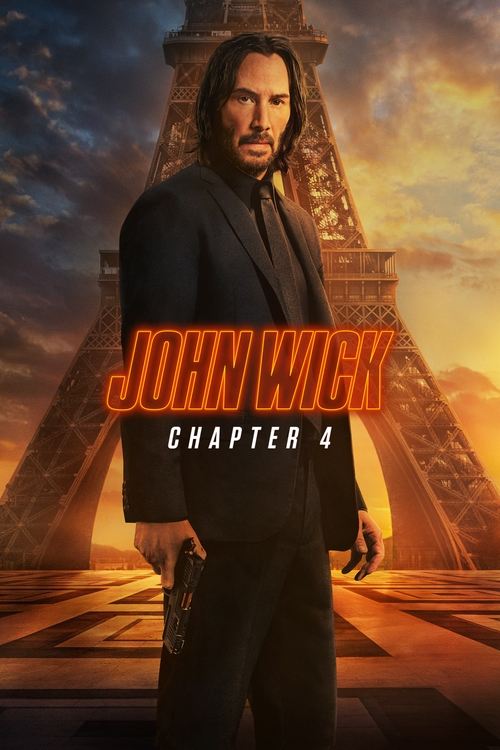
John Wick begins the film secluded beneath New York City in the Bowery King's subterranean stronghold. He hones his wrists and hands by repeatedly punching a wooden board until his knuckles bleed. The Bowery King enters and asks whether John is ready to strike back at the High Table; John answers affirmatively. He departs for Morocco to pursue the Elder, the figure who sits above the High Table. In Marrakech John pursues henchmen across desert terrain on horseback, kills them in a running fight, and traces the Elder to a monastery. Confronting the Elder over the ring that symbolizes his authority, John confronts him and then kills him with a blade during their encounter; after the killing the Elder warns John that ending his life will not free him from consequence.
Back in New York the High Table dispatches Marquis Vincent Bisset de Gramont to exert control and punish those who failed to stop John. The Marquis summons Winston and Charon, and publicly censures Winston for allowing John to survive; he formally strips Winston of his office, declares him excommunicado, and orders the New York Continental deconsecrated. After giving the hotel's staff and guests an hour to evacuate, the Marquis detonates charges and has the building destroyed. To further humiliate Winston the Marquis shoots Charon in the chest, fatally wounding him; Charon dies at Winston's side as Winston kneels and laments that the bullet should have been meant for him.
The Marquis recruits enforcers to hunt John and specifically coerces Caine, a blind, retired High Table assassin and an old acquaintance of John's, into the task by threatening Caine's young daughter, Mia. The Marquis also empowers his lieutenant Chidi to lead hit teams. John flees to Osaka and seeks refuge at the Continental there, run by his friend Shimazu Koji. Koji meets John on the hotel roof and agrees to hide him despite the risk; his daughter Akira, the hotel's concierge, protests and warns her father against sheltering John, but Koji chooses loyalty and secrecy.
Chidi arrives outside the Osaka Continental with armored mercenaries and declares the hotel deconsecrated, prompting Koji to prepare his staff and guards. In the night Koji's men open fire on Chidi's strike team using volleyed arrows and close-quarter weapons; John moves through the melee and begins killing incoming attackers himself, using pistols and improvised weapons. Caine approaches the hotel and sets acoustic traps--devices and tripwires that let him detect movement--then silently dispatches several intruders with blades and a pistol. Akira assists in evacuating guests and takes up arms, shooting and executing part of Chidi's squad, but she is hit and seriously wounded during the crossfire. John drags her to safety and covers Koji as the two men fight through waves of attackers.
Inside the rooftop battle John takes out multiple armoured assailants with precision; at one point he fights hand-to-hand with gunmen and improvises with a pair of nunchaku to neutralize enemies. Caine confronts John on the roof and the two men recognize a shared past; they exchange blows in a tense duel punctuated by gunshots and sword strikes. Caine, blind, uses his trained hearing and a sword to lethal effect. As Koji moves to protect John from Caine, Koji engages the blind assassin in a sword duel. The two men trade attacks until Caine delivers a killing blow: he pierces Koji's torso with his sword, fatally wounding him. Koji collapses; Akira cradles her father's body as he dies in her arms. Before she can take revenge on Caine, he tells her not to, instructing her to survive; he spares her life and departs. Akira, grieving and furious, vows to hunt Caine and demands that John avenge Koji.
During the Osaka assault a bounty hunter who calls himself Mr. Nobody, traveling with a German shepherd, shadows the fight. He kills a number of the High Table hitmen and interrupts Caine and John's duel briefly. Mr. Nobody tells John he is tracking the contract but refuses to finish the kill because the posted sum--first twenty million, later raised--is insufficient for his standard; he allows John to flee the city.
Winston, the Bowery King, and allies regroup after the destruction of the Continental and Charon's death. Winston visits Charon's grave, and he and John meet there to confer. Winston proposes an archaic, seldom-used recourse: John can challenge the Marquis to a formal High Table duel in order to break his obligations and regain his freedom. To present such a challenge John must act with the backing of an organized crime family. The Ruska Roma, the syndicate that once gave John sanctuary, severed their ties after his killing of the Elder precipitated reprisals against their leadership; John must journey to them and win their support.
John travels to Berlin and approaches the Ruska Roma stronghold. He is met on arrival with violence: their priest fires a shotgun as a warning and John is bound and suspended by a noose as the family judges him. Katia, John's adoptive sister within the Ruska Roma, refuses to approve his request and demands a deadly service in exchange for reinstatement--John must locate and kill Killa Harkan, a German High Table operative who arranged the murder of Katia's father and whom she blames for their family's losses.
John tracks Killa to a nightclub where Killa sits surrounded by bodyguards and revelers. Caine and Mr. Nobody are already present, each pursuing John for their own reasons. The three men take seats at Killa's table and play a tense card game; Killa cheats, which triggers a violent confrontation. In the ensuing brawl John weaves through clubgoers, slashing Killa's throat with a razor-like move performed with a card in hand, and pursues him through the club's upper levels. Killa uses his size to fight back and dumps John over a balcony, but John regains his footing, chases Killa down a stairwell and forces him to fall headfirst into concrete; Killa's impact smashes his skull upon the stairwell landing, killing him. John takes one of Killa's gold teeth as proof of his death and brings it to Katia. She accepts the evidence and supervises the ritual readmission; the Ruska Roma brand John with their crest and restore his membership, enabling him to officially issue a challenge to the Marquis.
Winston delivers John's formal challenge to the Marquis at a High Table convocation presided over by the Harbinger. The Marquis, though reluctant, is bound by High Table custom to accept. He designates Caine as his champion and claims that if John wins, Winston's excommunicado status and the destruction of the New York Continental will be reversed; Winston insists that he will serve as John's second in the duel. The duel's location and terms are negotiated: at sunrise they will meet at the steps of Sacré-Cœur in Paris and fire pistols at one another in successive rounds; failure to appear by the specified time will constitute forfeiture and justify execution. The Harbinger explicitly states that any delay by John or Winston will result in their deaths under High Table law.
The Marquis seeks to prevent John from reaching the duel. He orders Chidi and waves of contract gunmen to intercept John and posts an escalating bounty to lure other assassins to intercept John in transit. Mr. Nobody, meanwhile, returns to the Marquis and negotiates for a larger fee; the Marquis tests his resolve by impaling a blade into his own palm and forces Mr. Nobody to decide whether to pull it free with the knife still embedded or to tear his hand away. Mr. Nobody chooses to remove his hand from the blade, slicing between his fingers, and the Marquis agrees to raise the bounty.
John departs for Paris with the Bowery King's assistance. The Bowery King gives John a tailored ballistic vest and a pistol. En route to Sacré-Cœur the highway and streets around the Arc de Triomphe become a battlefield. Dozens of contractors and freelance assassins converge on John as the High Table's radio broadcast and word of the bounty attract lethal opportunists. John drives and fights through traffic, using vehicles as cover and ammunition; he shoots attackers on motorcycles and lets some assailants be struck by passing cars. In a warehouse outside the city John lures and detonates explosive rounds among a group of attackers, creating a blast that kills many of them. Mr. Nobody stalks John during these engagements with his shepherd at his side; Chidi throws Mr. Nobody's dog into oncoming traffic as a provocation, but John helps rescue the animal. That intervention turns Mr. Nobody from pursuer to ally, and he shifts to assisting John against Chidi's forces.
As John ascends the long flight of steps up Rue Foyatier toward Sacré-Cœur, the High Table floods the approach with trained killers. John fights through squads of gunners with pistols, rifles, and close-quarters weapons, systematically eliminating attackers on the steps and in surrounding alleys. Chidi confronts John near the summit and knocks him down the stairwell, injuring him grievously. Caine intervenes against Chidi's men and joins John after recognizing a common enmity; the sight of Caine fighting alongside John unsettles onlookers. Mr. Nobody retaliates for his dog by killing several assailants and ultimately fires a single, fatal bullet into Chidi's head when Chidi attempts to finish John--the shot collapses Chidi and ends his command. During Chidi's defeat the dog bites Chidi in the groin and urinates on his face before Chidi dies, and Mr. Nobody places the final shot in Chidi's skull.
John reaches the summit with minutes to spare as dawn approaches. He and Caine mount the marble steps to the Sacré-Cœur plaza, take positions opposite one another, and draw pistols under the Harbinger's watchful eye. The duel proceeds in three rounds. In the first and second rounds both men exchange fire and wound each other: each shooter manages to land shots that injure his opponent but neither delivers a fatal blow. In the third round Caine fires and hits John in the abdomen, inflicting a deep, life-threatening wound. The Marquis demands the right to administer the coup de grâce and moves forward, replacing Caine at the duel's center so that he can finish John himself. Winston, acting as John's second, admonishes the Marquis for his arrogance and points out that John has not fired his final round; the Marquis, having assumed John had no rounds left, turns to claim the killing shot and exposes himself. John, still able to lift his pistol, raises his arm and fires a single, precise headshot that kills the Marquis by destroying his skull. The Harbinger then declares that, by the duel's outcome and under High Table protocol, both John and Caine are released from their obligations--and Caine's daughter is freed from any leverage the Table held over him. The Harbinger also announces Winston's reinstatement: the New York Continental will be un-condemned and rebuilt, and Winston's manager's status is returned.
John descends the Sacré-Cœur steps bleeding and exhausted. He pauses near the closing light, calls out his late wife Helen's name as if to summon her memory, and then collapses from the cumulative injuries he sustained, slipping into death. He dies on the plaza steps, a free man who has expired from the wound inflicted by Caine and the prolonged battles that preceded the duel.
Winston and the Bowery King return to New York and inter John beside the grave already marking Helen's resting place. They dig and lower his coffin; the Bowery King assumes temporary care of John's surviving dog. Winston and the Bowery King stand at the burial site as they lay John to rest and then walk away together; the Continental is restored to Winston's stewardship in accordance with the High Table's decree.
In a short epilogue Caine returns to Paris to reunite with his daughter Mia. As he approaches her location he notices Akira nearby, knife in hand and intent on avenging her father Koji; she steps toward Caine, setting up a confrontation after the credits. The film ends with John Wick's burial and the High Table's punctuated reordering of alliances and freedoms following the duel.






What is the ending?
In the ending of John Wick: Chapter 4, John Wick faces off against the High Table and its enforcers in a final showdown. After a series of intense battles, John ultimately defeats his enemies but succumbs to his injuries. He finds peace in the end, reuniting with his late wife, Helen, in a serene afterlife.
As the climax unfolds, the scene opens with John Wick, battered but resolute, standing at the steps of the Sacré-Cœur in Paris. The sun is setting, casting a golden hue over the city, symbolizing both the end of his journey and the weight of his choices. He prepares for the final confrontation against the High Table, knowing that this battle could be his last.
The first major scene features John engaging in a fierce gunfight with the High Table's enforcers. The choreography is meticulous, showcasing John's skill and determination as he navigates through a barrage of bullets. Each shot fired is a testament to his resolve, but also a reminder of the toll this life has taken on him. The camera captures the intensity of his emotions--fear, anger, and a flicker of hope as he fights for his freedom.
As the battle escalates, John is joined by his ally, Caine, played by Donnie Yen. Caine, a blind assassin with a deep sense of honor, has his own motivations for helping John. Their partnership is fraught with tension, as both men are aware that their fates are intertwined with the High Table's ruthless agenda. Together, they face waves of adversaries, showcasing their combat prowess and the bond forged through shared struggles.
In a pivotal moment, John and Caine confront the Marquis de Gramont, the main antagonist, who represents the High Table's unyielding power. The confrontation is charged with emotion, as John seeks not only vengeance but also a chance to reclaim his life. The Marquis, confident in his superiority, underestimates John's resolve, leading to a brutal showdown. The fight is visceral, with each blow exchanged reflecting the stakes at hand--freedom versus servitude.
As the dust settles, John emerges victorious, but not without significant cost. He is gravely injured, and the weight of his choices begins to take its toll. In a poignant scene, he collapses on the steps of the Sacré-Cœur, the city of Paris sprawling behind him. The camera lingers on his face, capturing the pain and relief that wash over him as he realizes he has finally broken free from the chains of the past.
In the final moments, John is seen in a serene setting, reuniting with his late wife, Helen. This ethereal scene contrasts sharply with the violence that preceded it, symbolizing John's ultimate desire for peace and redemption. The emotional weight of their reunion is palpable, as John finds solace in the afterlife, free from the burdens that haunted him.
As the credits roll, the fates of the main characters are revealed. John Wick, having fought valiantly for his freedom, succumbs to his injuries but finds peace in death. Caine, having aided John, is left to navigate the consequences of his actions, potentially facing the wrath of the High Table. The Marquis de Gramont, defeated, represents the fall of the oppressive system that sought to control John. Each character's journey culminates in a powerful statement about the cost of vengeance, the quest for freedom, and the search for redemption.
Is there a post-credit scene?
In "John Wick: Chapter 4," there is indeed a post-credit scene that adds a poignant layer to the film's conclusion.
As the credits roll, the scene opens in a serene, sunlit cemetery. The camera pans slowly over the gravestones, finally settling on a particular grave marked with a simple headstone. The name inscribed is that of John Wick, a testament to his journey and the sacrifices he made throughout the series.
In this quiet moment, we see a figure approach the grave. It is Winston, the manager of the Continental Hotel, who stands solemnly, reflecting on the loss of his friend. His expression is a mix of sorrow and respect, embodying the weight of their shared history and the bond they forged through countless battles.
As Winston places a single white flower on the grave, he whispers a few words, perhaps a farewell or a promise to remember. The scene captures the emotional gravity of John's legacy, emphasizing themes of loyalty, sacrifice, and the cost of the life he led.
The camera lingers on the grave for a moment longer before fading to black, leaving the audience with a sense of closure while also hinting at the enduring impact of John Wick's story. This post-credit scene serves as a reflective pause, allowing viewers to contemplate the journey of the titular character and the world he inhabited.
What motivates John Wick to seek revenge in Chapter 4?
In John Wick: Chapter 4, John Wick is driven by a deep sense of betrayal and loss. After the events of the previous films, he seeks to free himself from the shackles of the High Table and the consequences of his past actions. The death of his beloved dog and the loss of his wife, Helen, continue to haunt him, fueling his desire for vengeance against those who wronged him. His emotional state is one of grief and determination, as he battles not only external foes but also his own inner demons.
How does the character of Marquis de Gramont impact the story?
Marquis de Gramont, portrayed as a cunning and ruthless member of the High Table, serves as the primary antagonist in Chapter 4. His motivations are rooted in a desire to maintain control and power within the assassin underworld. He sees John Wick as a threat to the established order and is determined to eliminate him. The Marquis's strategic mind and willingness to manipulate others create a tense atmosphere, as he orchestrates a series of challenges for Wick, showcasing his cold, calculating nature.
What role do the new allies play in John Wick's journey?
In Chapter 4, John Wick encounters several new allies, including Caine, a blind assassin played by Donnie Yen, and Akira, the daughter of an old friend. Caine's character adds depth to the narrative, as he is torn between his loyalty to the High Table and his friendship with Wick. Their relationship is complex, filled with mutual respect and an understanding of the burdens they both carry. Akira seeks revenge for her father's death, which intertwines her fate with Wick's, highlighting themes of loyalty and sacrifice.
What is the significance of the duel in the film?
The duel in John Wick: Chapter 4 serves as a climactic moment that encapsulates the film's themes of honor, revenge, and the consequences of one's choices. Set in a dramatic location, the duel is not just a physical confrontation but also a symbolic representation of Wick's struggle against the High Table's oppressive rules. The stakes are incredibly high, as Wick must confront not only his enemies but also the weight of his past decisions. The emotional intensity of the duel reflects Wick's desperation for freedom and closure.
How does the film explore the concept of legacy through John Wick's character?
Throughout Chapter 4, John Wick grapples with the concept of legacy, particularly in relation to his past actions and the impact they have on those around him. As he navigates the treacherous world of assassins, he reflects on the legacy he wishes to leave behind, not just as a feared assassin but as a man seeking redemption. His interactions with characters like Caine and Akira highlight the generational consequences of violence and the desire to break free from a cycle of revenge, making his journey deeply personal and emotionally resonant.
Is this family friendly?
"John Wick: Chapter 4" is not considered family-friendly due to its intense and graphic content. Here are some potentially objectionable or upsetting aspects:
-
Graphic Violence: The film features numerous scenes of intense hand-to-hand combat, gunfights, and elaborate action sequences that result in significant bloodshed and injury.
-
Death and Injury: Characters experience severe injuries and fatalities throughout the film, often depicted in a visceral manner that may be distressing.
-
Strong Language: The dialogue includes frequent use of strong profanity, which may not be suitable for younger audiences.
-
Dark Themes: The narrative explores themes of revenge, betrayal, and loss, which can be emotionally heavy and may not be appropriate for children.
-
Mature Situations: There are moments that involve morally ambiguous choices and the consequences of a violent lifestyle, which may be difficult for sensitive viewers to process.
Overall, the film's tone and content are geared towards an adult audience, making it unsuitable for children or those who are sensitive to violence and mature themes.








