





































Popular
What is Riggan Thomson's main struggle throughout the film?
How does Riggan's relationship with his daughter Sam evolve in the film?
What role does Mike Shiner play in Riggan's production, and how does he affect Riggan?
What significance does the character of Birdman have in Riggan's life?
How does the film depict Riggan's mental state through visual and auditory elements?
Should I watch it?
Ask Your Own Question

What is the plot?
Sorry, we aren't able to watch and write up a full detailed plot yet. Check back in a few days.



What is the ending?
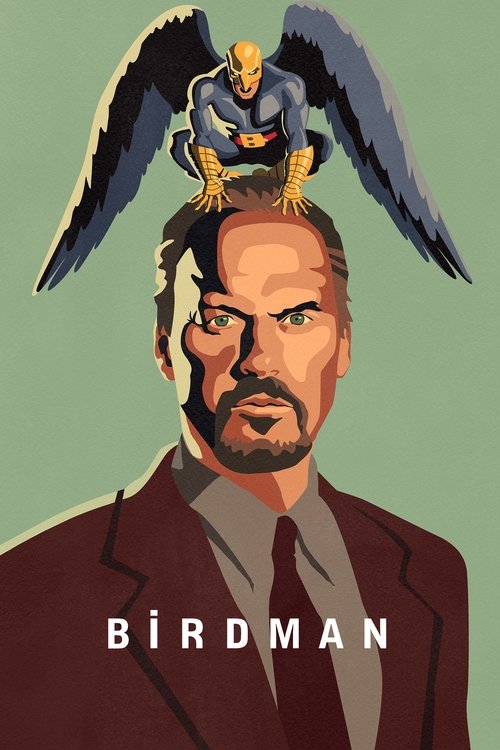
In the ending of "Birdman," Riggan Thomson, after a tumultuous journey of self-discovery and conflict, takes a drastic step during the final performance of his play. He shoots himself on stage, but the act is staged as part of the performance. The audience is captivated, believing it to be a part of the show. In the aftermath, Riggan is taken to the hospital, where he experiences a moment of transcendence. In the final scene, he awakens in the hospital, looks out the window, and seemingly takes flight. The film concludes ambiguously, leaving viewers to ponder the nature of Riggan's reality.
Expanding on the ending in a chronological and narrative fashion:
As the final act of Riggan's play unfolds, the tension in the theater is palpable. Riggan, portrayed by Michael Keaton, is on stage, grappling with his identity and the weight of his past as a former superhero actor. The audience watches as he prepares to deliver a climactic moment, one that has been building throughout the film. The atmosphere is thick with anticipation, and the lines between reality and performance blur.
In a moment of desperation and artistic expression, Riggan pulls out a real gun, which he had previously acquired for the play. The audience, unaware of the true nature of the weapon, is drawn into the intensity of the scene. Riggan aims the gun at his own head, and in a shocking twist, he pulls the trigger. The sound of the gunshot reverberates through the theater, and the audience gasps, believing it to be part of the performance. The stage is drenched in a mix of theatrical blood and the raw emotion of Riggan's struggle.
As the chaos unfolds, we see the reactions of the other characters. Mike Shiner, played by Edward Norton, is initially stunned but quickly realizes the gravity of the situation. Sam, Riggan's daughter, portrayed by Emma Stone, watches in horror, her face a mixture of fear and concern for her father. The audience is captivated, not fully understanding the reality of what has just transpired.
After the performance, Riggan is taken to the hospital, where he lies in a bed, surrounded by the sterile environment of medical equipment. In this moment of vulnerability, he experiences a profound sense of clarity. The film visually contrasts the starkness of the hospital with the vibrant, chaotic world of the theater. Riggan's internal struggle comes to a head as he reflects on his life choices, his relationships, and the pursuit of artistic validation.
In the final moments, Riggan awakens in the hospital room, and the camera captures his gaze as he looks out the window. The scene is imbued with a sense of hope and ambiguity. He sees the sky, and in a moment that feels almost surreal, he appears to take flight, symbolizing a release from his burdens and a transcendence beyond his struggles. The film leaves viewers questioning whether this flight is a metaphorical escape from his past or a literal act of liberation.
As the credits roll, the fates of the main characters are left somewhat unresolved. Riggan's journey culminates in a moment of self-acceptance, but the implications of his actions linger. Sam, having witnessed her father's turmoil, is left to navigate her own path, while Mike's ambition and ego remain intact, suggesting a continuation of the cycle of artistic struggle. The film closes on a note of uncertainty, inviting reflection on the nature of identity, success, and the human experience.
Is there a post-credit scene?
In "Birdman or (The Unexpected Virtue of Ignorance)," there is no post-credit scene. The film concludes with a powerful and ambiguous ending that leaves viewers contemplating the fate of Riggan Thomson, the protagonist played by Michael Keaton. After a climactic performance in which Riggan finally embraces his identity and purpose, the film ends with him stepping out of the window of the theater, seemingly taking flight. The final moments suggest a transformation, but the lack of a definitive resolution invites interpretation and reflection, making the absence of a post-credit scene fitting for the film's themes of identity, relevance, and the nature of art.
What is Riggan Thomson's main struggle throughout the film?
Riggan Thomson, a washed-up actor known for playing the superhero Birdman, struggles with his identity and relevance in the world of theater and film. He grapples with his desire for artistic validation and the fear of being overshadowed by his past success. This internal conflict is exacerbated by his mental breakdowns and the haunting presence of his Birdman persona, which represents both his former glory and his insecurities.
How does Riggan's relationship with his daughter Sam evolve in the film?
Riggan's relationship with his daughter Sam is strained and complex. Initially, Sam, who is recovering from substance abuse, feels resentment towards her father for his neglect and obsession with his career. As the film progresses, their interactions reveal a mix of love, disappointment, and a longing for connection. Riggan's attempts to reconnect with her are often met with skepticism, but there are moments of vulnerability that hint at a deeper bond, especially as Sam becomes more involved in the production.
What role does Mike Shiner play in Riggan's production, and how does he affect Riggan?
Mike Shiner is a talented but egotistical actor who is brought in to play a key role in Riggan's Broadway adaptation. His presence challenges Riggan both professionally and personally. Mike's confidence and disregard for conventional acting methods provoke Riggan's insecurities, leading to a rivalry that forces Riggan to confront his own artistic choices. Mike's unpredictable behavior and charisma also draw attention away from Riggan, intensifying his feelings of inadequacy and desperation.
What significance does the character of Birdman have in Riggan's life?
The character of Birdman serves as a manifestation of Riggan's inner turmoil and past fame. Throughout the film, Birdman represents both Riggan's former success as a blockbuster superhero and his ongoing struggle with self-worth and relevance. The voice of Birdman often taunts Riggan, urging him to embrace his past and return to the world of commercial cinema, which Riggan resists in favor of pursuing a more meaningful artistic endeavor. This internal conflict is central to Riggan's character arc.
How does the film depict Riggan's mental state through visual and auditory elements?
The film uses a unique visual style and sound design to depict Riggan's deteriorating mental state. The continuous, flowing camera work creates a sense of real-time urgency and disorientation, mirroring Riggan's chaotic thoughts. Additionally, the omnipresent sound of Birdman's voice and the drumming score heighten the tension and reflect his inner struggles. As Riggan's mental state worsens, the lines between reality and hallucination blur, culminating in surreal moments that illustrate his psychological breakdown.
Is this family friendly?
"Birdman or (The Unexpected Virtue of Ignorance)" is not considered family-friendly due to several potentially objectionable elements. Here are some aspects that might be upsetting for children or sensitive viewers:
-
Strong Language: The film contains frequent use of profanity, including strong language that may not be suitable for younger audiences.
-
Nudity and Sexual Content: There are scenes that include nudity and sexual situations, which may be inappropriate for children.
-
Substance Abuse: Characters are depicted using drugs and alcohol, which could be concerning for sensitive viewers.
-
Mental Health Themes: The film explores themes of mental illness, including depression and existential crises, which may be distressing for some viewers.
-
Violence: There are moments of physical altercations and intense confrontations that could be unsettling.
-
Dark Humor: The film employs dark humor that may not resonate well with younger audiences or those who prefer lighter themes.
These elements contribute to the film's mature rating and suggest that it may not be suitable for children or sensitive individuals.








