






















Popular
Should I watch it?
Ask Your Own Question

What is the plot?
E.T. the Extra-Terrestrial: Complete Plot Narrative
On a starry summer night in the San Fernando Valley of California in 1982, a small spacecraft descends silently through the fog-laden forest. Several small, plant-like alien botanists emerge from the vessel, their mission purely scientific--to collect botanical samples from Earth's diverse ecosystem. They move quietly through the undergrowth, their large eyes reflecting the moonlight as they work methodically among the vegetation. But their peaceful expedition is about to be violently interrupted.
The sudden arrival of government agents, alerted to the landing, transforms the forest into a scene of chaos and panic. Flashlights cut through the darkness, and the sound of dogs barking echoes through the trees. The agents move with military precision, determined to capture or contain whatever has landed on Earth. The aliens, caught completely off guard, scramble back toward their spacecraft in a desperate attempt to escape. In the confusion and haste, one small alien becomes separated from his group--left behind in the suburban sprawl as his companions flee back to their ship. The spacecraft lifts off into the night sky, leaving the lone alien stranded on an unfamiliar world, confused and frightened.
This abandoned alien, who will come to be known as E.T., finds himself alone in the darkness of a suburban neighborhood. He is small, no more than three feet tall, with a bulbous body, long fingers, and enormous luminous eyes that reflect both intelligence and vulnerability. His skin is wrinkled and leathery, his movements awkward yet purposeful as he begins to explore this strange new environment, searching desperately for shelter and safety.
Meanwhile, in a typical suburban home not far from where E.T. wanders, ten-year-old Elliott Taylor sits in his room, a boy caught between childhood and adolescence. Elliott is quiet and introspective, bearing the weight of his parents' recent separation. His father is absent, and Elliott has become somewhat withdrawn, spending his time alone with his thoughts and his toys. His older brother Michael is more outgoing and skeptical of the world, while his younger sister Gertie is playful and innocent, still untouched by the complications that plague her older siblings. Their mother, Mary Taylor, struggles to hold the family together, managing the household alone while working to provide for her three children.
On the evening when E.T. arrives in the neighborhood, Elliott is in the backyard, playing alone as the sun begins to set. He hears strange noises coming from the direction of the old gardening shed--sounds that don't quite match anything he recognizes. Curious and somewhat brave, Elliott approaches the shed and throws a baseball inside, hoping to flush out whatever creature might be hiding there. To his shock and amazement, the baseball comes flying back out, thrown by something--or someone--inside the shed. Elliott rushes back into the house to tell his family, but when they all come out to investigate, they find nothing except for some strange prints in the dirt, which Michael dismisses as belonging to a coyote from the nearby woods.
That evening, Elliott returns to the backyard alone, drawn by an inexplicable compulsion. He hears the noise again and this time ventures closer to the shed. In the darkness, he comes face to face with E.T. for the first time. The moment is electric with tension--Elliott sees the strange creature, small and alien, with those enormous glowing eyes staring back at him. For a moment, neither moves. Then, slowly, Elliott's fear transforms into curiosity, and E.T.'s fear transforms into a tentative hope. Elliott doesn't run away screaming. Instead, he speaks softly to the creature, and E.T., sensing the boy's gentle nature, emerges slightly from the shadows.
Elliott brings E.T. into his home, smuggling the alien into his bedroom and hiding him in the closet. That night, Elliott lies awake, unable to sleep, acutely aware of the presence in his closet. When he finally opens the door, E.T. is there, waiting. The two regard each other in the darkness, and something profound passes between them--a connection that transcends language and species. Elliott feels it deeply, a sense of understanding and acceptance that he has never experienced before.
The next morning, Elliott introduces E.T. to his siblings. Michael is skeptical at first, but when E.T. demonstrates his extraordinary abilities--causing several spheres to levitate and rotate like planets in the solar system--Michael's doubt transforms into wonder. Gertie, the youngest, is immediately enchanted by the creature. The three children make a pact: they will keep E.T.'s existence a secret from their mother and the outside world. E.T. becomes their secret, their shared mystery, their bond.
Over the following days, the children learn more about their new friend. E.T. is gentle and curious, eager to understand this strange world he has found himself in. Gertie, with her natural gift for communication, begins to teach E.T. to speak. The alien's first words are halting and strange, but gradually he learns to form simple sentences. He tells the children that he wants to "phone home"--that he needs to contact his people and return to his home planet. He hasn't been feeling well, he explains, and prolonged exposure to Earth's atmosphere is making him increasingly ill. The children understand the urgency of his situation.
Elliott and E.T. develop an extraordinary telepathic bond. When Elliott is at school, he can feel what E.T. feels. When E.T. is sad or frightened, Elliott experiences those emotions as if they were his own. During a school assembly about extinction, Elliott becomes emotionally overwhelmed, tears streaming down his face as he thinks about E.T.'s plight. His teacher is concerned, and Elliott is sent to the principal's office. The connection between boy and alien is so profound that they are almost becoming one consciousness, experiencing life through each other's perspectives.
E.T. demonstrates remarkable abilities that astound the children. He can heal wounds with a touch--when Elliott accidentally cuts his finger, E.T. places his glowing finger on the wound, and it closes instantly, leaving no scar. He can levitate objects through pure mental power. He can communicate telepathically across distances. He is clearly a being of extraordinary intelligence and capability, yet he is also vulnerable and dependent on the children's protection.
The children work together to help E.T. build a communication device. Using household items--a coat hanger, some electronic components, a record player, and various other objects scavenged from around the house and neighborhood--they construct a makeshift transmitter. E.T. directs them in the construction, his intelligence guiding their hands. The device is crude by any technological standard, yet it represents hope--hope that E.T. can contact his people and arrange for his rescue.
But as the days pass, E.T. grows sicker. His skin becomes paler, his movements more sluggish. The children become increasingly worried. They know that time is running out, that E.T. must return to his home planet soon or he will die. On Halloween, the children make their move. They dress E.T. in a ghost costume to disguise him, and Elliott and Michael sneak him out of the house under the cover of darkness and the chaos of Halloween night. They take E.T. to the forest, to the place where his spaceship originally landed.
In the forest, E.T. sets up his communication device, and he sends a signal out into the cosmos: "Phone home." The children wait anxiously, hoping that his people will receive the message and come to rescue him. But as the night wears on and E.T. grows weaker, doubt begins to creep in. Will they come in time? Will E.T. survive long enough to be rescued?
The next morning, Elliott wakes up alone and sick. He rushes to find E.T., but the alien is nowhere to be found. Panic seizes Elliott's heart. Michael searches frantically and discovers E.T. lying facedown in a creek bed, barely alive, his body cold and unresponsive. Michael carries E.T. back to the house, and for the first time, Mary Taylor discovers the truth about the alien living in her home. She is shocked and frightened, but when she sees how sick E.T. is and how much her children care for him, her maternal instinct overrides her fear. She helps the children bring E.T. inside.
But it is too late to keep the secret. The government agents, who have been searching for E.T. all along, have finally tracked him down. They arrive at the Taylor house with a team of doctors and scientists, armed with equipment and determination. They establish a sterile environment inside the house, setting up medical equipment and surveillance systems. E.T. is placed under observation, and the doctors begin running a battery of tests on him, trying to understand his physiology and capabilities.
As E.T. grows sicker, something extraordinary happens: Elliott grows better. The telepathic bond between them is so strong that as E.T.'s condition deteriorates, Elliott's health improves. It is as if E.T. is transferring his illness to Elliott, sacrificing his own life force to save the boy he has come to love. The doctors are baffled by this phenomenon, unable to explain the connection between the boy and the alien.
E.T.'s condition becomes critical. His heart stops beating. The machines monitoring him flatline. The doctors work frantically to revive him, but it seems hopeless. E.T. appears to be dead. Elliott is devastated, his grief profound and overwhelming. He sits beside E.T.'s lifeless form, tears streaming down his face, and he speaks to the alien one final time. "I love you," Elliott says, his voice breaking with emotion.
And then, something miraculous happens. E.T.'s eyes open. His heart begins to beat again. He is alive. The power of Elliott's love, the depth of their connection, has brought E.T. back from the brink of death. E.T. looks at Elliott and repeats the boy's words: "I love you." The alien's voice is weak but clear, and in those three words is the culmination of everything that has passed between them.
With E.T. revived, the children know they must act quickly. They cannot allow the government to keep E.T. imprisoned any longer. They must get him to the forest, to the place where his people will come to retrieve him. Elliott, Michael, and their friends devise a daring plan. They gather their bicycles--dozens of them--and they ride through the suburban streets toward the forest, with E.T. hidden in a basket on Elliott's handlebars.
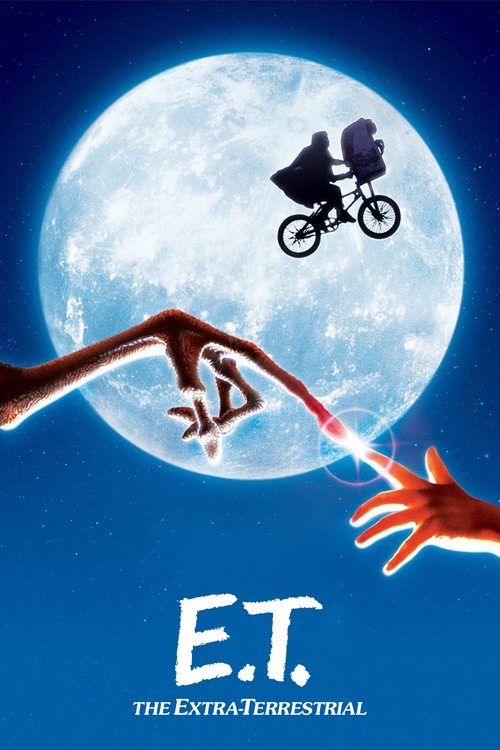
The government agents, realizing what is happening, pursue them in vehicles, sirens wailing and lights flashing. The chase is intense and thrilling, with the children on their bicycles racing through neighborhoods and across open fields, the agents in hot pursuit. In one of the most iconic moments in cinema history, Elliott's bicycle, with E.T. in the basket, lifts off the ground, rising into the air as E.T. uses his telekinetic powers to make them fly. The bicycle soars across the night sky, silhouetted against the full moon, a image of pure magic and wonder. Other bicycles follow, the children pedaling furiously as they too lift off the ground, defying gravity itself.
The chase culminates in the forest, where E.T. has arranged for his spaceship to return. The children arrive at the landing site, breathless and exhilarated. The government agents close in, but they are too late. The spaceship descends from the sky, its lights brilliant and otherworldly. E.T. moves toward the ship, but before he leaves, he turns back to Elliott one final time.
In this moment of farewell, E.T. places his glowing finger on Elliott's forehead, and he speaks words that will stay with Elliott forever: "I'll be right here." It is a promise that their bond will endure, that distance and time and the vast gulf between worlds cannot sever the connection they have formed. E.T. then turns and walks toward his spaceship, his small form silhouetted against the brilliant light of the vessel.
The spaceship rises into the sky, carrying E.T. back to his home planet, back to his people, back to where he belongs. The children watch as the ship disappears into the stars, taking with it the most extraordinary friend they will ever know. Elliott stands alone in the forest, looking up at the sky where E.T. has gone, his face wet with tears but also illuminated with a smile. He has been changed by this experience, transformed from a lonely, isolated boy into someone who has loved deeply and been loved in return.
The film ends with Elliott standing in the forest, his gaze fixed on the heavens, as the camera pulls back to show the vast expanse of the night sky. The stars twinkle above him, and somewhere among them, E.T. is returning home, carrying with him the memory of a boy named Elliott and the love they shared. The bond between them will endure forever, transcending the boundaries of species and worlds, a testament to the universal power of friendship, love, and connection.
No one dies in this story, though E.T. comes perilously close to death. No one is truly defeated, though the government agents fail in their mission to capture and study E.T. Instead, the story ends with a sense of hope and wonder, with the knowledge that Elliott has been forever changed by his encounter with an alien, and that somewhere in the cosmos, E.T. carries the memory of a boy who loved him unconditionally. The film suggests that this connection, this bond of love, is the most powerful force in the universe--more powerful than technology, more powerful than government authority, more powerful than the vast distances between worlds.









What is the ending?
In the ending of E.T. the Extra-Terrestrial, E.T. is captured by government agents and taken to a laboratory for examination. Elliott and his siblings, along with their friends, devise a plan to rescue him. They manage to free E.T. and help him escape on a bicycle, leading to a climactic chase scene. E.T. ultimately uses his powers to heal Elliott and the other children, and he prepares to return to his home planet. In a poignant farewell, E.T. says goodbye to Elliott, who is heartbroken but understands that E.T. must leave. E.T. departs in a spaceship, leaving behind a lasting impact on Elliott and his family.
As the story unfolds towards its conclusion, the tension escalates. E.T. is taken by government agents, who are determined to study him. The scene is tense and filled with urgency as Elliott, sensing E.T.'s distress, rallies his siblings and friends. They gather in the dark of night, their faces illuminated by the glow of their flashlights, filled with a mix of fear and determination. The children, united by their bond with E.T., devise a plan to rescue him from the sterile, cold environment of the laboratory.
In a pivotal moment, they sneak into the facility, their hearts racing as they navigate through the maze of white walls and harsh fluorescent lights. The atmosphere is thick with suspense as they finally locate E.T., who is lying on a table, surrounded by scientists and medical equipment. The sight of E.T. in distress ignites a fierce protective instinct in Elliott. With a burst of courage, they manage to free him, and the group escapes into the night, the sound of alarms blaring behind them.
The chase that follows is exhilarating. The children ride their bicycles through the streets, the wind whipping past them, their laughter mingling with the thrill of the moment. E.T. uses his telekinetic abilities to help them evade capture, lifting them into the air and allowing them to soar above the trees. The visual of the children flying against the backdrop of the moon is iconic, symbolizing freedom and the power of friendship.
As they reach a secluded area, E.T. begins to weaken, and the emotional weight of the moment settles in. Elliott, filled with a mix of sadness and understanding, realizes that E.T. must return home. In a heart-wrenching farewell, E.T. communicates his love for Elliott, and the bond they share is palpable. Elliott's face is a canvas of emotions--joy, sorrow, and acceptance--as he watches E.T. prepare to leave.
The spaceship arrives, glowing softly in the night. E.T. turns to Elliott one last time, and they share a moment of connection that transcends words. The spaceship ascends, and E.T. waves goodbye, leaving Elliott and his friends standing in awe, their hearts heavy yet filled with the warmth of their shared experiences.
In the aftermath, Elliott is left changed by the encounter. He returns home, where his family is waiting, and he carries with him the lessons of love, friendship, and the importance of understanding those who are different. The film closes with a sense of hope, as the stars twinkle above, a reminder of the vast universe and the connections that can be formed, no matter how far apart they may seem. Each character, from Elliott to his siblings and friends, is left with a profound sense of growth and the realization that love knows no boundaries.
Is there a post-credit scene?
"E.T. the Extra-Terrestrial," produced in 1982, does not have a post-credit scene. The film concludes with a poignant and emotional farewell between E.T. and Elliott, as well as the other children. After E.T. is rescued and prepares to return to his home planet, he shares a heartfelt goodbye with Elliott, who is visibly upset yet understanding of E.T.'s need to leave. The film ends with E.T. saying, "I'll be right here," while touching his finger to Elliott's, signifying their deep bond. The screen fades to black, and the credits roll without any additional scenes following them.
What is the significance of the glowing finger in E.T.?
The glowing finger of E.T. serves as a symbol of his extraterrestrial abilities and connection to life. It is often used to heal others, showcasing his compassionate nature. This ability is first demonstrated when E.T. heals a wounded Elliott's finger, establishing a bond between them.
How does Elliott first encounter E.T.?
Elliott first encounters E.T. in the woods near his home after a group of scientists and government agents have chased the alien spacecraft. Initially frightened, Elliott is drawn to E.T.'s gentle demeanor and curiosity, leading to a pivotal moment where he decides to help him.
What role does the bicycle play in the story?
The bicycle is a crucial element in the story, symbolizing freedom and adventure. Elliott and his friends use their bikes to escape from government agents and to help E.T. reach the spaceship. The iconic scene where they fly over the moon highlights the bond between Elliott and E.T., showcasing the magic of their friendship.
How does E.T. communicate with Elliott and his friends?
E.T. communicates with Elliott and his friends through a combination of telepathy and simple verbal phrases. He establishes a deep emotional connection with Elliott, allowing them to share thoughts and feelings. This unique form of communication emphasizes the theme of understanding beyond words.
What is the significance of the phrase 'E.T. phone home'?
The phrase 'E.T. phone home' is significant as it encapsulates E.T.'s longing to return to his home planet. It represents his desire for connection and belonging, as well as the emotional journey of Elliott, who learns about love, friendship, and letting go.
Is this family friendly?
"E.T. the Extra-Terrestrial" is generally considered a family-friendly film, but it does contain some scenes that may be potentially objectionable or upsetting for children or sensitive viewers. Here are a few aspects to consider:
-
Separation and Loneliness: The film explores themes of separation, particularly when E.T. is stranded on Earth and longs to return home. This can evoke feelings of sadness and empathy.
-
Government Pursuit: There are scenes where government agents pursue E.T. and the children, creating a sense of tension and fear. The agents are depicted as threatening, which may be unsettling for younger viewers.
-
E.T.'s Illness: E.T. becomes sick and weak, leading to emotional scenes where he is in distress. This can be distressing for children who may feel anxious about his well-being.
-
Emotional Moments: The film contains several poignant moments that deal with loss, friendship, and the fear of losing loved ones, which may resonate deeply and provoke strong emotions.
-
Mild Language: There are instances of mild language and some moments of teenage rebellion that may not be suitable for very young children.
Overall, while the film is heartwarming and carries a positive message about friendship and acceptance, these elements may require parental guidance for younger audiences.








