



















Popular
How does Piece by Piece show Pharrell Williams first discovering music and deciding to pursue it seriously?
What is the role of Chad Hugo in Pharrell’s early career in Piece by Piece?
How does Piece by Piece depict Pharrell’s relationship with his grandmother and pastor?
What does Piece by Piece show about Pharrell’s reaction to making hit songs for other artists like Snoop Dogg and Gwen Stefani?
How does Piece by Piece portray Pharrell’s emotional response to loss and crisis later in the story?
Should I watch it?
Ask Your Own Question

What is the plot?
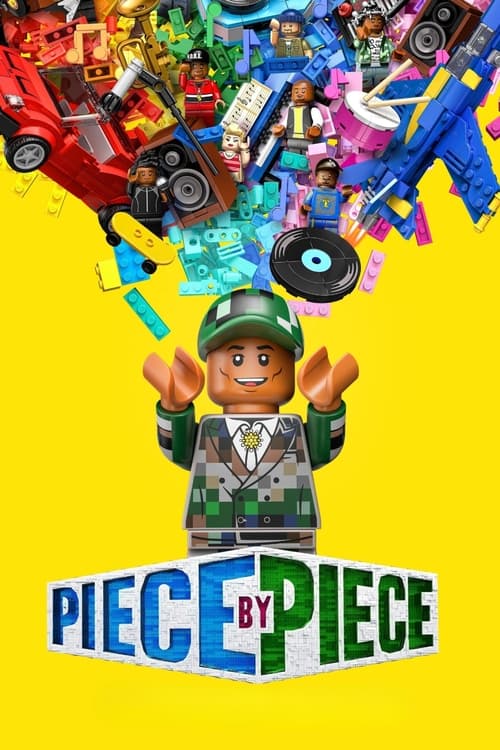
Piece by Piece opens not with a conventional scene of action, but with a quiet act of self-invention: Pharrell Williams sits for an interview with filmmaker Morgan Neville and explains that he wants his life told in LEGO because he sees the universe as something that can be built from pieces that already exist. That single idea becomes the emotional and visual engine of the entire film. Neville listens in disbelief as Pharrell smiles through the thought, and the documentary immediately transforms that interview frame into a bright, animated world where memory, music, and personality are literally constructed brick by brick. From there, Pharrell's story unfolds in a loose but chronological flow, moving from his childhood in Virginia Beach, Virginia to his emergence as one of the most influential producers in popular music.
The film begins by grounding Pharrell in the place that shapes him first: a humid, color-saturated Virginia upbringing where music feels less like a career choice than a private language he is already beginning to speak. He is introduced as a child with an unusually alert ear, someone who absorbs rhythm, melody, and sonic texture from the world around him. The LEGO animation gives these early scenes a childlike clarity, as if his imagination is already assembling the future before he does. Pharrell reflects on his own childhood ambitions, and the film emphasizes that he is not portrayed as a child prodigy in the stereotypical sense, but as a curious, observant kid whose sense of possibility is much larger than the neighborhood around him.
As he grows, the film introduces the people who will become central to his identity. One of the most important is Chad Hugo, Pharrell's best friend and musical counterpart, whose calm precision balances Pharrell's more instinctive, visionary energy. Their friendship is presented not as a sudden discovery but as the slow formation of a creative language shared between two teenagers who understand each other before the industry does. Around them, the documentary places the broader Virginia creative orbit that shaped Pharrell's generation, including Timbaland, Missy Elliott, and Pusha T. The film treats these names not as cameos but as living reminders that a surprisingly dense cluster of musical innovation is emerging from the same region. The effect is almost mythic: Virginia becomes the hidden birthplace of a sound that will eventually spread across pop, hip-hop, and R&B.
The early partnership between Pharrell Williams and Chad Hugo becomes the first true turning point. Together, they form The Neptunes, and the film carefully tracks their movement from local experimenters to professional producers. They begin working under Teddy Riley's record company in the 1990s, a crucial step that gives them access to the machinery of the industry while still leaving them on the margins of it. In these scenes, the tension is not physical but creative and social: two young men trying to prove that their strange, minimal, forward-leaning sound belongs in rooms where louder, more established formulas dominate. The documentary uses the LEGO form to show their ideas taking shape as small, vivid constructions--beats and grooves made visible as translucent bricks, floating like colored sound objects around them. Their early work is depicted as experimental and disciplined at once, the result of constant tinkering and a stubborn belief that their instincts are correct even when the industry is not yet convinced.
As The Neptunes begin to gain traction, the film widens into the 1990s and early 2000s music business, where Pharrell and Chad move from underdogs to essential architects of mainstream sound. The narrative shows them collaborating with major artists and gradually becoming synonymous with sleek, instantly recognizable production. Their work alongside Jay-Z and Snoop Dogg marks the moment when the world begins hearing what they have been building for years. The film also emphasizes how Pharrell pulls Pusha T up with him, reinforcing the sense that success, in this story, is never entirely individual; it is shared, relational, and built from loyalty as much as talent. The visual style keeps the energy buoyant, but beneath it is the unmistakable pressure of ascending into a world where every new success raises expectations and every hit hardens into a benchmark.
Pharrell's own voice continues to guide the narrative through the interview structure, and this framing becomes one of the film's major revelations: the story is not being narrated about him, but by him, with Morgan Neville acting as the listener who organizes memory into form. That choice makes the documentary feel intimate and self-aware. Pharrell is not just recounting events; he is explaining the logic behind his own life, especially the way he turns experience into art. The LEGO metaphor stops feeling like a gimmick and becomes the film's thesis: identity is assembled, not discovered all at once. Family, neighborhood, collaboration, failure, and luck all function as individual pieces that only reveal their meaning when connected. In this sense, the movie's biggest "twist" is simply the depth of Pharrell's worldview. He does not present creativity as divine inspiration falling from the sky, but as an act of construction, patience, and rearrangement.
That perspective helps the film move through the next phase of his career with a sense of momentum rather than conventional drama. As success grows, so does the complexity of his inner life. The documentary notes that Pharrell eventually enters a period of adversity after rising fame, followed by an existential crisis. This part of the story is less about scandals or external collapse and more about the strange disorientation that can come when a life built on constant making suddenly becomes defined by public expectation. The film does not invent a thriller-like conflict because there is none to invent; instead, it dramatizes the emotional cost of being so consistently productive that the self can start to feel abstract. In the LEGO visuals, this feels like a world that is still brightly colored but subtly unstable, as if the bricks are still connected but the structure is asking questions of itself.
The documentary uses these moments to deepen its portrait of Pharrell rather than to break him down. He is shown wrestling with what it means to have spent so long turning sound into identity, and the tension comes from wondering what remains when the applause quiets. Because the film is not built around a murder, secret, or hidden enemy, its largest confrontations are internal and professional: the friction between inspiration and pressure, between collaboration and the demands of fame, between the child who wanted to build and the adult who must live inside the structure he has made. Every conflict in the movie resolves not through defeat or victory in the conventional sense, but through reflection.
The emotional climax arrives as Pharrell reaches a humbler understanding of his own gifts and life. After all the ascent, the documentary steers him toward gratitude rather than triumphalism. The interview framing pays off here because it allows the audience to see the older Pharrell looking back at the younger versions of himself, recognizing that the path from Virginia child to global music force was never a straight line and never solely his alone. The film's visual language becomes especially expressive in these final passages: the LEGO pieces, once playful and almost toy-like, now feel symbolic of endurance, of the many small components that had to survive long enough to become a coherent life.
Because Piece by Piece is a documentary biography, there are no deaths to account for, no murders, and no hidden final antagonist waiting to be exposed. The film's drama lies in creation, memory, and the emotional burden of success. Its revelations are cumulative rather than shocking: Pharrell's early environment matters, Chad Hugo is foundational, The Neptunes are the crucial bridge to his career, and the whole movie is an act of self-portraiture shaped through Morgan Neville's documentary lens. Even the title suggests the method and the meaning at once. By the time the story reaches its end, the audience understands that Pharrell is not merely telling us what happened to him; he is showing how a life becomes intelligible when broken into pieces and rebuilt with intention.
In the final movement, the movie settles into celebration without losing its reflective tone. Pharrell emerges not as a victorious hero in a standard biopic arc, but as someone who has come to appreciate the scale of what he has made and the people who helped make it with him. The ending is quiet in emotional terms but expansive in meaning: he recognizes his own journey as something constructed from friendship, place, chance, discipline, and imagination. The LEGO world that seemed whimsical at the beginning now feels almost inevitable, because the film has proven that his life really does function like that--built from fragments, rearranged through sound, and held together by a creator's eye. The last impression is not of a mystery solved or an enemy defeated, but of a man looking back with gratitude at the improbable architecture of his own life, while the brightly assembled world around him continues to glow.
More Movies Like This
Browse All Movies →




What is the ending?
Short ending: Pharrell reaches a calm, reflective end point where he sees his life and career as part of something larger than himself, and the film closes on him with a feeling of gratitude, maturity, and purpose.
In the final stretch of the film, the story moves into a quieter, more reflective register. Pharrell is no longer being shown as only a rising artist chasing success; instead, he is presented as someone looking back on the life he has lived and the choices that shaped him. The ending emphasizes that he has been changed by the disappointments, mistakes, and pressures he faced along the way, and that he has come to understand how dangerous the pursuit of "relevance" can be.
The final scene builds toward a broad, almost cosmic realization. Pharrell says that once you go deeper, you realize that everything is vibrating--molecules, light, and sound--and that life is much bigger than one person. He then asks how he is meant to serve that larger thing called life. The film uses that moment to close on a sense of surrender and purpose: Pharrell is not standing at the center of everything anymore, but is instead placing himself within a larger whole.
By the end, Pharrell's fate is not a tragic or unresolved one; he ends as a successful artist who has also become steadier in his personal life. The film leaves the impression that he has grown into a good husband, father, and friend, while still remaining a major creative force. Chad Hugo is part of the story's musical foundation, and the film's closing focus remains on the creative life Pharrell built with the people around him, rather than on any separate final crisis for Hugo. The ending does not present a death, breakup, or defeat; it closes on reflection, growth, and continuation.
In the last sequence, the film's visuals and music underline that same feeling of movement and release. The final words and sounds carry the sense that Pharrell is still inside the music, but now he understands it differently: not as a prize to seize, but as part of a larger life he is trying to serve.
Is there a post-credit scene?
Yes. There is a mid-credits scene, but no post-credits scene after the credits finish.
In the credits scene, N.O.R.E. returns and says he is happy to be part of the movie while the bakery seen earlier in the film is shown in the background. Another description says the scene shows a line of customers at the beachfront shop from earlier in the movie, with N.O.R.E. saying he is proud to be in the film.
How does Piece by Piece show Pharrell Williams first discovering music and deciding to pursue it seriously?
In the film's early sections, Pharrell is shown in Virginia Beach as a curious kid who is surrounded by music but not yet shaped by it into a career. The story emphasizes the moment music becomes more than a hobby: he and his friends start skipping a lot of school to jam, and Pharrell begins to treat sound like the thing that will organize his life.
What is the role of Chad Hugo in Pharrell’s early career in Piece by Piece?
The film presents Chad Hugo as Pharrell's essential creative partner in the early rise of The Neptunes. Their collaboration is shown as a major turning point because Pharrell's ideas become sharper and more commercially powerful once Chad enters the picture, helping transform loose musical instinct into a recognizable production identity.
How does Piece by Piece depict Pharrell’s relationship with his grandmother and pastor?
The film gives their relationship a spiritual and grounding function. Pharrell's grandmother and pastor are shown in church-centered scenes speaking with him about faith and purpose, and they frame his gifts as something tied to God's plan for his life rather than just personal ambition.
What does Piece by Piece show about Pharrell’s reaction to making hit songs for other artists like Snoop Dogg and Gwen Stefani?
The movie highlights Pharrell's role as a behind-the-scenes architect of major pop and hip-hop hits. It shows him working with stars such as Snoop Dogg and Gwen Stefani, and it emphasizes the surprise and intensity around those sessions, including Snoop arriving with a heavy street presence and Pharrell learning how to shape songs that would become massive cultural touchpoints.
How does Piece by Piece portray Pharrell’s emotional response to loss and crisis later in the story?
Later in the film, Pharrell is shown grappling with the death of a family member and an existential crisis that pushes him to reconsider what success means. The emotional tone becomes more reflective and unsettled, with the LEGO imagery used to visualize fear, despair, and the effort to rebuild meaning from those experiences.
Is this family friendly?
Yes -- Piece by Piece is generally family friendly, but it is better for older kids and teens than for very young children because of mild language, some suggestive material, and a few tense or upsetting themes.
Potentially objectionable or upsetting elements for children or sensitive viewers include: - Mild profanity, including words such as "shit," "damn," and "hell," plus some misuses of God's name. - Suggestive material, including some LEGO characters in skimpy bikinis and brief references/images tied to music-video style sexuality. - Drug-related references or imagery, including weed-smoke imagery and other winks at the music industry. - Thematic heaviness, with material involving racism, rejection, arrogance, greed, and other mature life themes. - Brief violence or distressing scenes, such as demonstrations shown after George Floyd's killing and a few metaphorical peril moments in LEGO form.
For most children under 8, it is not recommended; for ages 8–12, parental guidance is advised; and it is generally considered more suitable for teens.









