














































































Popular
How does Robbie’s relationship with his father Peter affect his childhood and later choices in Better Man?
What happens when Robbie joins Take That, and how is he treated by the rest of the band?
Who is Nigel Martin Smith in Better Man, and what role does he play in Robbie’s career?
How does Better Man portray Robbie’s struggles with addiction and rehab?
What is Robbie’s relationship with his mother Janet, grandmother Betty, and girlfriend Nicole like in the film?
Should I watch it?
Ask Your Own Question

What is the plot?
Better Man opens in 1982 in Stoke-on-Trent, where eight-year-old Robert Williams is already learning the first rule that will govern his life: if he is noticed, he can survive, but if he is ignored, he disappears. In the playground, other children shame him as a loser, and the humiliation lands with the force of a wound that never quite closes. He goes home carrying that sting, only to find a household built around performance, disappointment, and yearning. His father, Peter Williams, is a police constable and failed entertainer who worships Frank Sinatra and speaks about stardom as if it is the only life worth living, while Robert's grandmother, Betty, counters that hunger with warmth and the simple insistence that Robert be true to himself. Even at this age, Robert absorbs both messages at once: the world tells him he is nothing, and Peter tells him that only greatness will save him.
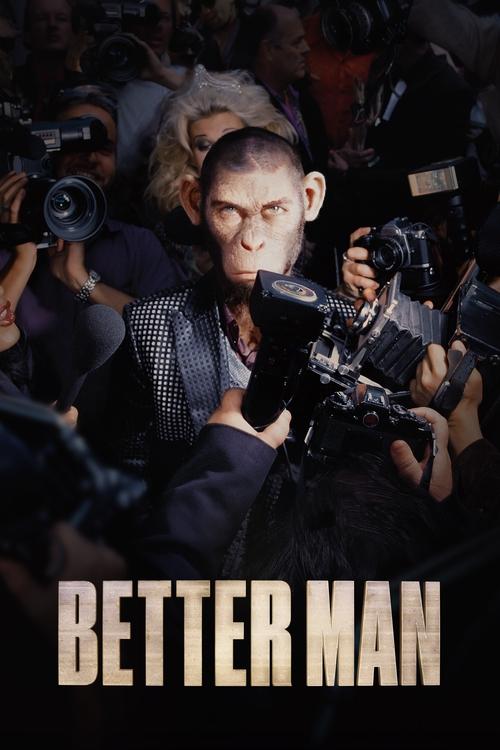
The film makes that conflict literal through Robbie's stylized ape-avatar and through the voice of the inner critic, an imagined, vicious version of himself that appears whenever his self-doubt spikes. The critic becomes the movie's most persistent antagonist, hissing that he is worthless, fake, and destined to fail. That internal voice is not a single twist so much as the revelation that the true enemy in Robbie's life is not just outside pressure but his own belief that he deserves contempt. The visual metaphor lets the film turn emotional pain into spectacle: Robbie does not merely feel ashamed, he sees shame looming over him like a monster he has to perform against.
As a child, Robert finds his first real escape in a school production of The Pirates of Penzance. Onstage, his fear gives way to instinct, then to showmanship, and he suddenly knows how to command a room. The applause is intoxicating, but it is also dangerous, because it teaches him that approval can be manufactured, chased, and lost. In that moment the film establishes the central equation that will drive everything that follows: performance equals love, and love equals survival. The applause fades, but the critic does not. Instead, Robert stands in the aftermath of triumph and is immediately attacked by his own mind, as if his psyche cannot tolerate happiness without sabotaging it.
The story moves into his teens, and the hunger to escape becomes more urgent. By 1990, Robert is writing amateur lyrics and obsessing over the idea of becoming somebody, while his friend Nate turns away from the same opportunity and takes a different path. That contrast matters because the film frames Robbie's life as a series of doorways he is desperate to run through, even when he cannot yet see what the doors cost him. His father's worldview has already lodged in him: to be ordinary is to be nothing. So when Nigel Martin Smith selects the teenage Robert to join the new boy band Take That, the moment feels to Robbie like destiny finally opening. What he does not yet understand is that the dream will give him everything he asked for and nearly destroy him in the process.
In the early years of Take That, Robbie is catapulted into a world of lights, screaming crowds, choreography, money, and a level of public adoration that turns every performance into proof of worth. He is young enough to be intoxicated by it and damaged enough to mistake it for identity. The band's success becomes a machine that rewards excess while hollowing him out. The film repeatedly shows that he is not simply ambitious; he is desperate, and desperation makes him reckless. Fame gives him access to booze, drugs, attention, and women, but it also feeds the self-loathing that has been waiting for reinforcement since childhood. The more people cheer, the more Robbie believes he has to keep being larger, louder, and more outrageous or risk being exposed as the "nobody" Peter warned him about.
One of the film's most important early adult revelations is that Peter's influence is not just inspirational; it is corrosive. Peter is not a monster in the simple sense, but he is a man whose own broken dreams have taught him to treat status like oxygen. He pushes Robert toward show business while also modeling instability, absence, and the emotional costs of living for applause. The younger Robbie inherits that hunger and the fear underneath it. Betty and Robert's mother, Janet, try to anchor him, but the pull of his father's dream is stronger because it is tied to the part of Robbie that equates visibility with worth. The family dynamic is therefore not just background detail; it is the engine of the film's tragedy. Robbie is raised on two incompatible teachings: be yourself, and never stop trying to be admired.
As Take That's popularity explodes, Robbie's own behavior unravels. The sources describe him spiraling into alcohol and drug abuse, treating people badly, and becoming increasingly unable to separate the stage from ordinary life. He is a star on paper and a wreck in private. The film's emotional design makes that collapse feel both loud and lonely. There are the flashy set pieces, like the much-discussed "Rock DJ" sequence on Regent Street, where the spectacle of performance is pushed so far that it becomes almost grotesque, a public manifestation of a man trying to out-sing his emptiness. But underneath the glitter, the story keeps returning to Robbie staring into himself and finding only the critic, a voice that turns every success into evidence that he is a fraud.
The band's success does not heal Robbie's insecurities; it magnifies them. He is surrounded by people, yet he becomes more isolated, because everyone seems to want the version of him that performs well and not the damaged boy underneath. That pressure begins to fracture his relationships. He falls out with his best friend Gary and later with Nate, and the film makes clear that these are not random losses but consequences of the same self-destructive pattern. Robbie's craving to be seen turns him into someone who hurts the people closest to him. The movie does not soften that damage. Instead, it uses it to show how fame can turn a wounded person into the very thing he fears: somebody unbearable to be around.
The next major emotional turn comes when Robbie enters a relationship with Nicole Appleton of All Saints. The romance is presented as a brief pocket of tenderness in a life otherwise ruled by noise and instability. They fall into each other with a kind of hopeful relief, and for a moment it looks as if Robbie has found something real that is not applause. The film then delivers one of its cruelest turns: the couple are expecting a child, but Nicole's manager forces her to have an abortion, shattering the relationship's fragile sense of future. The loss lands as both private grief and another reminder that Robbie's life is always being shaped by forces larger than his emotional maturity. Their romance begins with affection, but it ends in bitterness, heartbreak, and the slow collapse of trust.
As his addictions deepen and his relationships deteriorate, Robbie's inner world grows more unstable. The film repeatedly returns to the idea that he is living as a "dancing monkey," performing for a crowd while having no stable self beneath the act. The metaphor is humiliating and precise. He is adored for a persona he cannot sustain, and every attempt to escape the role seems to drag him back into it. The emotional consequence is despair. One of the more unsettling undercurrents of the film, as several sources note, is that it becomes increasingly obvious that Robbie is wrestling with suicidal thoughts. The movie does not sensationalize that darkness so much as show how fame, shame, and isolation can make death feel like a logical escape from self-hatred.
The turning point comes when Robbie finally reaches rehab. This is the film's most explicit reckoning scene, and it functions like a confession after years of deflection. In group therapy, Robbie admits that fame has stunted his growth, trapping him in emotional immaturity even as his career keeps expanding. The line is important because it reframes so much of what came before. His cruelty, his panic, his addiction, and his neediness are no longer presented as mere arrogance. They become symptoms of arrested development, the result of a boy who learned too early that he had to perform to be loved. Rehab becomes the first place where he is not rewarded for being outrageous. It is where he is forced to sit still long enough to hear what he has become.
That confession opens the door to a series of relationship repairs that function as the film's emotional release valve. Robbie apologizes to Gary, acknowledging the damage he has caused. He amicably parts with Nicole, accepting that love alone cannot repair what addiction and immaturity have broken. He also reconciles with Nate, the friend whose different path had quietly mirrored the life Robbie might have had if he had not been swallowed by fame's logic. These scenes are not melodramatic reversals so much as hard-earned acknowledgments that people are not props in Robbie's story. They have their own pain, and he has finally reached a point where he can see that clearly enough to make amends.
The film also brings Robbie back to the family wound at its center. His grandmother Betty dies, and her loss hits him with the force of a final lesson about what can be preserved and what cannot. He visits Betty's grave, and the scene becomes a quiet pivot away from grief's paralysis toward acceptance. Betty has been one of the few people in his life who consistently offered love without demanding a performance in return, so her death forces Robbie to confront the fact that the emotional shelter she gave him cannot be recovered. The grave is a place of mourning, but also of movement. It is where he begins to let grief exist without letting it define him.
The climax gathers all of these threads--father, son, performance, shame, redemption--into the final great set piece at the Royal Albert Hall. By this point, Robbie has already passed through rehab, repaired several broken ties, and begun to see himself with more honesty. The stage is no longer just the arena of validation; it becomes the place where he can finally answer his past. His father Peter Williams appears with him for a duet of Sinatra's "My Way". The choice of song is devastatingly apt. Peter has spent his life dreaming of a stage where he can matter, and Robbie has spent his life trying to prove that he matters by becoming impossible to ignore. Now, at last, they stand together in a song about owning one's life, flaws and all.
The performance lands as the film's ultimate reconciliation. The sources describe it as based on mutual respect and admiration, not rivalry. That is the transformation the movie has been working toward from the beginning. Peter's dream is no longer something Robbie has to submit to or rebel against; it becomes part of the inheritance he can finally understand without being consumed by it. Robbie is no longer the boy in the playground being called a loser. He is no longer the teenager starving for applause or the star collapsing under its weight. He is a man who can stand beside his father, sing the old Sinatra anthem, and accept that the life he has lived is his own.
The final emotional movement is not triumphant in a simple sense. It is quieter, more earned. Robbie has not erased his damage, but he has faced it. He has not reclaimed the boy he was, but he has stopped letting the inner critic define the whole of his identity. The movie ends with the sense that the biggest victory is not fame, success, or even reconciliation with the people he loves. It is the act of finally becoming honest about who he is, what hurt him, and what he has lost along the way.




What is the ending?
Robbie reaches a low point after his self-loathing and isolation have wrecked his relationships and nearly destroyed him. He goes to rehab, makes peace with the people he hurt, performs with his father, and ends the story on a note of reconciliation and acceptance.
In the final stretch, Robbie is at Knebworth, in front of a massive crowd, trying to perform while his inner voices and earlier versions of himself turn into a hostile mob around him. The crowd of inner critics swarms the stage, and Robbie fights through them in a chaotic, violent visualization of his self-hatred during "Let Me Entertain You." He is left facing only a mirror-like version of himself, and he tries to destroy even that. Then the scene shifts: Robbie is suddenly alone on a frozen lake, and a ray of sunlight breaks through, bringing with it the memory of Betty, the grandmother who anchored him earlier in life.
After that moment, Robbie enters rehab and tells the group that fame has arrested his emotional growth and left him stunted. From there, he begins to repair what he has broken. He apologizes to Gary, ends things with Nicole on amicable terms, and reconciles with Nate. He also moves through his grief over Betty by visiting her grave and emotionally letting go of that loss.
The ending then moves to the Royal Albert Hall, where Robbie performs "My Way" and brings his father, Peter, onto the stage with him. They sing together in a shared moment of respect rather than conflict. Peter, who had long been tied to Robbie's need for approval and performance, is no longer an adversary in this scene; he stands beside his son as a collaborator and witness. Robbie's earlier selves appear in the audience, but they are no longer attacking him. They watch with approval as he finishes the song and honors Betty at the end.
The main characters' endings are as follows: - Robbie Williams: he survives his breakdown, enters rehab, repairs important relationships, reconciles with his father, and closes the film in a state of acceptance and self-possession. - Peter Williams: he reaches a final place of mutual respect with Robbie and joins him onstage in the closing performance. - Gary: Robbie apologizes to him and makes peace with him. - Nicole: Robbie and Nicole part amicably after their relationship has already fractured. - Nate: Robbie reconciles with him after their long strain. - Betty: she is already dead by this point, and Robbie ends the film by honoring her memory and working through his grief at her grave.
Scene by scene, the ending begins with the Knebworth performance, where Robbie is surrounded by the physical form of his internal judgment. The imagined crowd is not just noise; it is made from his own past selves, and they attack him as he tries to keep the show going. The performance turns into a struggle for survival against his own self-contempt, ending with the image of Robbie turning that violence inward against himself.
Then the frozen lake appears, silent and empty, with only the light reaching him as a reminder of Betty. That moment interrupts the collapse and gives him a path out. The film then moves into rehab, where Robbie speaks plainly about what fame has done to him and acknowledges the emotional damage he has caused. This is the point where the story shifts from destruction to repair.
Next come the reconciliations. Robbie reaches out to Gary, reconnects with Nate, and separates from Nicole without further conflict. These are not shown as abstract changes; they are presented as specific emotional repairs to specific broken bonds. Robbie also confronts Betty's absence directly, using her grave as the place where his grief is released.
The final scene at Royal Albert Hall is staged like a return, but not a victory parade. Robbie stands with his father and sings "My Way," and the performance becomes a public reconciliation between them. Peter is no longer merely the man who pushed, disappointed, or haunted him; he is present as a man Robbie can stand beside. As the song ends, Robbie acknowledges Betty, and the older and younger versions of himself no longer attack him. They look on in approval, marking the end of the film's long conflict between self-loathing and self-acceptance.
Is there a post-credit scene?
Yes -- there is end-credits footage, but no post-credit scene after the credits finish.
During the credits, the film shows photos from Robbie Williams' past / images from the life of the real Robbie Williams for the first few minutes. After that, there is nothing extra.
How does Robbie’s relationship with his father Peter affect his childhood and later choices in Better Man?
Robbie grows up under the shadow of Peter's absence and constant pressure to become a star, while his mother Janet and grandmother Betty provide the emotional stability his father does not. Peter's habit of leaving, returning, and treating success as the only measure of worth shapes Robbie's insecurity, his need for approval, and his compulsive drive to prove himself, even when that drive damages his relationships and mental health.
What happens when Robbie joins Take That, and how is he treated by the rest of the band?
After being discovered and placed into Take That, Robbie experiences the intoxicating rise of fame, money, attention, and access to alcohol, drugs, and women, but the success is not emotionally satisfying. The film shows that he remains emotionally unsettled inside the group and eventually becomes overwhelmed by the excesses and pressures surrounding him, which pushes him toward conflict and, later, expulsion from the band.
Who is Nigel Martin Smith in Better Man, and what role does he play in Robbie’s career?
Nigel Martin Smith is the figure who spots Robbie and helps place him into the boy band that becomes Take That. He functions as the gatekeeper of Robbie's entry into fame, turning Robbie's desire to be seen into a career path that initially gives him success but also funnels him into the machinery of pop stardom and its pressures.
How does Better Man portray Robbie’s struggles with addiction and rehab?
The film shows Robbie's drinking and drug use escalating alongside fame, with excess becoming increasingly unmanageable. Later, he enters rehab and openly admits in a group session that fame has stunted his emotional maturity and growth, marking a key turn in which he begins to confront the damage caused by addiction and self-destruction.
What is Robbie’s relationship with his mother Janet, grandmother Betty, and girlfriend Nicole like in the film?
Janet and Betty are depicted as Robbie's emotional anchors, giving him warmth and care in contrast to his father's instability. Nicole becomes part of his adult life during his rise, but the relationship cannot survive the strain of his personal collapse; the film shows Robbie later apologising to Gary, parting amicably with Nicole, and continuing to process his grief at Betty's grave as he tries to rebuild himself.
Is this family friendly?
No, Better Man is not family friendly for children. It is rated R for drug use, pervasive language, sexual content, nudity, and some violent content, and multiple parental guides describe it as heavy with adult material.
Potentially objectionable or upsetting elements include: - Frequent strong profanity, including very heavy use of the F-word and other harsh language. - Sexual content and nudity, including implied sex, explicit sexual references, partial nudity, and scenes with topless women or scantily clad performers. - Drug and alcohol abuse, including cocaine use, heroin use, smoking, intoxication, and substance-related downward spirals. - Disturbing emotional material, including themes of addiction, mental health struggles, family conflict, grief, and suicidal thoughts or attempts. - Violent or intense scenes, including argument-heavy scenes, stylized fighting, and some bloody or frightening imagery in fantastical sequences.
For most children, and even for some sensitive teens, this would likely be upsetting rather than appropriate.








