


Popular
What are the main adventures of Bullwinkle and Rocky throughout the series?
How does Boris Badenov's character develop throughout the series?
What role does Natasha Fatale play in Boris Badenov's schemes?
What is the significance of the character Mr. Peabody and his boy Sherman?
How do Bullwinkle's misunderstandings contribute to the humor of the show?
Should I watch it?
Ask Your Own Question

What is the plot?
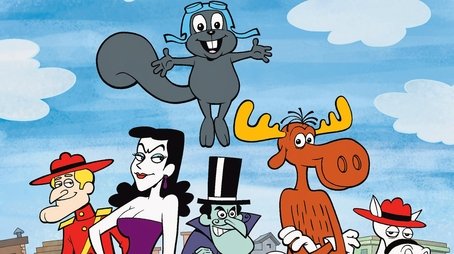
The Bullwinkle Show begins with the iconic opening sequence featuring Bullwinkle the moose and his best friend, Rocky the flying squirrel. The show is structured as a variety program, interspersed with various segments, including animated shorts and live-action skits. The first segment introduces Bullwinkle and Rocky as they embark on a new adventure, often involving their nemesis, Boris Badenov, and his partner, Natasha Fatale.
In the first episode, Bullwinkle and Rocky find themselves in a predicament when Boris and Natasha devise a plan to steal a valuable item, such as a rare jewel or a secret formula. The duo is often oblivious to the dangers around them, which adds a comedic element to their adventures. As they set off to thwart Boris and Natasha's plans, they encounter various obstacles, including traps set by the villains.
As the plot unfolds, Bullwinkle and Rocky use their unique skills to navigate through these challenges. Bullwinkle's naivety often leads to humorous misunderstandings, while Rocky's intelligence and quick thinking help them outsmart their foes. The characters' motivations are clear: Bullwinkle wants to help his friend and do the right thing, while Rocky is more focused on the practicalities of their situation.
In one notable sequence, Bullwinkle accidentally stumbles into a secret lair where Boris and Natasha are plotting their next move. The lair is filled with gadgets and contraptions, showcasing the villains' elaborate schemes. Bullwinkle, unaware of the danger, inadvertently activates one of the devices, causing chaos in the lair. This moment highlights Bullwinkle's clumsiness but also serves as a turning point in the story, as it alerts Rocky to the villains' presence.
Rocky quickly devises a plan to rescue Bullwinkle and stop Boris and Natasha. He uses his flying ability to scout the area and gather information. Meanwhile, Bullwinkle, still oblivious, continues to explore the lair, leading to a series of comedic encounters with the villains. The tension builds as Boris and Natasha realize that their plan is in jeopardy.
As the climax approaches, Rocky confronts Boris and Natasha, leading to a showdown. The confrontation is filled with slapstick humor, as Bullwinkle accidentally becomes involved in the fight. The sequence is chaotic, with characters running around, dodging traps, and engaging in humorous banter. Ultimately, Rocky's cleverness and Bullwinkle's accidental heroics lead to the villains' defeat.
In the aftermath, Bullwinkle and Rocky celebrate their victory, often with a humorous twist that leaves the audience laughing. The episode concludes with a light-hearted moment, reinforcing the friendship between the two main characters. The final scene often features a catchy jingle or a comedic wrap-up, leaving viewers entertained and eager for the next adventure.
Throughout the series, the recurring themes of friendship, adventure, and the battle between good and evil are explored in a whimsical and entertaining manner, with each episode presenting a new challenge for Bullwinkle and Rocky to overcome.








What is the ending?
The Bullwinkle Show, which aired in 1959, did not have a traditional ending as it was an episodic series featuring various segments and storylines. Each episode typically concluded with a humorous resolution to the plot introduced, often leaving the characters in their usual states of whimsical mischief and adventure.
In a more detailed narrative, let's explore a typical episode's ending, focusing on the characters and their fates:
As the episode draws to a close, we find Bullwinkle and his best friend, Rocky the Flying Squirrel, in a precarious situation. They have been trying to thwart the nefarious plans of their arch-nemesis, Boris Badenov, and his partner Natasha Fatale. The scene opens with Bullwinkle, his large antlers silhouetted against the setting sun, looking puzzled as he holds a contraption that Boris has devised to capture them.
Rocky, flapping his wings nervously, urges Bullwinkle to be careful. "Bullwinkle, don't touch that! It could be a trap!" But Bullwinkle, ever the optimistic and somewhat naïve character, responds with his trademark catchphrase, "Hey, Rocky! Watch me pull a rabbit out of my hat!" He pulls the lever on the contraption, and instead of a rabbit, a cloud of colorful smoke erupts, momentarily obscuring the scene.
When the smoke clears, we see Boris and Natasha, who had been hiding nearby, now covered in soot and looking utterly defeated. They had been trying to outsmart Bullwinkle and Rocky, but their plans have backfired spectacularly. Boris, with his signature thick accent, grumbles, "Curses! Foiled again!" Natasha, rolling her eyes, adds, "We'll get you next time, moose and squirrel!"
Meanwhile, Bullwinkle and Rocky share a triumphant moment. Bullwinkle, with a goofy grin, says, "That was a close one, eh, Rocky?" Rocky, relieved but still cautious, replies, "Yeah, but we can't let our guard down. They'll be back!"
As the episode wraps up, the camera pans out to show the duo walking off into the sunset, with Bullwinkle humming a cheerful tune and Rocky flying alongside him. The screen fades to black, and the familiar theme music plays, signaling the end of another adventure.
In this ending, Bullwinkle remains blissfully unaware of the dangers that lurk around him, embodying his character's innocence and optimism. Rocky, on the other hand, represents the voice of reason, always alert to the potential for trouble. The fate of Boris and Natasha is one of comedic failure, as they retreat to plot their next scheme, ensuring that the cycle of conflict and humor will continue in future episodes. The characters return to their status quo, ready for the next round of antics, leaving the audience with a sense of lightheartedness and anticipation for more adventures to come.
Is there a post-credit scene?
The Bullwinkle Show, which premiered in 1959, did not feature post-credit scenes in the way that many modern shows do. Instead, the format of the show typically concluded with a final gag or humorous moment before the credits rolled.
In the closing moments of an episode, viewers would often see a lighthearted exchange between Bullwinkle and his friend Rocky, or a comedic twist involving the various characters, such as Boris Badenov and Natasha Fatale plotting their next scheme. These moments served as a playful wrap-up to the episode's storyline, leaving the audience with a smile rather than a traditional post-credit scene.
The humor was often whimsical and absurd, reflecting the show's overall tone, and it would frequently involve a pun or a visual joke that tied back to the episode's main plot. The charm of The Bullwinkle Show lay in its ability to blend clever writing with slapstick comedy, making each episode memorable without the need for additional scenes after the credits.
What are the main adventures of Bullwinkle and Rocky throughout the series?
Throughout 'The Bullwinkle Show,' Bullwinkle the moose and Rocky the flying squirrel embark on numerous whimsical adventures that often involve thwarting the evil plans of their arch-nemeses, Boris Badenov and Natasha Fatale. In one notable adventure, they attempt to save the world from the dastardly schemes of Boris, who often concocts elaborate plots to steal valuable items or take over the world, only to be foiled by Bullwinkle's bumbling yet endearing nature and Rocky's quick thinking.
How does Boris Badenov's character develop throughout the series?
Boris Badenov is portrayed as a cunning yet comically inept villain whose schemes often backfire. His character is driven by a desire for wealth and power, but his plans are consistently thwarted by the unintentional heroics of Bullwinkle and Rocky. As the series progresses, Boris's frustration grows, leading to increasingly outrageous plots, yet his charm and humor keep him a beloved character despite his villainous intentions.
What role does Natasha Fatale play in Boris Badenov's schemes?
Natasha Fatale serves as Boris Badenov's partner in crime, often providing a more cunning and sophisticated approach to their villainous plans. She is characterized by her glamorous appearance and sharp wit, frequently attempting to keep Boris's more ridiculous ideas in check. Her motivations are often tied to her desire for success and recognition, and she exhibits a mix of loyalty to Boris while also showing a keen awareness of their failures.
What is the significance of the character Mr. Peabody and his boy Sherman?
Mr. Peabody, a highly intelligent dog, and his boy Sherman are introduced in segments of 'The Bullwinkle Show' as they travel through time using the WABAC machine. Their adventures often serve as humorous historical lessons, with Mr. Peabody's intellect and Sherman's innocence creating a dynamic that highlights the absurdities of history. Their escapades are filled with clever wordplay and visual gags, making them a memorable part of the series.
How do Bullwinkle's misunderstandings contribute to the humor of the show?
Bullwinkle's misunderstandings are a central source of humor in 'The Bullwinkle Show.' His naive and often literal interpretations of situations lead to comedic scenarios that highlight his good-natured personality. For instance, when he misinterprets a simple instruction or fails to grasp the gravity of a situation, it not only creates laugh-out-loud moments but also endears him to the audience, showcasing his lovable, albeit clueless, nature.
Is this family friendly?
The Bullwinkle Show, produced in 1959, is generally considered family-friendly, featuring a blend of humor, adventure, and whimsical storytelling. However, there are a few aspects that might be considered potentially objectionable or upsetting for children or sensitive viewers:
-
Mild Violence: Some episodes include slapstick humor that involves cartoonish violence, such as characters getting hit or falling in exaggerated ways. While this is presented in a comedic context, it may still be unsettling for very young children.
-
Villainous Characters: The show features antagonists like Boris Badenov and Natasha Fatale, who engage in scheming and plotting against the protagonists. Their menacing demeanor and intentions might be frightening for some viewers.
-
Political Satire: The series often includes elements of political satire and social commentary that may go over the heads of younger viewers, potentially leading to confusion or misunderstanding.
-
Silly Scares: Certain episodes may include scenarios that involve mild suspense or tension, such as characters being chased or placed in precarious situations, which could be alarming for sensitive viewers.
-
Absurdity and Surreal Humor: The show's surreal and absurd humor might be disorienting for some children, as it often defies logic and reality in ways that could be confusing.
Overall, while The Bullwinkle Show is designed to entertain a broad audience, these elements may warrant parental discretion for younger or more sensitive viewers.