


Popular
What motivates Date Masamune in his quest for power?
How does Sanada Yukimura's character develop throughout the series?
What is the significance of the rivalry between Takeda Shingen and Uesugi Kenshin?
What role does Oda Nobunaga play in the series, and how does he influence other characters?
How does the relationship between Date Masamune and his retainers evolve throughout the series?
Should I watch it?
Ask Your Own Question

What is the plot?
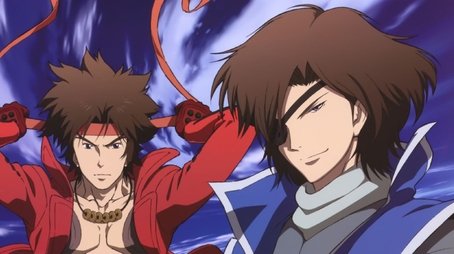
In the year 1547, Japan is engulfed in the chaos of the Sengoku period, a time of constant military conflict and power struggles among feudal lords. The story begins with the introduction of the main character, Date Masamune, a fierce and ambitious warlord known for his one-eyed appearance and his desire to unify Japan under his rule. He is seen rallying his troops, showcasing his determination and charisma as he prepares for battle against the forces of the tyrannical warlord, Oda Nobunaga.
As Masamune sets out, we are introduced to Oda Nobunaga, who is depicted as a ruthless and cunning leader. He is shown executing a group of rebels, demonstrating his merciless approach to maintaining power. Nobunaga's ambition is to conquer all of Japan, and he is willing to eliminate anyone who stands in his way. His forces are vast, and he employs a strategy of fear to keep his enemies at bay.
Masamune's first major confrontation occurs when he leads an assault on one of Nobunaga's strongholds. The battle is intense, with Masamune showcasing his exceptional combat skills and leadership. He fights alongside his loyal retainers, including Katakura Kojūrō, who is fiercely devoted to him. The clash is marked by dramatic sword fights, explosions, and the chaos of war. Masamune's forces manage to breach the defenses, but Nobunaga's troops retaliate fiercely, leading to a bloody stalemate.
After the battle, Masamune learns of a powerful artifact known as the "Demon's Blade," which is said to grant immense power to its wielder. This revelation ignites his ambition further, as he believes that obtaining the blade will solidify his position as a dominant force in Japan. He sets out on a quest to find the blade, which leads him to encounter other warlords, including Sanada Yukimura and Takeda Shingen, who also seek the blade for their own purposes.
Meanwhile, Nobunaga is not idle; he sends his most trusted general, Akechi Mitsuhide, to track down Masamune and eliminate him. Mitsuhide is portrayed as a calculating strategist, and he begins to gather intelligence on Masamune's movements. The tension between the two factions escalates as both sides prepare for an inevitable confrontation.
Masamune's journey takes him to a mysterious temple where the Demon's Blade is said to be hidden. He faces various trials and challenges, including battling fierce guardians and overcoming traps designed to protect the blade. During this quest, Masamune's internal struggles are highlighted; he grapples with the weight of his ambitions and the sacrifices he must make to achieve his goals. His determination is unwavering, and he ultimately retrieves the Demon's Blade, feeling a surge of power coursing through him.
With the blade in hand, Masamune returns to confront Nobunaga. The two warlords finally meet in an epic showdown. The battle is visually stunning, with both leaders displaying their unique fighting styles and the power of the Demon's Blade. Masamune's confidence is palpable as he unleashes the blade's power, but Nobunaga counters with his own formidable abilities. The fight is fierce, with both sides suffering heavy losses.
As the battle rages on, Masamune's allies, including Kojūrō and Yukimura, join the fray, creating a chaotic battlefield filled with clashing swords and strategic maneuvers. Nobunaga, realizing he is losing ground, resorts to desperate measures, unleashing a devastating attack that threatens to annihilate Masamune's forces. In a moment of clarity, Masamune understands that true strength lies not just in power but in the bonds he has forged with his allies.
In a climactic moment, Masamune and Nobunaga engage in a final duel. The fight is intense, with both warriors pushing their limits. Masamune, fueled by his desire to protect his friends and unify Japan, ultimately gains the upper hand. He delivers a decisive blow to Nobunaga, who falls, defeated. However, in his last moments, Nobunaga reveals a shocking twist: he had been manipulating events from the shadows, and his death will only lead to greater chaos in Japan.
With Nobunaga's defeat, Masamune stands victorious but is left with a heavy heart. He realizes that the battle for Japan is far from over, as new threats emerge from the shadows. The series concludes with Masamune vowing to continue his quest for unification, determined to forge a new path for Japan amidst the ongoing turmoil. The final scene captures his resolve, setting the stage for future conflicts and the enduring struggle for power in the Sengoku era.








What is the ending?
In the ending of Sengoku BASARA: Samurai Kings, the final battle takes place between the forces of Date Masamune and the remnants of the Toyotomi clan, led by the ambitious and ruthless Toyotomi Hideyoshi. After a fierce confrontation, Masamune emerges victorious, but the victory is bittersweet as he reflects on the cost of war and the loss of his comrades. The series concludes with Masamune standing alone, contemplating the future of Japan, while other characters like Sanada Yukimura and Tokugawa Ieyasu also face their own fates, each shaped by the tumultuous events of the conflict.
As the final episodes unfold, the tension escalates dramatically. The scene opens with the battlefield, a desolate landscape scarred by the ravages of war. The air is thick with the scent of smoke and the cries of warriors echo in the distance. Date Masamune, clad in his distinctive armor, stands resolute, his one eye gleaming with determination. He rallies his troops, urging them to fight for a future free from tyranny, as they prepare to confront Toyotomi Hideyoshi's forces.
The camera shifts to Hideyoshi, who is surrounded by his loyal generals, including the fierce and cunning Kato Kiyomasa. Hideyoshi's ambition is palpable; he seeks to unify Japan under his rule, and he views Masamune as the last obstacle in his path. The tension between the two leaders is electric, each representing contrasting ideals of leadership and power.
As the battle commences, the animation captures the chaos of war with vivid detail. Swords clash, arrows fly, and the ground shakes beneath the weight of armored warriors. Masamune fights with unparalleled skill, his dual-wielding swords slicing through enemies with grace and ferocity. His internal struggle is evident; he fights not just for victory, but to honor the fallen comrades who believed in his vision of a united Japan.
Meanwhile, Sanada Yukimura, a fierce warrior and Masamune's ally, engages in his own fierce battles, showcasing his loyalty and bravery. His character is driven by a desire to protect his friends and uphold the honor of the samurai. The emotional weight of his actions is highlighted as he faces overwhelming odds, embodying the spirit of sacrifice.
As the battle reaches its climax, Masamune confronts Hideyoshi in a dramatic showdown. The two engage in a fierce duel, their swords clashing with a symphony of metal. Masamune's resolve is tested as he recalls the sacrifices of his friends, fueling his determination. Hideyoshi, consumed by his ambition, fights with desperation, believing that his vision for Japan justifies any means.
In a pivotal moment, Masamune gains the upper hand, delivering a decisive blow to Hideyoshi. The scene is charged with emotion as Hideyoshi falls, his dreams of unification crumbling. Masamune stands over him, a mixture of triumph and sorrow washing over his face. He realizes that victory comes at a great cost, and the weight of leadership is heavier than he anticipated.
As the dust settles, the battlefield is littered with the remnants of war. Masamune surveys the aftermath, his heart heavy with the loss of life. He reflects on the futility of conflict and the need for a new path forward. The series concludes with Masamune standing alone, gazing into the horizon, contemplating the future of Japan and the legacy he wishes to leave behind.
In the final moments, the fates of the main characters are revealed. Sanada Yukimura, having fought valiantly, survives but is left to ponder the meaning of honor in a world ravaged by war. Tokugawa Ieyasu, who has been a strategic player throughout the series, watches the events unfold with a calculating gaze, hinting at his own ambitions for the future. The series closes on a note of uncertainty, leaving viewers to reflect on the complexities of power, loyalty, and the human cost of ambition.
Is there a post-credit scene?
In the anime "Sengoku BASARA: Samurai Kings," there is indeed a post-credit scene that adds a humorous touch to the series. After the main events of the final episode, the scene shifts to a light-hearted moment featuring the characters Date Masamune and Sanada Yukimura.
In this scene, Masamune is seen sitting on a rock, looking contemplative and somewhat bored. He is dressed in his usual armor, with his signature eyepatch over one eye. The atmosphere is calm, with the sounds of nature surrounding him. Suddenly, Yukimura appears, running energetically towards Masamune, his expression filled with excitement and determination. He is clad in his traditional samurai attire, his long hair flowing behind him as he approaches.
Yukimura enthusiastically challenges Masamune to a duel, his eyes sparkling with the thrill of competition. Masamune, initially surprised, smirks and accepts the challenge, his competitive spirit ignited. The two engage in a playful exchange, showcasing their camaraderie and mutual respect as warriors. The scene captures their dynamic perfectly, blending humor with the underlying tension of their rivalry.
As they prepare to clash, the scene cuts to black, leaving viewers with a sense of anticipation and a smile, encapsulating the spirit of the series. This post-credit moment serves as a reminder of the bonds formed through battle and the light-hearted moments that can exist even amidst the chaos of war.
What motivates Date Masamune in his quest for power?
Date Masamune, known as the One-Eyed Dragon, is driven by a desire to unify Japan under his rule and prove his strength as a warrior. His ambition is fueled by a need to surpass his rivals and gain respect, particularly from his father, who he feels has not acknowledged his potential. Masamune's internal conflict often revolves around his fierce independence and the burden of leadership, as he grapples with the expectations placed upon him.
How does Sanada Yukimura's character develop throughout the series?
Sanada Yukimura starts as a passionate and idealistic warrior, deeply committed to the cause of justice and the protection of the weak. His character development is marked by his encounters with various leaders, particularly with Date Masamune, which challenge his views on honor and strength. As the series progresses, Yukimura learns to balance his ideals with the harsh realities of war, ultimately becoming a more strategic and resilient fighter, while still holding onto his core values.
What is the significance of the rivalry between Takeda Shingen and Uesugi Kenshin?
The rivalry between Takeda Shingen and Uesugi Kenshin is central to the narrative, representing the clash of two powerful warlords who embody contrasting ideals of leadership and warfare. Shingen, with his bold and aggressive tactics, contrasts with Kenshin's more honorable and disciplined approach. Their battles are not just physical confrontations but also ideological ones, as each seeks to prove their superiority and vision for Japan's future. This rivalry drives much of the conflict in the series and highlights the complexities of loyalty and honor in the Sengoku period.
What role does Oda Nobunaga play in the series, and how does he influence other characters?
Oda Nobunaga is portrayed as a cunning and ruthless leader, whose ambition to conquer Japan sets the stage for much of the conflict in the series. His strategic mind and willingness to employ brutal tactics make him a formidable antagonist. Nobunaga's influence extends to other characters, as they either align with or oppose him, shaping their motivations and actions. His presence looms large over the narrative, as characters like Masamune and Yukimura must navigate their own paths in relation to his growing power.
How does the relationship between Date Masamune and his retainers evolve throughout the series?
The relationship between Date Masamune and his retainers, particularly Katakura Kojūrō, evolves significantly as the series progresses. Initially, Kojūrō serves as a loyal and steadfast supporter, often acting as the voice of reason to Masamune's impulsive nature. However, as the stakes rise and conflicts intensify, tensions emerge, revealing deeper emotional layers and the complexities of loyalty. Masamune's struggle to balance his ambition with the well-being of his retainers leads to moments of vulnerability and growth, ultimately strengthening their bond as they face external threats together.
Is this family friendly?
"Sengoku BASARA: Samurai Kings" is an action-packed anime set during Japan's Sengoku period, featuring intense battles and dramatic character interactions. While it has a vibrant art style and engaging storylines, there are several aspects that may be considered objectionable or upsetting for children or sensitive viewers:
-
Violence and Bloodshed: The series is filled with large-scale battles, sword fights, and intense combat scenes. Characters often engage in brutal confrontations, and there are instances of bloodshed that may be graphic.
-
Death and Injury: Many characters face death or severe injuries throughout the series. The emotional weight of loss is a recurring theme, which may be distressing for younger viewers.
-
Dark Themes: The narrative explores themes of betrayal, ambition, and the consequences of war. Characters often grapple with their motivations and the moral implications of their actions, which can be heavy for sensitive audiences.
-
Mature Character Interactions: Some characters exhibit aggressive or manipulative behavior, and there are moments of tension that may not be suitable for younger viewers.
-
Supernatural Elements: The presence of supernatural abilities and fantastical elements may be unsettling for some, particularly in how they are portrayed in battle.
Overall, while "Sengoku BASARA: Samurai Kings" offers an exciting and visually striking experience, its themes and content may not be appropriate for all children or sensitive individuals. Viewer discretion is advised.