




Popular
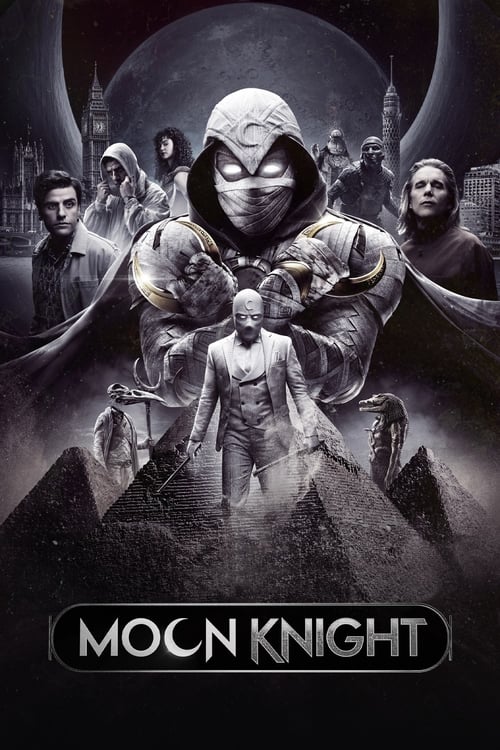
What are the different identities of Steven Grant and Marc Spector in Moon Knight?
How does Khonshu influence Marc Spector's actions throughout the series?
What role does Layla El-Faouly play in Marc Spector's journey?
What is the significance of the scarab in Moon Knight?
How does the series portray the theme of mental health through Steven and Marc's identities?
Should I watch it?
Ask Your Own Question

What is the plot?
The series begins with Steven Grant, a mild-mannered gift shop employee in London, who experiences blackouts and strange visions. He wakes up in a remote area, confused and disoriented, with a voice in his head urging him to take control. He discovers that he has been sleepwalking and has no memory of how he got there. Steven's life is disrupted by these episodes, and he struggles to maintain his job and relationships.
One night, after a blackout, Steven finds himself in a confrontation with a group of armed men led by a mysterious figure named Arthur Harrow. Harrow, a former avatar of the Egyptian goddess Ammit, is searching for a scarab that Steven unknowingly possesses. During this encounter, Steven transforms into a more aggressive persona, Marc Spector, who is a former mercenary and the avatar of the Egyptian moon god Khonshu. Marc takes control and fights off the attackers with exceptional combat skills, leaving Steven bewildered.
After the fight, Steven learns about his dissociative identity disorder and the existence of Marc Spector. He struggles to understand his dual identity and the implications of being an avatar for Khonshu. Marc explains that he has been protecting Steven and that they must work together to stop Harrow from resurrecting Ammit, who would judge and punish people before they commit crimes. Steven is initially resistant but realizes the gravity of the situation.
As the story progresses, Steven and Marc navigate their conflicting personalities. They visit a museum where Steven works, and he discovers more about Egyptian mythology and the artifacts related to Khonshu and Ammit. They also learn that Harrow is seeking to find the tomb of Ammit to unleash her power. Steven's knowledge of the artifacts becomes crucial as they search for the scarab that leads to Ammit's tomb.
The duo travels to Egypt, where they encounter various challenges, including mercenaries working for Harrow. They are pursued relentlessly, and during a tense chase, Marc takes control to fight off their attackers. The action is intense, with Marc showcasing his combat prowess, while Steven grapples with fear and uncertainty. They manage to escape but are left with a sense of urgency to find the tomb before Harrow.
In Egypt, they meet Layla El-Faouly, Marc's estranged wife, who is also searching for answers about her father's death, which is tied to Marc's past. Layla becomes an ally, and the three of them work together to locate the tomb. Tensions rise as Marc and Steven's personalities clash, with Steven feeling sidelined and wanting to assert himself.
As they delve deeper into the tomb, they face supernatural challenges and traps. They encounter mummies and other guardians of the tomb, leading to a series of intense confrontations. Marc and Steven must cooperate, with Marc taking the lead in combat while Steven provides knowledge and insight. They eventually find the tomb of Ammit, but Harrow arrives shortly after, leading to a climactic confrontation.
Harrow successfully resurrects Ammit, who takes the form of a massive creature. The situation escalates as Ammit begins to judge people, and chaos ensues. Marc and Steven must confront their fears and insecurities, leading to a moment of unity where they combine their strengths to fight against Harrow and Ammit. The battle is fierce, with both sides using their powers and skills.
In a pivotal moment, Marc confronts Harrow, who reveals his own motivations and beliefs about justice. The fight is brutal, with Marc tapping into his full potential as Moon Knight. However, Harrow manages to gain the upper hand, and in a desperate moment, Steven sacrifices himself to save Marc, leading to an emotional and heartbreaking moment.
With Steven gone, Marc is left to face Harrow and Ammit alone. He channels his grief and anger into the fight, ultimately defeating Harrow and preventing Ammit from wreaking havoc. However, the victory comes at a cost, as Marc is left to grapple with the loss of Steven and the implications of their shared existence.
In the aftermath, Marc is taken to a psychiatric facility, where he encounters a mysterious figure who seems to know about his past. This figure reveals that there are more identities within Marc, hinting at a deeper complexity to his character. The series ends with Marc's journey of self-discovery continuing, leaving the door open for further exploration of his identities and the consequences of their actions.



What is the ending?
In the ending of the TV show "Moon Knight," Marc Spector and Steven Grant confront the Egyptian god Ammit, who seeks to judge humanity and eliminate those deemed unworthy. They manage to stop her with the help of Khonshu, the moon god. In the final moments, Marc and Steven find a way to coexist, and Marc is freed from Khonshu's control. The series concludes with a hint of a new threat as a mysterious figure, Jake Lockley, emerges.
As the final episode unfolds, the tension escalates in the Great Pyramid of Giza, where Marc Spector and Steven Grant face off against Ammit, who has been resurrected by Arthur Harrow. The scene is set with a dark, foreboding atmosphere, illuminated by the flickering light of torches and the ominous presence of the ancient gods. Marc, still grappling with his identity and the weight of his past, feels the urgency of the moment. He knows that the fate of humanity hangs in the balance.
In a climactic confrontation, Harrow, now empowered by Ammit, stands before a gathering of the gods, ready to unleash her judgment. The tension is palpable as Marc and Steven, having merged their identities, embody the strength of Moon Knight. They engage in a fierce battle against Harrow, showcasing their combined skills and determination. The choreography is intense, with swift movements and powerful strikes, reflecting their growth and unity.
As the fight reaches its peak, Marc and Steven manage to summon Khonshu, the moon god, who appears in a dramatic display of power. Khonshu's arrival shifts the tide of battle, and together, they confront Ammit. The visual effects are striking, with the ethereal glow of Khonshu contrasting against the dark energy of Ammit. The gods clash, and in a moment of desperation, Marc and Steven work together to trap Ammit, preventing her from enacting her judgment on humanity.
With Ammit defeated, the scene shifts to a quieter moment. Marc, now free from Khonshu's control, stands in the aftermath of the battle, reflecting on his journey. The emotional weight of his struggles is evident as he contemplates his identity and the lives he has touched. Steven, who has been a crucial part of Marc's journey, shares this moment of introspection, and they express a newfound understanding of each other.
However, the resolution is not entirely peaceful. In a shocking twist, the final moments reveal a new layer to Marc's psyche. A mysterious figure, Jake Lockley, emerges, hinting at a darker side of Marc that has been lurking beneath the surface. This revelation leaves the audience with a sense of unease, as it suggests that the battle for Marc's soul is far from over.
As the credits roll, viewers are left contemplating the complexities of identity, the struggle for control, and the ongoing conflict within Marc Spector. The series concludes with a powerful visual of the moon, symbolizing the duality of light and darkness that defines Marc's journey, while the fate of each character hangs in the balance, leaving room for future exploration.
Is there a post-credit scene?
Yes, "Moon Knight" features a post-credit scene that adds a significant layer to the story.
As the final episode concludes, the screen fades to black after the climactic events involving Marc Spector and Steven Grant's confrontation with Arthur Harrow and the goddess Ammit. The audience is left with a sense of resolution, but the post-credit scene shifts the tone and opens new possibilities.
In this scene, we see Marc Spector, now seemingly at peace after the tumultuous events, in a hospital room. The atmosphere is tense yet calm, with soft lighting casting shadows across the sterile environment. Suddenly, the scene cuts to a darkened alley where a mysterious figure approaches. This figure is revealed to be Jake Lockley, another personality within Marc's mind, who has been hinted at throughout the series but not fully explored until this moment.
Jake is portrayed as a more ruthless and aggressive version of Marc, embodying a darker side that has been lurking beneath the surface. He is dressed in a sharp suit, exuding confidence and a sense of danger. The camera captures his intense gaze as he steps into the light, revealing a glint of menace in his eyes.
The scene escalates as Jake confronts Arthur Harrow, who is now incapacitated and seemingly at the mercy of this new persona. With a chilling calmness, Jake delivers a cryptic line, hinting at his own motivations and the potential for violence. The final shot is a close-up of Jake's face, a smirk playing on his lips, suggesting that he is ready to take control and act on his own terms.
This post-credit scene not only teases the complexity of Marc's psyche but also sets the stage for future developments in the Moon Knight narrative, leaving viewers intrigued about the implications of Jake Lockley's emergence and what it means for Marc and Steven moving forward. The emotional weight of the scene lies in the realization that while Marc and Steven may have found some semblance of peace, the battle within him is far from over.
What are the different identities of Steven Grant and Marc Spector in Moon Knight?
In 'Moon Knight', Steven Grant is a mild-mannered gift shop employee with dissociative identity disorder, who is unaware of his alternate identity as Marc Spector, a former Marine and mercenary. Marc is the primary identity who becomes the avatar for the Egyptian moon god Khonshu, tasked with delivering justice. As the series progresses, viewers also meet Jake Lockley, another identity of Marc, who is more aggressive and street-smart.
How does Khonshu influence Marc Spector's actions throughout the series?
Khonshu, the Egyptian god of the moon, exerts a significant influence over Marc Spector. He resurrects Marc after his death and compels him to become his avatar, which leads to a complex relationship marked by manipulation and dependency. Khonshu's demands often put Marc in morally ambiguous situations, forcing him to confront his own sense of justice and the consequences of his actions.
What role does Layla El-Faouly play in Marc Spector's journey?
Layla El-Faouly is introduced as Marc Spector's estranged wife, who is deeply involved in the conflict against the antagonist, Arthur Harrow. She is resourceful and determined, often acting as a moral compass for Marc. Her character adds emotional depth to the narrative, as she grapples with her love for Marc while also seeking her own identity and purpose, especially as she learns about the complexities of Marc's life and his connection to Khonshu.
What is the significance of the scarab in Moon Knight?
The scarab in 'Moon Knight' serves as a crucial plot device, acting as a compass that leads to the tomb of Ammit, an ancient Egyptian goddess. It symbolizes the quest for justice and the moral dilemmas faced by the characters. The scarab is sought after by both Marc and Arthur Harrow, representing their opposing ideologies regarding justice and the use of power.
How does the series portray the theme of mental health through Steven and Marc's identities?
The series intricately explores mental health through the lens of Steven Grant and Marc Spector's dissociative identity disorder. It portrays their struggles with identity, trauma, and the impact of their past experiences. The visual representation of their internal conflicts, such as the shifting between identities and the emotional turmoil they face, highlights the complexities of living with mental health issues, making it a central theme in their character development.
Is this family friendly?
"Moon Knight," produced in 2022, contains several elements that may not be suitable for children or sensitive viewers. Here are some potentially objectionable or upsetting aspects:
-
Violence: The series features intense action sequences, including hand-to-hand combat, weapon use, and scenes of characters being harmed or killed. The violence is often graphic and can be unsettling.
-
Psychological Themes: The show delves into themes of mental illness, dissociative identity disorder, and trauma. These topics are explored in a way that may be distressing for some viewers, particularly those who have experienced similar issues.
-
Supernatural Elements: There are scenes involving supernatural beings, including gods and monsters, which may be frightening for younger audiences. The portrayal of these entities can be intense and dark.
-
Death and Loss: Characters experience significant loss and grief, which is depicted in a raw and emotional manner. This can evoke strong feelings and may be upsetting for sensitive viewers.
-
Dark Atmosphere: The overall tone of the series is dark and brooding, with a sense of foreboding that permeates many scenes. This atmosphere may be unsettling for younger viewers.
-
Mature Themes: The narrative includes themes of betrayal, identity crisis, and moral ambiguity, which may be complex and difficult for children to understand.
These elements contribute to a mature viewing experience, making "Moon Knight" more suitable for older teens and adults rather than a family-friendly show.