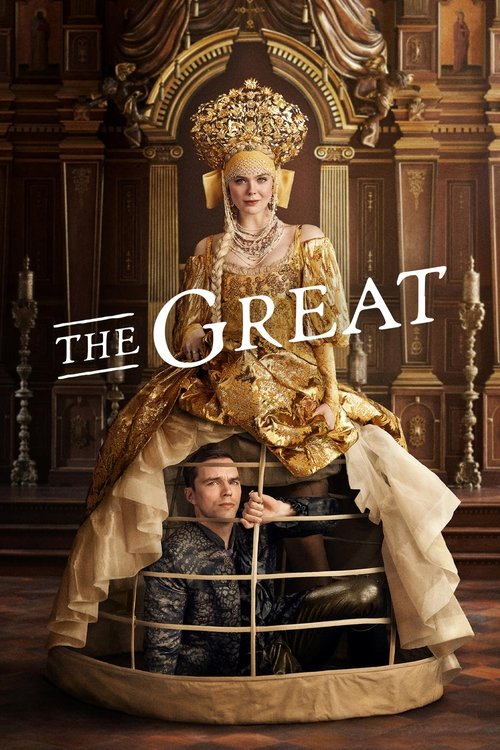














Popular
What are the main challenges Catherine faces in her rise to power?
How does Peter III's character evolve throughout the series?
What role do the supporting characters play in Catherine's journey?
How does Catherine's relationship with her mother impact her decisions?
What pivotal moments lead to Catherine's coup against Peter?
Should I watch it?
Ask Your Own Question

What is the plot?
Catherine, a young German princess, arrives in Russia to marry Emperor Peter III. She is filled with hope and excitement about her new life, but upon her arrival, she quickly realizes that the court is filled with intrigue and that Peter is not the man she expected. He is immature, self-indulgent, and obsessed with his own pleasures, which leaves Catherine feeling isolated and disillusioned.
As Catherine settles into her new life, she struggles to adapt to the rigid and often absurd customs of the Russian court. She befriends a few members of the court, including the sharp-tongued and witty lady-in-waiting, Marial, who helps her navigate the complexities of court life. Catherine's initial attempts to connect with Peter are met with indifference, as he is more interested in his own pursuits than in being a husband.
Catherine learns about Peter's relationship with his mistress, the beautiful but manipulative Countess, which deepens her sense of betrayal. She begins to realize that Peter's reign is marked by cruelty and a lack of concern for the welfare of his subjects. This realization ignites a desire within her to enact change and improve the lives of the Russian people.
Determined to gain power and influence, Catherine starts to gather allies among the nobility. She forms a bond with the ambitious and cunning nobleman, Grigor, who sees potential in her and offers to help her navigate the treacherous waters of the court. Together, they begin to plot against Peter, seeking to undermine his authority and position.
As Catherine's confidence grows, she becomes more assertive in her interactions with Peter. She confronts him about his behavior and expresses her desire for a more meaningful relationship. Peter, however, remains dismissive and continues to indulge in his whims, further alienating Catherine.
The tension between Catherine and Peter escalates when she discovers that he has been planning to send her away to a remote estate. In a moment of desperation, Catherine decides to take matters into her own hands. She gathers her supporters and begins to plot a coup against Peter, believing that she can lead Russia into a new era of enlightenment and progress.
The coup is set into motion when Catherine and her allies stage a dramatic confrontation with Peter. In a tense standoff, Catherine confronts Peter in the palace, revealing her intentions to take the throne. Peter, caught off guard, reacts with anger and disbelief. The confrontation escalates into a physical struggle, with Catherine fighting for her life and her vision for Russia.
In the chaos, Catherine's supporters manage to overpower Peter's guards, and she seizes control of the palace. Peter is ultimately captured and taken prisoner, while Catherine is declared the new ruler of Russia. The victory is bittersweet for Catherine, as she grapples with the reality of her actions and the bloodshed that has occurred.
As Catherine begins her reign, she faces the challenges of ruling a vast and complex empire. She is determined to implement reforms and improve the lives of her subjects, but she must also contend with the remnants of Peter's regime and the opposition from those who are loyal to him. The court remains a dangerous place, filled with intrigue and betrayal, and Catherine must navigate these challenges with cunning and strength.
Throughout her journey, Catherine evolves from a naive young woman into a powerful and determined ruler. She learns to wield her influence and navigate the treacherous political landscape of the Russian court, all while grappling with her own moral dilemmas and the consequences of her rise to power. The series concludes with Catherine firmly in control, but the path ahead remains fraught with uncertainty and challenges as she seeks to fulfill her vision for Russia.








What is the ending?
In the ending of "The Great," Catherine finally takes control of her destiny, leading a coup against Peter. The season culminates in a dramatic confrontation between Catherine and Peter, resulting in her emerging as the new ruler of Russia. The season closes with Catherine asserting her power, while Peter is left in a vulnerable position, hinting at the ongoing conflict between them.
As the final episode unfolds, the tension in the air is palpable. Catherine, having spent much of the season grappling with her identity and the oppressive nature of her marriage to Peter, stands resolute. The scene opens in the grand palace, where the opulence contrasts sharply with the turmoil brewing within Catherine. She has gathered her loyal supporters, including her confidante, Marial, and the ambitious Orlo, who has been a key player in her plans.
Catherine's internal struggle is evident as she prepares for the coup. She reflects on her journey from a naive young woman to a determined leader, fueled by her desire for reform and a better Russia. The camera captures her steely gaze, a mix of fear and determination, as she knows the risks involved in her actions.
The scene shifts to Peter, who is blissfully unaware of the impending coup. He is in his chambers, indulging in his whims, surrounded by his loyalists. His arrogance and entitlement are on full display, showcasing the stark contrast between him and Catherine. As he revels in his power, the audience can sense the impending doom that awaits him.
As night falls, Catherine and her supporters move stealthily through the palace. The atmosphere is tense, with shadows dancing on the walls, symbolizing the uncertainty of their mission. They reach the throne room, where Peter is still celebrating. The moment is charged with anticipation as Catherine steps forward, her heart racing, ready to confront her husband.
In a dramatic confrontation, Catherine declares her intentions to take the throne. Peter, initially dismissive, quickly realizes the gravity of the situation. The dialogue crackles with tension as they exchange barbs, revealing their deep-seated animosity and the emotional scars of their tumultuous relationship. Catherine's voice is steady, filled with conviction, while Peter's bravado begins to crumble.
The coup unfolds with chaos as Catherine's supporters clash with Peter's guards. The palace, once a symbol of Peter's power, becomes a battleground. The camera captures the frantic energy of the fight, with close-ups of faces filled with fear and determination. Catherine fights her way through, embodying the strength she has cultivated throughout the season.
In the climax of the episode, Catherine confronts Peter one last time. The emotional weight of their relationship hangs heavy in the air. Peter, now stripped of his bravado, pleads with Catherine, revealing a vulnerability that contrasts sharply with his earlier arrogance. Catherine, however, stands firm, her resolve unshaken. She understands that this moment is not just about power; it is about her reclaiming her identity and her vision for Russia.
As the dust settles, Catherine emerges victorious. The final scene shows her seated on the throne, a symbol of her hard-won power. The camera lingers on her face, capturing a mix of triumph and the weight of responsibility that now rests on her shoulders. She looks out over her new kingdom, aware that the challenges ahead will be immense, but resolute in her commitment to lead.
Peter, on the other hand, is left in a state of despair, a stark contrast to the confident ruler he once was. His fate is uncertain, but it is clear that he has lost not only his throne but also the woman he underestimated. The season ends with a sense of both closure and anticipation, as Catherine's journey is just beginning, and the conflict between her and Peter is far from over.
In this final act, the series encapsulates the themes of power, identity, and the complexities of love and ambition, leaving the audience eager for what lies ahead in Catherine's reign.
Is there a post-credit scene?
The Great does not feature a post-credit scene. The series concludes its episodes without any additional scenes after the credits roll. Each episode wraps up its narrative arcs, focusing on the tumultuous and often darkly comedic journey of Catherine the Great as she navigates the complexities of the Russian court and her tumultuous relationship with Emperor Peter III. The storytelling is rich and detailed, leaving viewers with a sense of closure at the end of each episode, rather than teasing future developments through post-credit content.
What are the main challenges Catherine faces in her rise to power?
Catherine, portrayed by Elle Fanning, faces numerous challenges in her rise to power, including navigating the treacherous court politics of Russia, dealing with her husband Peter III's erratic behavior, and overcoming the skepticism of the nobility. Her initial naivety is tested as she learns to manipulate those around her, including forming alliances and confronting betrayals.
How does Peter III's character evolve throughout the series?
Peter III, played by Nicholas Hoult, begins as a whimsical and immature ruler, often indulging in childish antics and showing little regard for the responsibilities of his position. As the series progresses, his character reveals deeper insecurities and vulnerabilities, particularly in his relationship with Catherine. His struggle to maintain control and his eventual realization of Catherine's ambition lead to a complex dynamic between the two.
What role do the supporting characters play in Catherine's journey?
Supporting characters such as Grigor Dymov, played by Adam Godley, and Aunt Elizabeth, portrayed by Fiona Shaw, significantly influence Catherine's journey. Grigor serves as both a confidant and a source of comic relief, while Aunt Elizabeth embodies the traditional expectations of women in the court, often challenging Catherine's modern views. Their interactions highlight the societal constraints and personal relationships that shape Catherine's decisions.
How does Catherine's relationship with her mother impact her decisions?
Catherine's relationship with her mother, who represents the traditional values of the Russian aristocracy, deeply impacts her decisions. Her mother's expectations weigh heavily on Catherine, pushing her to conform to societal norms. This tension fuels Catherine's desire to break free from these constraints and forge her own path, ultimately influencing her political strategies and personal relationships.
What pivotal moments lead to Catherine's coup against Peter?
Several pivotal moments lead to Catherine's coup against Peter, including his increasing instability and the realization that he is unfit to rule. Key scenes involve Catherine gathering support from influential nobles, her strategic manipulation of court dynamics, and her growing confidence in her own abilities. The culmination of these events is marked by a dramatic confrontation with Peter, where she asserts her power and determination to take the throne.
Is this family friendly?
"The Great" is a satirical and darkly comedic take on the life of Catherine the Great, and while it has moments of humor and wit, it contains several elements that may not be suitable for children or sensitive viewers.
-
Sexual Content: The show features explicit sexual scenes and innuendos, often portrayed in a humorous or exaggerated manner, but they can be graphic and frequent.
-
Violence: There are instances of physical violence, including duels and confrontations that can be intense. Some scenes depict the brutality of court life and the consequences of power struggles.
-
Language: The dialogue includes strong language and profanity, which may be inappropriate for younger audiences.
-
Themes of Betrayal and Manipulation: The narrative explores complex themes of betrayal, manipulation, and political intrigue, which may be difficult for younger viewers to understand or process.
-
Mental Health Issues: Characters experience emotional turmoil, including depression and anxiety, which are depicted in a raw and sometimes unsettling manner.
-
Death and Loss: The show addresses themes of mortality and the impact of loss, which can be heavy and emotional.
Overall, while "The Great" offers a unique and entertaining perspective on historical events, its mature themes and content make it more suitable for adult audiences.