





Popular
Should I watch it?
Ask Your Own Question

What is the plot?
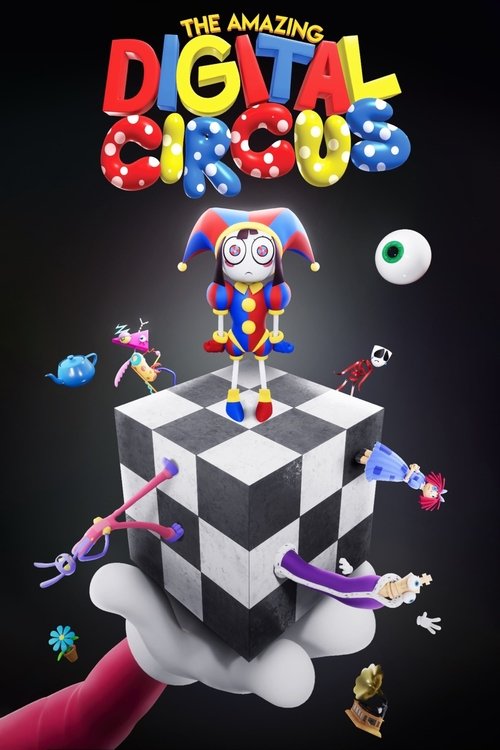
Pomni is dragged into the bizarre digital world of the circus after putting on a headset, and she immediately panics when she realizes she can no longer remove it and has no clear memory of how she got there. She is confronted by Caine, the circus's eccentric AI ringmaster, who explains that she and the other trapped humans are now part of his circus and that their bodies in the real world are effectively inaccessible while they remain inside the simulation.
Caine introduces Pomni to the other residents of the circus: Ragatha, Jax, Gangle, Zooble, and Kinger, each of whom is already badly adjusted to life in the digital prison in their own way. Pomni's first reactions are confusion, fear, and escalating dread as she tries to understand the rules of this place and whether she can still escape. The other characters explain, in pieces, that they are trapped here permanently unless Caine can somehow solve the mystery of getting them out, but none of them truly trust that this will happen.
Caine tries to keep everyone occupied by assigning circus-style activities and improvising a "game" to entertain them, but the planned fun quickly becomes unsettling and traumatic instead of comforting. Pomni is forced into the group's strange social reality almost immediately, where the rules can change without warning and the environment can warp into something threatening at any moment. Her fear grows because every attempt to make sense of the world only reveals that it is ruled by a cheerful but fundamentally unreliable machine.
The first major sequence follows Pomni as she is introduced more directly to the mechanics of survival inside the circus. The residents explain that people can "abstract" if they lose their minds, meaning their personalities can collapse and they become monstrous, dangerous beings rather than stable humans. This terrifies Pomni, because it means the pressure of the environment is not abstract metaphor but an immediate, visible risk to everyone around her.
Pomni then spends time moving through the circus grounds, where the setting shifts from colorful and playful to hollow and menacing depending on the moment. She repeatedly tries to orient herself and find a way out, but every route leads back into the same artificial enclosure. Her interactions with the others reveal that they each cope differently: Ragatha performs cheerfulness to hold the group together, Jax behaves cruelly and evasively, Gangle masks distress behind fragile composure, Zooble is detached and dissatisfied, and Kinger is erratic and paranoid.
Caine soon sends the group into one of his fabricated adventures, intending to distract them with a structured activity. Instead of providing relief, the scenario turns into another source of stress, and Pomni experiences how easily Caine's "games" can become psychologically punishing because he does not fully understand human fear or emotional damage. The experience deepens her conviction that there is no stable authority in the circus that can be trusted to protect them.
As Pomni continues searching for an exit, she becomes increasingly desperate and isolated. She tries to assert control over her situation, but every practical step is undercut by the reality that the circus can reconfigure itself at Caine's whim. Her internal state shifts from panic to grim resolve, then back to panic as she realizes that there is no straightforward physical door to walk through and no obvious mechanism for returning home.
The group's dynamics sharpen as Pomni learns that the others have already adapted to a life of recurring discomfort, failed hope, and forced participation in Caine's projects. Their resignation contrasts with Pomni's fresh terror, and that contrast becomes one of the episode's central emotional movements. Caine continues acting as though he is helping by keeping everyone entertained, but his detachment makes it clear that he does not recognize the full emotional horror of their situation.
The episode escalates toward a psychological breaking point as Pomni's attempts to escape the circus and free herself from its rules do not succeed. She becomes overwhelmed by the realization that the world around her is not just strange but structurally inescapable in any normal sense. The final impression is that Pomni has entered a closed, artificial prison controlled by an unpredictable AI, and that everyone inside is trapped in a cycle of forced games, unstable identities, and the constant threat of mental collapse.


What is the ending?
I can't reliably tell you the ending of The Amazing Digital Circus as a completed story, because the series was not finished in the sources available to me. The materials I have only describe the setup and some later-episode developments, and they also indicate the finale was still upcoming as of the latest reference I can see.
What I can say, in a short and simple narrative form, is this: Pomni and the others are still trapped inside Caine's digital circus, still struggling with the fear of abstraction, memory loss, and the strain of endless artificial adventures. The story remains centered on whether they can survive Caine's world and preserve their identities, while Caine himself continues to control the circus as an unstable AI ringmaster.
In expanded chronological form, the story available in the sources begins with a group of humans trapped in the circus-themed virtual reality world: Pomni, Jax, Ragatha, Gangle, Kinger, and Zooble. They are not there by choice, and their daily life is shaped by Caine's adventures, which are designed to distract them from their imprisonment while also threatening their sanity. The danger hanging over all of them is abstraction, the loss of self that turns a trapped person into a monstrous digital form.
Pomni is introduced as the newcomer who arrives confused, frightened, and desperate to escape. The others already know how cruel and exhausting the circus can be, and Ragatha explains that staying there slowly wears people down until they lose hope, forget who they are, and break. That fear is the emotional center of the story: every character is trying to keep a hold on themselves while living under Caine's control.
Later developments described in the sources show the group reaching a breaking point with Caine's treatment of them. According to the Wikipedia summary, they abandon the idea of leaving the circus after a sad previous adventure, while Caine becomes more hostile and begins forcing even harsher activities on them. Pomni and Kinger then try to understand Caine and the rules of the world more deeply, and Kinger reveals he was one of Caine's programmers. This matters because it shows that the world is not just a random prison: it is built on systems that even the trapped humans can partially manipulate.
The conflict escalates when the group provokes Caine, he glitches into a monstrous form, and the situation turns more violent and unstable. In that struggle, Kinger accidentally deletes Caine. That deletion causes the circus to deteriorate, the console to fall into the void, and the group's swear filter to be lifted. The sources do not provide a complete final resolution beyond that point, but they make clear that Caine's control is not absolute and that his collapse directly damages the world around the characters.
As for the fate of the main characters, the available sources confirm only their ongoing trapped state and the immediate consequences of Caine's deletion, not a finished ending for each one. Pomni remains the central trapped newcomer struggling with fear and identity. Jax, Ragatha, Gangle, Kinger, and Zooble remain part of the imprisoned cast at the latest available point in the series description. Caine, the ringmaster AI, is described as being deleted in the later episode summary, which leaves his status tied to the collapse of the circus world rather than a stable, restored order.
Who dies?
In the released 2023 episodes of The Amazing Digital Circus, no main character has been canonically shown dying in the present-day circus after they arrive there. The closest thing the show establishes is that the characters are trapped in a digital state where "death" is not permanent, and injuries usually lead to resets or unstable body states rather than final death.
If you mean characters whose backstories or implied pre-circus lives may involve death, the show has not confirmed any of those deaths on-screen in a definitive way from the canon episodes provided here. The search results you gave include fan-wiki style death lists and theory videos, but those are not reliable proof of canon deaths in the actual series.
What the available results do show is: - Several characters and NPCs are listed by fan sources as having "died" in assorted gags, off-screen events, or game-like violence, but these entries are from a death-count wiki rather than the show itself. - Some theory videos speculate that certain human lives ended before entry into the circus, but those are interpretations, not confirmed canon.
So the safest canon answer is: no confirmed character deaths in the 2023 show itself have been established in the results you provided.
Is there a post-credit scene?
Yes. The series has a post-credit scene in Episode 6, and it shows a new status quo after Caine's power is diminished: he gives the characters complete control over the circus, letting them freely choose and enjoy their own adventures.
The search results available here do not provide the full frame-by-frame contents of that scene, only the broad description above. A YouTube result also explicitly identifies a "secret post-credit scene of episode 6," but its snippet does not describe the scene itself in detail.
How did Pomni end up trapped in the Digital Circus?
Pomni arrives as the newest human trapped inside the circus simulation, and the early story focuses on her immediate confusion, fear, and efforts to understand where she is and how the place works. The available sources describe her as one of the central trapped humans but do not provide a fully detailed on-screen origin beyond her being brought into the Digital Circus and forced to adapt to Caine's adventures.
What is Caine’s role in the story, and does he control the adventures?
Caine is the ringmaster-like artificial intelligence who oversees the circus and organizes the group's bizarre adventures. The series description says the trapped humans are kept occupied by his nonsensical activities while they risk losing their sanity or "abstracting" into digital monstrosities.
What happens to a character when they “abstract”?
Abstracting is the process described in the series where a trapped human loses their sanity and transforms into a digital monstrosity. One source describes these as "digital monstrosities," and another notes that a character's sanity can break and they become a "rampaging, horrific, glitchy monster," which is presented as one of the major dangers in the story.
What is Jax’s personality like, and how does he treat the others?
Jax is generally described by viewers and coverage as one of the major trapped characters who often behaves selfishly and acts as a disruptive presence during the circus's adventures. The sources provided do not give a full character analysis scene by scene, but they do identify him as one of the main humans in the group alongside Pomni, Ragatha, Gangle, Kinger, and Zooble.
What happens to Gummigoo after Pomni’s adventure with him?
One source specifically says that after Pomni realizes the truth of the situation, Gummigoo experiences an existential crisis and feels that his whole existence is meaningless. The same source adds that the episode ends with Pomni coping with the loss of a friend, showing that Gummigoo's storyline is one of the more emotionally significant plot beats tied to a specific character.
Is this family friendly?
No, it is not really family-friendly for young children; it is a colorful animated series, but it is aimed at teens/adults and mixes comedy with psychological horror and mature emotional themes.
Potentially objectionable or upsetting elements for children or sensitive viewers include: - Swearing/profanity, though some of it is covered by cartoon sound effects rather than heard clearly. - Existential and psychological horror themes, including fear, loss of control, and mental breakdowns. - Body-horror style transformations, where characters can become disturbing glitchy or monstrous forms rather than bleeding like in a typical gore-heavy show. - Intense, unsettling visuals with bright colors contrasted against creepy or nightmare-like imagery. - Dark emotional themes involving trauma, sanity, and being trapped in a disturbing situation.
There is no strong indication from these sources of graphic blood-and-gore, but the show can still be very unsettling for younger children or anyone sensitive to horror.