



























Popular
How is Lee Harker connected to Longlegs personally, and why does he seem to focus on her?
What is the deal between Ruth Harker and Longlegs, and how does it affect Lee’s family?
How do the dolls in Longlegs work, and which characters are controlled by them?
Why does Longlegs choose families with 9-year-old daughters born on the 14th?
What role does William Carter play in Lee’s investigation, and how is his family tied to the case?
Should I watch it?
Ask Your Own Question

What is the plot?
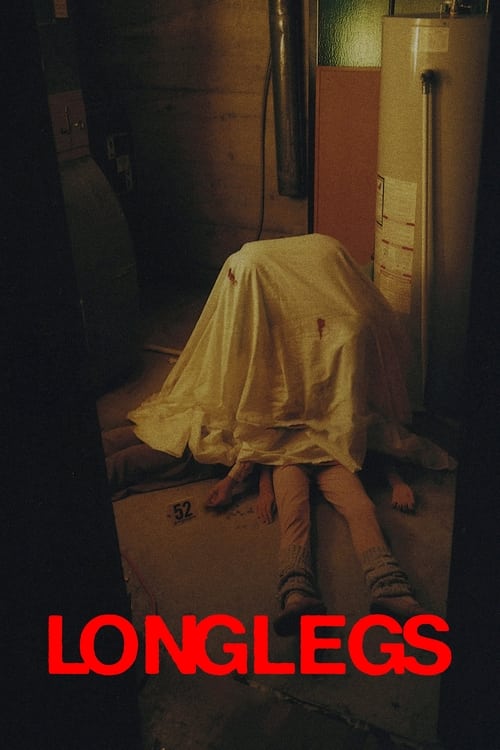
In 1974 Oregon, a young Lee Harker wanders through the snowy silence with her Polaroid camera, following a strange, disembodied voice that seems to pull her deeper into the dark woods and toward a lonely house. Inside that house waits Longlegs, a man with pale makeup, an eerie, childlike manner, and an almost theatrical way of speaking, and the encounter leaves an imprint on Lee that the film will not fully explain until much later. The moment is brief but wrong in a way that feels permanent: the house is still, the air feels contaminated, and Longlegs' presence hangs over the scene like a curse that has already begun. What the film withholds here becomes the engine of everything that follows, because this childhood encounter is not just a memory but the hidden origin point of the nightmare Lee will spend the rest of the story trying to solve.
Twenty years later, in the 1990s, Lee Harker is now an FBI agent working in Oregon, introduced as unusually precise, emotionally sealed, and capable of reading details that other agents miss. Her supervisor, William Carter, assigns her to a disturbing case involving a string of familicides and murder-suicides in which the fathers have killed their wives and children before turning the gun on themselves. Every scene of carnage follows a similar pattern: there is no obvious outside intruder, no sign of forced entry, and at each site investigators find a cryptic letter signed "Longlegs" and marked with Satanic glyphs. The case has haunted the bureau for years precisely because Longlegs seems to leave almost no trace of how he reaches these men or why they obey him, and the murders read less like a conventional serial killing than like some hidden ritual moving from house to house.
Lee enters the investigation alongside another agent, and almost immediately her instinctive, almost unnatural perception sets her apart. When she and her partner go door-to-door in a neighborhood, Lee identifies the correct house before anyone else has clear evidence, and the moment proves fatal for her partner, who is shot in the head when the door opens. Lee pushes forward anyway, enters the house, and finds the murderer sitting as if waiting for her, hands raised in surrender. That combination of eerie intuition and unflinching calm gets the attention of William Carter, who begins to suspect that Lee may have some kind of psychic sensitivity rather than merely sharp instincts. He places her deeper into the Longlegs case, and the investigation becomes an uneasy partnership between methodical FBI procedure and something more occult, more intuitive, and more dangerous than either Lee or Carter wants to name out loud.
Lee studies the letters at the crime scenes and begins to decode the Satanic symbols hidden in them. The messages are not random taunts; they are clues, though they are clues written in a language that seems designed to make reason fail. As she traces the pattern, she discovers that the murdered families all share a hidden similarity: each family includes a 9-year-old daughter born on the 14th day of the month, and the murder dates form an occult triangle on a calendar with one date missing. The case shifts from brutal homicide to something more systematic, as if each family has been selected according to a secret arithmetic. Lee's ability to understand the symbols begins to resemble a trap of its own, because the more she learns, the more the case seems to turn inward, as though it is already aware of her.
At home, Lee lives in isolation and carries visible tension in every interaction with her mother, Ruth Harker, whose relationship with her is strained and emotionally distant. Lee tries to contact Ruth, but even those exchanges feel uneasy, as if the family bond has been frayed for years by something never spoken aloud. One night, Lee hears pounding at her door and sees a figure standing in the woods outside her isolated house. When she steps out to confront it, the figure slips into her home unseen, and by the time she gets back inside, the intruder is gone. In the house she finds an envelope with instructions not to open it until January 14, a date that lands with unnerving specificity because it ties her personal life to the birthdays already embedded in the case. The film keeps tightening this knot: Lee is not merely investigating Longlegs; Longlegs appears to have been circling her for years.
The investigation deepens when Lee and Carter track one of the families' cases to a farm and uncover the physical evidence hidden beneath the floorboards of a barn. They find a lifelike doll meant to resemble a young girl named Carrie Anne, and the discovery suddenly makes the murders feel even more intimate and grotesque. This is the first real hint that the killings are not being carried out through ordinary coercion or simple madness, but through some object-based mechanism, some hidden channel of influence that reaches into the home itself. The doll is not a symbol; it is a tool, and the implication is that the families have been targeted and prepared in advance.
As more pieces come together, the investigation circles back to the opening case material and to Longlegs himself, who has long existed as a mythic presence at crime scenes before becoming a man the bureau can physically pursue. Using a snapshot and the evidence gathered across the cases, the FBI eventually tracks and captures him, and the film briefly gives his full name as Dale Ferdinand Cobble. Longlegs is brought in, but even in custody he remains unnervingly performative, slipping between mockery, confession, and grotesque theatricality. He does not behave like a man whose plan has failed; he behaves like someone whose plan is already deeper than the arrest itself. The interrogation room becomes another stage for him, and the film's tension shifts from "Can they catch him?" to "What has he already set in motion?"
The answer comes through the hidden history of Lee's own family. The film reveals that Longlegs did not simply choose random victims and disappear; instead, he made a bargain that reaches directly into the Harker household. Ruth Harker is exposed as his longtime accomplice, having agreed to help him in exchange for sparing Lee's life. The revelation recasts the entire case in a new and cruel light. Longlegs lived in the Harker basement, where he made Satanic dolls, and Ruth, dressed as a nun, delivered those dolls to targeted households under a guise of harmless religious service. The mothers and fathers who received them had no idea that the objects were part of a mechanism designed to corrupt the family from within, turning the father into the agent of slaughter. The film does not present this as a simple curse in the abstract; it presents it as a long, deliberate system of domestic infiltration, where the evil enters under the appearance of care and trust.
This revelation also explains the strange, lingering presence of Lee's childhood connection to Longlegs. The opening scene is no longer a mystery of an isolated encounter; it is the first visible thread in a much larger web tying Lee's life, her mother's choices, and Longlegs' occult operation together. Lee's apparent clairvoyance now seems less like a gift arriving from nowhere and more like a wound that has shaped how she perceives the world. The story hints that Longlegs has been manipulating her since childhood, perhaps even grooming her intuition to serve the investigation that will eventually expose him. What once looked like supernatural ability becomes harder to separate from trauma, conditioning, and the story's broader suggestion that the occult may be working through human vulnerability rather than replacing it.
The final stretch becomes a race against time as Lee realizes the case is no longer just historical but immediate and personal. The pattern of the 14th birthday, the dolls, the buried evidence, and Ruth's involvement all converge when Lee discovers that the next stage of Longlegs' plan is about to reach her own family again. She rushes to the Harker home and learns that it is not only her birthday but also Ruby's--the child now caught in the center of the nightmare. By the time she arrives, Ruth has already delivered another doll into the house, and the old pattern is about to repeat itself under the same roof that once sheltered Longlegs in secret. The family dinner or domestic gathering that follows is thick with dread, because Lee can see what is happening and the others cannot or will not believe her warnings.
Lee pleads with William Carter, Anna, and the others in the house to recognize that Ruth is the accomplice and that the doll must be destroyed, but her desperate warnings meet disbelief and inertia. The tension becomes brutal and immediate when Carter instructs Anna to go into the kitchen, and there Carter suddenly stabs his wife fatally. The violence hits like a rupture in the domestic space, turning the home into exactly what the case has always been: a place where the family is made to destroy itself from within. Lee responds by holding Ruth at gunpoint and demanding that she stop, but the crisis has already crossed the point of reversal. When Carter returns to the living room and refuses to halt the bloodshed, Lee shoots him. The sequence is fast, ugly, and devastating, and every emotional line in Lee's life seems to collapse at once: her professional investigation, her family history, and her fragile trust in anyone around her all shatter in the same space.
Ruth is also shot by Lee in the chaos, and the scene leaves the household stripped down to its bare essentials: Lee, Ruby, and the doll that still carries the possibility of another death. Lee tries to destroy the doll to save Ruby, but her gun is empty. That detail lands with sickening finality, because after everything she has uncovered, after all the hours spent decoding glyphs and tracing patterns, she is left powerless in exactly the moment the threat becomes physical and irreversible. The film's horror here is not just that the evil persists, but that the machinery of the evil has been embedded so deeply that ordinary force may already be too late. Lee's desperation is palpable, and the house feels less like a place of safety than the last chamber of a long, predatory ritual.
The story then cuts back to Longlegs in custody for the final time, and his prison-cell presence becomes the film's final grotesque punctuation mark. He is seen once more in interrogation, and he repeats "Hail Satan" before blowing a kiss toward the audience, an act that makes his defeat feel less like defeat than performance. In some accounts of the ending, Longlegs takes his own life in custody; in others, the film's final emphasis is less on the mechanics of his death than on the fact that the evil he initiated remains active beyond him. What is certain is that the film refuses to give the audience clean closure. Longlegs may be physically contained, but the doll system, the bargain with Ruth, and the contamination of Lee's family history have already done their damage.
The last movement of the film leaves Lee in a ruin of revelations and consequences. She has learned that the case was never just about a serial killer moving through Oregon; it was about a hidden domestic conspiracy, a Satanic manipulation scheme built on dolls, family trust, and a decades-long pact between Longlegs and Ruth Harker. She has killed her mother to stop the immediate chain of destruction, but that act does not restore safety or certainty. Ruby is still there, the doll is still there, and the film refuses to tell the viewer whether the influence embedded in those objects has truly ended. The final emotion is not victory but suspended dread, as though Lee has uncovered the truth only to discover that the truth itself is another room with the door still open. The ending lingers on the possibility that the corruption Longlegs created may continue to shadow Lee and the child left behind, and the story closes not with resolution but with the sense that the nightmare has merely changed shape.



What is the ending?
Lee Harker reaches the Carter house just as the last part of Longlegs' plan is unfolding. She kills William Carter after he murders his wife, then kills her own mother Ruth when Ruth tries to attack Ruby, but Lee cannot destroy the doll, and Ruby is left staring at it as the ending cuts away.
The ending unfolds like this:
- Lee wakes up in the basement and answers the phone. A demonic voice warns her about Ruby Carter's ninth birthday party, which is happening that day.
- Lee realizes the Carters are the next target and rushes to their house.
- She arrives after Ruth has already delivered the doll and the family has been put under its influence.
- William, now possessed, kills his wife Anna.
- Lee shoots William dead to protect Ruby.
- Ruth then lunges at Ruby with a dagger, and Lee shoots Ruth to stop her.
- Lee tries to destroy the doll, but her revolver misfires, leaving her unable to finish it.
- Ruby does not move away from the doll; she keeps staring at it as Lee stands there with no clear way to end the danger.
The fates of the main characters at the end are:
- Lee Harker survives, but she is left with the aftermath of killing both William and Ruth and is stuck facing the doll's continuing threat.
- Ruth Harker dies by Lee's hand after trying to kill Ruby.
- William Carter dies after killing Anna and then being shot by Lee.
- Anna Carter dies at William's hands.
- Ruby Carter is alive at the end, but she is still trapped in the final moment with the doll and its influence unresolved.
- Longlegs is already dead by this point, but his plan is still active through the doll and Ruth's actions.
The movie ends on a chilling, unresolved note: Lee has stopped the immediate killings, but the doll remains, Ruby is still in danger, and the evil tied to Longlegs has not fully gone away.
Is there a post-credit scene?
No. Longlegs (2024) does not have a post-credits scene, and there is also no mid-credits extra footage.
The credits simply roll without any added teaser or bonus scene, so if you stay through them you are only seeing the names of the cast and crew, not new story content.
How is Lee Harker connected to Longlegs personally, and why does he seem to focus on her?
In the film's story, Longlegs does not treat Lee as just another investigation target: he has a direct, hidden connection to her from childhood, which is later revealed to be tied to Ruth's pact with him and the doll placed in Lee's life. That connection is what makes her memories, instincts, and investigation so central to the case, and it explains why Longlegs appears to know her so well.
What is the deal between Ruth Harker and Longlegs, and how does it affect Lee’s family?
Ruth is revealed to have made a bargain with Longlegs to spare Lee, and that agreement becomes the mechanism that lets Longlegs stay close to the Harker family and continue his killings through the dolls Ruth delivers. The arrangement is the key reason Lee's upbringing, memory gaps, and family relationships are all bound up with the murders.
How do the dolls in Longlegs work, and which characters are controlled by them?
The film establishes that Longlegs creates Satanic dolls that are delivered into family homes, where they influence the household and help trigger the fathers' familicides. Lee is specifically affected by one of these dolls, which blocks her memories of Longlegs while still exerting a hidden influence over her behavior.
Why does Longlegs choose families with 9-year-old daughters born on the 14th?
The investigation reveals a repeating pattern: each family targeted by Longlegs includes a 9-year-old daughter born on the 14th day of the month. That detail is one of the clues Lee uses to understand the killer's selection process and the occult logic behind the murders.
What role does William Carter play in Lee’s investigation, and how is his family tied to the case?
William Carter is Lee's supervisor and the person who assigns her to the Oregon murder-suicide case, placing him directly inside the investigation's structure. By the later parts of the story, his household becomes entangled with the same occult pattern, showing that the killer's reach extends into the investigators' own lives.
Is this family friendly?
No, it is not family-friendly. It is an R-rated horror thriller with bloody violence, disturbing images, supernatural/occult threats, and strong language, so it is better suited for adults and older teens rather than children.
Potentially objectionable or upsetting elements include: - Graphic violence and gore, including bloody crime scenes and injury detail. - Familial murder-suicide material and other intensely disturbing violence involving parents and children. - Dead bodies, blood, and gruesome imagery such as maggots. - Occult and Satanic references/symbols, which may be especially upsetting for sensitive viewers. - Strong language, though it is described as infrequent in one classification. - A very intense, graphic suicide scene noted by one review source.
If you want, I can also give you a very short "safe for what ages?" recommendation based on how sensitive the viewer is.








