















Popular
Should I watch it?
Ask Your Own Question

What is the plot?
Sorry, we aren't able to watch and write up a full detailed plot yet. Check back in a few days.



What is the ending?
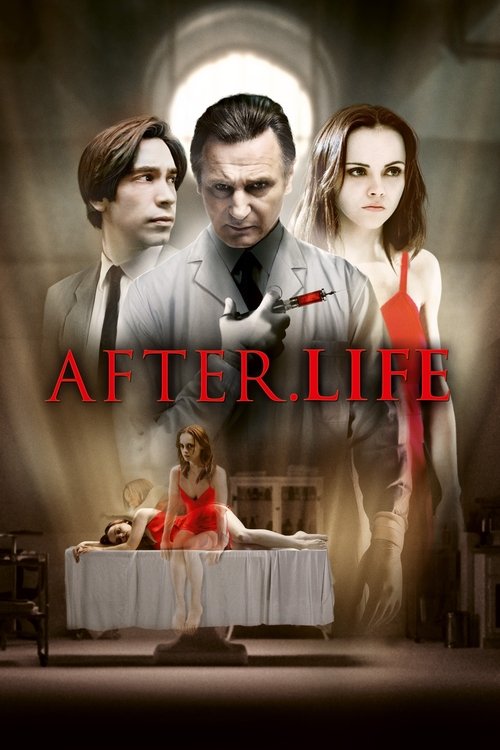
In the ending of "After.Life," Anna, who has been struggling with the reality of her death, ultimately confronts her fate. After a series of intense and emotional encounters with Eliot, the funeral director, she realizes that she is indeed dead. In a climactic moment, she fights against Eliot's control, ultimately breaking free from his grasp. The film concludes with a haunting ambiguity as Anna's fate remains uncertain, leaving viewers questioning the nature of life and death.
As the film approaches its conclusion, the tension escalates within the dimly lit confines of the funeral home. Anna, portrayed by Christina Ricci, is initially disoriented and frightened, grappling with the realization that she may be dead. Eliot, played by Liam Neeson, is a calm yet unsettling presence, guiding her through what he claims is the process of acceptance.
In a pivotal scene, Anna, still in disbelief, begins to piece together the events leading to her current state. She recalls the car accident that left her unconscious, and the memories flood back, intensifying her emotional turmoil. Eliot, with his soothing yet eerie demeanor, attempts to convince her that she is merely transitioning to the next phase of existence. He explains that he has a unique ability to communicate with the deceased, and he believes he is helping her.
As Anna's fear grows, she becomes increasingly defiant. She struggles against Eliot's attempts to control her, both physically and emotionally. In a moment of desperation, she fights back, pushing against the boundaries of her perceived reality. The struggle is visceral; Anna's determination to reclaim her life is palpable. She screams, pleading for her existence to be acknowledged, and in this moment, the audience feels her desperation and longing for life.
The climax unfolds as Anna manages to break free from Eliot's grasp. She runs through the funeral home, her heart racing, the walls closing in around her. The atmosphere is thick with tension, and the dim lighting casts long shadows, symbolizing her fight against the darkness of death. In a final confrontation, Anna confronts Eliot, demanding to be recognized as alive. The emotional weight of her struggle is evident as she battles not just for her life, but for her identity and agency.
In the final moments, Anna's fate hangs in the balance. She reaches a door that symbolizes her escape from the confines of the funeral home. As she pushes it open, the screen fades to black, leaving her fate ambiguous. The audience is left to ponder whether she has truly escaped the clutches of death or if she remains trapped in a liminal space between life and the afterlife.
Meanwhile, Eliot's character is left in a state of unresolved tension. His role as the facilitator of death is called into question as Anna's defiance challenges his authority. The film closes with a lingering sense of uncertainty, emphasizing the themes of life, death, and the struggle for autonomy in the face of overwhelming circumstances. The fate of Anna remains open-ended, inviting viewers to reflect on the nature of existence and the choices we make in life.
Is there a post-credit scene?
The movie "After.Life," produced in 2009, does not have a post-credit scene. The film concludes with its final moments, leaving the audience to reflect on the themes of life, death, and the uncertainty of what lies beyond. The narrative wraps up with a haunting atmosphere, focusing on the protagonist, Anna, and her struggle to understand her fate, rather than providing any additional scenes or revelations after the credits roll.
What happens to Anna after she wakes up on the table?
After Anna wakes up on the table, she finds herself in a funeral home, where she is confronted by Eliot, the funeral director. He informs her that she is dead and begins to prepare her for burial. Anna is confused and terrified, struggling to understand her situation as Eliot tries to convince her that she is in a state of transition.
What is Eliot's role in Anna's experience?
Eliot serves as both a caretaker and a manipulator in Anna's experience. He believes he has the ability to help the deceased transition to the afterlife, but his methods are questionable. He often speaks to Anna about her life and death, attempting to guide her through her fears, but his intentions become increasingly ambiguous, leading to a sense of dread and uncertainty.
How does Anna's relationship with her boyfriend Paul affect the story?
Anna's relationship with Paul is central to her emotional turmoil throughout the film. As she lies on the table, she recalls moments with Paul, which highlight their love and the pain of separation. Paul's desperate search for Anna after she goes missing adds tension to the narrative, as he grapples with his grief and the possibility of her death, ultimately leading him to confront Eliot.
What is the significance of the flashbacks in Anna's story?
The flashbacks in Anna's story serve to reveal her past, her relationships, and her emotional struggles. They provide context for her character, showcasing her insecurities and the complexities of her life. These memories contrast sharply with her current situation, emphasizing her fear and confusion as she tries to reconcile her past with her present state of being.
How does Eliot's character evolve throughout the film?
Eliot's character evolves from a seemingly calm and collected funeral director to a more sinister figure as the story progresses. Initially, he appears to be a compassionate guide for Anna, but as his true nature is revealed, his obsession with control and power over the dead becomes apparent. His interactions with Anna shift from nurturing to manipulative, showcasing his darker motivations and the moral ambiguity of his actions.
Is this family friendly?
"After.Life," produced in 2009, is not considered family-friendly due to its mature themes and graphic content. Here are some potentially objectionable or upsetting aspects that may affect children or sensitive viewers:
-
Death and Mortality: The central theme revolves around death, the afterlife, and the process of dying, which may be distressing for younger audiences.
-
Graphic Imagery: The film contains scenes that depict corpses and the physicality of death, including close-ups of a body being prepared for burial.
-
Intense Emotional Scenes: Characters experience profound grief, fear, and confusion, which may be unsettling for viewers who are sensitive to emotional distress.
-
Violence: There are moments of implied violence and tension that could be disturbing, including scenes that suggest harm or danger.
-
Themes of Control and Manipulation: The film explores themes of power dynamics and manipulation, which may be complex and unsettling for younger viewers to understand.
-
Psychological Horror Elements: The film incorporates psychological horror, creating an atmosphere of dread and uncertainty that may be frightening.
Overall, the film's exploration of dark themes and its unsettling visuals make it more suitable for mature audiences.






