
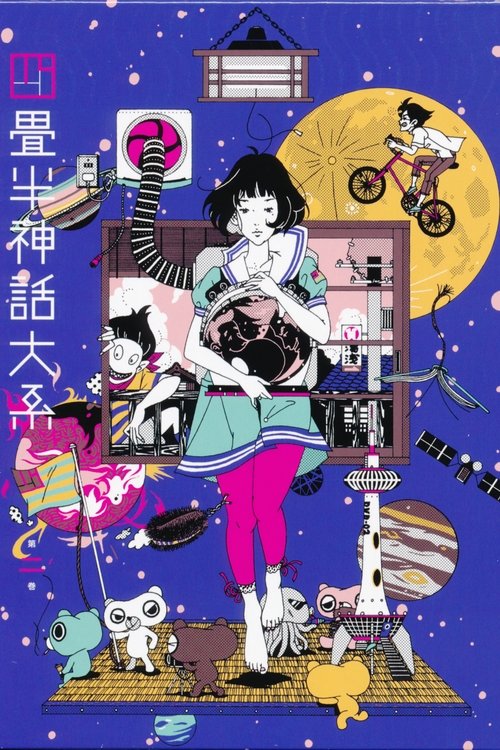








Popular
What is the significance of the 'Tatami Galaxy' in the story?
How does the character of Akashi influence the protagonist's journey?
What role does the 'God of the Universe' play in the protagonist's life?
How does the protagonist's relationship with his friends evolve throughout the specials?
What is the impact of the protagonist's repeated failures on his character development?
Should I watch it?
Ask Your Own Question

What is the plot?
In "The Tatami Galaxy" Specials, the narrative continues to explore the life of the unnamed protagonist, who is a college student navigating the complexities of his university experience. The story begins with the protagonist reflecting on his past choices and the various paths he could have taken during his time at college. He is haunted by the idea of wasted opportunities and the impact of his decisions on his life.
The protagonist recalls his first encounter with the enigmatic Ozu, a fellow student who embodies chaos and mischief. Ozu introduces the protagonist to the idea of living life to the fullest, but his influence often leads to trouble. The protagonist is drawn to Ozu's carefree attitude, despite the negative consequences that often follow. This relationship sets the stage for the protagonist's internal conflict between pursuing a conventional path and embracing the unpredictable nature of life.
As the story unfolds, the protagonist finds himself in various scenarios that highlight the different clubs and activities available at the university. Each scenario presents a unique set of characters and challenges, showcasing the protagonist's attempts to fit in and find his place. He experiences moments of joy and camaraderie, but these are often overshadowed by feelings of isolation and regret as he realizes that he is not truly connecting with those around him.
In one sequence, the protagonist joins a club that focuses on creating a film. He becomes excited about the project and invests a lot of time and energy into it. However, as the production progresses, he becomes increasingly frustrated with the lack of direction and the chaotic nature of the group. Ozu's antics disrupt the workflow, leading to conflicts among the members. The protagonist's desire for a meaningful experience clashes with the reality of the situation, leaving him feeling disillusioned.
Another significant moment occurs when the protagonist meets Akashi, a girl who represents a more stable and grounded path. He is immediately drawn to her, seeing her as a potential escape from the chaos that Ozu brings into his life. However, his inability to express his feelings and his tendency to overthink lead to missed opportunities for connection. The tension between his attraction to Akashi and his loyalty to Ozu creates a rift in his emotional state, causing him to spiral further into confusion.
As the protagonist continues to navigate his college life, he faces a series of choices that lead him down different paths. Each decision results in a new timeline, showcasing the consequences of his actions. He grapples with the idea of fate versus free will, questioning whether he is truly in control of his life or if he is merely a pawn in a larger game. The repetition of these scenarios emphasizes his struggle to break free from the cycle of regret and dissatisfaction.
In the climax of the Specials, the protagonist confronts Ozu about their friendship and the impact it has had on his life. This confrontation is charged with emotion, as the protagonist expresses his frustration and desire for change. Ozu, in his typical nonchalant manner, brushes off the seriousness of the situation, leading to a moment of realization for the protagonist. He understands that he must take responsibility for his own happiness and make choices that align with his true desires.
The narrative concludes with the protagonist reflecting on his journey and the lessons learned from his experiences. He acknowledges the importance of embracing uncertainty and the value of genuine connections with others. The final scenes depict him taking a step towards a new beginning, symbolizing his growth and the potential for a brighter future. The story leaves viewers with a sense of hope, as the protagonist finally begins to forge his own path, free from the constraints of his past.
🔥 Trending TV Shows Now
Browse All TV Shows →






What is the ending?
In the ending of "The Tatami Galaxy" Specials, the protagonist, known as Watashi, reflects on his experiences throughout his college life. He realizes the importance of making choices and the impact they have on his relationships. Ultimately, he finds a sense of closure and acceptance, particularly in his feelings for Akashi, leading to a hopeful yet ambiguous conclusion.
As the final scenes unfold, Watashi stands in a dimly lit room, surrounded by the remnants of his past choices. The air is thick with nostalgia and regret as he recalls the various paths he could have taken during his college years. Each memory plays out like a vivid dream, showcasing the vibrant yet chaotic life he led, filled with eccentric friends and surreal experiences.
In one poignant moment, he encounters Akashi, the enigmatic girl who has been a constant presence in his thoughts. Their interactions are charged with unspoken emotions, and Watashi grapples with his feelings for her. He reflects on the times he hesitated to express his true self, realizing that his indecision has often led to missed opportunities. The weight of his past choices hangs heavily on him, but there is a flicker of hope as he contemplates the possibility of a different future.
As the narrative progresses, Watashi's internal struggle becomes more pronounced. He is torn between the allure of the fantastical experiences he had with his friends and the genuine connection he feels with Akashi. The scenes shift rapidly, illustrating the contrasting paths he could have taken, each leading to different outcomes. The vibrant colors of his memories clash with the stark reality of his current situation, emphasizing the tension between dreams and reality.
In a climactic moment, Watashi confronts his fears and insecurities. He stands before Akashi, the weight of his past choices pressing down on him. The atmosphere is charged with anticipation as he finally musters the courage to speak his heart. The words flow out, raw and unfiltered, as he expresses his desire to embrace the present and the future, rather than being shackled by the past.
Akashi listens intently, her expression a mix of surprise and understanding. The connection between them deepens, and for the first time, Watashi feels a sense of clarity. The chaotic whirlwind of his college life begins to settle, and he realizes that the journey is just as important as the destination. The vibrant colors of his memories start to blend into a more harmonious palette, symbolizing his acceptance of both the good and the bad.
As the story draws to a close, Watashi stands at a crossroads, a metaphorical representation of his newfound understanding. He acknowledges that while he cannot change the past, he has the power to shape his future. The final scene leaves viewers with a sense of ambiguity, as Watashi walks away from the memories that once haunted him, stepping into an uncertain yet hopeful future.
In this ending, Watashi's fate is one of growth and self-discovery. He learns to embrace his choices and the relationships he has formed, particularly with Akashi, who represents both a challenge and a source of inspiration. The other characters, such as Ozu and the various friends he made along the way, serve as reflections of his journey, each contributing to his understanding of himself and the world around him. The narrative concludes with a sense of possibility, inviting viewers to ponder their own paths and the choices that shape their lives.
Is there a post-credit scene?
In "The Tatami Galaxy" Specials, there is indeed a post-credit scene that adds a layer of depth to the narrative. After the main credits roll, viewers are treated to a brief yet poignant moment that encapsulates the essence of the series.
The scene opens with a serene view of the university campus, bathed in the soft glow of twilight. The atmosphere is tranquil, contrasting with the chaotic experiences of the protagonist, Watashi. As the camera pans, we see Watashi sitting alone on a bench, lost in thought. His expression is a mix of contemplation and nostalgia, reflecting on the myriad of choices he has made throughout his college life.
In this moment of solitude, he is approached by the enigmatic Akashi, who sits beside him. The air is filled with unspoken words, and the silence is heavy with the weight of their shared experiences. Akashi's presence brings a sense of warmth and understanding, as she has been a pivotal figure in Watashi's journey.
As they exchange glances, a subtle smile forms on Akashi's lips, hinting at the possibility of new beginnings. Watashi, still grappling with his past decisions, feels a flicker of hope. The scene captures the essence of connection and the potential for change, leaving viewers with a sense of optimism.
The post-credit scene concludes with a lingering shot of the two characters, framed against the backdrop of the setting sun, symbolizing the end of one chapter and the dawn of another. This moment encapsulates the themes of choice, regret, and the search for meaning that permeate the series, resonating deeply with the audience.
What is the significance of the 'Tatami Galaxy' in the story?
The 'Tatami Galaxy' serves as a metaphor for the protagonist's life choices and the various paths he can take during his college years. Each episode explores different scenarios based on his decisions, illustrating how these choices lead to different outcomes and experiences, all while being visually represented by the tatami mat layout.
How does the character of Akashi influence the protagonist's journey?
Akashi is a pivotal character who embodies the ideal of a perfect college experience. Her presence often serves as a catalyst for the protagonist's decisions, pushing him to confront his own desires and fears. The emotional complexity of their interactions highlights the protagonist's internal struggle between idealism and reality.
What role does the 'God of the Universe' play in the protagonist's life?
The 'God of the Universe' appears as a whimsical yet profound figure who guides the protagonist through his various timelines. This character represents the randomness of fate and the idea that one's life can change dramatically based on seemingly trivial decisions, emphasizing the theme of chance versus choice.
How does the protagonist's relationship with his friends evolve throughout the specials?
Throughout the specials, the protagonist's relationships with his friends, particularly with Ozu and the other members of the college clubs, reveal the complexities of friendship and loyalty. As he navigates different scenarios, the dynamics shift, showcasing both the bonds and tensions that arise from their shared experiences.
What is the impact of the protagonist's repeated failures on his character development?
The protagonist's repeated failures serve as a crucial element of his character development. Each iteration of his college life reveals his flaws, insecurities, and the consequences of his choices. These failures force him to reflect on his actions and ultimately lead to moments of self-discovery and growth, shaping his understanding of what he truly values.
Is this family friendly?
The Tatami Galaxy, particularly in its Specials, contains themes and elements that may not be suitable for younger audiences or sensitive viewers. Here are some potentially objectionable aspects:
-
Existential Themes: The narrative delves into complex themes of regret, identity, and the search for meaning, which may be difficult for children to grasp and could evoke feelings of confusion or sadness.
-
Romantic Relationships: There are depictions of romantic interests and relationships that may include emotional turmoil, unrequited love, and jealousy, which could be upsetting for younger viewers.
-
Substance Use: Some scenes may reference or depict drinking and partying, which could be inappropriate for children.
-
Mental Health: The protagonist experiences anxiety and frustration regarding his life choices, which may resonate with sensitive viewers and could be distressing.
-
Surreal Imagery: The animation style includes surreal and abstract visuals that might be unsettling or confusing for some viewers.
-
Social Pressure: The characters often face intense social dynamics and peer pressure, which could be relatable but also distressing for younger audiences.
These elements contribute to a narrative that is more suited for older teens and adults, as it explores deeper emotional and philosophical questions.