
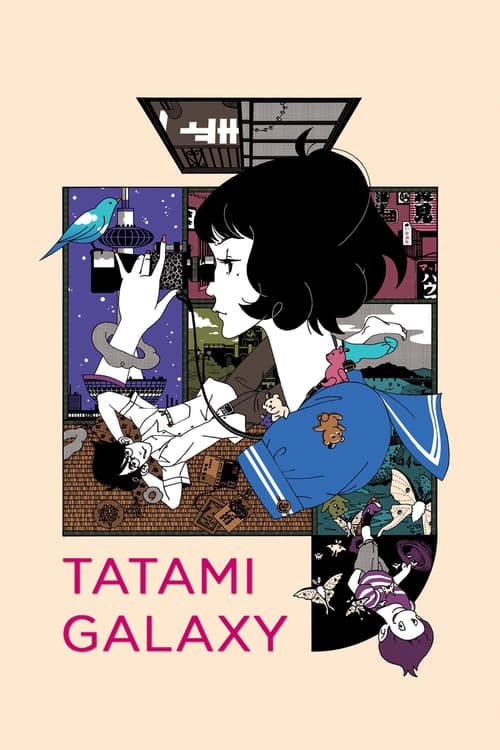








Popular
What are the different clubs that the protagonist joins throughout the series?
What is the significance of the 'Tatami Galaxy' itself in the story?
How does the narrative structure of the series affect the development of Watashi's character?
How does Watashi's relationship with Ozu evolve throughout the series?
What role does Akashi play in Watashi's life and choices?
Should I watch it?
Ask Your Own Question

What is the plot?
The story begins with the protagonist, an unnamed college student, reflecting on his life choices as he enters his second year at university. He is filled with regret over how he wasted his first year, longing for a more fulfilling experience. He is introduced to the concept of the "Tatami Galaxy," a metaphorical space representing the potential of his life choices. The protagonist is determined to make the most of his time in college and vows to find a meaningful path.
In his quest for a better college experience, he joins the "Art Club," where he meets a girl named Akashi. He is immediately drawn to her, captivated by her beauty and intelligence. However, he struggles to connect with her, feeling inadequate and overshadowed by his peers. The protagonist's infatuation with Akashi drives him to pursue art, but he quickly realizes that he lacks the talent and passion for it. This leads to feelings of frustration and self-doubt.
As the story progresses, the protagonist encounters a series of alternate realities, each representing different choices he could have made. In one reality, he joins the "Cycling Club," where he meets a charismatic and carefree student named Ozu. Ozu becomes a significant influence on the protagonist, encouraging him to embrace a more reckless lifestyle. The protagonist finds himself swept up in Ozu's schemes, which often lead to chaotic and humorous situations. Despite the fun, he begins to feel the weight of his decisions and the consequences they bring.
In another reality, the protagonist decides to join the "Theater Club," where he meets a girl named Himemiya. He becomes enamored with her, but his attempts to impress her often backfire. The protagonist's insecurities resurface as he struggles to find his place within the club. He feels overshadowed by the more talented members and grapples with the fear of failure. This leads to a pivotal moment where he must confront his own limitations and the impact of his choices on his relationships.
The narrative continues to shift through various realities, each time revealing different aspects of the protagonist's character and the people around him. He experiences moments of joy, heartbreak, and confusion as he navigates friendships, romantic interests, and the pressures of college life. Each choice he makes leads to new consequences, often intertwining with Ozu's antics, which add a layer of absurdity to his journey.
In one particularly significant reality, the protagonist finally confronts Akashi, expressing his feelings for her. However, the moment is fraught with tension as he realizes that his idealized version of her does not match the reality. Akashi reveals her own struggles and insecurities, leading to a deeper understanding between them. This moment of vulnerability forces the protagonist to reevaluate his desires and the nature of his relationships.
As the story nears its climax, the protagonist faces a critical decision that will determine the course of his life. He must choose between pursuing a safe, conventional path or embracing the uncertainty of his dreams. This choice is compounded by the presence of Ozu, who represents both the allure of freedom and the chaos that comes with it. The protagonist's internal conflict reaches a boiling point as he grapples with the fear of making the wrong choice.
In the final reality, the protagonist finds himself at a crossroads, reflecting on all the experiences he has had throughout his college journey. He realizes that each choice, whether good or bad, has shaped him into who he is. With newfound clarity, he decides to take control of his life, embracing the uncertainty and potential of the future. He reaches out to Akashi one last time, hoping to forge a genuine connection based on honesty and mutual understanding.
The series concludes with the protagonist stepping into the unknown, ready to face whatever comes next. He acknowledges the complexity of his experiences and the importance of the choices he has made. The final scene encapsulates the essence of the "Tatami Galaxy," leaving the audience with a sense of hope and possibility as the protagonist embarks on a new chapter of his life.
🔥 Trending TV Shows Now
Browse All TV Shows →







What is the ending?
In the ending of The Tatami Galaxy, the protagonist, known as Watashi, finally comes to terms with his choices and the nature of his college life. After experiencing multiple parallel realities and the consequences of his decisions, he realizes the importance of genuine connections and the value of the present moment. He ultimately chooses to embrace his feelings for Akashi and seeks a more authentic life, breaking free from the cycle of regret.
As the narrative unfolds, we find ourselves in the final moments of Watashi's journey. The scene opens with him standing in a familiar yet surreal landscape, a representation of his mind's labyrinthine paths. He reflects on the various lives he has led during his college years, each filled with different choices and outcomes. The vibrant colors of the tatami mats around him symbolize the myriad possibilities he has explored, each leading to a different version of himself.
In this moment of introspection, Watashi recalls his encounters with various characters: the enigmatic Akashi, who has always been a beacon of hope and understanding; the boisterous Ozu, who embodies chaos and mischief; and the earnest but often overlooked Higashikata. Each character represents a facet of Watashi's experiences, and as he revisits these memories, he feels a deep sense of longing and regret for the connections he failed to nurture.
The narrative shifts as Watashi confronts Ozu one last time. Ozu, with his trademark smirk, challenges Watashi to reconsider his choices. Their dialogue is charged with tension, as Ozu represents the darker side of Watashi's desires--the temptation to escape reality through superficial pleasures. Watashi, however, stands firm, realizing that he no longer wishes to be a passive participant in his own life. He acknowledges the pain of his past but chooses to move forward, seeking authenticity over escapism.
As the scene transitions, we see Watashi finally approach Akashi. The atmosphere is charged with unspoken emotions, and the world around them seems to fade away. Watashi's heart races as he gathers the courage to express his feelings. In a moment of vulnerability, he confesses his admiration for her, recognizing that she has always been the one person who truly understood him. Akashi, surprised yet touched, reciprocates his feelings, and a sense of warmth envelops them both.
In the final moments, the camera pulls back to reveal the vibrant campus life around them, filled with laughter and camaraderie. Watashi's choice to embrace his feelings marks a significant turning point; he is no longer trapped in the cycle of regret and indecision. Instead, he steps into a new chapter of his life, one where he is willing to forge genuine connections and live in the present.
The series concludes with a sense of hope and renewal. Watashi's journey through the labyrinth of his college years has taught him invaluable lessons about love, friendship, and the importance of making choices that align with his true self. The fate of each character is intertwined with his realization: Ozu remains a chaotic force, but Watashi no longer allows him to dictate his path; Akashi becomes a partner in his journey, symbolizing the potential for a brighter future. Higashikata, though often in the background, represents the quiet strength of true friendship, reminding Watashi of the bonds that can be formed when one is open and honest.
In this way, The Tatami Galaxy closes on a note of optimism, emphasizing the beauty of human connections and the transformative power of self-acceptance.
Is there a post-credit scene?
The Tatami Galaxy does not have a post-credit scene. The series concludes with its final episode, wrapping up the story of the protagonist, Watashi, and his journey through various parallel universes during his college years. The ending focuses on his realization of the importance of connections and experiences rather than the pursuit of an idealized college life. After the credits roll, there are no additional scenes or content that extend the narrative or provide further closure. The series leaves viewers with a sense of introspection and contemplation about the choices made throughout the story.
What are the different clubs that the protagonist joins throughout the series?
In 'The Tatami Galaxy', the protagonist, known as Watashi, explores various clubs during his time at university. He first joins the 'Art Club', where he meets the eccentric Ozu and the beautiful Akashi. Later, he becomes involved with the 'Cycling Club', which leads to a series of misadventures. He also briefly joins the 'Theater Club', where he experiences the complexities of performance and relationships. Each club represents a different path and set of experiences that shape his journey.
What is the significance of the 'Tatami Galaxy' itself in the story?
The 'Tatami Galaxy' serves as a metaphor for the cyclical nature of Watashi's experiences and choices during his university life. Each episode presents a different timeline or scenario, illustrating how small decisions can lead to vastly different outcomes. The tatami mat, a traditional Japanese flooring, symbolizes the constraints and possibilities of Watashi's life, as he navigates through various paths that ultimately lead him back to similar situations, reflecting his internal conflicts and the search for meaning.
How does the narrative structure of the series affect the development of Watashi's character?
The narrative structure of 'The Tatami Galaxy' is non-linear, with each episode presenting an alternate reality based on Watashi's choices. This structure allows for deep exploration of his character, as viewers witness the consequences of his decisions in various scenarios. Each iteration reveals different facets of Watashi's personality, his fears, and his aspirations, ultimately leading him to a greater understanding of himself. The repetition of themes and characters emphasizes his growth and the realization that he must take responsibility for his own happiness.
How does Watashi's relationship with Ozu evolve throughout the series?
Watashi's relationship with Ozu is complex and evolves significantly throughout the series. Initially, Ozu appears as a mischievous and manipulative figure, often leading Watashi into chaotic situations. However, as the story progresses, it becomes clear that Ozu embodies both a friend and a foil to Watashi, representing the darker aspects of his desires and choices. Their interactions are filled with humor, tension, and a sense of inevitability, culminating in moments that challenge Watashi's understanding of friendship and self.
What role does Akashi play in Watashi's life and choices?
Akashi is a pivotal character in Watashi's life, representing both his romantic aspirations and the ideal of a fulfilling university experience. She is intelligent, assertive, and often challenges Watashi's indecisiveness. Throughout the series, Watashi's feelings for Akashi drive many of his decisions, and he grapples with the fear of losing her due to his own shortcomings. Their relationship is marked by moments of connection and misunderstanding, highlighting Watashi's internal struggle between his desires and his actions.
Is this family friendly?
The Tatami Galaxy, while visually striking and narratively complex, contains several elements that may not be suitable for children or sensitive viewers. Here are some potentially objectionable aspects:
-
Themes of Existentialism: The show delves into deep philosophical questions about life choices, regret, and the search for meaning, which may be confusing or unsettling for younger audiences.
-
Depictions of Loneliness and Isolation: The protagonist often grapples with feelings of loneliness and alienation, which can evoke strong emotional responses.
-
Romantic and Sexual Themes: There are references to romantic relationships and sexual situations that may not be appropriate for younger viewers, including unrequited love and complex interpersonal dynamics.
-
Substance Use: There are scenes that imply or depict the use of alcohol, which may be concerning for some viewers.
-
Mental Health Struggles: The protagonist experiences anxiety and frustration regarding his life choices, which could resonate negatively with sensitive individuals.
-
Fast-Paced and Intense Visuals: The animation style is frenetic and can be overwhelming, potentially causing discomfort for those sensitive to rapid visual changes.
These elements contribute to a narrative that is more suited for older teens and adults, as it explores intricate themes that require a mature understanding.