
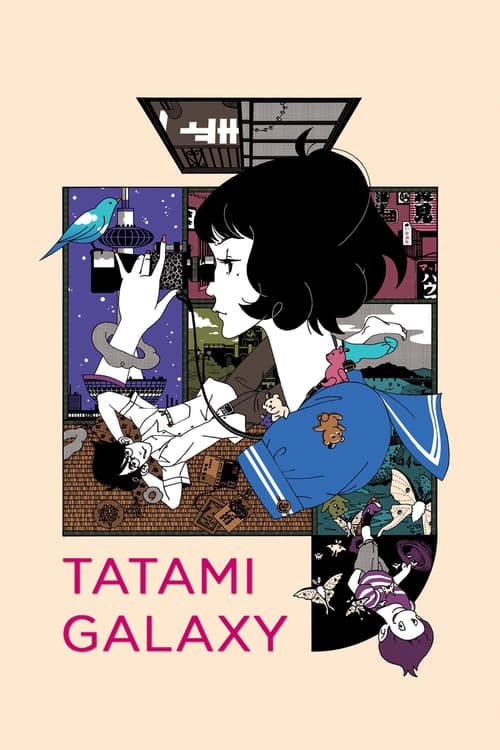








Popular
What are the different clubs that the protagonist joins throughout the series?
How does Watashi's relationship with Akashi evolve throughout the series?
What role does the character Ozu play in Watashi's life?
What is the significance of the 'Tatami Galaxy' itself in the story?
How does the narrative structure of the series affect the development of Watashi's character?
Should I watch it?
Ask Your Own Question

What is the plot?
The story begins with the protagonist, Watashi, a nameless college student, reflecting on his life choices as he navigates through the surreal landscape of his university experience. He is filled with regret and frustration over his inability to find happiness and fulfillment. Watashi is introduced to the concept of the "Tatami Galaxy," a metaphorical space representing the infinite possibilities of his college life.
Watashi recalls his first encounter with the enigmatic Ozu, a fellow student who embodies chaos and mischief. Ozu introduces Watashi to the idea of joining a club, which sets off a chain of events that will lead him through various alternate realities. Watashi's first choice is to join the "Art Club," where he meets the beautiful and mysterious Akashi. He is immediately drawn to her, but his awkwardness and Ozu's interference lead to a series of misunderstandings.
As Watashi becomes more involved with the Art Club, he experiences moments of joy and connection with Akashi. However, Ozu's antics create tension, and Watashi's insecurities surface. He struggles with his feelings for Akashi and the influence of Ozu, who seems to revel in sabotaging Watashi's attempts at happiness. The Art Club's activities culminate in a disastrous exhibition, leaving Watashi feeling defeated and disillusioned.
In the next iteration of his college life, Watashi decides to join the "Theater Club," hoping for a fresh start. He meets a new cast of characters, including the eccentric club president, who is passionate about avant-garde performances. Watashi's interactions with the club members are filled with comedic moments, but he soon realizes that the dynamics are just as complicated as before. Ozu continues to meddle, leading to a chaotic production that ultimately fails to impress.
Watashi's journey continues as he explores other clubs, including the "Basketball Club" and the "Literature Club." Each choice leads him to new experiences and relationships, but Ozu's presence remains a constant source of chaos. Watashi's feelings for Akashi persist, but he struggles to express them, often getting sidetracked by Ozu's schemes. The emotional weight of his decisions begins to take a toll on him, as he grapples with the fear of missing out on true happiness.
As the narrative unfolds, Watashi's internal conflict deepens. He becomes increasingly aware of the cyclical nature of his choices, realizing that each decision leads him back to the same point of dissatisfaction. The repetition of events creates a sense of urgency for Watashi to break free from this cycle. He begins to question his relationship with Ozu and the impact of his choices on his life.
In a pivotal moment, Watashi confronts Ozu about his manipulative behavior. This confrontation leads to a temporary rift between them, allowing Watashi to explore a more genuine connection with Akashi. They share a moment of vulnerability, and Watashi feels a glimmer of hope for a different outcome. However, Ozu's influence is never far behind, and their friendship is tested once again.
The climax of the story occurs when Watashi faces a critical decision that could alter the course of his life. He must choose between pursuing a relationship with Akashi or continuing to follow Ozu's reckless path. In a moment of clarity, Watashi realizes that he must take control of his own destiny. He decides to confront his fears and express his feelings to Akashi, leading to a heartfelt exchange that reveals their mutual affection.
However, just as Watashi begins to feel a sense of fulfillment, Ozu reappears, throwing everything into disarray once more. The cycle of choices continues, and Watashi finds himself back at the beginning, reflecting on the nature of his existence. The story concludes with Watashi gaining a deeper understanding of himself and the importance of making choices that align with his true desires, leaving the audience with a sense of ambiguity about his ultimate fate.
🔥 Trending TV Shows Now
Browse All TV Shows →






What is the ending?
In the ending of "The Tatami Galaxy," the protagonist, known as Watashi, finally comes to terms with his choices and the impact of his past decisions. He realizes that the pursuit of an ideal college life has led him through a series of alternate realities, each filled with regret and missed opportunities. Ultimately, he finds a sense of closure and acceptance, leading him to a new beginning with Akashi, a girl he has long admired.
As the narrative unfolds, we find ourselves in the final moments of Watashi's journey. The scene opens in a familiar setting, the tatami room, where Watashi reflects on his experiences. He has traversed through various timelines, each representing a different club and a different path in his college life. The weight of his choices hangs heavily on him, as he recalls the moments that led to his dissatisfaction and the relationships he failed to nurture.
In a pivotal moment, Watashi encounters Akashi, who has been a constant presence throughout his journey. Their interactions have been fraught with misunderstandings and missed connections, but now, in this moment of clarity, he sees her in a new light. The atmosphere is charged with unspoken feelings, and as they converse, Watashi begins to understand the importance of genuine connections over the superficial pursuits he had previously chased.
The scene shifts to a vibrant festival, a stark contrast to the introspective moments in the tatami room. Here, Watashi and Akashi share a fleeting yet profound moment, symbolizing the potential for a new beginning. The festival is alive with color and energy, representing the joy and spontaneity of life that Watashi had overlooked in his quest for perfection. As they walk together, the weight of his past choices begins to lift, and he feels a sense of hope for the future.
In the final moments, Watashi stands at a crossroads, both literally and metaphorically. He is faced with the choice of continuing to dwell on his past or embracing the present and the possibilities it holds. The narrative culminates in a moment of acceptance, as he chooses to move forward with Akashi by his side. The screen fades to black, leaving viewers with a sense of resolution and the understanding that while the past cannot be changed, the future is still unwritten.
As for the fates of the main characters, Watashi emerges with a newfound perspective, ready to embrace life with Akashi. Akashi, who has been a source of inspiration and longing for Watashi, stands as a symbol of hope and connection. Other characters, such as Ozu and the various club members, remain part of Watashi's memories, representing the lessons learned through his experiences. The ending encapsulates the essence of growth, acceptance, and the importance of human connections, leaving a lasting impression on the audience.
Is there a post-credit scene?
In "The Tatami Galaxy," there is no post-credit scene. The series concludes with its final episode, leaving viewers with a sense of resolution regarding the protagonist's journey. The narrative wraps up the themes of choices, regrets, and the search for meaning in college life, but it does not include any additional scenes or content after the credits. The focus remains on the main storyline and the character development throughout the series, culminating in the protagonist's realization and acceptance of his experiences.
What are the different clubs that the protagonist joins throughout the series?
In 'The Tatami Galaxy', the protagonist, known as Watashi, explores various clubs during his time at university. He first joins the 'Cycling Club', where he meets the eccentric Akashi and experiences a sense of freedom. Later, he becomes involved with the 'Theater Club', which introduces him to the dramatic and chaotic world of performance. He also joins the 'Photography Club', where he grapples with the concept of capturing moments versus living them. Each club represents a different path and set of experiences, reflecting Watashi's search for meaning and connection.
How does Watashi's relationship with Akashi evolve throughout the series?
Watashi's relationship with Akashi is complex and evolves significantly throughout the series. Initially, he is infatuated with her, drawn to her intelligence and assertiveness. However, as he navigates different timelines and choices, he realizes that his inability to communicate and his selfishness hinder their connection. Akashi, who is often portrayed as strong-willed and independent, becomes a pivotal figure in Watashi's journey, representing both his desires and the consequences of his actions. Their relationship is marked by moments of tension, misunderstanding, and ultimately, a longing for genuine connection.
What role does the character Ozu play in Watashi's life?
Ozu serves as both a friend and a catalyst for chaos in Watashi's life. He is a mischievous and enigmatic figure who often leads Watashi into absurd situations. Ozu embodies the darker aspects of university life, encouraging Watashi to indulge in reckless behavior and question societal norms. Despite his seemingly carefree attitude, Ozu's presence forces Watashi to confront his own choices and the impact of his friendships. Their dynamic is characterized by a blend of camaraderie and manipulation, highlighting the complexities of their relationship.
What is the significance of the 'Tatami Galaxy' itself in the story?
The 'Tatami Galaxy' serves as a metaphor for the protagonist's life choices and the cyclical nature of his experiences. Each episode presents a different timeline, showcasing how small decisions lead to vastly different outcomes. The tatami mat, a traditional Japanese flooring, symbolizes the constraints and limitations Watashi feels in his life. As he navigates through various scenarios, the tatami becomes a representation of his internal struggles, desires, and the search for fulfillment. The recurring imagery of the tatami mat emphasizes the idea of being trapped in one's own choices while also hinting at the potential for change.
How does the narrative structure of the series affect the development of Watashi's character?
The narrative structure of 'The Tatami Galaxy' is non-linear, with each episode exploring alternate realities based on Watashi's choices. This unique storytelling approach allows for deep character exploration, as viewers witness the consequences of his decisions in real-time. Watashi's character develops through his repeated experiences, revealing his flaws, insecurities, and desires. The repetition of scenarios forces him to confront his own shortcomings and ultimately leads to moments of self-reflection. This structure not only enhances the emotional depth of Watashi's journey but also emphasizes the theme of personal growth through the acknowledgment of one's past mistakes.
Is this family friendly?
The Tatami Galaxy is a unique and complex anime that explores themes of youth, choices, and the passage of time. While it is not overtly graphic or violent, there are several aspects that may be considered objectionable or upsetting for children or sensitive viewers:
-
Existential Themes: The show delves into deep philosophical questions about life choices, regret, and the search for meaning, which may be difficult for younger audiences to grasp.
-
Romantic Relationships: There are scenes that explore romantic interests and relationships, including unrequited love and emotional turmoil, which may be confusing or uncomfortable for some viewers.
-
Social Anxiety and Isolation: The protagonist experiences feelings of loneliness and social anxiety, which could resonate negatively with sensitive viewers who relate to these emotions.
-
Surreal Imagery: The animation style includes surreal and abstract visuals that may be disorienting or unsettling for some, particularly younger viewers.
-
Substance Use: There are references to drinking and partying, which may not be suitable for children.
-
Dark Humor: The series employs a form of dark humor that may not be appropriate for all audiences, as it often touches on themes of failure and despair.
Overall, while The Tatami Galaxy is not explicitly inappropriate, its thematic depth and emotional complexity may not be suitable for younger children or those sensitive to such topics.