























Loading additional questions...
Should I watch it?
Additional Questions
Ask Your Own Question

What is the plot?
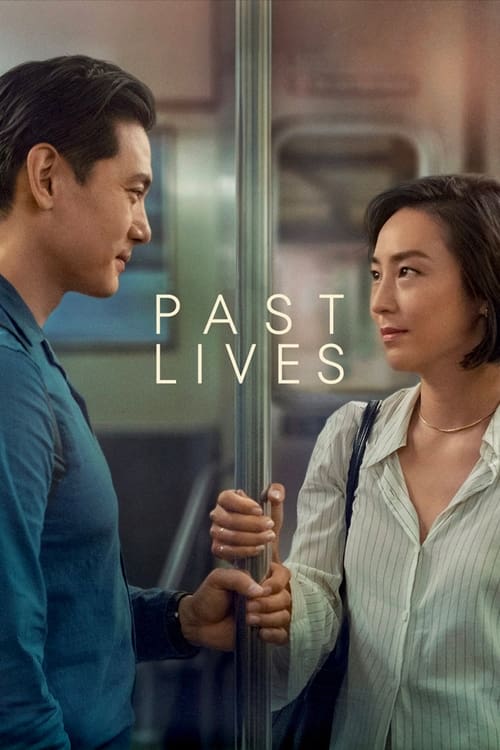
A dimly lit Manhattan speakeasy opens the film. Two patrons seated at the bar watch a table across the room where three people sit close together: Nora Han, a woman who keeps most of her face visible under the glow of a lamp; Hae Sung, a quiet man who leans forward when she speaks; and Arthur Zaturansky, who sits beside Nora and looks toward her as if cataloguing memories. The couple at the bar trade guesses about how the three are connected, their voices hushed against the music and clink of glasses, while the camera lingers on Nora, Hae Sung, and Arthur in the low light.
The story then cuts back twenty-four years to Seoul in 1999. A twelve-year-old girl named Na Young walks home with her classmate Hae Sung. Na Young sulks about coming in second on a recent class test; Hae Sung, who won first place, brushes off her frustration by telling her she usually does better. The two walk beside each other under the street lamps; their parents have arranged a playdate and call them in from the park. At Na Young's apartment the family is in the middle of preparations: boxes, conversations about moving, and the small rituals of departure. Her parents and her younger sister Si Young gather English names from a book of suggestions. Na Young chooses Nora. On the family's last day in Seoul, both mothers take the children to a park. Afterward the two of them walk home together and Hae Sung can only manage "Bye" before Na Young steps into a taxi and leaves with her family bound for Canada.
Twelve years pass. Hae Sung completes his mandatory military service in South Korea and resumes a routine of meeting friends, drinking and telling jokes in Seoul. Nora finishes school in North America and begins attending college in New York City while she explores writing as a career. One evening, while Nora speaks to her mother on the phone, her mother mentions a Facebook post: someone named Hae Sung has commented on the page for Nora's father's restaurant asking whether anyone knows where Na Young went. Nora recognizes the name and sends a friend request.
Hae Sung accepts. The two reconnect through webcams and video calls on Skype. They talk haltingly at first and then fall into a more fluent rhythm, recounting shared childhood memories and updating one another on their separate lives. Nora describes long hours she spends drafting and revising scripts and short prose pieces; Hae Sung tells her he is planning to study Mandarin in China as part of a language exchange. Their conversations stretch into the night across time zones. They imagine meeting, but the realities of visas and obligations keep them apart. After weeks of renewed connection Nora tells Hae Sung that she needs to stop their daily chats for a while; she says she must dedicate uninterrupted time to her writing and the work that could shape her career.
Nora travels to a writers' retreat on the eastern shore, in Montauk. There she meets Arthur Zaturansky, a fellow writer. Arthur is talkative, earnest, and curious about Nora's bilingual past. One night they sit outside watching stars and Nora mentions the Korean idea of in-yun, a notion about connections that stretch across lives. She speaks about the possibility that people encounter one another repeatedly across different lifetimes. Arthur listens closely and then, over the next days, Nora and Arthur grow closer. Their relationship moves from flirtation to intimacy. Arthur reads Nora's pieces and Nora attends Arthur's readings; they slip into a domestic rhythm. Arthur writes a novel that attains bestseller status; its public title is provocative and receives attention from the literary world. Nora continues to write and to use her experience in auditions for plays and staged readings.
Meanwhile, Hae Sung arrives in China for his Mandarin program and meets a woman there. He dates, laughs, and moves forward. Months and then more years pass. Nora and Arthur marry and settle into life in New York. Arthur makes an effort to learn some Korean for Nora's sake and supports her at events: he sits beside her at a book signing for his novel, they attend theater workshops together, and he encourages her to audition pieces she has written. Nora's career as a writer progresses in small, concrete ways--rehearsals, readings, late-night redrafts. Arthur's book tour includes sessions where fans line up to get copies signed; at one such signing he holds Nora's hand for photographs.
A further twelve years move the timeline forward. Hae Sung ends a relationship in Seoul and decides to travel to New York. He arrives alone, intent on seeing Nora. Walking the city streets, he spots Nora by chance; she sees him as he approaches. They fall into an easy conversation as if the years have become an interlude rather than a rupture. He spends a day with her in Manhattan: they ride the Staten Island ferry together, stand before the Statue of Liberty, browse through neighborhoods, and share meals while they catch up. They speak in Korean for much of the day; their cadence carries traces of childhood familiarity and adult restraint.
When Nora returns to the apartment she shares with Arthur, she tells him that Hae Sung has unexpectedly visited. Arthur reacts with a mixture of curiosity and unease. He voices a hypothetical: he wonders whether he is simply an obstacle in a narrative that began in Korea, asking whether Nora's childhood connection with Hae Sung might be a fate he cannot unseat. In private conversation he explains that sometimes he fears the differences between them--culture, language, and family ties--may create chasms he cannot bridge. He notes that Nora sleeps in Korean, that she dream-speaks the language he does not always understand. Nora responds that she loves Arthur, that the life they share is chosen, and she comforts him against the anxieties he expresses.
The three of them agree to go out to dinner. They choose a small speakeasy downtown, the same kind of dim bar from the opening, and they sit together at a round table. Nora alternates between translating for Arthur and speaking directly with Hae Sung in Korean. At one point the English exchange thins out and Hae Sung and Nora speak to one another without Arthur; he apologizes when their private dialogue resumes but Arthur assures him he does not mind. During the meal Hae Sung asks Nora about in-yun. He wonders aloud who they might have been to one another in previous lives and what that could explain about the depth of their present recognition. Nora answers that she does not know and that, while such ideas intrigue her, she believes they are different people now than they were as children or as the young adults who first reconnected across a computer screen. Arthur listens and then, later on, tells Nora that he is glad to have met Hae Sung in person.
After dinner they return to Nora and Arthur's apartment. Hae Sung phones an Uber to take him to his hotel. Nora steps outside with him to wait on the stoop. The air is cool and the street is quiet. They stand close and fall into a silence that stretches for nearly a full minute; the camera measures the length of the pause. When Hae Sung finally speaks he suggests that perhaps in this moment they are experiencing one of those past-life encounters that people refer to in their childhood tales--that they might be occupying the same line of continuity between lives. He asks Nora where she thinks they might meet again in some future life. Nora says she does not know. He places his hand on her arm, pulls her into a brief embrace, and then climbs into the waiting car. As the vehicle pulls away he calls back, "I'll see you then," or words to that effect, and the light in his face disappears into the taxi's windows as it drives off into the night.
Nora turns and walks back to the apartment where Arthur awaits on the threshold. She moves toward him, the years of conversation and the sudden intensity of the evening weighing on her. She collapses into his arms and begins to cry; Arthur wraps his arms around her and holds her as she sobs. In the doorway they stand together, Arthur steady and Nora shaking with emotion.
The film's final images follow Hae Sung as he rides through the city toward the airport. He sits in the back of the car and watches buildings glide by, an absent look on his face. At the airport he checks in and boards a plane bound away from New York. The last shot frames him in the aircraft as the city recedes, and the story ends with his departure from Nora's life in that moment.
No principal character dies over the course of the film. The narrative closes on the three central figures--Nora, Hae Sung, and Arthur--alive and moving forward into separate, defined futures: Hae Sung leaving New York by plane, Nora returning inside to the home she shares with Arthur, and Arthur standing with her in the apartment doorway as the city continues below.









What is the ending?
In the ending of "Past Lives," two childhood friends, Nora and Hae Sung, reunite after decades apart. They confront their feelings and life choices, understanding their deep connection yet acknowledging the paths they took in life. Ultimately, they share a heartfelt moment that shifts into a poignant farewell, leaving both with a sense of what could have been.
As the film nears its conclusion, viewers are drawn into a contemplative scene set in a quiet café in New York City where Nora and Hae Sung find themselves seated across from each other. The soft hum of background conversations fades as they dive into a candid discussion about their lives, ambitions, and memories of their childhood in South Korea. The atmosphere between them is charged with nostalgia and unspoken emotions.
Nora, now a successful playwright, reflects on her upbringing and the cultural distance she has traversed since moving to the States. Hae Sung, still carrying remnants of his origination in Korea, reveals the life he has constructed, mating the two different worlds he has inhabited. They share laughter but also wistfulness, as their conversations constantly brush against the immutable distance of their separate lives.
Gradually, the conversation shifts to their current relationships. Nora delicately introduces the subject of her husband, expressing gratitude for his support but also grappling with the lingering emotions she feels for Hae Sung. This moment is critical as it unveils their dichotomy--having progressed in their respective lives yet feeling an undeniable connection that transcends time and geography.
The climax comes when Hae Sung, his voice slightly quivering with vulnerability, admits that whatever the present circumstances may dictate, he has always felt a bond with Nora. They share a long gaze filled with memories and what-ifs, creating an emotional climax that leaves them both contemplative.
In the emotional denouement, it becomes apparent that this reunion cannot sustain itself indefinitely. They discuss their choices with a sense of acceptance; Hae Sung's acknowledgment that he must return to Korea signals a bittersweet farewell. They walk through the city, each of them reflecting inwardly as they share the streets that were once their playgrounds. The fleeting moments of closeness become poignant symbols of what might have been--a love not quite realized but profoundly felt.
The final moments are serene, as they arrive at an interchange, both daunted by the thought of letting go. Nora, with tears in her eyes, proposes a simple goodbye. They clasp hands tightly for a moment, embodying the weight of all unsaid thoughts, and then part ways, each stepping into their respective lives apart yet forever intertwined in memory.
In that farewell, the film encapsulates a powerful sense of yearning and the bittersweet nature of life's decisions, leaving audiences with a resonant message about love, choices, and the passage of time.
Is there a post-credit scene?
Is this family friendly?
"Past Lives" (2023) is generally considered a drama that deals with themes of love, fate, and personal growth. While it does not contain extreme violence or explicit content, there may be some scenes that could be emotionally intense or touch on complex themes that might not be suitable for very young children. These could include:
- Emotional Conversations: There are likely to be scenes with deep emotional discussions around relationships and life choices that might be heavy for younger viewers.
- Cultural Identity and Separation: The film explores themes of cultural identity and separation, which could evoke feelings of sadness or confusion.
- Romantic Tension: There may be moments of romantic tension that could be more appropriate for older teens and adults.
Overall, while it may not be explicitly objectionable, parental discretion is advised for younger viewers or those sensitive to emotional themes.
Who does Nora pick in the end?
In the movie "Past Lives," Nora ultimately chooses to stay with her husband, Arthur, despite her deep emotional connection with her childhood friend Hae Sung.







