















Popular
What are the main character's motivations in the first story segment involving Octavio?
How does the relationship between Valeria and Daniel evolve throughout the film?
What role does the dog, Cofi, play in the story of El Chivo?
What events lead to the tragic fate of Octavio in the film?
How does the car accident impact the lives of the characters in the film?
Should I watch it?
Ask Your Own Question

What is the plot?
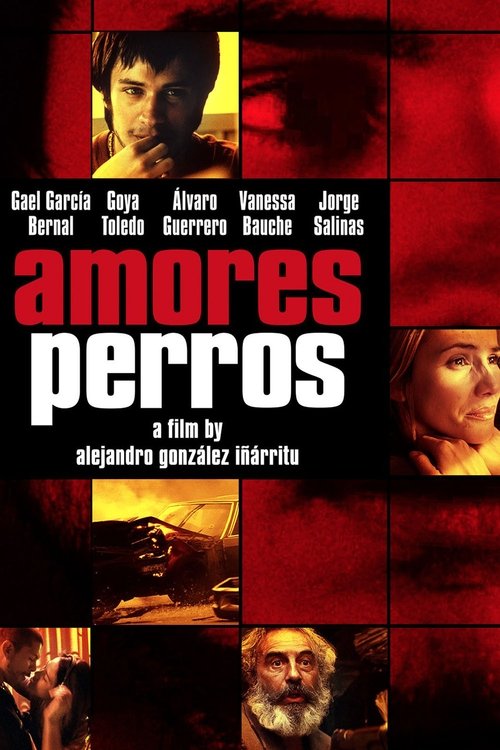
Octavio races through the chaotic streets of Mexico City, his hands gripping the steering wheel white-knuckled as bullets shatter the rear window. Blood pools in the back seat where his beloved Rottweiler, Cofi, lies wounded, growling through the pain from a savage dogfight. Gunfire erupts from the pursuing car--it's Jarocho, the local thug Octavio has just bested in a private underground match, desperate to reclaim his pride and the bets he lost. Octavio swerves wildly, heart pounding, whispering urgently to Cofi, "Hold on, boy, we're almost out," as the city lights blur into a frenzy of desperation. This frantic chase, born from Octavio's slum-born dreams of escape, hurtles toward a collision that will shatter three lives forever.
Flash back to the cramped slum apartment in Mexico City's poor neighborhoods, where Octavio (Gael García Bernal), a restless young man in his early twenties, shares a suffocating space with his older brother Ramiro (Marco Pérez) and Ramiro's wife, Susana (Vanessa Bauche). The air reeks of stale sweat and baby formula; a crib sits in the corner beside mattresses stuffed with Octavio's secret earnings. Ramiro, burly and brooding, stumbles home from his night shifts as an armored truck guard, oblivious to Octavio's burning gaze on Susana as she rocks their infant son to sleep. Octavio's love for her simmers unspoken, a toxic brew amid the family's poverty. "Why do you put up with him?" Octavio mutters one evening, cornering Susana in the dim kitchen, his voice thick with longing. She brushes him off gently, eyes weary: "He's my husband, Octavio. That's life."
Ramiro's infidelity gnaws at Octavio like an open wound. One afternoon, while Ramiro is out, Octavio uncovers Polaroids hidden in Ramiro's jacket--graphic shots of his brother with a mistress, thrusting crudely in a motel room. Rage boils over. "That bastard," Octavio snarls to his friend Jorge (Humberto Busto), who nods knowingly as they tend to Cofi in the alley behind the building. Cofi, a massive, scarred Rottweiler with eyes like burning coals, has become Octavio's ticket out. Earlier that day, on a trash-strewn street, Jarocho--fresh from winning a dogfight at Mauricio's underground pit--spots some strays and sics his champion dog on them. A machete-wielding homeless man intervenes, blade glinting menacingly: "Touch them, and you lose more than a fight." Jarocho laughs it off, redirecting his beast toward Octavio's passing Cofi. The dogs clash in a whirlwind of snarls and blood; Cofi tears Jarocho's dog apart, ripping its throat in seconds. Jarocho's face twists in fury as Octavio scoops up his victorious pet. "This dog's a killer," Jorge says, eyes lighting up. "We can make money."
They plunge into the brutal world of Mauricio's dogfighting venue, a blood-soaked pit in the slums ringed by howling bettors. Cofi dominates, jaws snapping through opponents in sprays of crimson, piling cash under the family mattresses. Octavio pays Mauricio a cut to arrange a "lesson" for Ramiro--thugs corner the older brother in an alley, beating him bloody with fists and boots until Ramiro wheezes, "Enough! Who sent you?" Octavio watches from shadows, satisfaction mingling with guilt. Tension mounts at home; Ramiro eyes Octavio suspiciously during tense dinners, Susana caught between them. "Leave with me, Susana," Octavio pleads one night, clutching her hand as the baby cries. "I've got enough money now. We can start over." She hesitates, tears welling, but whispers, "I can't. I'm pregnant." The revelation hits like a gut punch--likely Ramiro's child. Undeterred, Octavio presses, but Ramiro steals the hidden cash stash one dawn, fleeing with Susana and the baby, leaving Octavio penniless and seething.
Meanwhile, across the city's glittering divide, Daniel (Álvaro Guerrero), a suave magazine publisher, abandons his wife and young daughter Maru for the siren call of Valeria (Goya Toledo), a Spanish supermodel whose luminous face beams from a massive billboard dominating the skyline. They move into a sleek luxury apartment overlooking that very ad--floor-to-ceiling windows framing Valeria's image like a personal shrine. Richie, her pampered lapdog, yaps playfully, chasing a ball across the unfinished floors riddled with construction holes. Daniel pulls her close amid unpacked boxes, murmuring, "This is our paradise now." Valeria smiles radiantly, legs endless and flawless, embodying vanity's fleeting thrill. But shadows lurk; Daniel's guilt flickers when he glances at a photo of Maru, though he pushes it down in the haze of new love.
In the film's underbelly prowls El Chivo (Emilio Echevarría), a grizzled, bearded homeless man with feral eyes and a pack of mangy mongrel dogs trailing him through derelict alleys. His true lair is a shadowy warehouse hideout cluttered with rusted sculptures of twisted human forms, faded photos of a wife and young girl--his estranged family--and an arsenal of guns and blades. By day, he scavenges; by night, he's a mercenary hitman, taking anonymous calls for kills. A gravelly voice on the phone instructs: "Ramírez and Luis--make one betray the other." El Chivo nods silently, loading a silenced pistol, his past as a revolutionary flickering in haunted stares at Maru's photo. He abandoned them for the cause, now drowning regret in tequila and dog loyalty.
The threads tighten toward catastrophe. Octavio, rejected and robbed, accepts Jarocho's challenge for a high-stakes private dogfight at Mauricio's pit. Cofi triumphs again, but Jarocho, enraged, stabs Octavio in the side during the chaos--non-fatally, but enough to send him fleeing with the remaining winnings stuffed in a bag. Bleeding and pursued by Jarocho's crew firing wildly, Octavio guns the car through Mexico City's veins, Cofi whimpering in back. Tension peaks as he weaves past honking traffic, bullets pinging metal.
Parallel paths converge: El Chivo drives toward his hit on businessman Luis, rifle ready. Valeria cruises nearby, Richie on the passenger seat. Daniel trails in another car, heading to a meeting. Fate detonates in a screech of tires and shattering glass--the pivotal crash on a bustling urban artery. Octavio's car slams into Valeria's, spinning both into a mangled heap as El Chivo's vehicle fishtails to a halt amid the wreckage. Horns blare, bystanders scream; blood slicks the asphalt. Valeria's leg twists unnaturally beneath the dashboard, compound fracture grinding bone--agony rips through her as she claws at the metal, screaming, "My leg! Daniel!" Octavio staggers out, clutching his wound, only to collapse as Jarocho's men close in. El Chivo, opportunistic amid the pandemonium, rifles Octavio's wrecked car, pocketing the bloody cash bag. He spots Cofi, still alive but gravely injured, and hauls the massive dog into his van, vanishing into the night.
Sirens wail as lives fracture irrevocably. Valeria, rushed to the hospital, endures excruciating pain; her leg swells grotesquely from arterial thrombosis. Daniel hovers anxiously, guilt etching his face. Back in the "lovenest," tension festers. Richie, spooked by the crash damage, slips through a gaping floorboard hole into the unfinished subfloor, his muffled barks echoing like a trapped soul. "Where's Richie?" Valeria cries upon returning in a wheelchair, her immaculate world unraveling. Days blur into arguments--Daniel paces the torn-up apartment, floor gaping like an open wound. "We can fix this," he insists, but Valeria snaps, "Everything's broken! My career, my body--you still want the billboard girl?" Desperation peaks one night; hearing Richie's faint whimpers, Valeria hobbles on crutches to pry at the boards, re-injuring her leg catastrophically. She collapses in agony, hours passing before Daniel finds her, pale and feverish. Gangrene sets in swiftly--doctors amputate her leg above the knee in a sterile operating theater, the blade's whine underscoring her fall from grace. While she's hospitalized, Daniel tears up the floorboards, rescuing the emaciated Richie, who licks his hands weakly. Valeria returns to a hollow shell: wheeling through the gutted apartment, she gazes out the window. The billboard is gone--her image erased, replaced by blank sky. "It's over," she whispers, eyes hollow, as Daniel stands distant, their love curdled into doubt and resentment.
El Chivo nurses Cofi in his warehouse lair, stitching wounds amid his mongrel pack's wary snarls. Photos of his daughter Maru--unknowingly Daniel's child from his prior marriage--stare back accusingly. One fateful day, El Chivo steps out for a job, leaving Cofi chained loosely. The Rottweiler, trained killer unleashed by instinct, slaughters the entire pack in a visceral frenzy--throats torn, bodies eviscerated in pools of gore. El Chivo returns to carnage, mongrel corpses strewn like broken toys. He raises his pistol to Cofi's head, finger trembling on the trigger, the dog's eyes mirroring his own savage soul. "You're me," he growls, lowering the gun, tears carving tracks in grime. Shaving his beard clean in a cracked mirror, he sheds his old skin, emerging transformed.
His hit contract twists into poetic justice. El Chivo kidnaps Ramírez, partner to target Luis, chaining him in the warehouse. Staging a ruse, he forces Ramírez to "kill" Luis--actually a mannequin--then shoots the real Luis with a silenced pistol through the temple, blood spraying in slow motion. He unchained Ramírez, plants the gun in his hand, arranging the scene as mutual betrayal: two suited corpses slumped together, evidence pointing to each other's guilt. "Your greed killed you both," El Chivo mutters, walking away clean. Elsewhere, Ramiro meets his end during a botched bank robbery--his crew storms the armored site, but police gunfire erupts; Ramiro crumples, shot dead by an unnamed guard or officer, body twitching on bloodied marble as alarms shriek.
Post-crash, Octavio survives the streets, stabbed wound festering, dreams shattered. Susana rejects him utterly, choosing Ramiro's memory and their child. Penniless after El Chivo's theft, Octavio limps into exile, body broken, future a void.
El Chivo's redemption crests. Clean-shaven and raw, he stalks Maru from afar, watching her laugh in school uniform--innocent echo of his failures. From a payphone, he dials her number anonymously, voice cracking: "Maru... it's me. I've changed. Forgive me someday." He leaves cash and a note at her door--"From your father"--then abandons his weapons, hitman life discarded like shed fur.
The film closes on dusty plains outside Mexico City. El Chivo strides into the vast desert horizon, Cofi at his side, the dog's wounds healed, stride purposeful. No words, just wind-whipped silence--a man reborn through violence's mirror, walking toward uncertain freedom. Octavio flees wounded into shadows; Daniel and Valeria drift apart in their ruined nest, Richie barking faintly; lives collided, forever altered, redemption flickering only for the one who faced his beast.
(Word count: 3472)

What is the ending?
In the ending of "Amores Perros," the three main characters--Octavio, Daniel, and Valeria--experience the consequences of their choices. Octavio, after a violent confrontation, is left with a sense of loss and despair. Daniel, who has pursued a relationship with Valeria, faces the harsh reality of their situation as Valeria's life is irrevocably changed due to her injuries. Valeria, now unable to walk, grapples with her new reality and the impact it has on her relationship with Daniel. The film concludes with a sense of unresolved tension, highlighting the interconnectedness of love, loss, and the choices that lead to tragic outcomes.
Now, let's delve into the ending in a more detailed, chronological narrative.
As the film approaches its conclusion, we find Octavio in a desperate situation. After the dogfight that spiraled out of control, he is on the run, having committed acts of violence that have left him isolated. He is haunted by the choices he made, particularly the decision to involve himself in the brutal world of dog fighting to secure money for his escape with Susana. The weight of his actions bears down on him, and he is filled with regret as he reflects on the life he could have had.
In a parallel narrative, Daniel and Valeria are dealing with the aftermath of a tragic car accident that has left Valeria severely injured. The scene is heavy with emotion as Valeria lies in a hospital bed, her body broken and her dreams shattered. The camera captures her vulnerability, the sterile environment of the hospital contrasting sharply with the vibrant life she once led as a model. Daniel, who has been by her side, is filled with a mix of love and despair. He tries to comfort her, but the reality of her condition looms large. Valeria's frustration and anger at her situation are palpable; she struggles to come to terms with her new identity, one that is defined by her physical limitations.
As the narrative unfolds, we see Octavio's fate take a darker turn. He confronts the consequences of his actions when he is cornered by the people he owes money to. In a tense and violent encounter, he is forced to face the reality of his choices. The scene is charged with emotion as Octavio realizes that his dreams of escape and a better life are slipping away. The desperation in his eyes reflects a man who has lost everything, and he is left to grapple with the futility of his pursuits.
Meanwhile, Valeria's struggle continues as she faces the reality of her injuries. The film captures her emotional turmoil through intimate close-ups, showcasing her pain and the deep sense of loss she feels for the life she can no longer lead. Daniel, despite his love for her, is also confronted with the harsh truth that their relationship may never be the same. The bond they once shared is tested as they navigate the complexities of her recovery and the emotional scars that remain.
In the final moments of the film, the three characters' stories converge in a hauntingly poignant way. Octavio, Daniel, and Valeria are all left to confront the consequences of their choices, each in their own way. The film closes with a sense of unresolved tension, leaving the audience to ponder the intricate web of love, loss, and the impact of decisions made in moments of desperation. The fates of Octavio, Daniel, and Valeria serve as a stark reminder of the fragility of life and the interconnectedness of their stories, forever altered by the events that transpired.
Is there a post-credit scene?
"Amores Perros," directed by Alejandro González Iñárritu, does not have a post-credit scene. The film concludes with a powerful and emotional ending that ties together the three interconnected stories of its main characters: Octavio, Daniel, and Valeria. After the final segment, the credits roll without any additional scenes or content following them. The film's focus remains on the intense narratives and the themes of love, loss, and the impact of choices, leaving the audience to reflect on the stories presented rather than providing any further resolution or commentary in a post-credit sequence.
What are the main character's motivations in the first story segment involving Octavio?
In the first segment, Octavio is driven by his intense love for his brother's girlfriend, Susana. He feels trapped in a life of poverty and seeks to escape it through dog fighting, believing that winning money from the fights will allow him to run away with Susana. His desperation and passion lead him to make reckless decisions, showcasing his internal conflict between loyalty to his family and his desire for love.
How does the relationship between Valeria and Daniel evolve throughout the film?
Valeria and Daniel's relationship begins with a passionate affair, as Daniel leaves his wife for Valeria, who is a model. However, their bond is tested when Valeria is involved in a car accident that severely injures her dog, Richie. The accident symbolizes the fragility of their relationship, as Valeria's focus shifts to her recovery and the care of Richie, while Daniel struggles with feelings of guilt and helplessness. Their love is ultimately strained by the trauma and the realities of their lives.
What role does the dog, Cofi, play in the story of El Chivo?
Cofi, the dog that El Chivo rescues, serves as a symbol of redemption and companionship for him. El Chivo, a former hitman, is portrayed as a lonely figure seeking to reconnect with his estranged daughter. Cofi's presence brings a sense of purpose to El Chivo's life, as he cares for the dog and begins to confront his past. The bond between them highlights El Chivo's internal struggle for redemption and the desire for a meaningful connection.
What events lead to the tragic fate of Octavio in the film?
Octavio's tragic fate is precipitated by a series of escalating conflicts. After winning a significant dog fight, he believes he can finally escape with Susana. However, his brother, Ramiro, confronts him about his feelings for Susana, leading to a violent altercation. In a desperate attempt to protect Susana, Octavio confronts Ramiro again, resulting in a fatal confrontation. This moment encapsulates Octavio's tragic arc, as his love and ambition ultimately lead to his downfall.
How does the car accident impact the lives of the characters in the film?
The car accident serves as a pivotal moment that intertwines the lives of the three main characters: Octavio, Valeria, and El Chivo. For Valeria, the accident results in a life-altering injury that affects her career and her relationship with Daniel. For Octavio, it marks the beginning of his downward spiral, as he is left to grapple with the consequences of his actions. For El Chivo, the accident leads him to confront his own past and the choices he has made, ultimately pushing him towards a path of redemption. The accident acts as a catalyst that reveals the interconnectedness of their fates.
Is this family friendly?
"Amores Perros," directed by Alejandro González Iñárritu, is not considered family-friendly due to its mature themes and graphic content. Here are some potentially objectionable or upsetting aspects that may affect children or sensitive viewers:
-
Violence: The film contains several scenes of intense violence, including dog fighting, which is graphic and disturbing.
-
Death: There are multiple instances of death, both human and animal, portrayed in a raw and emotional manner that can be distressing.
-
Substance Abuse: Characters are shown using drugs and engaging in reckless behavior, which may be inappropriate for younger audiences.
-
Sexual Content: The film includes explicit sexual situations and themes of infidelity that may be uncomfortable for some viewers.
-
Emotional Trauma: Characters experience significant emotional pain, betrayal, and loss, which can be heavy and unsettling.
-
Social Issues: The film addresses themes of poverty, homelessness, and the struggles of marginalized individuals, which may be difficult for some viewers to process.
Overall, the film's exploration of love, loss, and the human condition is profound but presented in a way that is likely unsuitable for children or those sensitive to such themes.








