
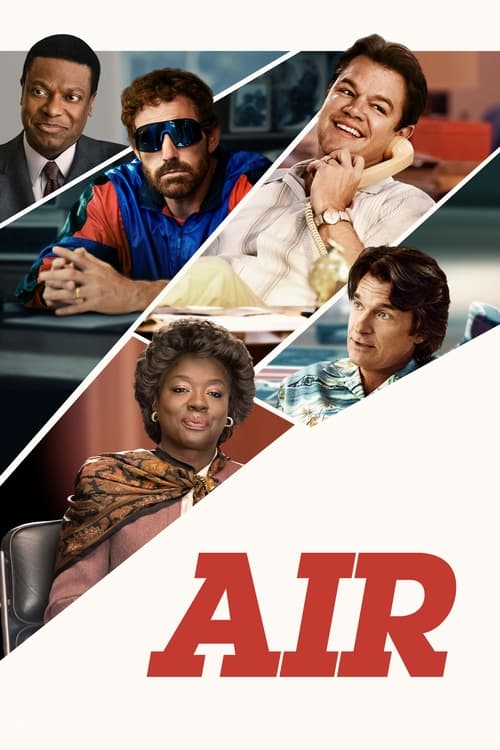















Popular
Why is Richard such an important figure in Air, and what happens to him after Sonny and Strasser meet him in the restroom?
Why does Sonny become so fixated on Michael Jordan instead of the other players Nike is considering?
What exactly happens when Sonny tries to contact the Jordan family before the meeting in North Carolina?
What role does Deloris Jordan play in the negotiation, and why does she matter so much in the story?
Why does Nike create the Air Jordan prototype, and what is the importance of the shoe’s name?
Should I watch it?
Ask Your Own Question

What is the plot?
The film opens in 1984 with Sonny Vaccaro scanning gymnasiums and high school courts for basketball talent while the sun sets on Nike's struggling basketball division. Nike sits well behind Converse and Adidas in sneaker sales and influence; Sonny moves through the stands and sidelines convinced that a single player could change that trajectory. At the Beaverton headquarters he briefs Howard White, the head of basketball, who bluntly reports that kids and athletes prefer Adidas and that Nike's basketball business is threatened with closure. Sonny takes that as a dare. He convenes a strategy meeting with Rob Strasser and other marketing executives and lays out a radical plan: find the one player who can become the face of Nike basketball.
While the men run down the 1984 draft, Sonny fixates on Michael Jordan, a rookie whose athletic highlights and relentless competitiveness he watches repeatedly at home. He juxtaposes Jordan's on-court hunger with an Arthur Ashe racket commercial and imagines a shoe built around a single athlete rather than the market's usual brand-first approach. Rob greets Sonny's ambition with skepticism, but Sonny persists, showing footage of Michael rising for shots and battling for rebounds, making a case that Jordan's image and movement would lend itself to a signature sneaker line. Rob's posture shifts from doubt to curiosity as Sonny makes his case.
Sonny meets with Phil Knight; Phil admits the basketball budget is meager and he is contemplating disbanding the unit. Phil and Rob leave the room to weigh options, while Sonny returns to the field he knows: tracking players and convincing people. He calls David Falk, Michael Jordan's agent, who warns him to stay away from the family. Falk insists Michael refuses to meet with Nike and cautions that contacting the Jordans directly would be unprofessional. Sonny hears the warning but does not accept it as final.
Sonny seeks counsel from George Raveling, the coach who worked with Jordan during Olympic play. Over dinner, George teases Sonny with a line about Michael taking a Mercedes Benz--every player has a price--but he also shares something heavier: a typed copy of Dr. Martin Luther King Jr.'s "I Have A Dream" speech that he keeps; George uses that speech as an exhortation for Sonny to act boldly and approach the Jordans with conviction. Encouraged, Sonny decides to drive to Wilmington, North Carolina.
At the Jordan home Sonny meets Deloris and James Jordan Sr. He asks for a few minutes of Deloris's time and sits in their living room delivering an unorthodox pitch: other companies will throw money at Michael, Sonny says, but Nike will build a shoe around his identity and career. He stresses that Nike will give Michael individual attention and that the shoe can be part of Michael's legacy. Deloris listens with caution and maternal protectiveness; Sonny leans on sincerity rather than theatrics. When David Falk discovers Sonny's visit, he erupts in an angry, profanity-laden phone call at Sonny, warning him off. Sonny takes the outburst in stride and keeps working to win Deloris.
Back in Oregon Sonny recruits Peter Moore, Nike's shoe designer, to sketch prototypes. Moore experiments with a predominantly white shoe with red accents; Sonny finds that the crimson hints read too tame for his vision. Moore explains the NBA's uniform and shoe color rules: any shoe whose non-white color predominates will subject the player to fines. Phil agrees to absorb any fines Michael might face in order to allow a bolder colorway, and he lends the team the full basketball division budget of $250,000 as their opening offer--an amount that equals the entire department's annual allocation.
Sonny returns to Wilmington with a name, a prototype, and a plan. The Jordans meet with Converse and Adidas first; both companies bring lucrative offers and persuasive salespeople. Adidas includes a Mercedes-Benz 380SL among its inducements, confirming George's offhand remark about players and cars. The Jordans then travel to Nike's Beaverton campus. Inside the meeting room Phil stands alongside Rob, Sonny, and Moore presenting the prototype that Moore has dubbed "Air Jordan," borrowing from Nike's Air Sole technology and from a phrase that floated up during earlier phone arguments. Sonny delivers an extended speech that lays out not only Michael's potential for athletic greatness but also the hardships and trials that will shape his long-term story. Sonny punctuates his argument with archival-style footage of Michael's future successes and setbacks--clips that the film intercuts with Sonny's narration--reminding the Jordans that the shoe can be more than footwear; it can be part of Michael's narrative.
The meeting concludes with the Jordans departing the campus looking pleased but noncommittal. Shortly after, Sonny learns that Adidas has matched Nike's $250,000 offer and added the Benz. He assumes the deal is lost. Then Deloris calls. She tells Sonny that the family will sign with Nike, but on one condition: Michael must receive a percentage of every shoe sold bearing his name. Sonny balks, insisting that this compensation structure is not standard business practice. Deloris counters by restating something Sonny himself said in their meeting: "A shoe is just a shoe until my son steps into it." Her phrasing reframes Sonny's earlier rhetoric as a straightforward business justification. Sonny takes her request to Phil.
Phil sits in his office and, after a beat, accepts Deloris's demand with a frank expletive--"fuck it"--and signs off on giving Michael a cut of royalties. Phil's decision puts the company on a risky course; it also keeps alive the people and resources that depend on the basketball department. Sonny dials Deloris back and, finally cleared to speak to Michael, tells him plainly: "Welcome to Nike." Back at the office the news spreads into a spontaneous celebration. Staff members who had pinned their livelihoods on the basketball line open champagne and embrace; they place the first Air Jordan prototype into the center of the room and cheer.
After the deal closes David Falk calls Sonny again. This time his tone has softened; he congratulates Sonny and, in the background, the family's decision shows. Sonny, feeling vindicated, treats himself to a new pair of shoes and goes out to run. He takes a few steps on the track but returns to the sidelines, abandoning the run, a small private joke about his own fitness and the long fight he has waged to keep the basketball division breathing.
The film then moves into an epilogue that catalogs immediate and later outcomes. In its first year of sales the Air Jordan line far outperforms expectations, bringing in $162 million--well beyond Phil Knight's conservative projections. Michael Jordan receives the contractual percentage Deloris insisted upon and is able to acquire a car and other trappings of success. Rob Strasser gains prominence as a marketing force at Nike. Howard White rises to run the Air Jordan brand. Peter Moore, credited with creating the now-iconic silhouette of Michael suspended in midair clutching a basketball, had died shortly before production began; the film notes his passing rather than depicting it, and it acknowledges him posthumously for his design contribution.
The film's archival montage includes footage and intertitles that touch on later real-life events. The narrative includes later images and news clips of Michael's life, at one point referencing the later murder of his father, James Jordan Sr.; the film does not dramatize that crime in its narrative, nor does it identify perpetrators on screen. George Raveling receives mention for declining payment when he transferred his copy of Dr. Martin Luther King Jr.'s speech to the team; David Falk's later business success is noted by an on-screen statement that he sold his company for $100 million. The epilogue records that Phil Knight has given billions to charitable causes, and that Nike subsequently acquired Converse. Deloris Jordan's later career as an author and her establishment of a memorial fund in honor of her husband receive mention. The final textual update specifies Sonny Vaccaro's role in a 2014 antitrust case against the NCAA that resulted in a decision favorable to student-athletes and frames his career as having a lasting impact on the business of sports.
The movie ends where the business meeting began: with Sonny standing among people whose livelihoods and reputations he has risked. Office chatter fades into archival footage and white text that lists the post-deal outcomes. The camera lingers on the Air Jordan prototype and on Michael Jordan's early images as the credits roll, closing with the factual updates about the people involved and the financial triumph of the shoe line. The last on-screen entry ties Sonny's effort to a later legal victory in 2014, leaving the audience with a chronological ledger of results rather than a dramatic coda: the Air Jordan deal has reshaped careers, a company's fortunes, and aspects of the athletic world, and the film concludes with those concrete outcomes displayed for the viewer.



What is the ending?
Short version: Nike agrees to Deloris Jordan's demand that Michael receive a percentage of every Air Jordan sold, and the deal is signed. Sonny's gamble pays off, Phil Knight accepts the risk, and the film closes by showing that the partnership becomes hugely successful.
Expanded ending, scene by scene:
The final negotiations tighten around one central demand: Deloris Jordan will not let Michael sign unless he gets a percentage of each pair of Air Jordans sold. Sonny brings that condition back to Nike, knowing it is the one thing the company has been resisting. Phil Knight, after weighing the risk, decides to accept it.
In the last stretch of the story, the deal finally comes together. Sonny's persistence has led the company to the edge of a choice it cannot reverse, and Phil agrees to move forward with Deloris's terms. Michael's place in the deal is secured not just with money up front, but with a share of the shoes themselves.
The film then moves into its closing material, showing that the agreement becomes far larger than anyone initially expected. The Air Jordan line succeeds on a massive scale, and the ending makes clear that the promise Deloris demanded was not a small addition to the contract but the thing that transformed the entire arrangement.
For the main characters at the end: Sonny Vaccaro ends the story vindicated, having pushed the deal through against skepticism. Phil Knight ends the story as the executive who finally accepts the risk and signs off on the agreement. Deloris Jordan ends the story as the person who secured the defining condition of the deal for her son. Michael Jordan ends the story with the Nike partnership in place, setting up the Air Jordan legacy that follows.
Is there a post-credit scene?
No. Air (2023) does not have a true post-credit scene after the credits finish.
What it does have is footage and captions during the closing credits, not an extra scene at the very end. That material includes Michael Jordan's Nike "Be Like Mike" commercial and a portion of his Hall of Fame speech, along with text explaining what happened to the real people after the deal. There is nothing new after that credits footage ends.
Why is Richard such an important figure in Air, and what happens to him after Sonny and Strasser meet him in the restroom?
Richard is treated as a small but memorable connection in the film's early Nike-office world, and viewers often ask who he is because the scene plays like a quick, easily missed detour in Sonny's larger push to save the basketball division.
Why does Sonny become so fixated on Michael Jordan instead of the other players Nike is considering?
Sonny latches onto Jordan after seeing something bigger than ordinary athletic promise: he sees a once-in-a-generation force whose style, poise, and future fame could lift Nike's entire basketball business and make the brand feel alive rather than desperate.
What exactly happens when Sonny tries to contact the Jordan family before the meeting in North Carolina?
Sonny's attempt to reach the Jordan family is blocked by David Falk, Jordan's agent, which raises the stakes and makes Sonny's pursuit feel increasingly reckless, personal, and urgent as he keeps pushing toward a face-to-face meeting.
What role does Deloris Jordan play in the negotiation, and why does she matter so much in the story?
Deloris is not just Michael's mother but the family member who understands the value of his talent and controls access to his future, so her calm authority turns the negotiation into something much bigger than a shoe deal and forces Nike to prove respect, not just enthusiasm.
Why does Nike create the Air Jordan prototype, and what is the importance of the shoe’s name?
Peter Moore's prototype is created as a concrete way to sell the vision to the Jordans, and the name 'Air Jordan' connects Michael to Nike's Air Sole technology while also making the shoe feel tailored to him rather than borrowed from a generic line.
Is this family friendly?
No--Air (2023) is not especially family friendly for young children because it is rated R for language throughout, with frequent strong profanity as the main issue.
Potentially objectionable or upsetting content includes: - Very frequent strong language, including repeated F-words and other crude profanity. - Sex-related jokes and vulgar insults, including some sexually aggressive or crude dialogue. - A brief glimpse of adult-magazine imagery in a store setting, with no explicit nudity or sex scenes. - Social drinking by adults and brief smoking in the background. - A few tense arguments and heated confrontations, but no significant violence or gore is reported in the parental guides.
If you are mainly concerned about explicit content, the movie is relatively tame apart from the language, but for children sensitive to profanity or crude humor, it is better suited to older teens and adults.








