
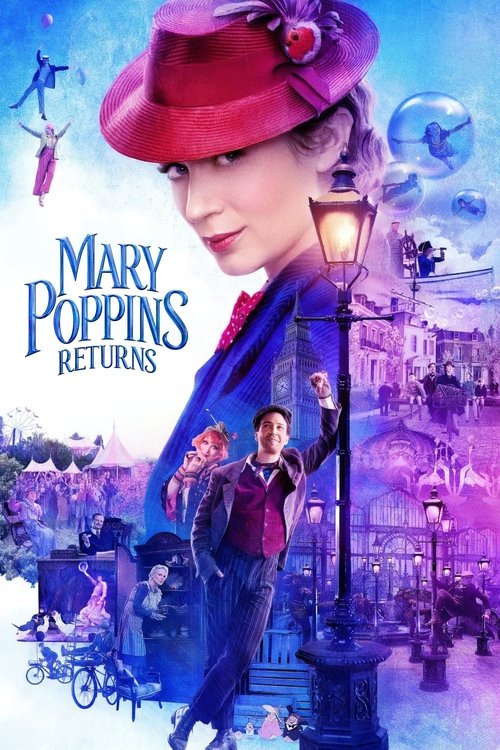



















































Popular
What is the significance of the blue kite in Mary Poppins Returns?
How does Mary Poppins help the Banks children cope with their father's struggles?
What role does Jack play in the story, and how does he connect with Mary Poppins?
What is the significance of the song 'A Cover is Not the Book' in the narrative?
How does the character of Michael Banks evolve throughout the film?
Should I watch it?
Ask Your Own Question

What is the plot?
In 1935 London, under the gray pressure of the Great Depression, Michael Banks lives in the old Banks house at 17 Cherry Tree Lane with his three children, John Banks, Annabel Banks, and Georgie Banks, and with the household help of Ellen. His wife, Kate Banks, has died about a year earlier, and her absence hangs over the home like a shadow that never lifts. Michael is not only grieving but drowning in practical trouble: he has taken a loan from Fidelity Fiduciary Bank, he is already months behind on payments, and he is told that unless the debt is repaid by Friday, the house will be repossessed. The threat is immediate and brutal, and because Michael is a widower trying to hold everything together alone, the deadline feels less like a warning than a sentence.
The film opens out on the streets of London rather than inside the house, and the first note of life comes from Jack, a cheerful lamplighter cycling through the city and singing "Underneath the Lovely London Sky" as he works the lamps and insists on beauty even in hardship. He becomes one of the film's emotional anchors, a kind of grown-up echo of Bert from the first film, connected to the city's ordinary people and to the quiet labor of keeping darkness at bay. As Jack moves through London, the city feels half-in ruin and half-alive, a place where music and routine are trying to outlast despair.
Inside Cherry Tree Lane, Michael's situation is worsening by the day. He is working at the bank as a teller, but that job does not save him from the bank's own pressure, because the institution that employs him is also the one threatening to take his home. He is overwhelmed by bills, repairs, and grief, and the children can see it. The pipes leak, the house is strained, and Michael has effectively become both parent and lost child at once, unable to manage the practical world because he is still emotionally trapped by Kate's death. Jane Banks, now an adult and a labor activist, steps in to help her brother, but she cannot magic away the debt or the pain.
The first major turning point comes when representatives of the bank arrive to deliver the notice of foreclosure. The message is simple and merciless: if Michael cannot repay the loan in full by Friday, the house is gone. That deadline becomes the engine driving everything that follows. Michael remembers that his and Jane's father once left them shares in the bank, and those shares may be enough to cover the debt if the family can find the certificate proving ownership. The revelation changes the problem from pure ruin into a desperate scavenger hunt. Now the house might be saved, but only if a missing document can be found in time.
Michael and Jane begin searching the house for the certificate, and the search itself becomes a journey through memory. Their father's legacy is no longer just emotional; it is financial, legal, and buried somewhere inside the rooms where they grew up. The house, once a place of childhood security, now feels like a layered archive of old lives and lost order. Michael's grief over Kate has left him unable to keep the family organized, and the hunt for the certificate mirrors the way the family has to recover both a document and a sense of direction. But the search is interrupted by a small and crucial accident of fate: the younger children are sent out for forgotten groceries, and Georgie Banks wanders off in the park chasing an old kite that belonged to Michael. That kite climbs into the sky, and with it comes the impossible.
Mary Poppins returns by descending from the sky with the kite in hand. She appears as if she has never been away, immaculate and self-possessed, carrying her umbrella with the familiar parrot-head handle and speaking with the same mixture of politeness and authority that makes it clear she is already in command. Her arrival is not treated as a spectacle for its own sake; it is a response to emergency, the precise kind of emergency Mary Poppins always seems to know before anyone else does. She takes the children home and declares that she will look after them as their nanny, just as she once did for their father and aunt. Her return immediately changes the atmosphere. The house does not become safe yet, but it becomes possible again.
Mary Poppins's way of working is less about explanation than reorientation. She does not tell the Banks children to stop grieving; she shows them how grief has distorted their view of what remains. Through magic, music, and a series of impossible excursions, she draws them into experiences that make memory active rather than paralyzing. She is joined in spirit and eventually in action by Jack, whose role becomes increasingly important as a guide through London and as a bridge between the ordinary city and Mary's impossible interventions. Together, they create a world in which the family can breathe enough to remember who they are.
The children's first new perspective comes through Mary's wondrous, almost theatrical excursions. The film uses these sequences to turn emotion into image: the household is no longer just a place of worry but a world where the hidden shapes of things can be seen. One of the most memorable detours takes them to Topsy's workshop, a distorted, tilted interior run by Mary's eccentric cousin Topsy. There, gravity itself feels unstable, and the room's physical disorientation mirrors the family's emotional one. The visit becomes a comic storm of confusion and transformation, but underneath the humor is a serious point: when life has tipped sideways, a different angle may be the only way to make sense of it.
Another major magical sequence unfolds in and around the bathtub, where the film plunges the characters into an underwater fantasy that turns bathing into an escape route through memory and wonder. The sequence is vivid and emotionally tuned to the children's longing, using color and motion to transform a domestic ritual into a reminder that imagination can still open a passage through sadness. These scenes are not random diversions. They are Mary's method of repairing a family that has become too frightened and too emotionally cramped to see beyond its immediate crisis.
While the children are pulled into these adventures, Michael and Jane continue hunting for the bank-share certificate, because the deadline remains fixed and unyielding. Their search eventually reveals the terrible irony at the center of the plot: the proof that could save the house has been present all along, but in damaged form. Michael discovers that the certificate has been torn into pieces and used to patch up an old kite. This is the film's central revelation and one of its most elegant twists. The thing that was meant to preserve the family's future has been hidden in a child's object of play, fused into the fabric of memory itself. It is both practical and symbolic: the family's salvation is literally sewn into a keepsake from childhood.
As the deadline closes in, the tone tightens. The bank is not a cartoon villain in the abstract; it is a system of legal force, represented most immediately by William Weatherall Wilkins, the greedy chairman who is determined to repossess Michael's home and, by implication, many others' homes as well. He is the face of institutional cruelty, a man prepared to use the machinery of finance against vulnerable families. The film's confrontations with him are not physical fights but battles of will, time, and paperwork, and the stakes are made brutally concrete by the clock ticking toward Friday. Michael and Jane must get the certificate to the bank before the office closes, while Mary, Jack, and the lamplighters work to buy them time in the city outside.
This is where the film's most kinetic public set pieces come into play. Jack and the other lamplighters move through London in a coordinated act of help, using their knowledge of the streets and the city's rhythms to delay the inevitable. Their work is communal and almost mythic, turning the city itself into an accomplice in the rescue attempt. At one point, they are involved in literally turning back time in order to create the minutes Michael and Jane need to reach the bank. The effect is fantastical, but the emotional logic is clear: when a family is about to lose its home, every second feels like a stolen chance at survival.
Michael and Jane reach Fidelity Fiduciary Bank with what they believe are all the pieces, only to discover that they do not yet have the complete certificate. The scene is a panic of near-success, the kind of near-miss that stretches tension to its limit. The bank's authority looms over them, and the possibility of legal failure presses in hard. Then the story delivers its final reversal: Mr. Dawes Jr., Wilkins's uncle, arrives and backs Michael and his family, then fires Wilkins. The revelation is decisive. Wilkins is not the ultimate power after all; his authority is stripped away by the older generation's intervention, and the bank's moral posture shifts at the key moment away from predation and toward restitution.
Dawes then reveals another truth that reframes the entire crisis: Michael's father had saved enough money that it is more than sufficient to save the house. The family's rescue is therefore not dependent solely on the certificate hunt after all. The shares, the father's savings, and Dawes's intervention converge to undo the foreclosure threat. The plot's financial labyrinth resolves not through violence or sacrifice, but through recovered inheritance, institutional correction, and the restoration of what was always meant to belong to the Banks family. The house is saved, not because the bank shows kindness on its own, but because the family's true financial standing is finally recognized.
There is no death in the film's present action; the only death that shapes the story is Kate Banks's off-screen passing before the film begins, a loss that has left Michael emotionally stranded and the household unsteady. That absence is the deepest wound in the narrative. Every argument about money and every scramble for paperwork is really an argument about what happens to a family after love has been interrupted by death and duty has outgrown grief. Mary Poppins does not bring Kate back, and the film never suggests she can. Instead, she helps the family understand that Kate remains present in memory and affection, which is how the children are finally able to accept that their mother is "alive in their hearts," as the story's emotional logic puts it. The healing is not supernatural resurrection but emotional reattachment.
As the crisis eases, the family finally begins to rediscover what Mary has been trying to restore all along: not just enough money to stay in the house, but the lost sense of childlike wonder that grief and responsibility have buried. Michael and Jane recognize that the magic was never only about the location of the certificate. It was about what the search forced them to recover in themselves: patience, trust, play, and the courage to let memory be a source of strength rather than a prison. The children, too, are changed. They have been frightened, confused, and overburdened, but they emerge with a more stable sense of where they belong and of how their family can carry loss without being destroyed by it.
The ending is quiet after the storm. With the house restored to stability and the immediate threat gone, the emotional work of the film comes into focus. Michael and Jane understand that Mary Poppins's visit has done what it always does: it has repaired a family by giving them enough wonder to re-enter their own lives. Mary herself does not stay. Having completed her purpose, she prepares to leave again, just as she did in the first story. The Bankses know she will not remain in the household permanently, and they accept that her role is not to settle down but to arrive when needed and depart when the lesson has been learned.
Her farewell is restrained rather than tearful, but it carries all the emotional weight of the story. Michael and Jane thank her quietly for what she has done, and the film ends with the sense that the family has not simply avoided foreclosure but has been restored to itself. Jack, whose presence throughout has tied the story to the life of the city, remains part of the world Mary has helped to brighten, and the lamplighters' role in the rescue lingers as a sign that ordinary acts of care can become extraordinary when joined to hope. The final image is not of triumph in the usual sense but of a repaired life: a house still standing on Cherry Tree Lane, children no longer lost in grief, and a family that can once again look upward without fear.








What is the ending?
At the end of Mary Poppins Returns, the Banks family comes together to save their home, and Mary Poppins helps them rediscover joy and the importance of family. Michael Banks realizes the value of his children and the memories of his late wife. The family successfully prevents the bank from taking their home, and Mary Poppins departs, leaving a lasting impact on their lives.
As the story reaches its climax, the Banks family faces the imminent threat of losing their beloved home at 17 Cherry Tree Lane. Michael Banks, played by Ben Whishaw, is overwhelmed with grief and responsibility after the death of his wife, and he struggles to keep his family together. His children, Annabel, John, and Georgie, are also feeling the weight of their mother's absence and the uncertainty of their future.
In a pivotal scene, the family gathers in the living room, where they confront the reality of their situation. The children, inspired by Mary Poppins, decide to take action. They rally together, determined to save their home. Mary Poppins, portrayed by Emily Blunt, encourages them to embrace their imagination and creativity. She leads them on a whimsical adventure through the streets of London, where they encounter various colorful characters, including the lamplighter Jack, played by Lin-Manuel Miranda.
As they navigate through their challenges, the children learn valuable lessons about courage, resilience, and the importance of family. They realize that even in the face of adversity, they can find joy and hope. The climax builds as they participate in a fantastical animated sequence, where they help a group of animated animals and ultimately find a way to confront the bank.
In a tense moment, the family attends a meeting at the bank, where they present their case to the stern bank manager, Mr. Wilkins. The children bravely stand up for their home, recounting their memories and the love that fills it. Their heartfelt plea resonates, and the bank manager is moved by their determination.
In the final moments, the family receives a surprise inheritance from Michael's late father, which allows them to pay off their mortgage and save their home. The joy and relief wash over them as they realize they will not lose their cherished memories and the place that holds their family together.
As the story concludes, Mary Poppins prepares to leave, having fulfilled her purpose. She shares a heartfelt goodbye with the Banks family, who have grown closer and learned to cherish each other. Michael, now more confident and hopeful, understands the importance of embracing life's challenges with love and laughter. The children, filled with newfound joy, wave goodbye to Mary Poppins as she ascends into the sky, her umbrella floating gracefully above them.
In the end, the Banks family stands together, united and stronger than before. They have not only saved their home but have also rediscovered the magic of family and the importance of holding onto memories. Mary Poppins departs, leaving behind a legacy of love and joy that will forever resonate in their hearts.
Is there a post-credit scene?
In "Mary Poppins Returns," there is no post-credit scene. The film concludes with a heartwarming finale that wraps up the story without any additional scenes after the credits. The ending emphasizes themes of family, love, and the importance of imagination, leaving the audience with a sense of closure and joy. The final moments feature Mary Poppins and the Banks children flying a kite, symbolizing hope and the continuation of their adventures, but there are no further scenes or surprises after the credits roll.
What is the significance of the blue kite in Mary Poppins Returns?
The blue kite in Mary Poppins Returns symbolizes hope and the connection between the Banks family and their late mother, Winifred. It serves as a reminder of the joy and imagination that she brought into their lives. When Michael and his children fly the kite together, it represents their unity and the rekindling of their spirits, as well as the importance of cherishing memories.
How does Mary Poppins help the Banks children cope with their father's struggles?
Mary Poppins uses her magical abilities and whimsical approach to life to help the Banks children, Annabel, John, and Georgie, navigate their father's financial troubles and emotional distance. Through imaginative adventures, such as visiting the animated world of the 'Royal Doulton Bowl' and the 'A Cover is Not the Book' sequence, she encourages them to embrace their creativity and resilience, ultimately helping them to bond as a family and support their father.
What role does Jack play in the story, and how does he connect with Mary Poppins?
Jack, played by Lin-Manuel Miranda, is a lamplighter and former apprentice of Bert from the original film. He serves as a cheerful and optimistic companion to Mary Poppins, helping her navigate the challenges faced by the Banks family. Jack embodies the spirit of community and friendship, and his connection with Mary Poppins is rooted in their shared understanding of the importance of joy and imagination in overcoming adversity.
What is the significance of the song 'A Cover is Not the Book' in the narrative?
The song 'A Cover is Not the Book' serves as a pivotal moment in Mary Poppins Returns, emphasizing the theme of looking beyond appearances and understanding the deeper truths of life. It reflects Mary Poppins' philosophy of embracing adventure and the unexpected. The lively performance, featuring animated sequences, illustrates how the characters learn to appreciate the richness of their experiences, encouraging them to be open-minded and adventurous.
How does the character of Michael Banks evolve throughout the film?
Michael Banks begins the film as a grieving widower, struggling to manage his responsibilities and the loss of his wife. Initially, he is overwhelmed by his financial troubles and the pressure to maintain his family's home. However, through Mary Poppins' guidance and the support of his children, Michael gradually learns to reconnect with his sense of wonder and joy. By the end of the film, he embraces the importance of family, imagination, and the value of cherishing memories, ultimately finding hope for the future.
Is this family friendly?
"Mary Poppins Returns" is generally considered family-friendly, but there are a few scenes and aspects that might be potentially objectionable or upsetting for children or sensitive viewers:
-
Loss and Grief: The film opens with the Banks family dealing with the loss of Mr. Banks, which may evoke feelings of sadness or confusion in younger viewers.
-
Financial Struggles: The Banks family faces the threat of losing their home due to financial difficulties, which could be distressing for children who may not fully understand the implications of such situations.
-
Dark Imagery: Some scenes feature darker visual elements, such as the depiction of the villain, which may be frightening for younger children.
-
Emotional Turmoil: Characters experience moments of despair and anxiety, particularly Michael Banks, who struggles with the weight of his responsibilities and the pressure of his family's situation.
-
Chase Scenes: There are sequences that involve frantic chases or moments of danger, which could be intense for sensitive viewers.
-
Surreal Elements: The film includes fantastical and surreal moments that might be confusing or unsettling for some children, particularly those who are sensitive to unusual or bizarre imagery.
Overall, while the film contains these elements, it also emphasizes themes of hope, family, and the importance of imagination, which can provide a comforting counterbalance.









