





Popular
How do Korvo and Terry’s marriage and honeymoon affect their relationship in Season 5 of Solar Opposites?
What is Yumyulack’s dark secret or reveal in Season 5?
What happens in the ‘Ex-Boyfriend Island’ episode with Jesse’s exes?
What is the Clervix 3 citizenship or residence plot in Season 5?
What happens to the Wall or the miniature humans story in Season 5?
Should I watch it?
Ask Your Own Question

What is the plot?
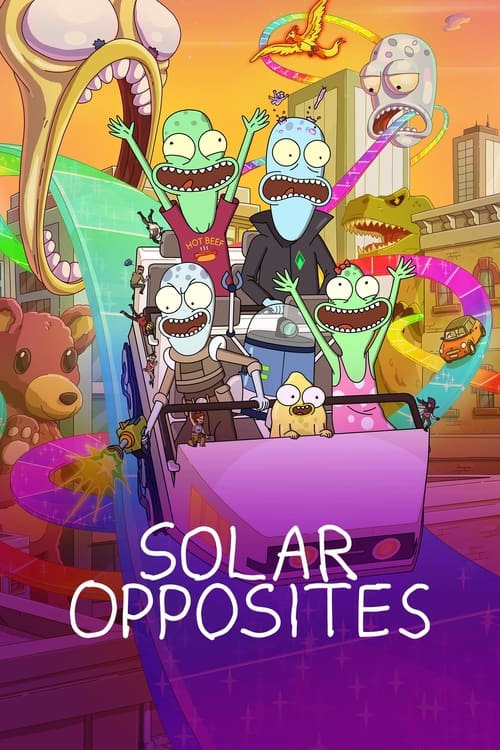
The fifth season opens with the Solars still living on Clervix 4 after leaving Earth, trying to build a home on a planet that at first seems perfectly stripped of anything "extra," orderly, and safe, but they gradually discover that the planet is being controlled by a single mind and that its apparent calm is artificial.
As that control becomes clear, the family is forced into a tense escape from Clervix 4 and chooses to abandon the planet rather than stay trapped under its influence. During the flight away, J.K. Sevens, a friendly robot from Clervix 4, goes with them, and the group heads back toward Earth because the new planet is no longer viable for them.
Back on Earth, the season resumes the broader family dynamic with the Solars trying to settle back into their old mission and daily life, even as the show keeps the consequences of the previous season's ending in play. Korvo, Terry, Jesse, and Yumyulack are again dealing with the question of whether they can still carry out their original Shlorpian purpose while living among humans.
In the continuing Wall storyline, the season follows the aftermath of the escapees who had broken out into the backyard and started trying to live freely there. Their lives in the open are thrown into crisis when the sprinklers are mysteriously shut off, turning the backyard from a fragile refuge into a dangerous battleground where survival suddenly becomes harder again.
That pressure feeds into the larger mystery surrounding the backyard societies and the hidden systems controlling them, and the season continues to develop the Wall/yard conflict by revealing that the surviving tiny people are no longer just trying to endure confinement but are now fighting over what kind of world they can build outside it. The setting shifts from prison-like survival to unstable freedom, but that freedom quickly proves precarious.
At the same time, the Solars' own family situation keeps shifting as they try to stabilize their lives after the upheaval of the prior finale. Korvo and Terry's married relationship remains central to the season's emotional and practical decisions, and the family's choices are repeatedly driven by whether they can preserve one another while still fulfilling the pupa's needs.
A major turning point comes when the season reveals the hidden truth about the pupa's long-term feeding cycle. Korvo has been killing and disposing of Yumyulack repeatedly as part of the ritual required to feed the pupa, then uploading Yumyulack's consciousness, transferring memories into a fresh brain, and printing a new body so the cycle can continue.
Yumyulack eventually discovers the full reality of that process and learns that he has been the one repeatedly sacrificed because he is the nutrient replicant. That revelation horrifies him and turns the season's family tension into open crisis, because the whole pattern of survival he thought he understood is exposed as a repeated, brutal loop.
As the cycle continues toward collapse, the machine used for this process explodes and takes Yumyulack with it. Korvo attempts to repair the machine afterward, but the effort goes wrong in a new way: Yumyulack's head emerges from the printer and enlarges uncontrollably because of growth particles, forcing Korvo to throw the head outside before it becomes even more dangerous.
Outside, the oversized head continues growing until it floats away, while the pupa, now starving without the nutrient replicant, begins squirting out terraforming fluids. The family realizes that if it does not eat soon, the situation will deteriorate further and their mission may fail entirely.
With the machine beyond repair and the usual method of feeding the pupa destroyed, Korvo loses hope and remembers a past decision: he once allowed another Yik to escape, and that escaped Yik had gone on to live peacefully in Ireland. Korvo travels to Ireland to find him, and the journey becomes an urgent attempt to salvage the pupa's survival by recovering the one creature who may still solve the problem.
Korvo and the others enter a tavern and begin asking about the missing Yik, but the bartender claims not to know where he is. This forces the search to continue more directly, and the family closes in on the escaped Yik as the only remaining path to restoring the old feeding system.
Before Korvo can force the old solution back into place, Jesse interrupts with a new discovery. She has found that the pupa does not need the nutrient replicant at all and can instead be fed chalupas, which the family had used before.
Jesse's discovery changes the entire direction of the season's endgame, because it replaces the brutal repeating sacrifice with a nonlethal alternative. The pupa is then fed chalupas, which saves it and breaks the cycle that had defined Korvo's hidden maintenance of the mission.
By the end of the season, the family and their alien household are no longer headed toward the gruesome fate that Korvo had been sustaining behind the scenes. The new feeding method preserves the pupa, spares Yumyulack from continuing as the required sacrifice, and allows the Solars to survive without repeating the old killing-and-reprinting routine.



What is the ending?
The ending of Solar Opposites season 5 leaves the Solars in a false, altered reality, and then it cuts to a bigger danger arriving as the story expands outward instead of resolving cleanly. At the same time, the backyard storyline ends with The Wall's people taking control of their own fate, while the main alien family is left headed into another conflict.
The season's ending, told simply, is this: the team learns that much of their life has been happening inside a "What If?"-style setup, and the truth of their mission is destabilized. In the final stretch, the backyard plot reveals that The Wall residents have secured power over their world, but the ending does not restore normalcy for everyone; it instead leaves the story in motion, with a new threat arriving and the main family still trapped in the consequences of everything that came before.
In chronological order, the ending unfolds like this:
The Solar Opposites begin the final run of the season still dealing with the aftermath of their broken, shifting life on Earth and the larger question of what their existence is actually for. The season's "What If?" reveal reframes the story, showing that what the characters have been living through is not the simple original mission they believed it was.
As the truth comes into focus, the narrative turns away from the old idea of a clean Shlorpian destiny and toward a more unstable reality where the team's purpose is no longer secure. The Pupa's fate is also clarified in the broader ending logic of the show: it does not carry out the full terraforming endgame it was originally meant for.
In the backyard storyline, the ending moves toward control rather than escape. Cherie and the people of The Wall reach the shrink ray and gain the power that once belonged to others, but Cherie chooses not to restore everyone to normal size because her child was born inside The Wall and cannot safely live as a giant in the outside world. She then keeps that truth from the others, which means The Wall remains intact instead of being opened up or abandoned.
For the main characters, the endings are as follows:
Korvo ends the season still tied to the alien mission and to the unresolved larger conflict, with no clean return to the old life he once had.
Terry remains part of that same unstable future, still bound to the family unit and the consequences of the season's reality shift.
Jesse is positioned as one of the characters who helps expose the truth and keep the group moving forward, but she does not receive a neat personal resolution.
Yumyulack is also left within the fractured main storyline, with his fate tied to the team's continued survival rather than closure.
The Pupa is not shown completing its original terraforming purpose, and its destiny is effectively interrupted rather than fulfilled.
In The Wall, Cherie becomes the key decision-maker, and her choice determines that the residents stay inside their miniature society instead of returning to normal size.
The ending then closes by expanding the stakes again: a new villain reaches Earth, setting up the next conflict rather than solving the current one. That final movement leaves both storylines unfinished, with the Solars still caught in the aftermath of the season's revelations and The Wall locked into its own new order.
Is there a post-credit scene?
Yes. The Season 5 finale has a post-credit scene, and it is important because it sets up the next season rather than serving as a throwaway gag.
In the scene, the long-running backyard world is upended when the Solar Opposites fire a ray into the lawn to make the grass green again after a fire, but the blast accidentally brings back everyone who had died in the backyard, including the Duke.
That ending is tied to the season's larger twist: season 5 reveals the events of the show are taking place inside a kind of "What If?" reality, with the final moments of the season pushing the story toward the next chapter.
How do Korvo and Terry’s marriage and honeymoon affect their relationship in Season 5 of Solar Opposites?
Season 5 focuses heavily on Korvo and Terry adjusting to being married, with their relationship framed around newlywed life, honeymoon behavior, and the struggle to balance affection with control. Reviews describe the season as centering on Korvo learning to respect Terry's agency and make the marriage feel more mutual, while episode listings show a honeymoon episode and later stories built around their domestic partnership on Clervix 3.
What is Yumyulack’s dark secret or reveal in Season 5?
Yumyulack discovers that his role in the mission is not what he believed, and the season reveals a disturbing truth about his purpose: he is tied to feeding the Pupa, with Korvo having repeatedly killed and cloned him to serve that function in the past. This revelation becomes one of the season's major character shocks and is directly tied to Yumyulack's growing understanding of how the family's mission actually works.
What happens in the ‘Ex-Boyfriend Island’ episode with Jesse’s exes?
In the episode commonly identified as 'Ex-Boyfriend Island,' Jesse's former boyfriends return and become a major source of trouble for the Solar family. The episode title and summary indicate that the conflict is centered specifically on Jesse's past relationships resurfacing in a way that forces her to deal with them again rather than treating the story as a general family subplot.
What is the Clervix 3 citizenship or residence plot in Season 5?
The season opens with the Solar Opposites trying to obtain permanent residence on their new planet, Clervix 3, which becomes the setup for the season's early conflict. A review describes this as involving a government official who makes home visits to judge whether Korvo, Terry, Jesse, and Yumyulack deserve citizenship, turning the family's new home into a bureaucratic test.
What happens to the Wall or the miniature humans story in Season 5?
Season 5 continues to include The Wall alongside the main alien storyline, and reviews note that it remains one of the show's parallel narratives. The season's episode list also points to miniature-world developments, including Yumyulack's backyard-related story and a separate mini-society adventure, indicating that the tiny-human plot stays active rather than disappearing.
Is this family friendly?
No -- Solar Opposites Season 5 is not family friendly for children. It is an adult animated comedy with strong animated violence, strong language, drug use, nudity, and sex-related content, and it carries an MA 15+ classification in Australia.
Potentially objectionable or upsetting content for kids or sensitive viewers includes:
- Graphic cartoon violence and gore: frequent blood, injuries, brutal fights, and other over-the-top violent scenes, even when played for laughs.
- Strong profanity: repeated use of harsh language throughout the season.
- Sexual content and nudity: sex jokes, sexual references, brief nudity, and other mature sexual material.
- Drug-related content: references to drugs and drug use appear in the series.
- Disturbing or dark humor: surreal, chaotic situations and jokes that can be unsettling, especially for younger viewers.
- Occasional intense or horror-adjacent moments: scenes meant to shock or provoke discomfort rather than provide gentle family viewing.
If you want, I can also give you a very brief age-suitability verdict like "okay for teens?" versus "only for adults," without spoilers.