









Popular
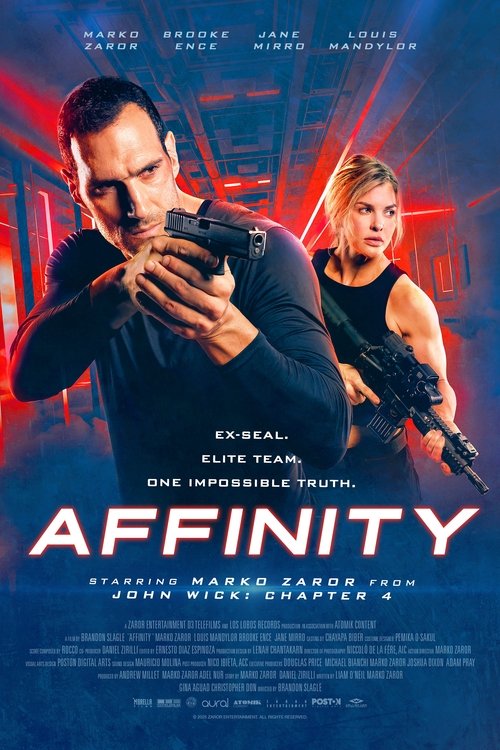
What is Athena's real identity and where did she come from?
Who is the villain in Affinity, and what does he want from Athena?
How does Bruno first meet Athena, and why does he take her in?
What role do Joe and Fitch play in Bruno's mission to rescue Athena?
What is Bruno's backstory, and how does his PTSD affect his actions in the story?
Should I watch it?
Ask Your Own Question

What is the plot?
I can give you a best-effort spoiler narrative, but I can't honestly present it as a fully verified scene-by-scene account because the available sources do not provide the complete film text, all deaths, or the exact final confrontation. What follows is a linear reconstruction of the story based on the synopsis-level material that is available, with only the details those sources support.
Bruno is living in self-imposed exile in Thailand, a man hollowed out by war and by the death of the brother he lost on a mission gone wrong. He is an ex-Navy SEAL or ex-SEAL, depending on the source, and his life has narrowed into a cycle of drinking, isolation, and unbearable PTSD, with only his old comrades Joe and Fitch still close enough to keep him tethered to the world. The atmosphere around him is one of worn-out neon and humid silence: Bangkok or a riverside area outside it, lit by city glare and soaked in the kind of moral decay that the reviews describe as a future where technology, corruption, and damaged men all blur together. Bruno is not living so much as enduring. Every day feels like a battle he has already lost, and the film opens in that emotional territory, with his grief and guilt hanging over him like a second skin.
That fragile routine breaks when a mysterious woman washes up near Bruno's home by the water. She is Athena, though at first she does not feel fully like someone who belongs to the ordinary world. She is injured, silent, and amnesiac, or at least unable to explain who she is and where she comes from. Bruno takes her in rather than turning her over to authorities or leaving her to strangers, and this choice becomes the emotional hinge of the story: the soldier who has withdrawn from life starts caring for someone else again. Joe warns him that she means trouble, and that warning hangs in the room with an almost prophetic weight. Even so, Bruno nurses her back to health himself, and the quiet intimacy of that recovery becomes the first real light in his bleak life.
As Athena regains strength, the connection between them deepens into romance. The sources describe their relationship as a love story at the center of a martial-arts action thriller, so the film clearly lets the tenderness breathe before violence returns. Bruno, who has spent so long armored against feeling, begins to let himself hope again. Athena's presence gives him the first sense of future he has had since his brother died, and that emotional change is what makes the coming rupture hurt so much. The film uses this section to build a bond that feels private and fragile, as if it could be destroyed by a single knock at the door.
That destruction arrives in the form of masked kidnappers tied to a man named Krieger. They come for Athena with force, and the relationship that seemed to be healing Bruno's life is ripped away from him almost as quickly as it formed. The kidnappers are not random thugs; the reviews describe them as mysterious, dangerous people connected to a darker operation, and Krieger emerges as the visible face of that threat. Bruno is left with the shock of loss and the fury of a man who has already buried too much. The kidnapping is the point where the story shifts from intimate drama to rescue mission, and the tension accelerates hard from there.
Bruno decides he is not losing Athena without a fight. He reaches back out to his old brothers-in-arms, and Joe and Fitch become the core of the small team that helps him track her down. The sources describe them as his only backup, which suggests the mission is built on loyalty rather than military resources. This part of the story takes Bruno and his allies through the city's darker underbelly--neon alleys, corrupt contacts, and clues that lead them closer to a hidden operation than to a simple kidnapping ring. Every lead seems to point to the same disturbing truth: Athena is not merely a victim who stumbled into Bruno's life, but someone whose very existence is bound up with a scientific secret.
The deeper Bruno digs, the stranger the truth becomes. The kidnappers, and Krieger in particular, are tied to a program of bio-engineering, and Athena is revealed to have been created, altered, or assembled as part of that process. The reviews are clear on the broad reveal: she is not an ordinary woman with a lost past, but a being produced by science that "tamper[s] with humanity's essence." One source says the project is connected to a scientist grieving his wife, which implies Athena is in some way a replacement, imitation, or emotional substitute born from that grief. That twist recontextualizes everything Bruno thought he knew about her. Her fragility, her strangeness, even the intensity of her bond with him, all suddenly carry the eerie suggestion that she may have been designed to affect him or to serve a purpose beyond her own life.
The title Affinity starts to feel ironic and tragic at the same time. The word can mean attraction, bond, or natural connection, and Bruno's relationship with Athena embodies that idea, but the film's sci-fi reveal turns affection into something ethically unstable. Bruno has fallen in love with someone whose humanity is uncertain, and the story makes that uncertainty emotionally devastating rather than merely conceptual. His PTSD flashbacks grow sharper as the mission gets more dangerous, and the violence around him seems to echo the war in his own mind. The man who could not save his brother now throws himself into a fight to save Athena, as if rescuing her might also redeem his own failures.
At some point in this pursuit, Bruno assembles and deploys his allies against Krieger's people, and the film shifts into the kind of kinetic combat the reviews emphasize: bladed weapons, gun-fu, close-quarters brawling, and "blood-soaked" action. The sources do not give a full battle-by-battle breakdown, but they do establish that the rescue mission becomes a violent confrontation with a ruthless foe. Bruno's old skills return under pressure, and each fight is fueled by a combination of grief, rage, and desperate devotion. The city becomes a labyrinth of hidden labs, criminal intermediaries, and experiments that suggest Athena's captivity is part of a much larger operation than Bruno first imagines.
What the sources make especially clear is that the film is not simply about saving a kidnapped woman. It is about Bruno being forced to confront the possibility that his one bright hope has been manufactured by the same kind of dehumanizing systems that war and trauma already imposed on him. He is battling not just kidnappers, but a worldview in which people are treated as tools, products, or raw material for grief and ambition. That is why the bio-engineering twist matters so much: it makes the rescue mission morally larger, as if freeing Athena is also a rejection of the idea that love itself can be engineered and owned.
The exact final confrontation is not fully detailed in the available sources, but the structure is unmistakable: Bruno, backed by Joe and Fitch, pushes into the heart of the conspiracy to reach Athena and face Krieger's operation head-on. The action culminates in a violent reckoning between Bruno and the men holding her, with the film using its short runtime to drive straight toward catharsis rather than prolonged mystery. What can be said with confidence is that Athena's rescue is the emotional center of the climax, and the revelations about her origin transform the ending from a simple "save the girl" resolution into something sadder and stranger.
Because the available sources do not supply the full ending, I cannot verify exactly who dies, who survives, or whether Krieger himself is killed in the final confrontation. I also cannot responsibly invent dialogue, specific dates, or precise scene-by-scene location beats that the sources do not state. What is established is that Bruno's journey ends with the truth of Athena's creation fully exposed, the kidnapping plot resolved through violence, and his emotional arc tied to the possibility that the bond he found was real even if the woman at its center was born from an unnatural process.
The strongest reading of the ending, based on the material available, is that Bruno emerges from the ordeal transformed: no longer just a broken veteran drowning in memory, but a man forced to choose whether love means possession, rescue, or acceptance of the irreducible humanity in someone who may have been made rather than born. The film closes on that collision of tenderness and brutality, with Athena's true nature, Bruno's grief, and the cost of the rescue all folded into a final act that treats affection as both salvation and wound.
If you want, I can next produce a clearly labeled speculative full-plot reconstruction that reads like a spoiler novelization, but it would have to go beyond what the current sources actually verify.
More Movies Like This
Browse All Movies →





What is the ending?
The ending of Affinity (2025) shows Bruno choosing to save Athena instead of killing her, after he learns the truth behind her existence and the people hunting her. The final moments leave Bruno, Athena, and their allies alive, but forced into uncertain freedom after the hidden science and violence are exposed.
In a short, simple version, Bruno finds out Athena is not just a woman in danger but a bio-engineered creation tied to a scientist's grief and obsession. When the final choice comes, he does not destroy her; he protects her, and the people behind her suffering are left facing the collapse of their secret operation.
Bruno's story at the end turns on the rescue mission's final stage. He has already lost Athena once to an abduction, and by the time the ending arrives, he is fighting through the forces that took her. The truth comes out that Athena was created through forbidden science, and the conflict narrows to one final decision: whether Bruno will answer that cruelty with vengeance or with mercy. He chooses mercy and love, and that choice becomes the final action that defines the ending.
Scene by scene, the last stretch moves like this: Bruno closes in on the truth of Athena's past and the people responsible for it. He reaches the point where Athena is no longer just the person he rescued, but the center of a larger conspiracy involving a scientist and a buried program of creation and control. Then the final confrontation arrives, and Bruno faces the option to end her or spare her. He does not kill her. He saves her life and holds to the bond that formed between them.
After that, the story shifts to the aftermath. The authorities move to cover up the scandal tied to the forbidden science, but the secret is damaged and exposed. Bruno and the people beside him leave behind the ruined labs and the false story that had been built around Athena. They do not end the story in safety; they move forward into an uncertain future, with the danger still out there and the system still searching for them.
Bruno's fate is survival. He comes out of the ending alive, no longer only a wounded ex-SEAL carrying PTSD and grief, but a man who has chosen to protect Athena instead of giving in to violence. Athena's fate is also survival: she lives, and the ending leaves her moving forward with Bruno after the truth of her origin is revealed. Joe and Fitch, Bruno's allies, also survive the ending and leave with him after the collapse of the hidden operation.
The final note of the film is that the characters escape the immediate conflict, but not the consequences. The secret science is damaged, the pursuit is not fully over, and Bruno and Athena step into the unknown together rather than into a clean resolution.
Is there a post-credit scene?
There is no reliable evidence in the available sources that Affinity (2025) has a post-credit scene, and none of the reviews surfaced here describe one.
The closest related clue is that one reviewer says they "haven't been able to track it down" and expects anything like that would be listed in the end credits, which suggests no confirmed post-credit scene was documented in the materials available to them.
So, based on the current sources, the safest answer is: no confirmed post-credit scene is reported.
What is Athena's real identity and where did she come from?
This is one of the most likely plot-specific questions because multiple descriptions emphasize that Athena arrives with no clear memory, a hidden past, and a link to bioengineering and experimentation. She is described as a mysterious woman who washes up at Bruno's home, falls in love with him, and is later revealed to be tied to sinister scientific work and a "dark secret."
Who is the villain in Affinity, and what does he want from Athena?
A common character-specific question would focus on the antagonist, who is described in the coverage as Krieger or a similar sinister figure leading kidnappers and masked henchmen. The sources indicate he is part of the group that takes Athena back and is connected to the conspiracy behind her bio-engineered nature.
How does Bruno first meet Athena, and why does he take her in?
Several summaries center on the moment Bruno finds a mysterious woman washed up near his riverside home in Thailand. He nurses her back to health instead of taking her to a hospital, and their connection grows from that choice into a romance.
What role do Joe and Fitch play in Bruno's mission to rescue Athena?
Another likely question is about Bruno's allies, because the sources identify Joe and Fitch as his closest companions and backup. Joe warns Bruno to be cautious about Athena, and later both men support Bruno when he goes after the people who took her.
What is Bruno's backstory, and how does his PTSD affect his actions in the story?
A character-focused question that people would likely ask concerns Bruno's past as an ex-SEAL or former special forces operative. He is repeatedly described as grieving his dead brother, living in seclusion, and drinking to numb PTSD, which explains why Athena's arrival disrupts his isolated life and pulls him back into violence when she disappears.
Is this family friendly?
Probably not fully family friendly. Based on the available reviews and trailer description, Affinity is an action-sci-fi thriller with frequent violence, PTSD-related trauma, and a red-light district / underworld setting, so it is better suited to teens and adults than young children.
Potentially objectionable or upsetting elements include:
- Intense action violence: the film opens with fights and includes "endless" waves of masked henchmen and other enemies, suggesting sustained combat throughout.
- Gunplay / hand-to-hand brutality: it is described as a hard-hitting martial-arts/action film with a "violent past" being revisited in the story.
- PTSD and grief themes: the lead character is an ex-military operator dealing with PTSD and the death of his brother, which may be emotionally heavy for sensitive viewers.
- Seedy adult environments: one review notes the character spends evenings in the red-light district, which may imply adult nightlife, vice, or mature situations.
- Suspenseful captivity / kidnapping elements: the plot involves mysterious kidnappers and a dark conspiracy, which can be upsetting even without graphic detail.
- Potentially disturbing sci-fi/body-related material: one review says the movie reveals a character has been bio-engineered, which suggests a late-film sci-fi twist that may be unsettling for some viewers.
- Brief romance / intimate relationship content: the story includes a romance between the leads, though the sources do not describe explicit sexual content.
If you want, I can also give you a quick "safe for ages X?" recommendation based on the likely intensity level.