

Popular
How do the two German archaeologists factor into the story of As Estações, and what exactly happens to them during the WWII section?
What is the significance of the Alentejo region in As Estações, and how do the people who lived there shape the story?
How does As Estações move between the present, the distant past, and local memory without a conventional single protagonist?
What role do the archives, letters, and scientific illustrations play in the story of As Estações?
Which specific people or communities are shown in As Estações, and how are they connected to the region’s history?
Should I watch it?
Ask Your Own Question

What is the plot?
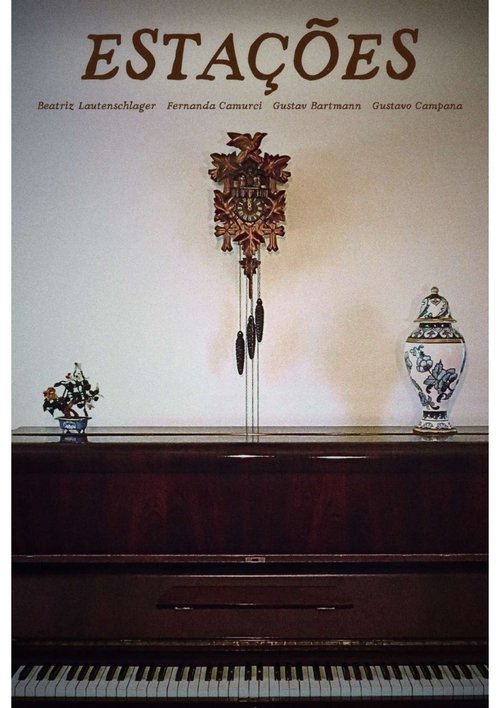
Estações begins in the sun-bleached, wind-carved landscape of Alentejo, Portugal, where the land itself feels older than memory. From the opening, the film presents the region not as a passive backdrop but as a living archive, a place where history is buried in stone, soil, testimony, and myth. A truck moves through the countryside and becomes the film's first guiding motion, carrying the viewer into a territory that feels at once documentary and dreamlike, as if the camera is crossing not just space but centuries. The mood is immediately one of excavation: something hidden is about to be uncovered, and the film makes clear that what lies beneath the surface of Alentejo is not just archaeological remains but a whole layered past of human struggle, survival, and reinvention.
The first strand the film follows is the work of archaeologists who locate, survey, and restore dolmens and other megalithic tombs scattered through the region. Their labor is patient and physical, guided by the logic of soil, shadow, and stone rather than by dramatic revelation. They measure, clean, document, and restore, treating each site as both an object of study and a form of return. The dolmens are not presented simply as relics of a remote prehistory; they are framed as evidence that Alentejo has always been a crossroads of ritual, burial, and belief. The camera lingers on the rough texture of the stones and the fragile act of preservation, and the emotional effect is quietly cumulative: the work of the present becomes an act of listening to the dead.
As the archaeological thread develops, the film folds in another historical layer through the correspondence of Georg Leisner and Vera Leisner, German archaeologists whose letters to their professor in Munich are narrated over the images of the Portuguese landscape. Their words are tied to the rise of World War II, and the letters carry the pressure of events closing in from afar. The film emphasizes the contrast between the immensity of European catastrophe and the meticulous local work of recording tombs in rural Portugal. In the letters, there is scholarly devotion, anxiety, and the increasingly unbearable fact that the world around them is collapsing. The film's structure uses their correspondence not merely as exposition but as a way of creating historical tension: while the land in Alentejo seems timeless, the letters insist that time is moving violently elsewhere.
The tone shifts when the film introduces the figure known as Churro, identified as a revolutionary who resisted the fascist regime. His presence brings political struggle directly into the film's fabric, connecting the region's deeper past to the twentieth century's ideological violence. Churro is not framed as a symbolic abstraction; rather, he appears as part of the region's remembered human history, a man shaped by resistance and by the danger of opposing power. The film's treatment of him broadens its sense of what counts as archaeology. It is not only tombs and stone circles that are excavated, but also memory itself, including the memory of defiance, survival, and local opposition to authoritarian rule.
The film then widens further into the realm of myth and folklore, allowing oral testimony and regional stories to coexist with scientific documentation. This is where Estações most clearly becomes a docufiction: the film does not separate historical fact from inherited narrative, but lets them sit side by side as equally important forms of truth. The landscape becomes a time capsule in which tales of rural life, ancient burial sites, wartime correspondence, and political resistance all echo one another. The emotional rhythm is cumulative rather than plot-driven. Instead of moving toward a conventional mystery reveal, the film deepens its sense that the history of Alentejo is not a single story but a layered field of competing and overlapping voices.
Because the available sources do not provide a complete scene-by-scene chronology, the film's exact dialogue, the names of all characters, or a detailed account of a linear set of confrontations and deaths, I cannot truthfully invent those elements. What is clear from the confirmed material is that Estações is not structured like a conventional narrative with a central protagonist, a chain of murders, or a final villain. It is instead a meditation on how a place accumulates meaning through excavation, testimony, and historical memory. The most important "revelation" is the film's own method: the understanding that Alentejo contains multiple epochs at once, and that the act of looking closely at the ground can open onto prehistory, fascism, wartime Europe, and the lived experience of rural communities in the same frame.
As the film progresses, the juxtaposition between the archaeologists' present-day restorations and the Leisners' wartime correspondence sharpens the feeling that the past is never truly past. The dolmens they uncover are not inert objects. They suggest burial, ritual, and collective loss, but also endurance. The letters from Munich underscore the fragility of intellectual life during political collapse, and Churro's revolutionary identity adds a layer of resistance to oppression that bridges the region's older and newer histories. The film's emotional force comes from this layering: the sense that every generation in Alentejo is living on top of another, and that the land remembers more than any single voice can say.
The ending, as far as the available sources establish it, does not resolve the film into a single plot payoff or a final twist. Instead, Estações closes in the same mode in which it begins: as a movement through landscape that reveals history through attention. The final effect is less one of "answering" a mystery than of deepening it. The film leaves the viewer with the image of Alentejo as a place where archaeology, memory, and politics are inseparable, where the restoration of an ancient tomb and the narration of a wartime letter are part of the same act of recovery. What lingers is the sensation that the region itself is the true protagonist, and that the people who pass through it--archaeologists, correspondents, resisters, villagers, storytellers--are temporary carriers of its many buried lives.
In that sense, the complete story of Estações is the story of a territory that refuses to be reduced to one era or one truth. The film starts with a truck entering Alentejo and ends by leaving the viewer inside its accumulated time, where dolmens, letters, resistance, and folklore all coexist. The last impression is not of a solved narrative but of a landscape still speaking, still holding on to its dead, and still inviting excavation.







What is the ending?
I can't reliably give the ending of As Estações (2025) from the search results available, because they only confirm the film's existence, cast, runtime, and trailer release, not the plot's final events. The one review snippet mentions the scientist, a straw hut turned canoe, and returning German researchers, but it does not provide the full ending or the fates of the main characters.
What the available sources do establish is that As Estações is a 2025 film by Maureen Fazendeiro, runs 1h22, and features Simão Ramalho, Cláudio Da Silva, Ana Potra, and Manuel Leitão. A synopsis also describes it as mixing "the real and invented history" of a region in southern Portugal, which suggests a hybrid documentary-narrative form rather than a straightforward plot summary.
If you want, I can still help in one of two ways: - I can give you a careful, source-limited ending summary based only on what is actually visible in the review snippet and trailer references. - I can search for more detailed reviews, festival synopses, or interviews that may reveal the ending and each main character's fate.
Is there a post-credit scene?
Não consigo confirmar uma cena pós-créditos de Estações (2025) com base nos resultados fornecidos. A busca trouxe principalmente material sobre outro filme, Quarteto Fantástico: Primeiros Passos, e o único resultado diretamente relacionado a cenas pós-créditos de um título 2025 no IMDb aparece sem registrar nenhuma cena durante ou após os créditos.
Se você quiser, posso tentar novamente focando especificamente em Estações (2025) para verificar se há alguma cena pós-créditos e, se houver, descrevê-la com precisão.
How do the two German archaeologists factor into the story of As Estações, and what exactly happens to them during the WWII section?
This is one of the most likely character-specific questions because the film's synopsis highlights "the work and life of German archaeologists detained far away from home during WWII" and says their story is told through archives and letters. The available synopsis does not name them individually or describe a full scene-by-scene arc, but it does establish that they are central to the film's historical layer and that their experiences are intertwined with the broader memory of the Alentejo region.
What is the significance of the Alentejo region in As Estações, and how do the people who lived there shape the story?
This is a highly probable plot-element question because multiple sources describe the film as tracing the documented and fictional histories of Portugal's Alentejo region and its successive inhabitants. The story is built through encounters with women and men of different ages and occupations--shepherds, hunters, beekeepers, archaeologists, teachers, and storytellers--who collectively form the film's portrait of the region.
How does As Estações move between the present, the distant past, and local memory without a conventional single protagonist?
A common specific question for this title would focus on its narrative structure, because the synopsis says it begins "at a present with no memory" and travels backward to times before writing, while also crossing more recent historical layers. The film is explicitly described as a polyphonic, layered work that combines archives, letters, oral testimony, and folklore rather than following one character-driven linear plot.
What role do the archives, letters, and scientific illustrations play in the story of As Estações?
This is another likely question because the film's description emphasizes archival materials as part of the storytelling itself. According to the synopsis, the archaeologists' story is complemented by testimonies, field notes, scientific illustrations, amateur recordings, and artistic interpretations, which suggests that these materials are not background detail but one of the main ways the film reconstructs history and memory.
Which specific people or communities are shown in As Estações, and how are they connected to the region’s history?
This is a specific cast-and-character question that fits the film's ensemble structure. The sources say the film includes rural inhabitants along with shepherds, hunters, beekeepers, archaeologists, teachers, storytellers, women, men, old people, and children, all contributing fragments of memory and knowledge to the portrait of Alentejo.
Is this family friendly?
As Estações (2025) is not strongly family-oriented, but it is also not described as having explicit adult content; the available rating listed for the film is 12 anos (ages 12+).
Potentially objectionable or upsetting aspects for children or sensitive viewers may include: - Real-life rural hardship and historical/social hardship in the Alentejo region, since the film focuses on workers' testimonies and a portrait of people who lived there. - Archival and documentary material that may include older or rougher imagery, since the film blends amateur archive images, field notes, legends, poems, and songs. - Somber or reflective themes tied to history, memory, and lived experience rather than light entertainment.
Based on the available information, there is no evidence in the sources of graphic violence, sexual content, or strong language, but the documentary's historical and human themes may still be too serious for very young children.








