
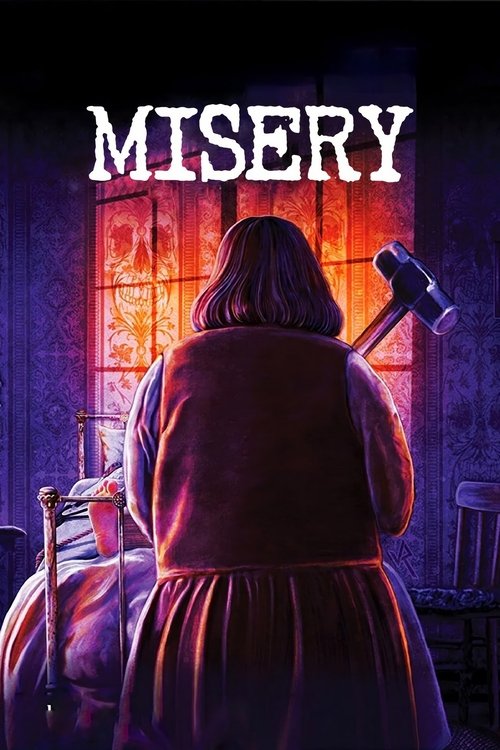
















Popular
Should I watch it?
Ask Your Own Question

What is the plot?
Sorry, we aren't able to watch and write up a full detailed plot yet. Check back in a few days.








What is the ending?
In the ending of "Misery," Paul Sheldon confronts Annie Wilkes in a final showdown. After a brutal struggle, Paul manages to kill Annie, escaping her clutches. He is later found by the authorities, and while he is physically safe, the psychological scars of his ordeal linger.
As the climax of "Misery" unfolds, the tension reaches a fever pitch in Annie Wilkes' isolated home. Paul Sheldon, the captive author, has been pushed to his limits by Annie's increasingly erratic behavior. The scene is set in the dimly lit bedroom where Paul has been bedridden, recovering from the injuries sustained in a car accident. The air is thick with a sense of dread as Paul realizes that Annie's obsession with his work has turned dangerously violent.
In a pivotal moment, Paul, fueled by desperation and a flicker of hope, decides to confront Annie. He has been secretly plotting his escape, and now he must act. As Annie enters the room, Paul feigns compliance, pretending to be submissive to her whims. He engages her in conversation, trying to buy time and gauge her mood. The tension is palpable; Annie's demeanor oscillates between nurturing and menacing, revealing her unstable psyche.
When the moment is right, Paul seizes an opportunity. He grabs a heavy typewriter and strikes Annie, knocking her to the ground. The struggle that ensues is brutal and chaotic. Paul, driven by sheer survival instinct, fights with everything he has. Annie, despite her injuries, proves to be a formidable opponent, showcasing her strength and determination. The room becomes a battleground, filled with the sounds of grunts and the clattering of furniture as they grapple for control.
In a desperate act of self-preservation, Paul manages to overpower Annie. He finds a wooden statue, a gift from Annie that symbolizes her twisted affection, and uses it to deliver a fatal blow. The moment is both cathartic and tragic; Paul has finally escaped the clutches of his captor, but at a great cost. Annie lies lifeless on the floor, her reign of terror finally at an end.
After the confrontation, Paul stumbles out of the house, battered and traumatized. He collapses in the snow outside, where he is eventually discovered by the authorities. The scene shifts to a hospital room, where Paul is recovering from his physical injuries. He is surrounded by police officers who are piecing together the events that transpired in Annie's home. Paul's face is a mixture of relief and deep-seated trauma; the psychological scars of his experience are evident in his haunted expression.
In the final moments of the film, Paul is seen in a support group, attempting to come to terms with his ordeal. He is a changed man, grappling with the memories of Annie and the impact she had on his life. The film closes with a lingering sense of unease, highlighting the lasting effects of trauma and the complexities of survival. Paul Sheldon may have escaped physically, but the emotional and psychological ramifications of his captivity will follow him indefinitely.
Is there a post-credit scene?
The movie "Misery," produced in 1990, does not have a post-credit scene. The film concludes with a tense and dramatic climax, followed by a resolution that leaves the audience with a sense of closure regarding the fate of the main characters. After the final confrontation between Paul Sheldon and Annie Wilkes, the film ends without any additional scenes or content during or after the credits. The focus remains on the psychological horror and the intense relationship between the characters throughout the film.
What happens to Paul Sheldon after he crashes his car in the snow?
After Paul Sheldon crashes his car in the snow, he is rescued by Annie Wilkes, a former nurse and his 'number one fan.' She takes him to her remote home to care for him, where he is bedridden and recovering from his injuries.
How does Annie react when she reads the manuscript of Paul's new book?
Annie becomes furious when she reads the manuscript of Paul's new book, which kills off her favorite character, Misery. Her anger escalates to violence, and she forces Paul to rewrite the story to bring Misery back to life, demonstrating her obsessive control over him.
What methods does Annie use to keep Paul captive?
Annie uses physical and psychological methods to keep Paul captive. She restricts his movement by keeping him in bed, threatens him with violence, and even breaks his ankles with a sledgehammer to ensure he cannot escape.
What is the significance of the typewriter in the story?
The typewriter is significant as it symbolizes Paul's struggle for creativity and freedom. Annie provides him with a typewriter to rewrite the Misery manuscript, but it also represents his captivity, as he is forced to write under her oppressive demands.
How does Paul manage to escape from Annie's clutches?
Paul manages to escape from Annie's clutches by using his wits and resourcefulness. After completing the manuscript to her satisfaction, he sets a plan in motion, ultimately confronting her in a final struggle that leads to his escape.
Is this family friendly?
"Misery," produced in 1990, is not considered family-friendly due to its intense themes and graphic content. Here are some potentially objectionable or upsetting aspects that may affect children or sensitive viewers:
-
Violence and Gore: The film contains scenes of physical violence, including a particularly graphic moment involving a character's injury that is both shocking and disturbing.
-
Psychological Terror: The main character experiences severe psychological manipulation and threats, creating a tense and unsettling atmosphere that may be distressing.
-
Strong Language: There are instances of strong language throughout the film, which may not be suitable for younger audiences.
-
Themes of Obsession and Isolation: The film explores dark themes such as obsession, captivity, and the struggle for survival, which can be emotionally heavy and unsettling.
-
Intense Emotional Distress: The protagonist endures significant emotional and physical suffering, which may be difficult for sensitive viewers to watch.
Overall, "Misery" is best suited for mature audiences due to its intense and disturbing content.









