

Popular
Who is Tracii in The Devil Is Busy, and what is her role at the Atlanta clinic?
What specific dangers or threats does the clinic face in the film?
Does the film show only abortion care, or does it include other kinds of medical services too?
How does Tracii respond to the pressure of protecting patients and staff throughout the day?
What is the relationship between the clinic staff and the protestors outside?
Should I watch it?
Ask Your Own Question

What is the plot?
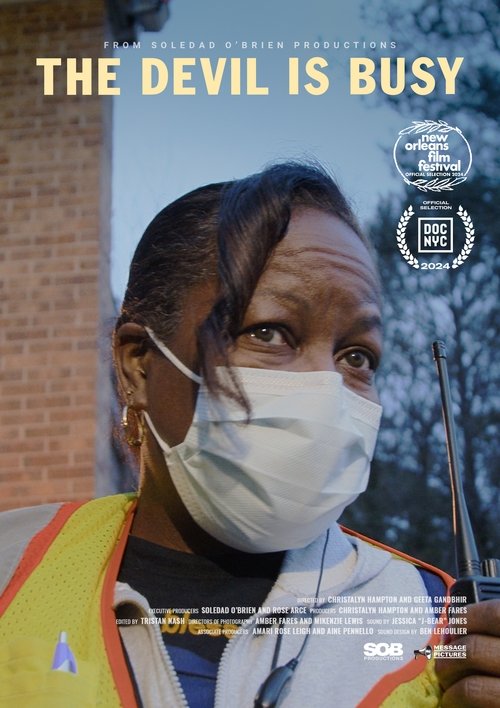
The Devil Is Busy opens before dawn in Atlanta, Georgia, in the hard, bluish light of a city that is still half asleep while one clinic is already bracing for a fight. Tracii, the clinic's head of security and director of operations, begins her day in prayer and determination, a quiet ritual that sets the tone for everything that follows as she prepares to shield patients and staff from the hostility gathering outside the building.
The film stays tightly with this single day, and from the start the clinic feels less like an ordinary medical office than a fortified space under siege. New legal restrictions after Roe v. Wade have transformed the surrounding environment into what the film's sources describe as a battleground, with protesters massed outside and the threat of violence hanging over every arrival. Tracii moves through the early hours with practiced urgency, checking the building for intruders, preparing security procedures, and making sure the staff is ready before the first patients arrive. The camera, in a cinéma vérité mode, observes her as she works without any sense of performance; her vigilance is not abstract, but physical, methodical, and immediate.
The clinic itself is in Atlanta, and the sources describe it as a women's healthcare center providing not only abortions but also routine checkups and preventive care, which makes the surrounding harassment feel even more pointed and absurd. This is not a place devoted to a single controversial procedure; it is a medical space trying to function under pressure while still serving a broad range of patients. The exterior, however, is dominated by protesters, scripture, and megaphones, creating a harsh wall of noise and accusation that the staff must repeatedly push through. Tracii's job is to absorb that chaos without letting it reach the people coming in for care.
As the morning builds, the film introduces the operational choreography that keeps the clinic moving. Security guards coordinate with Tracii to escort patients from the perimeter to the entrance, and the staff uses numbered systems rather than names to preserve privacy. That detail becomes one of the documentary's clearest revelations: this is a place where anonymity is not a convenience but a necessity. Every step is designed to prevent exposure, shame, or identification in an environment where even a person's presence at the clinic could make them a target. The film lingers on the seriousness of those routines, showing that safety here depends on precision, repetition, and trust.
Tracii emerges immediately as the emotional center of the story. She is not portrayed only as a protector in a tactical sense; she is also the person patients see when fear is at its highest. In the trailer, she explains the intimacy of that role in a line that becomes the film's moral spine: "Before I send them in, I look in their eyes. I say to them, 'you're safe now.'" That sentence captures the strange tenderness of her work. She is standing at the edge between panic and relief, and her calm voice is part of the barrier that keeps the outside world from breaking in.
The film also reveals that Tracii's strength is inseparable from her faith. The sources emphasize that she begins the day in prayer, and that her courage is "faith-fueled," which gives the documentary a spiritual dimension without turning it into a sermon. Her prayers are not an escape from the violence around her; they are a way of gathering herself to meet it. The juxtaposition is powerful: outside, protesters weaponize scripture as a tool of intimidation, while inside Tracii uses prayer as a source of steadiness and service. The same language of faith is being used in two opposite ways, and the film lets that contradiction sit in the air.
As patients arrive, the emotional temperature rises. Some have traveled for hours from states where abortion access is severely restricted or effectively unavailable, and their long journeys underline the weight of the legal landscape beyond the clinic walls. The film does not present these patients as abstractions or symbols. Instead, it shows the immediate, bodily reality of getting through the front door while people outside shout at them. Tracii's role is to protect that fragile moment of entry, the instant when a person moves from public hostility into a space where care is still possible.
The confrontations in the film are constant but largely nonphysical. Protesters gather outside with megaphones and scripture, trying to shame, frighten, or stop patients and staff. Their presence turns every arrival into a confrontation, even when no one throws a punch. Tracii meets that pressure with discipline. She keeps people moving, communicates with security, and refuses to let the harassment control the rhythm of the day. Each small act of protection becomes its own victory: a patient escorted safely in, a privacy procedure followed correctly, an intruder checked for and not found, a moment of panic calmed before it becomes chaos.
The film's tension comes from accumulation rather than a single explosive incident. The day is built from repeated threats, repeated arrivals, and repeated assertions of order in the face of disorder. The building is checked again. The doors are watched again. Another patient approaches. Another protester shouts. Another staff member coordinates with Tracii to keep the clinic functioning. Because the documentary covers only one day, the story gains force from the sense that this is not exceptional at all; this is the routine reality of abortion care in a hostile climate.
Tracii's personal background is mentioned as part of the film's portrait of her, but the available sources do not give a fuller biographical twist or secret history beyond the fact that she shares where she comes from and carries herself with unwavering commitment. What the film reveals instead is how much invisible labor is required to make the clinic work. Her job includes not only security, but also operations, privacy management, emotional reassurance, and the constant reading of danger in the environment. The film's power lies in showing that the "front line" of reproductive healthcare is not only medical; it is logistical, psychological, and social.
One of the most striking recurring ideas is that the clinic is under a kind of siege, yet the staff refuses to surrender normalcy. Patients still need routine checkups and preventive care, and the documentary makes clear that abortion is only part of the broader healthcare mission. That matters because the protesters outside are trying to collapse the entire institution into a single issue, while the staff insists on the fuller reality of what the clinic is there to do. In that sense, every patient walked inside is a rebuttal to the world outside.
The film's revelations are less about secret plot turns than about exposure: it exposes the pressure placed on the clinic, the security procedures required to keep it open, and the emotional load borne by people like Tracii. It also reveals how deeply post-Roe conditions reshape ordinary healthcare access. The women coming through the door are often carrying the burden of geography, law, and time, and their vulnerability is intensified by the fact that they must pass directly through a gauntlet of hostile attention to reach care. The documentary never lets that reality soften into rhetoric; it stays with the practical consequences.
The film does not report any deaths, and none are described in the available sources. That absence matters. The threat is real, the atmosphere is dangerous, and the clinic is treated as a place where violence is imaginable, but the documentary's action as documented in the sources centers on prevention, not tragedy. The stakes are survival, access, and dignity rather than bodies on the floor. The danger is in what might happen, and in the fact that the staff must behave as though it could happen at any moment.
As the day continues, Tracii's authority becomes increasingly visible. She is the one who makes people feel contained inside the clinic's protective boundaries, the one who knows the procedures, the exits, the security posture, and the emotional rhythm needed to guide frightened patients forward. Her eye contact with each patient becomes a ritual of transfer: from fear to safety, from exposure to privacy, from public threat to controlled care. The words "you're safe now" are not just reassurance; they are the film's central promise, repeated in action if not always in speech.
The protesters never disappear, and the hostility never fully lifts. The documentary's atmosphere stays taut because there is no single resolution to the conflict outside the clinic. Tracii's prayer, the escorts, the numbered system, and the controlled movement of people through the building all exist because the danger is ongoing, structural, and familiar. That is the film's most sobering revelation: safety here is not a condition that can be achieved once and for all. It must be constructed minute by minute.
By the time the day reaches its end, the film has not built toward a conventional climax with a final showdown or cathartic victory. Instead, it ends by reinforcing the continuing necessity of the work Tracii does every day. The clinic remains open. The patients have been protected as best they can be. The staff has held the line for another day under pressure. There is no suggestion that the outside world has changed, no indication that the protesters are gone, and no sign that the larger political crisis has been solved. What the ending leaves behind is a lingering sense of endurance: the clinic persists, Tracii persists, and the fight to preserve access to care continues into the next dawn.
More Movies Like This
Browse All Movies →






What is the ending?
The film does not have a conventional plotted ending with a final twist or resolution. It ends by staying with Tracii and the clinic staff as they continue their day, still working under pressure from protesters, legal restrictions, and the emotional strain of protecting patients seeking care.
In short, the ending shows that the conflict is still ongoing: the clinic remains open, the staff keeps doing their jobs, and the patients still need protection.
The film's ending unfolds as part of the same single-day observational structure that runs through the whole documentary. It is set inside an Atlanta women's health clinic, where Tracii, the head of security and operations, moves through routines meant to keep people safe. The camera remains with the clinic rather than shifting into a dramatic outside conclusion, so the ending feels like the day simply continues rather than decisively closes.
Tracii is shown as the center of that closing stretch. She remains alert to the threats around the building, continuing the same practical work she has done throughout the day: watching entrances, helping maintain privacy, and standing between patients and protesters. Her role does not end in a victory or defeat; instead, she is still on duty when the film stops, with her responsibility still active.
The patients are also still in motion at the end. The documentary shows women arriving for abortion care and other medical services, some of them traveling from far away and coming in with visible stress and uncertainty. By the end, the film does not isolate one patient's full personal story into a completed dramatic arc; it leaves them within the clinic's protective system, still dependent on staff vigilance for access and safety.
The protesters remain part of the ending atmosphere as well. They do not disappear, and the film does not present their presence as resolved. Instead, their continued presence reinforces the same conflict the documentary has been showing all along: access to care is still being contested outside the clinic doors.
So, the fate of the main participants at the end is simple and immediate: Tracii remains at work, the staff remain committed to protecting patients, the patients continue seeking care inside the clinic, and the protest pressure outside is still there. The documentary ends by preserving that reality rather than closing it off.
Is there a post-credit scene?
There is no credible indication that The Devil Is Busy has a post-credit scene. The film is a 31-minute documentary short about an Atlanta abortion clinic, and the available listings and festival descriptions do not mention any post-credit material.
Because it is a documentary short rather than a narrative franchise film, a post-credit scene would be unusual, and none of the sources describing the film's content, runtime, or release information indicate one.
Who is Tracii in The Devil Is Busy, and what is her role at the Atlanta clinic?
Tracii is the film's central real-world subject, and she serves as the head of security at a women's healthcare clinic in Atlanta. The documentary follows her through a single day as she protects patients and staff while the clinic operates under constant protest and legal pressure.
What specific dangers or threats does the clinic face in the film?
The clinic is shown operating amid persistent anti-abortion protests and new legal restrictions after the overturning of Roe v. Wade. The film presents the threat level as daily and ongoing, with staff working in an environment where patients and workers can face real danger.
Does the film show only abortion care, or does it include other kinds of medical services too?
It includes more than abortion care. The clinic staff are shown providing a range of services such as routine checkups, preventive screenings, and other reproductive healthcare alongside abortion-related care.
How does Tracii respond to the pressure of protecting patients and staff throughout the day?
The film depicts Tracii making careful, necessary decisions to keep the clinic secure while continuing operations. She is shown balancing vigilance, risk, and responsibility as she works to safeguard both patients seeking care and the staff who treat them.
What is the relationship between the clinic staff and the protestors outside?
The staff work inside the clinic under a tense and confrontational outside atmosphere created by protesters. The film emphasizes the contrast between the staff's routine medical work and the constant external pressure surrounding the building.
Is this family friendly?
No, The Devil Is Busy is not especially family-friendly for young children, and it may also be upsetting for sensitive viewers.
Potentially objectionable or upsetting elements include:
- Abortion healthcare and discussion of reproductive rights in a clinic setting.
- Harassment and intimidation by protesters outside the clinic, including shouting and confrontational behavior.
- Tense security concerns and the sense that patients and staff are in potential danger.
- Emotional distress around private, serious medical decisions and the stress of accessing care.
- Religious conflict and scripture-based condemnation used by protesters, which may be upsetting to some viewers.
The film is a 31-minute documentary short and is listed by IMDb as TV-14, suggesting it is aimed more at teens and adults than younger children.
If you want, I can also give a very brief age-suitability recommendation by age group without spoilers.









