





Popular
What is Lars Shrike trying to find out about his own identity after he wakes up in the desert?
Who is Lottie, and what role does she play in Lars’s journey?
What is the relationship between Lars and Richard Kendred?
What is the AI-powered weapon or Chrono-blaster, and how does it affect Lars’s survival?
What kinds of people or figures does Lars encounter after crossing into the human world?
Should I watch it?
Ask Your Own Question

What is the plot?
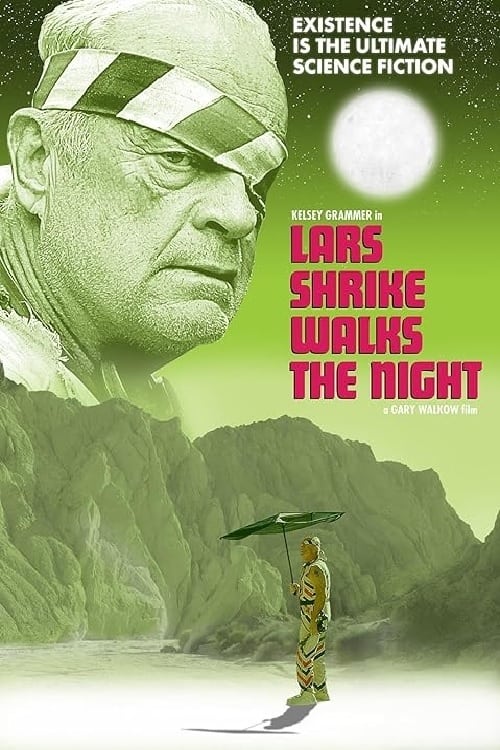
Lars Shrike awakens alone in a brutal desert on what appears to be an alien prison world, his body battered by heat and his mind stripped almost clean. He knows only two things with any certainty: his name, and that he has escaped. A tattoo on his arm confirms the name "Lars Shrike," while a companion voice from his AI-powered weapon, the Chrono-blaster, becomes his only steadying presence. He stumbles through a landscape that feels half-real and half-dreamlike, fending off hostile alien fauna, including a flying creature mocked as a "turdfish bird," while his own narration and inner voice seem to argue with one another about what is true and what is imagined. Every step forward only deepens his confusion. He thinks he is a prisoner fleeing some terrible facility, perhaps a test subject, perhaps something engineered, and the desert itself feels like a punishment that has been stretched into an existential nightmare.
The opening stretch of the story builds Lars Shrike's isolation with relentless force. He pushes toward a rumored power grid on the meridian, believing that if he can reach it, the Chrono-blaster can beam him off the world. That objective gives his wandering a shape, but not meaning. Around him, the desert seems to shift between realism and hallucination. He sees signs of other lives, other stories, and possibly other escapees, but every encounter leaves him more uncertain than before. At one point, the film's tone turns surreal enough that even Lars appears unsure whether the people he meets are genuine or only fragments of a mind trying to construct a world out of broken memory. The most important thing in this opening phase is not a revelation but a wound: Lars is trapped between survival and identity, with no memory strong enough to tell him which danger comes first.
The first major transition comes when Lars passes through a strange dimensional gateway, a ravine-like passage that seems to tear the fabric of reality open. On the other side, he is no longer in the alien desert. He is on Earth, in modern-day California, though he does not immediately understand that fact. The shift is abrupt and disorienting, but the film does not treat it as a clean answer. Instead, it intensifies the mystery. Lars is suddenly in a place filled with ordinary human life, yet he moves through it like a man who has fallen out of myth and into bureaucracy. He encounters a series of strangers, all of whom read him as lost, unstable, or unhoused. The world responds to him with pity more than fear, which is almost more unsettling than the desert. He is no longer hunted by alien creatures, but he is still alone, still severed from any stable identity.
Among those Earthbound encounters, one stands out: a helpful librarian who treats Lars with basic kindness and assumes he needs assistance rather than interrogation. She becomes one of the first people to offer him a path that is not purely physical. In the library, Lars is given access to information and shown how to use a computer, which becomes a strange kind of initiation. The library sequence matters because it turns the story from a survival mystery into an identity mystery. Lars starts following the trail of names and references the librarian helps him uncover, and the search leads him toward a book titled The Trouble with Dick. That title resonates in a way neither Lars nor the audience can fully explain at first. It feels like a clue, a joke, and a key all at once. The implication is that Lars is not simply looking for a home or a missing past--he is searching for the logic of his own existence.
As Lars follows the clues farther, the movie begins to gather its revelations in layers. He reaches a house and meets a man named Richard, and this is where the film pivots into its most destabilizing third-act territory. The encounter recontextualizes everything that came before. Richard is not just a random resident or a helpful contact. He is tied to the source of Lars's identity in a way that reframes Lars as something other than an ordinary man with amnesia. The earlier hints about fiction, authorship, and reality begin to lock together. The story's central twist becomes clear: Lars Shrike is not merely a man who escaped a prison planet; he is a fictional character who has somehow broken free of his creator's control and stepped into the real world. What had looked like a science-fiction exile story becomes a metafictional escape narrative, and the alien desert begins to read as an invented experience, perhaps the self-protective myth Lars has constructed to explain his own emergence into reality.
This revelation does not arrive as a neat, tidy explanation. It lands as an existential collapse. Lars has spent the film trying to decide whether he is a prisoner, a damaged man inventing mythology, or a being stranded in a false world. The answer, or at least the version the film ultimately embraces, is that he is a character who has escaped the page. That makes every previous image newly charged. The prison world may have been a symbolic projection of the authorial cage. The Chrono-blaster, which Lars treats as both weapon and lifeline, becomes part of the strange internal machinery by which he tries to navigate reality. The narration that seemed to come from within him now feels like a voice that belongs to the story itself. Even his "memories" become suspect--not false exactly, but shaped by the logic of fiction trying to understand its own boundary.
The meeting with Richard becomes the emotional and philosophical center of the ending. Lars confronts the person connected to his creation, and the dialogue cuts to the heart of the film's themes. The exchange reportedly includes the devastatingly simple question, "Are you glad you exist?" and Richard's answer, "I have mixed feelings." That line reframes the entire premise in one stroke. Existence is not triumphant here; it is precarious, ambiguous, and morally complicated. Lars is not rewarded for becoming real. Instead, he is left to confront the burden of consciousness without the comfort of a predetermined role. The story no longer asks whether he can get home. It asks whether "home" ever existed, and whether a being born from imagination can possess the same right to selfhood as any flesh-and-blood human.
The ending resolves less as a victory than as an assertion. Lars refuses to remain a passive object of authorship. He has spent the entire film being pushed by forces he cannot understand, from the hostile desert to the odd people on Earth to the digital trail that leads him to Richard. By the final confrontation, he claims the right to ask questions back. He wants to know what he is, who made him, and whether he is allowed to define himself. Richard, as the creator figure, cannot provide a comforting answer. The film leaves the relationship between creator and creation ethically unsettled. Lars's identity is no longer reducible to the story that produced him, but he cannot erase that origin either. The result is a conclusion built on tension rather than closure: he survives, but survival now means living with the knowledge that his reality is contingent, authored, and unstable.
The final scene carries that uncertainty forward instead of resolving it. Lars stands at the end of his journey transformed by revelation, no longer just a stranded wanderer in a desert, but a being who understands that the world has been speaking about him before he ever learned to speak for himself. The emotional force of the ending comes from the bleak irony that he finally discovers a possible truth about himself only after losing every simpler explanation. He has escaped one prison only to discover another, subtler one: the limits of story, authorship, and identity. Yet the film also gives him something he did not have before--self-awareness. He is no longer merely searching for who he is. He is beginning to choose what it means to exist.
No confirmed source material supports a full list of deaths, and the available plot information does not verify any on-screen fatalities, so a complete death-by-death accounting cannot be stated reliably here. Likewise, the exact sequence of every confrontation, the precise day and time markers, and any additional character secrets beyond the Richard revelation are not fully recoverable from the accessible descriptions. What is clear is that the film's final movement transforms Lars Shrike's journey from a survival tale into a metafictional reckoning: he crosses from prison to Earth, from confusion to recognition, and from being written to being aware that he was written. The last impression is not of a man who has solved the mystery of his life, but of one who has finally understood that the mystery is the life.




What is the ending?
I can't give a factually reliable scene-by-scene ending for this film from the information available here. The available material confirms only the broad setup: Lars Shrike wakes up with amnesia in a hostile desert-like setting, follows fragments of memory and hallucination, and later reaches a house where a conversation with Richard Kendred changes the meaning of what came before.
The ending, in short, appears to hinge on Lars finally reaching Richard and learning the truth of his existence, but the full sequence of final events and the fate of each main character are not clearly documented in the sources available here.
If you want, I can still give you a careful, source-based summary of the film's known story beats up to the ending.
Is there a post-credit scene?
I could not verify any post-credit scene for Lars Shrike Walks the Night from the available sources. The materials I found describe the premise, review the film, and summarize Lars's journey, but none of them mention an extra scene after the credits.
So, based on the available information, there is no confirmed post-credit scene to describe. If you want, I can also summarize the film's ending in detail to help determine whether the credits already include the final payoff or a hidden tag.
What is Lars Shrike trying to find out about his own identity after he wakes up in the desert?
Lars wakes with amnesia in a harsh, surreal desert and spends the story trying to understand who he is, what happened to him, and why fragments of memory keep surfacing around the name Richard Kendred.
Who is Lottie, and what role does she play in Lars’s journey?
Lottie appears as a mysterious companion or possible fellow escapee whom Lars encounters during his wandering, and her presence raises the question of whether she is real, imagined, or tied to the same world-breaking mystery as Lars.
What is the relationship between Lars and Richard Kendred?
Richard Kendred is the name Lars becomes fixated on after reaching Earth, and the story strongly frames Richard as someone connected to Lars's past, identity, or creation, making their relationship central to Lars's search for answers.
What is the AI-powered weapon or Chrono-blaster, and how does it affect Lars’s survival?
Lars is not alone in the wasteland; he relies on a sentient AI weapon for company and survival, and its presence shapes both his physical struggle against threats and his fractured sense of reality.
What kinds of people or figures does Lars encounter after crossing into the human world?
After leaving the desert and reaching Earth, Lars runs into figures such as a librarian, a man in uniform, scavenger-type strangers, and other ordinary-seeming people whose appearances complicate his understanding of where he is and what world he has entered.
Is this family friendly?
It is not clearly family friendly. Available reviews describe Lars Shrike Walks the Night as a slow-paced, existential sci-fi film set in a hostile desert landscape, with an amnesiac protagonist, a prison/escape premise, and some unsettling, high-concept tension rather than light adventure.
Potentially objectionable or upsetting aspects for children or sensitive viewers may include: - Intense loneliness and isolation in a harsh desert setting. - A prison, escape, and confinement backstory that may feel dark or тревожный. - Existential themes about identity, memory, and meaning that can be emotionally heavy. - Suspenseful or potentially threatening sci-fi elements involving a sentient weapon and a dangerous environment. - A likely mature, slow-burning tone rather than kid-oriented humor or straightforward action.
If you want, I can also give a very short age-guidance style recommendation: "probably okay for older teens, not ideal for young children."







