
























Popular
What is the significance of Oliver's relationship with Anna in the film?
How does Hal's coming out affect his relationship with Oliver?
What role does the dog, Arthur, play in the story?
How does the film depict Oliver's struggle with his father's death?
What does the timeline structure of the film reveal about Oliver's character development?
Should I watch it?
Ask Your Own Question

What is the plot?
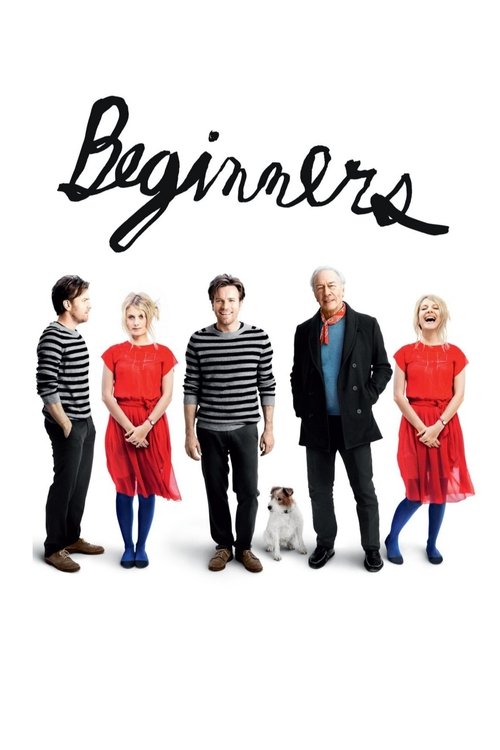
Oliver Fields is already living in the aftermath when the story begins: he stands in his late father Hal Fields's Los Angeles house, sorting through boxes, photographs, clothes, and the ordinary wreckage of a life now sealed by death. The rooms feel suspended in time, and as Oliver moves through them, the film slips back and forth between the present and the memories that explain how he got here, slowly revealing a family history built on silence, loyalty, and delayed truth.
In the present, Oliver is 38, a quiet graphic designer who has inherited not just a house but a kind of emotional paralysis. He drifts through Hal's belongings with the careful, detached tenderness of someone afraid to feel too much at once. The house itself becomes a museum of absence: the place where his mother Georgia Fields lived and died, where his father spent decades performing the role of husband, and where the final years of Hal's life have left behind traces of a secret second self. Oliver's companion in all of this is Arthur, Hal's small Jack Russell Terrier, who pads around the house with restless, watchful energy, as if he senses that the old order of the home has collapsed but not disappeared. Arthur is more than a dog in these scenes; he is Hal's last living echo, and Oliver takes him in almost without deciding to, as though caring for the dog is the only way he knows to keep caring for his father.
The memories begin with Georgia Fields. She is already gone by the time the main story is underway, and her death is not a dramatic event on screen so much as a grief that has settled into the family's bones. The film establishes that she dies of natural causes after a long marriage to Hal--decades in which she and Hal build a life together, raise Oliver, and inhabit the roles of husband, wife, mother, and father so completely that even they seem to believe those roles are the full truth. But after Georgia dies, the hidden architecture of that life begins to crack open. Hal, now 75, tells Oliver the revelation that changes everything: he is gay. He has known it for a long time, perhaps always, but he has lived inside the concealment of heterosexual marriage for nearly all of his adult life. The admission lands not as a single clean shock but as a rewiring of Oliver's entire understanding of his parents. It retroactively changes the meaning of old family dynamics, old silences, old emotional distances.
Hal's coming out is not the end of the revelation. It is the beginning of his second life. Freed, or at least no longer willing to hide, he starts living openly and with startling enthusiasm. He gets involved in the local gay community, begins dressing and acting with new confidence, and meets Andy, a younger man who becomes his lover and companion. Andy is patient, warm, and deeply kind, and their relationship gives Hal a kind of brightness that Oliver has never seen in him before. The contrast is painful and moving: the father who spent so long buried under obligation and habit suddenly appears more alive in late age than he ever did in Oliver's memory. At the same time, Hal's joy is shadowed by mortality. He is diagnosed with terminal cancer, and the new life he has only just begun is already under sentence. The diagnosis gives his freedom a fierce, compressed urgency, as if he has been handed happiness only to have it raced toward the edge of extinction.
Oliver watches all of this from the emotional distance of a son who does not know how to enter his father's new world. He is loving, but unsure; present, but withdrawn. His father's late-life authenticity unsettles him because it suggests that people can be one thing for decades and then suddenly become another, and that possibility terrifies him in a different way. If Hal can reinvent himself this late, what does that mean about everything Oliver thought he knew about identity, love, and family? He is forced to confront not only Hal's secret, but the fact that his father's most honest self arrives only near the end. Hal's death from cancer follows not long after this period of openness, and Oliver is left with the burden of everything that arrived too late: truth, tenderness, and the chance to know Hal as himself. The loss is not only that Hal dies, but that the father-son relationship finally becomes more emotionally available just in time to be cut off.
The film then returns to the present-day emotional terrain of Oliver's own life, and the pattern of avoidance begins to echo Hal's long concealment in a different form. Months after Hal's death, Oliver attends a Halloween party dressed as Sigmund Freud, bringing Arthur along with him. The party is a noisy, mask-filled, half-playful space where identity is literally costumed, and Oliver's sadness hangs around him even before he speaks. That is where he meets Anna, a French actress in Los Angeles for a film shoot. At first she is unable to speak because of laryngitis, which makes their connection strangely intimate: their early exchanges depend less on polished conversation than on expression, gesture, attention, and shared misfit energy. Oliver, in his Freud costume, seems absurd and vulnerable at once; Anna is spontaneous, witty, and self-protective. There is immediate chemistry, but it is not the easy kind. It feels like two lonely people recognizing their own loneliness in another person.
Their relationship grows quickly. Anna is bright and irreverent, but also emotionally guarded, and Oliver, who has spent so much time in muted introspection, opens to her in ways that feel both liberating and dangerous. They spend time together, fall in love, and begin to imagine a shared life. The film makes this romance feel earned through small, human details rather than grand declarations. Arthur remains present as a tiny domestic witness, and Anna begins to fit herself into Oliver's world. At some point, Oliver asks Anna to move in with him, and she agrees. But the move, which should signify stability, instead introduces a new layer of unease. Anna arrives with a suitcase that she never fully unpacks. That single object becomes one of the film's sharpest emotional symbols: she is physically there, but not fully settled, never quite surrendered to the idea of permanence. Oliver notices. The sight of that packed or half-packed suitcase bothers him deeply because it reflects his own hidden fear that intimacy is only temporary, that commitment is a kind of performance that can collapse at any moment.
As they try to live together, the relationship becomes strained. Neither Oliver nor Anna knows how to make a shared life feel natural. Oliver wants closeness but recoils from the vulnerability it requires. Anna, who has her own history of emotional distance and family damage, especially with a depressive father and a habit of ending her serious relationships, also resists being fully claimed by domestic life. The tension builds quietly, without melodrama, until Oliver finally says that living together does not feel right. His words carry the weight of a defense mechanism dressed up as honesty. Anna understands the break more clearly than he does at first: this is not simply a practical issue about space or habits, but a failure of nerve. She gathers herself and decides to leave, returning to New York City.
The breakup is one of the film's most painful emotional turns because it is both sudden and, in retrospect, inevitable. Anna's departure looks like the end of their story. Oliver is left alone again, and his regret begins almost immediately. He tries to call her, but she does not answer. The silence stretches into something like panic. Realizing he has made a mistake--or perhaps realizing that he is about to let another chance at love disappear without fighting for it--Oliver decides to go after her. He drops Arthur off with Andy, which is another quietly moving moment: Hal's younger lover becomes the caretaker of Hal's dog, symbolically receiving the family's living thread before Oliver flies away in search of his own future.
Oliver travels to New York, where the emotional geography of the story shifts from the familiar rooms of Los Angeles to the uncertainty of pursuit. He goes to Anna's apartment and calls out to her from outside, expecting the confrontation of a final, decisive goodbye. This is the point at which the film's central romantic twist lands. Anna answers, and Oliver discovers that she never actually left Los Angeles. The assumed breakup was not as complete as he believed; the separation exists partly in his mind, created by fear and miscommunication. In that instant, the film reconfigures the entire emotional meaning of the preceding silence. What looked like a decisive abandonment is revealed to be something more fragile and provisional. Oliver's assumption that the relationship had become permanently over is wrong, and that error exposes how quickly he turns uncertainty into catastrophe.
The revelation does not resolve everything neatly. Instead, it opens a small space for honesty. Oliver returns home changed by the realization that he and Anna have both been doing the same thing in different ways: retreating, delaying, protecting themselves from the risk of real attachment. When he gets back, Anna comes to visit him there. The final scenes are quiet rather than triumphant. There is no grand reconciliation speech, no promise that all wounds are healed, no easy confirmation that love will now be simple. But the emotional direction is unmistakable: both of them are choosing to remain available to each other. Their future is uncertain, but now uncertainty is shared rather than avoided.
The last emotional lesson of the film is carried by the convergence of Hal's and Oliver's stories. Hal, after a lifetime of repression, spends his final years living openly and loving without apology. Oliver, who inherits his father's caution in a different form, finally begins to understand that fear can masquerade as reason, that keeping distance can feel safe while costing a person everything. Anna's presence teaches him that love cannot be preserved by hesitating forever. Hal's death from cancer has already made that truth unavoidable: life ends, secrets end, and the time to begin is never as long as it seems. In the final balance of the film, Oliver is left with grief, but also with the possibility of a different kind of adulthood--one in which he does not wait until the end of life to tell the truth, and does not mistake withdrawal for wisdom. The story closes in a spirit of fragile hope, with Oliver and Anna no longer separated by the false finality of their breakup, and with Hal's memory lingering as the paradoxical guide who, only after death, teaches his son how to begin.








What is the ending?
In the ending of "Beginners," Oliver reflects on his relationship with Anna and the impact of his father's passing. He finds a sense of hope and possibility as he embraces a new beginning with Anna, who has returned to him. The film concludes with a poignant moment that emphasizes the themes of love, loss, and the courage to embrace life.
As the film approaches its conclusion, we see Oliver, played by Ewan McGregor, grappling with the loss of his father, Hal, who has recently passed away. Hal, portrayed by Christopher Plummer, had come out as gay late in life, and his journey of self-discovery and acceptance has deeply influenced Oliver. The narrative interweaves flashbacks of Hal's life with Oliver's present, showcasing the profound impact of Hal's authenticity on Oliver's understanding of love and relationships.
In the final scenes, Oliver is seen in his apartment, surrounded by memories of his father. He reflects on the lessons Hal imparted, particularly the importance of living authentically and embracing love, regardless of the circumstances. The emotional weight of Hal's death lingers, but Oliver begins to find solace in the memories they shared.
Meanwhile, Anna, played by Mélanie Laurent, re-enters Oliver's life after a period of separation. Their relationship had been strained, but Anna's return signifies a new chapter for both of them. In a tender moment, they meet at a park, where the atmosphere is filled with a sense of renewal. Oliver expresses his feelings, revealing his vulnerability and desire to move forward together. Anna reciprocates, and they share a heartfelt connection, symbolizing their willingness to embrace the uncertainties of love.
The film culminates in a scene where Oliver and Anna walk together, hand in hand, through the park. The camera captures their faces, illuminated by the soft glow of the setting sun, reflecting a sense of hope and possibility. As they walk, Oliver's voiceover reveals his thoughts about the future, emphasizing the idea that life is unpredictable, but love is worth pursuing despite the risks.
In the final moments, the film leaves viewers with a sense of optimism. Oliver has learned to navigate his grief and embrace the potential for new beginnings. The fate of Hal is one of acceptance and peace, having lived authentically until the end. Oliver and Anna's relationship stands as a testament to the resilience of love, suggesting that even in the face of loss, there is always the opportunity for connection and growth. The film closes on a note of hope, inviting the audience to reflect on the beauty of life and the importance of cherishing the moments we have with those we love.
Is there a post-credit scene?
The movie "Beginners," released in 2011, does not have a post-credit scene. The film concludes with a poignant ending that encapsulates the themes of love, loss, and the complexities of relationships. After the credits roll, there are no additional scenes or content that follow. The narrative wraps up with a sense of closure, focusing on the journey of the main characters, Oliver and Anna, as they navigate their feelings and the impact of Oliver's father's coming out and subsequent passing. The film leaves viewers with a reflective tone, emphasizing the importance of embracing life and love despite its uncertainties.
What is the significance of Oliver's relationship with Anna in the film?
Oliver's relationship with Anna serves as a pivotal emotional anchor in the film. As he navigates the complexities of his father's late-life revelation of being gay and his own struggles with intimacy and connection, Anna represents a chance for genuine love and vulnerability. Their relationship is marked by moments of tenderness and uncertainty, reflecting Oliver's internal conflict about opening up to someone after the loss of his father. The way they communicate, often through playful banter and shared experiences, highlights Oliver's desire for a meaningful connection while grappling with his fears of abandonment.
How does Hal's coming out affect his relationship with Oliver?
Hal's coming out as gay at the age of 75 profoundly impacts his relationship with Oliver. Initially, Oliver feels a mix of confusion, concern, and a sense of loss regarding his father's identity. Hal's newfound freedom and happiness challenge Oliver's perceptions of his father and their relationship. As Hal embraces his true self, Oliver grapples with feelings of guilt for not having recognized his father's struggles earlier. This dynamic creates a complex emotional landscape where Oliver learns to accept his father's choices, ultimately leading to a deeper understanding and appreciation of Hal's journey.
What role does the dog, Arthur, play in the story?
Arthur, the dog, serves as a significant emotional symbol throughout 'Beginners.' He represents loyalty, companionship, and the unconditional love that Oliver craves. After Hal's passing, Arthur becomes a source of comfort for Oliver, mirroring his own feelings of loss and loneliness. The dog's quirky behavior and interactions with Oliver and Anna provide moments of levity amidst the film's heavier themes. Arthur's presence also emphasizes the importance of connection and the ways in which love can manifest, even in the form of a pet, as Oliver navigates his grief and attempts to build new relationships.
How does the film depict Oliver's struggle with his father's death?
Oliver's struggle with his father's death is portrayed through a series of poignant flashbacks and present-day reflections. The film captures his grief in a raw and honest manner, showcasing moments of vulnerability as he processes the loss. Oliver often finds himself reminiscing about his father's life, grappling with feelings of regret and unresolved emotions. The use of visual storytelling, such as the juxtaposition of past and present, highlights his internal conflict and the impact of Hal's death on his ability to form new relationships. This struggle is further emphasized by Oliver's interactions with Anna, where his fear of loss resurfaces, complicating his journey toward healing.
What does the timeline structure of the film reveal about Oliver's character development?
The non-linear timeline structure of 'Beginners' reveals the complexities of Oliver's character development by intertwining his past and present experiences. This narrative choice allows viewers to see how Oliver's childhood memories of his parents, particularly his father's struggles with identity, shape his adult relationships and emotional responses. The flashbacks provide context for Oliver's fears and insecurities, illustrating how his father's late-life transformation influences his understanding of love and connection. As the story unfolds, the juxtaposition of joyful moments with Hal and the pain of his loss highlights Oliver's growth, ultimately leading him to embrace vulnerability and the possibility of love with Anna.
Is this family friendly?
"Beginners," produced in 2011, is a film that explores themes of love, loss, and the complexities of family relationships. While it has a heartfelt narrative, there are several elements that may be considered objectionable or upsetting for children or sensitive viewers:
-
Depictions of Illness: The film addresses terminal illness and the emotional impact it has on family members, which may be distressing for some viewers.
-
LGBTQ+ Themes: The film features a character coming out as gay later in life, which may be challenging for younger audiences to understand fully.
-
Death and Grief: There are scenes that deal with the death of a parent and the subsequent grief, which can be heavy and emotional.
-
Mature Language: The dialogue includes some strong language and adult themes that may not be suitable for younger viewers.
-
Romantic Relationships: The film explores adult romantic relationships, including discussions about intimacy and commitment, which may not be appropriate for children.
-
Emotional Turmoil: Characters experience significant emotional struggles, including loneliness and existential crises, which could be upsetting for sensitive viewers.
Overall, while "Beginners" is a poignant exploration of life and relationships, its themes and content may not be suitable for all audiences, particularly children.








