




































Popular
Should I watch it?
Ask Your Own Question

What is the plot?
Sorry, we aren't able to watch and write up a full detailed plot yet. Check back in a few days.


What is the ending?
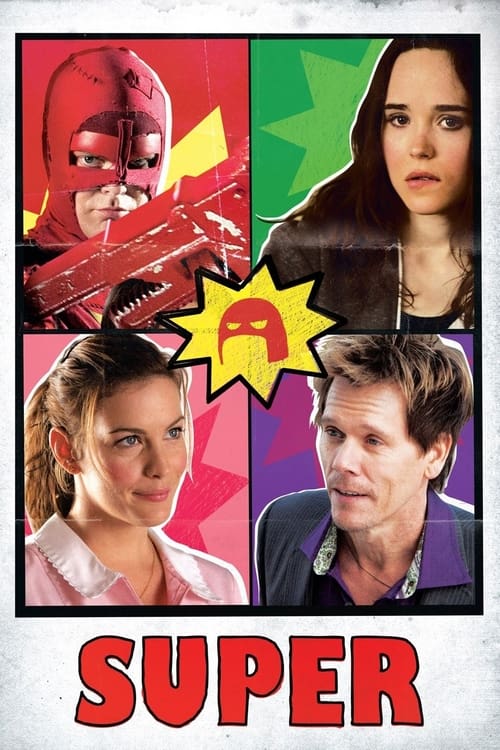
In the ending of the movie "Super," Frank, the main character, confronts the villain, Jacques, in a climactic battle. After a brutal fight, Frank ultimately defeats Jacques but suffers severe injuries. He is left in a state of despair, reflecting on his actions. The film concludes with Frank finding a sense of purpose, as he is seen helping others, suggesting a shift in his character.
Now, let's delve into the ending in a more detailed narrative fashion.
As the climax of "Super" unfolds, Frank, donned in his makeshift superhero costume as Crimson Bolt, prepares for a final confrontation with Jacques, the drug dealer who has taken his wife, Sarah, away from him. The scene is tense, filled with a palpable sense of dread and determination. Frank's face is bruised and battered, a testament to the physical toll his quest for justice has taken on him. He is fueled by a mix of desperation and a desire to reclaim his life and the love he lost.
The setting shifts to a dilapidated warehouse, where Jacques has been holding Sarah captive. The atmosphere is dark and foreboding, with flickering lights casting ominous shadows. Frank bursts through the door, adrenaline coursing through his veins. He is met with Jacques and his henchmen, who are surprised by Frank's audacity. The confrontation escalates quickly, and a brutal fight ensues. Frank, despite his lack of real combat training, fights with a raw intensity, using whatever he can find as weapons. He is driven by love and rage, each punch thrown a reflection of his inner turmoil.
As the fight progresses, Frank is outnumbered and overpowered. Jacques taunts him, mocking his efforts and belittling his identity as a superhero. Frank's resolve wavers, but he digs deep, recalling the moments of joy he shared with Sarah. This memory reignites his determination, and he fights back with renewed vigor. The scene is chaotic, filled with the sounds of grunts, shattering glass, and the thud of bodies hitting the ground.
In a pivotal moment, Frank manages to gain the upper hand. He confronts Jacques directly, and in a final, desperate act, he stabs him with a knife. The camera captures the moment in slow motion, emphasizing the gravity of Frank's actions. Jacques falls to the ground, defeated, but not without a final, chilling laugh that echoes in the warehouse, leaving Frank momentarily paralyzed by the weight of what he has done.
In the aftermath of the fight, Frank is left severely injured, bloodied and bruised. He stumbles out of the warehouse, the adrenaline fading, replaced by a profound sense of emptiness. He finds Sarah, who is shaken but unharmed. Their reunion is bittersweet; while they embrace, the reality of Frank's violent actions looms over them. Frank's face reflects a mix of relief and horror, as he grapples with the consequences of his choices.
The final scenes depict Frank in a state of reflection. He is seen helping others in a community setting, suggesting a shift in his character. The camera captures him engaging with people, offering support and kindness, a stark contrast to the violence he previously embraced. This transformation hints at a newfound purpose, as he seeks to make amends for his past actions.
As the credits roll, the fate of each main character is laid bare. Frank, though scarred physically and emotionally, begins to find redemption in helping others. Sarah, having survived the ordeal, stands by his side, embodying resilience. Jacques, the antagonist, lies defeated, a reminder of the darkness that can consume a person when driven by vengeance. The film closes on a note of hope, suggesting that even in the aftermath of chaos, there is a possibility for healing and change.
Is there a post-credit scene?
In the movie "Super," produced in 2010, there is indeed a post-credit scene. After the main credits roll, the scene opens with Frank Darbo, played by Rainn Wilson, who has taken on the persona of the Crimson Bolt. He is seen in a diner, where he is approached by a waitress. She expresses her admiration for his superhero persona and asks if he is going to continue his crime-fighting efforts.
Frank, still grappling with the aftermath of his violent journey and the loss of his love, Sarah, played by Ellen Page, reflects on his experiences. He seems to be in a state of contemplation, weighing the consequences of his actions and the impact they have had on his life and the lives of others. The scene captures a moment of vulnerability, as Frank acknowledges the complexity of his choices and the blurred lines between heroism and vigilantism.
The waitress, intrigued by his story, offers him a slice of pie, symbolizing a small gesture of kindness and normalcy in the wake of chaos. Frank's response is subdued, hinting at his ongoing internal struggle but also suggesting a glimmer of hope for redemption and connection. The scene closes with Frank looking out the window, lost in thought, leaving the audience with a sense of ambiguity about his future as a self-proclaimed hero.
What motivates Frank to become the Crimson Bolt?
Frank, played by Rainn Wilson, is motivated to become the Crimson Bolt after his wife, Sarah, portrayed by Liv Tyler, leaves him for a drug dealer named Jacques. This betrayal shatters Frank's world, leading him to seek a way to reclaim her and restore a sense of justice in his life. His emotional turmoil and desperation drive him to adopt a superhero persona, believing that he can make a difference and win Sarah back.
How does Frank's relationship with Libby develop throughout the film?
Libby, played by Ellen Page, initially approaches Frank with enthusiasm and admiration for his superhero persona, the Crimson Bolt. As they embark on their vigilante missions together, Libby's infatuation with Frank grows, and she becomes increasingly invested in his quest. However, Frank's emotional distance and obsession with Sarah create tension, leading to a complex dynamic where Libby struggles with her feelings of love and frustration as she tries to support him.
What is the significance of the 'God' scene in the movie?
In a pivotal scene, Frank has a moment of desperation where he pleads with God for guidance and strength. This moment is significant as it highlights Frank's internal conflict and his search for purpose. He feels abandoned and powerless, and this plea reflects his deep emotional pain and desire for validation. The scene underscores his transformation from an ordinary man to a vigilante, as he seeks divine intervention to justify his violent actions.
How does Frank's first encounter with Jacques unfold?
Frank's first encounter with Jacques is intense and chaotic. After tracking him down, Frank confronts Jacques in a diner, where he attempts to assert his authority as the Crimson Bolt. The scene escalates quickly, showcasing Frank's naivety and lack of experience in real combat. He is overwhelmed by Jacques's confidence and the situation spirals out of control, leading to a violent confrontation that leaves Frank feeling more vulnerable and desperate than ever.
What role does violence play in Frank's journey as the Crimson Bolt?
Violence is a central element of Frank's journey as the Crimson Bolt. Initially, he believes that by fighting crime and punishing wrongdoers, he can restore order and win back Sarah. However, as the film progresses, the violence becomes increasingly brutal and chaotic, reflecting Frank's deteriorating mental state. Each act of violence pushes him further away from his original intentions, leading to moral dilemmas and questioning the righteousness of his actions.
Is this family friendly?
The movie "Super," produced in 2010, is not family-friendly and contains several potentially objectionable or upsetting scenes and aspects that may be distressing for children or sensitive viewers. Here are some key points:
-
Graphic Violence: The film features intense and graphic scenes of violence, including brutal fights and injuries that can be quite shocking.
-
Dark Humor: The humor in "Super" often leans towards the dark and absurd, which may not be suitable for younger audiences.
-
Drug Use: There are instances of drug use depicted in the film, which may be inappropriate for children.
-
Sexual Content: The film includes sexual situations and references that are explicit and may be uncomfortable for younger viewers.
-
Mental Health Themes: The protagonist struggles with mental health issues, including delusions and obsessive behavior, which could be upsetting for some viewers.
-
Mature Language: The dialogue contains strong language and profanity throughout the film.
These elements contribute to the film's overall tone and themes, making it more suitable for an adult audience.








