










Popular
What motivates Mija to start writing poetry?
How does Mija react to the revelation about her grandson's actions?
What role does the character of the poetry teacher play in Mija's journey?
How does Mija's relationship with her sick husband evolve throughout the film?
What significance does the natural scenery hold in Mija's journey?
Should I watch it?
Ask Your Own Question

What is the plot?
Sorry, we aren't able to watch and write up a full detailed plot yet. Check back in a few days.



What is the ending?
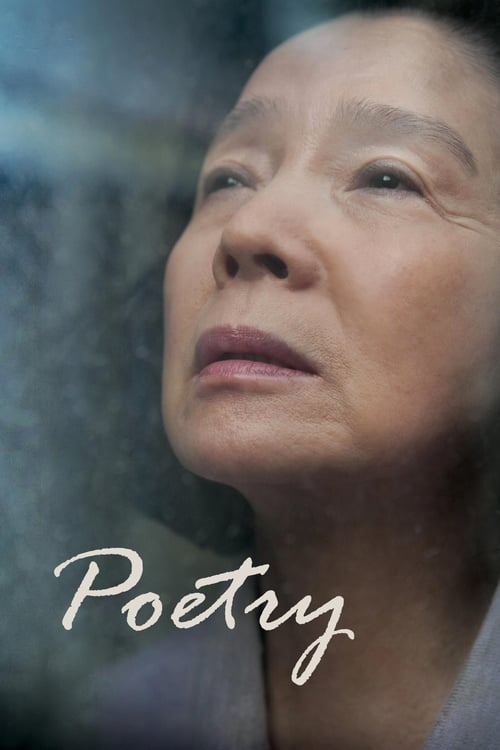
In the ending of the movie "Poetry," Mija, the elderly woman, faces the harsh reality of her life and the actions of her family. After discovering the truth about her grandson's involvement in a crime against a young girl, she grapples with her emotions and the weight of her responsibilities. Ultimately, she decides to take a drastic step to find peace and resolve her internal conflict, leading to a poignant and tragic conclusion.
As the film approaches its climax, Mija is seen walking through the serene landscapes, reflecting on her life and the poetry she has been trying to write. The beauty of nature contrasts sharply with the turmoil within her. She has been attending poetry classes, where she struggles to express her feelings and experiences through words. The instructor encourages her to find beauty in her life, but Mija is haunted by the knowledge of her grandson's actions and the impact it has had on an innocent girl.
In a pivotal scene, Mija confronts her grandson, who is indifferent to the gravity of the situation. He dismisses her concerns, revealing a troubling lack of empathy. This confrontation deepens Mija's internal conflict, as she realizes that her family is entangled in a web of moral failure. The weight of her grandson's crime and the suffering it has caused the victim weighs heavily on her conscience.
Mija's journey leads her to the young girl who has been affected by her grandson's actions. She seeks to understand the girl's pain and the consequences of the crime. This encounter is filled with tension, as Mija grapples with her role as a grandmother and her desire to protect the innocent. The girl's vulnerability starkly contrasts with Mija's own struggles, highlighting the generational divide and the complexities of familial loyalty.
As Mija continues to write her poetry, she becomes increasingly aware of the futility of her attempts to find beauty in a world marred by suffering. The act of writing becomes a cathartic release for her, yet it also serves as a reminder of her failures as a caregiver and a moral compass for her family. The poetry she creates reflects her inner turmoil, capturing the essence of her grief and confusion.
In the final scenes, Mija makes a heart-wrenching decision. She walks to a river, a place that symbolizes both life and death. The serene water contrasts with the chaos in her heart. In a moment of profound despair, she chooses to end her life, believing it to be the only way to escape the pain and guilt that have consumed her. This act serves as a tragic culmination of her struggles, leaving behind a world that has become unbearable.
The film concludes with a haunting image of Mija's empty poetry notebook, symbolizing the unfulfilled potential of her voice and the unresolved conflicts that linger in her life. The fate of Mija is one of tragic loss, as she succumbs to the weight of her family's sins and her inability to reconcile her love for them with the moral decay surrounding her. The ending leaves a lingering sense of sorrow, emphasizing the complexities of human relationships and the often-painful search for beauty in a flawed world.
Is there a post-credit scene?
The movie "Poetry," produced in 2010, does not have a post-credit scene. The film concludes with a poignant and reflective ending that encapsulates the emotional journey of the protagonist, Yang Mi-ja. After grappling with the complexities of her life, including her grandson's troubling actions and her own battle with Alzheimer's, the film leaves viewers with a sense of unresolved tension and contemplation rather than a traditional post-credit moment. The focus remains on the themes of art, beauty, and the harsh realities of life, culminating in a powerful final scene that emphasizes Mi-ja's internal struggle and her quest for meaning through poetry.
What motivates Mija to start writing poetry?
Mija, the protagonist, is motivated to start writing poetry as a way to find beauty and meaning in her life amidst the chaos and challenges she faces. She is inspired by her desire to express herself and to capture the fleeting moments of beauty in her surroundings, especially as she grapples with her own personal struggles.
How does Mija react to the revelation about her grandson's actions?
When Mija learns about her grandson's involvement in a serious crime against a young girl, she is devastated and filled with a mix of emotions, including shock, guilt, and a sense of helplessness. This revelation deeply affects her, as she feels torn between her love for her grandson and the moral implications of his actions, leading her to question her own values and the world around her.
What role does the character of the poetry teacher play in Mija's journey?
The poetry teacher serves as a catalyst for Mija's creative journey, encouraging her to explore her emotions and thoughts through writing. He provides guidance and support, helping her to understand the nuances of poetry and the importance of expressing her inner feelings, which becomes a crucial part of her coping mechanism as she navigates her personal turmoil.
How does Mija's relationship with her sick husband evolve throughout the film?
Mija's relationship with her sick husband is complex and evolves as she grapples with her responsibilities as a caregiver while also seeking her own identity. Initially, she feels burdened by his illness and the demands it places on her, but as the story progresses, she begins to confront her feelings of resentment and finds moments of tenderness, reflecting her internal struggle between duty and her own desires.
What significance does the natural scenery hold in Mija's journey?
The natural scenery in 'Poetry' serves as a poignant backdrop to Mija's emotional journey, symbolizing both beauty and transience. The lush landscapes and serene environments contrast with her internal chaos, providing her with moments of reflection and inspiration for her poetry. These scenes highlight her longing for peace and her quest for meaning in a life filled with sorrow and moral dilemmas.
Is this family friendly?
"Poetry," produced in 2010, is not considered family-friendly due to its mature themes and emotional depth. The film explores complex and often distressing subjects that may be upsetting for children or sensitive viewers.
Potentially objectionable or upsetting aspects include:
-
Sexual Assault: The film addresses the aftermath of a sexual assault, which is a central theme and is depicted in a way that highlights its emotional and psychological impact on the characters involved.
-
Suicide: There are references to suicidal thoughts and actions, which are portrayed in a serious and somber manner, reflecting the characters' struggles with despair.
-
Family Strain: The dynamics within the protagonist's family are fraught with tension, including themes of neglect and emotional turmoil, which may be difficult for younger viewers to process.
-
Mental Health Issues: The film delves into the protagonist's mental health challenges, including feelings of isolation and existential crisis, which may resonate deeply and evoke strong emotions.
-
Graphic Language: The dialogue includes strong language and discussions of sensitive topics that may not be suitable for younger audiences.
Overall, the film's exploration of these heavy themes is profound and thought-provoking but may not be appropriate for children or those who are sensitive to such content.







