





Popular
What are the three main stories that Hoffmann recounts in the film?
How does Hoffmann's relationship with Olympia develop throughout her story?
What role does the character of the Muse play in Hoffmann's journey?
What is the significance of the character of Lindorf in Hoffmann's tales?
How does Antonia's story reflect Hoffmann's internal conflicts?
Should I watch it?
Ask Your Own Question

What is the plot?
Sorry, we aren't able to watch and write up a full detailed plot yet. Check back in a few days.






What is the ending?
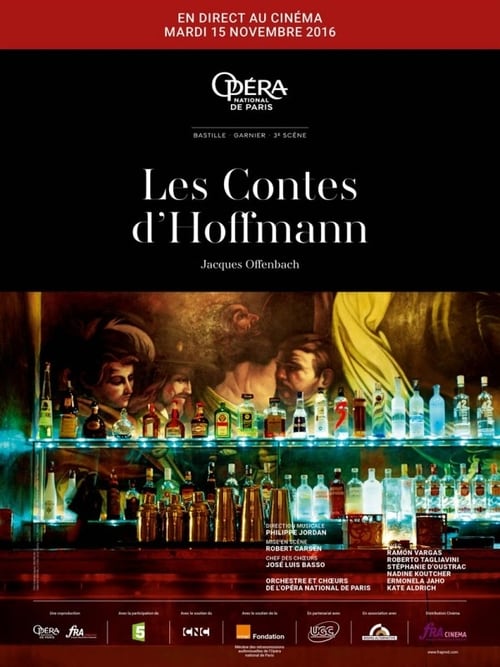
In the ending of "Offenbach: The Tales of Hoffmann," Hoffmann confronts the reality of his unfulfilled love and the loss of his idealized relationships. He realizes that the women he adored--Olympia, Antonia, and Giulietta--were mere illusions, leading to his ultimate despair. The film concludes with Hoffmann embracing his artistic identity, finding solace in his creativity despite the pain of lost love.
As the final act unfolds, we find Hoffmann in a dimly lit tavern, surrounded by shadows and echoes of his past. The atmosphere is heavy with melancholy, reflecting his internal struggle. He is haunted by memories of the three women who have shaped his life and art. Each woman represents a different facet of love and loss, and as he recalls their stories, the scenes shift between the tavern and the vivid, dreamlike sequences of his past.
The first memory is of Olympia, the mechanical doll. In this scene, Hoffmann is entranced by her beauty and grace, unaware that she is a mere creation of the inventor Spalanzani. As he realizes the truth, the enchantment shatters, leaving him heartbroken. The vibrant colors of the earlier scenes fade into a somber palette, symbolizing the loss of innocence and the harsh reality of unattainable love.
Next, Hoffmann's thoughts drift to Antonia, the fragile singer. In a poignant sequence, she is consumed by her passion for music, but her health deteriorates under the pressure of her art. Hoffmann watches helplessly as she succumbs to her fate, her voice fading into silence. The emotional weight of this memory is palpable, as Hoffmann grapples with the idea that love can lead to destruction.
Finally, Hoffmann recalls Giulietta, the seductive courtesan. Their relationship is marked by betrayal and manipulation, as she is entangled with the villainous Dapertutto. In a climactic confrontation, Hoffmann realizes that Giulietta's love is a façade, a mere illusion crafted to ensnare him. The scene is charged with tension, as Hoffmann fights against the forces that seek to control his heart and soul.
As the memories culminate, Hoffmann is left alone in the tavern, surrounded by his friends who have been watching his emotional turmoil. They urge him to embrace his pain and transform it into art. In this moment of clarity, Hoffmann understands that while he may never attain the love he desires, he can channel his experiences into his storytelling. The final scene is a powerful affirmation of the artist's journey, as Hoffmann picks up his pen, ready to weave the tales of his heartache into a new narrative.
The film concludes with Hoffmann's acceptance of his fate. He acknowledges that the women he loved were not real, but the emotions they inspired are genuine. The characters of Olympia, Antonia, and Giulietta fade into the background, leaving Hoffmann to stand alone, yet resolute. He is no longer just a lover; he is a creator, ready to face the world with his art as his solace. The screen fades to black, leaving the audience with a sense of bittersweet resolution, as Hoffmann embraces his identity as a storyteller, forever marked by the tales of love and loss.
Is there a post-credit scene?
The movie "Offenbach: The Tales of Hoffmann," produced in 2016, does not contain a post-credit scene. The film concludes with the final act of Hoffmann's journey, encapsulating the emotional and thematic resolutions of the story without any additional scenes or content after the credits roll. The focus remains on the narrative of Hoffmann's love and loss, leaving the audience with a poignant sense of closure as the credits play.
What are the three main stories that Hoffmann recounts in the film?
In the film, Hoffmann recounts three main stories: the tale of Olympia, a mechanical doll created by the inventor Spalanzani; the story of Antonia, a young woman whose singing is stifled by her father's ghost; and the narrative of Giulietta, a femme fatale who seduces Hoffmann and ultimately leads to his despair.
How does Hoffmann's relationship with Olympia develop throughout her story?
Hoffmann becomes infatuated with Olympia, believing her to be a real woman. He is enchanted by her beauty and grace, but as the story unfolds, he discovers that she is a lifeless automaton, which shatters his romantic illusions and leads to feelings of betrayal and heartbreak.
What role does the character of the Muse play in Hoffmann's journey?
The Muse, who appears as a woman throughout the film, represents Hoffmann's inspiration and artistic drive. She encourages him to embrace his creativity and confront his emotional struggles, acting as a guiding force in his life and his storytelling.
What is the significance of the character of Lindorf in Hoffmann's tales?
Lindorf serves as a recurring antagonist in Hoffmann's stories, representing the darker aspects of love and desire. He embodies betrayal and manipulation, particularly in the tale of Giulietta, where he deceives Hoffmann and ultimately leads him to despair.
How does Antonia's story reflect Hoffmann's internal conflicts?
Antonia's story reflects Hoffmann's internal conflicts between love and artistic ambition. As she is torn between her desire to sing and the haunting presence of her father's ghost, Hoffmann grapples with his own fears of losing the woman he loves to the pressures of the past and the sacrifices required for true artistry.
Is this family friendly?
The 2016 film "Offenbach: The Tales of Hoffmann" is a visually stunning adaptation of Jacques Offenbach's opera, but it does contain some elements that may be considered objectionable or upsetting for children or sensitive viewers.
-
Dark Themes: The narrative explores themes of love, loss, and betrayal, which may be emotionally intense for younger audiences.
-
Supernatural Elements: The presence of fantastical characters, such as automatons and spirits, may be unsettling for some children.
-
Violence and Death: There are scenes that depict violence and the consequences of obsession, including moments that suggest harm or death, which could be distressing.
-
Romantic Obsession: The portrayal of obsessive love and heartbreak may be complex and difficult for younger viewers to fully understand.
-
Visual Imagery: Some scenes feature surreal and dark visual imagery that may be frightening or confusing for sensitive viewers.
Overall, while the film is a rich artistic experience, its emotional depth and darker themes may not be suitable for all children.








