





Popular
What are the three main stories that Hoffmann recounts in the film?
Who is the character of Nicklausse and what role does he play in Hoffmann's journey?
What is the significance of the character of Lindorf in Hoffmann's stories?
How does the character of Antonia's father influence her fate in the story?
What is the role of the magical elements in the story of Olympia?
Should I watch it?
Ask Your Own Question

What is the plot?
Sorry, we aren't able to watch and write up a full detailed plot yet. Check back in a few days.








What is the ending?
In the ending of the 2016 film "Les Contes d'Hoffmann," Hoffmann, after experiencing the tragic loss of his beloved Antonia, is left heartbroken and disillusioned. He confronts the reality of his unfulfilled love and the pain of his past. The film concludes with Hoffmann embracing his artistic spirit, finding solace in his creativity despite the sorrow that surrounds him.
As the final act unfolds, we find Hoffmann in a state of despair, grappling with the memories of his three lost loves: Olympia, Antonia, and Giulietta. Each of these women represents a different facet of his romantic idealism, and their respective stories have culminated in a profound sense of loss for him.
The scene transitions to a dimly lit tavern where Hoffmann is surrounded by friends, yet he feels isolated in his grief. The atmosphere is heavy with melancholy as he recalls the beauty and tragedy of his relationships. His friends, including the character Nicklausse, attempt to lift his spirits, but Hoffmann is consumed by the haunting memories of Antonia, who has tragically succumbed to her illness, exacerbated by the manipulations of the villainous Dr. Miracle.
In a poignant moment, Hoffmann's memories of Antonia come flooding back, and he is transported to a vision of her, singing beautifully, embodying both the love he lost and the pain of her absence. This vision is interspersed with flashes of his other loves, Olympia and Giulietta, each representing a different ideal that ultimately led to his heartbreak. The emotional weight of these memories is palpable, as Hoffmann grapples with the realization that love, while beautiful, can also lead to profound sorrow.
As the narrative progresses, Hoffmann's internal struggle becomes evident. He is torn between the desire to escape his pain and the need to embrace it as part of his artistic journey. In a climactic moment, he confronts the specter of his past loves, acknowledging their impact on his life and art. This confrontation is both cathartic and tragic, as he understands that he cannot change the past but can channel his experiences into his creative work.
The film culminates in a powerful scene where Hoffmann, despite his heartbreak, finds a renewed sense of purpose. He begins to write, using his pain as inspiration for his art. The tavern transforms into a vibrant space filled with music and creativity, symbolizing Hoffmann's acceptance of his losses and his commitment to his craft. His friends rally around him, encouraging him to embrace his identity as a storyteller.
In the final moments, Hoffmann stands alone, yet empowered, as he reflects on the beauty and tragedy of love. The film closes with a sense of hope, suggesting that while love may lead to suffering, it also fuels the creative spirit. Hoffmann's journey is one of resilience, illustrating that even in the face of heartbreak, art can provide solace and meaning.
The fates of the main characters are as follows: Hoffmann, though heartbroken, emerges as a more profound artist, ready to channel his experiences into his work. Antonia, tragically, remains a memory, her life cut short by illness and manipulation. Olympia, the mechanical doll, symbolizes unattainable love, while Giulietta represents the seductive yet destructive nature of desire. Each character's fate serves to highlight the complexities of love and loss, ultimately leading Hoffmann to a deeper understanding of himself and his art.
Is there a post-credit scene?
The 2016 film "Les Contes d'Hoffmann" does not feature a post-credit scene. The film concludes with the final act of Hoffmann's tragic journey, encapsulating the emotional weight of his experiences and the themes of love, loss, and artistic creation. The ending leaves the audience reflecting on Hoffmann's struggles and the nature of his romantic ideals, without any additional scenes or content after the credits.
What are the three main stories that Hoffmann recounts in the film?
In 'Les Contes d'Hoffmann,' Hoffmann recounts three main stories: 'Olympia,' where he falls in love with a mechanical doll; 'Antonia,' where he is captivated by a young woman whose singing is threatened by her father's dark past; and 'Giulietta,' where he is seduced by a femme fatale who ultimately leads to his despair.
Who is the character of Nicklausse and what role does he play in Hoffmann's journey?
Nicklausse is Hoffmann's muse and confidant, often appearing as a male character who supports Hoffmann throughout his tales. He represents Hoffmann's inner voice, urging him to recognize the illusions of love and the dangers of his romantic pursuits.
What is the significance of the character of Lindorf in Hoffmann's stories?
Lindorf serves as the antagonist in Hoffmann's tales, appearing in various forms across the three stories. He embodies the darker aspects of love and desire, manipulating the situations to lead Hoffmann into heartbreak and despair, ultimately representing the obstacles Hoffmann faces in his quest for true love.
How does the character of Antonia's father influence her fate in the story?
Antonia's father, a once-great musician, is haunted by the memory of his deceased wife, which leads him to forbid Antonia from singing. His overprotectiveness and fear of losing her to the same fate ultimately contribute to her tragic demise, as he inadvertently stifles her spirit and passion.
What is the role of the magical elements in the story of Olympia?
In the story of Olympia, the magical elements are embodied in the mechanical doll, which is a creation of the inventor Spalanzani. Hoffmann is enchanted by Olympia's beauty and grace, unaware that she is not a living being. The magic of the doll symbolizes the allure of unattainable love and the dangers of being deceived by appearances.
Is this family friendly?
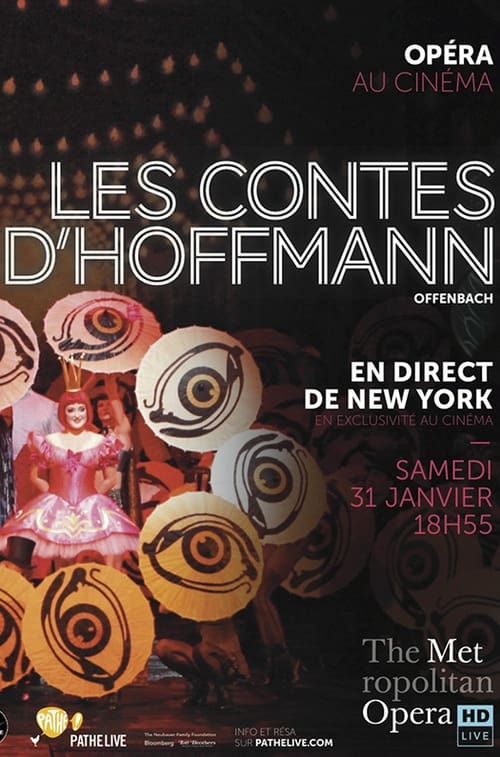
"Les Contes d'Hoffmann," produced in 2016, is an adaptation of Jacques Offenbach's opera that features a blend of fantasy, romance, and tragedy. While it is a visually stunning and artistically rich film, there are several elements that may be considered objectionable or upsetting for children or sensitive viewers.
-
Dark Themes: The film explores themes of unrequited love, betrayal, and loss, which may be emotionally heavy for younger audiences.
-
Violence and Death: There are scenes that depict violence, including a character being attacked and the presence of death, which could be distressing.
-
Supernatural Elements: The film includes fantastical and eerie elements, such as automatons and spirits, which might be frightening for some children.
-
Romantic Obsession: The protagonist's obsessive love for various women leads to tragic outcomes, which may be difficult for younger viewers to understand.
-
Emotional Turmoil: Characters experience intense emotional pain and despair, which could be upsetting for sensitive viewers.
Overall, while the film is a work of art, its complex themes and darker moments may not be suitable for all children or sensitive individuals. Viewer discretion is advised.