























Popular
What role does the neighborhood play in shaping the characters' lives?
What pivotal moments lead to character transformations in the film?
What challenges does the character of Nouf face throughout the film?
How does the relationship between the brothers evolve in the film?
How does Nouf's relationship with her father impact her decisions?
Should I watch it?
Ask Your Own Question

What is the plot?
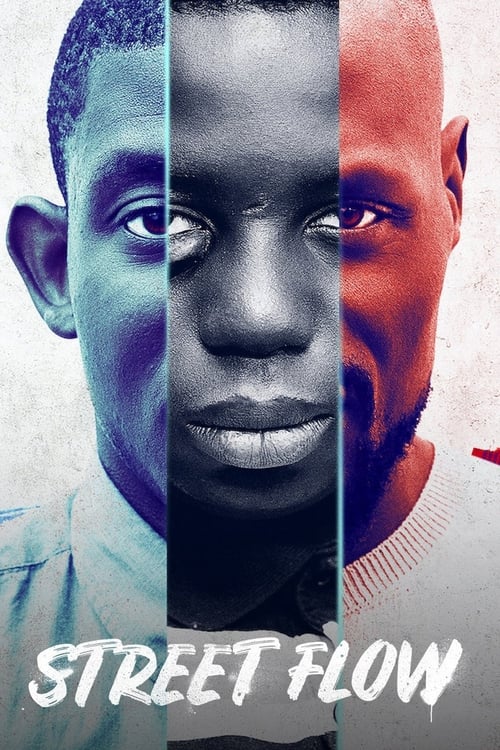
Street Flow opens in the dense, concrete sprawl of a Paris banlieue, where the Traoré family of Malian descent is already living under pressure before the plot even begins to move. In the family apartment, Khadija Traoré, the weary and anxious mother, tries to keep the household together after the death of her husband, while her three sons have already split into three different versions of survival: Demba Traoré, the eldest, is a powerful local drug dealer who lives apart from the family and moves through the neighborhood with the authority and danger of someone who has built his life on street power; Soulaymaan Traoré, the middle brother, is a law student commuting into Paris and trying to build a respectable future; and Noumouké Traoré, the youngest, is still in high school and already drifting toward the same rebellious, criminal energy that defines Demba's life.
The film immediately makes the contrast between the brothers feel like the central wound in the family. Demba is introduced as glamorous in the way street criminals often are to younger boys: he has money, a flashy vehicle, and the confidence of someone who appears untouchable, even though rival dealers and retaliation are always close behind him. Soulaymaan, by contrast, is shown in motion between worlds, leaving the banlieue for his studies in Paris and returning home afterward to tutor younger children, trying to act as both the family's model son and a quiet stabilizing force in a place that refuses to become stable. Noumouké watches both men and feels the pull of each life. He is old enough to be tempted by the speed and status of Demba's world, but still young enough to believe that one reckless choice might not permanently define him.
Soulaymaan's story establishes that his future is not simply academic; it is ideological. He is preparing for a debate in which the question of government responsibility for the suburbs becomes personal, and the film sharpens the contradiction between what he argues and what he lives. In the classroom, and especially in his exchanges with Lisa, he presents one position while his own experience of police scrutiny, neglect, and social abandonment keeps pushing against it. Lisa, a classmate from a more affluent background, becomes more than a romantic interest; she is the film's living reminder that Soulaymaan is trying to cross a social boundary that may never fully accept him. Their budding romance gives him a glimpse of another life, one organized around university, confidence, and possibility rather than threat and desperation.
Back at home, Khadija Traoré remains the emotional center of the film even as her health visibly weakens. She is not just worried about her sons; she is holding the last threads of a family that has already been pulled apart by poverty, grief, and the long absence of any real support. The boys' father is dead, and the family history carries the weight of that loss in every conversation and every silence. Khadija's concern is especially focused on Noumouké, who is at the exact age where childhood dependence ends and a choice begins to form. The film keeps returning to the idea that he is being recruited not by one person, but by an entire environment.
Noumouké's downward drift begins in school, where his frustration and defiance turn into outright conflict. One of his first major crises comes during gym class, where he gets into a serious altercation with a teacher and risks expulsion. The scene matters because it is not presented as an isolated act of bad behavior; it is framed as the point where the school system starts to lose him. He is not simply acting out for attention. He is already absorbing the logic of the street, and the institution around him responds more with discipline than understanding.
That trouble at school drives Noumouké back to Demba, not for emotional guidance but for money, as if financial help might also provide a way out of humiliation. Demba refuses to simply give him what he asks for. Instead of rescuing his younger brother, he pushes him toward finding his own way to earn money, reinforcing the harsh code by which he lives. The exchange is one of the film's quiet but devastating revelations: Demba may be the family's visible success story, but his model of survival is built on moral abrasion. He offers Noumouké a lesson, not a lifeline.
Noumouké takes that lesson in the worst possible way. He and a classmate, Sofia, move into theft, stealing a large sum of money from the apartment of one of Demba's rivals. The money is described as about 30,000 dollars in one account, and it becomes the object that turns private family pressure into open gang danger. The apartment belongs to Sahli, a rival who is "a bit of a livewire," and the theft is not just a crime but a provocation that inserts Noumouké directly into the violent economy of the neighborhood. He is no longer merely flirting with the street; he has stepped into it. This theft is the film's major turning point because it drags the youngest brother into a conflict he does not understand well enough to control.
At the same time, the film continues to show that Demba's world is already unstable. He is in conflict with other gangs, and his power depends on a delicate balance of fear, retaliation, and reputation. Lakdar, one of the rival figures, tries to take out Samir, who is Demba's partner in crime. The attempted hit escalates tensions further, and Demba and Samir decide they will retaliate, but only when the time is right. This waiting is important; the film makes violence feel organized and strategic rather than random. Every insult is stored, every slight remembered, every act of force answered later with a more calculated act of force.
As Demba's side begins tracing the stolen money and the theft's consequences, another layer of conflict forms around mediation. Abdel, an old acquaintance of Demba's, steps in to keep the peace between Sahli and Demba once the situation becomes too combustible to contain directly. Abdel functions like a dangerous intermediary, someone who understands the code of the streets well enough to delay disaster but not prevent it. He is not a neutral peacemaker so much as a man trying to stop a war from breaking out before the timing suits him or his allies.
Meanwhile, Soulaymaan keeps moving through his academic life with increasing strain. His commute into Paris is more than a commute; it is the film's visual shorthand for his attempt to travel from one social universe to another every day without being pulled apart by either. He tutors younger children when he returns home, showing a patience and responsibility that stands in stark contrast to the violence around him. He is also becoming emotionally entangled with Lisa, and their relationship suggests a possible future in which he is no longer defined entirely by his neighborhood. But the film never lets that hope become simple. His debate preparation, especially his public argument with Lisa about state responsibility in the suburbs, reveals that his intellectual stance is still shaped by personal contradiction. He can speak about neglect in theory, but the facts of his life make the subject impossible to detach from his own body and family.
That contradiction gives the film one of its most important emotional currents. Soulaymaan is trying to prove that another path exists, but he is doing so while standing inside the very structures that make that path so fragile. His law studies represent aspiration, middle-class legitimacy, and the idea of exit; his home life represents obligation, grief, and the constant pull back into the neighborhood's pressure. The film does not present him as superior to Demba, only as differently trapped. Demba is imprisoned by street crime. Soulaymaan is imprisoned by the burden of being the one who might escape and therefore the one expected to save everyone else.
Noumouké, for his part, is increasingly exposed to both models. He sees Demba's wealth and authority, and he sees Soulaymaan's discipline and apparent promise. But his own behavior suggests that he is still searching for a route that will deliver respect without sacrifice. The theft from Sahli's apartment reveals how easily he slips into the logic of fast money. The fact that he does it with a schoolmate, Sofia, makes the action feel all the more dangerous: the pressure has moved from family conflict into peer partnership, spreading like an infection through the next generation.
As tensions rise in the gang conflict, Khadija's health becomes the family's other crisis. She is already fragile and increasingly overwhelmed, and then she suffers a stroke near the climax. The stroke lands like a blow from outside the street war, but it is part of the same system of collapse. The family has been under too much pressure for too long, and her body finally gives way at the moment when her sons are least capable of protecting her. The medical emergency is not isolated from the criminal violence; it is the domestic mirror of it. Both are expressions of a household pushed beyond endurance.
The final stretch of the film converges all the tensions at once. The theft, the rivalries, the retaliations, and Khadija's condition all move toward the same breaking point. Sahli's demand becomes more aggressive, and the conflict escalates into direct violence. When the retaliation finally arrives, it is Demba who pays the highest price. Sahli shoots Demba. The shooting is the film's most shocking turn because it pierces the aura of control around the eldest brother. Demba has spent the whole film acting like the man most capable of surviving the streets, and yet the streets take aim at him anyway. The violence is not only brutal; it is humiliating in its finality. The brother who seemed strongest is suddenly just another body in the line of fire.
The sources confirm the shooting of Demba, but they do not make the outcome simple or clean in the way a conventional crime film might. One account states that Demba is shot by Sahli and that Abdel is somehow "in on the assassination attempt" and shoots Sahli, possibly to cover his tracks. Another source confirms the same main event--that Sahli shoots Demba--while not clearly resolving whether Demba dies. What is certain is that the film treats the shooting as a catastrophic climax rather than a contained skirmish. If Demba survives, he survives gravely wounded and permanently altered; if he dies, his death is the direct result of Sahli's retaliation after the money theft and the failed attempts at mediation. The available plot data do not clearly settle that final medical outcome, but they do make the chain of causation unmistakable: Noumouké's theft feeds the gang conflict, Abdel's mediation fails, Sahli escalates the feud, and Demba is shot as the consequence.
At the same time, Khadija's stroke forces the family crisis into the open. She is not dying in the same explicit instant as Demba is shot, but her collapse gives the ending its emotional structure. The brothers are suddenly dealing with the two things they have spent the film failing to protect: the family's physical center and the eldest son who had become the street's most visible shield. The film makes it clear that no one in the Traoré household can keep pretending these crises are separate. The street has entered the home, and the home has collapsed into the street.
The final emotional effect comes from the collision of the brothers' paths. Demba's life has been built on crime, violence, and status. Soulaymaan's life has been built on education, self-discipline, and the hope of leaving. Noumouké stands between them, young enough to still choose, but old enough to already be marked by the choice. The film ends without offering any easy reconciliation. Khadija's stroke leaves the family shaken, and Demba's shooting leaves the future of the brothers uncertain. Soulaymaan's effort to keep the family intact is tested to its limit, and his romance with Lisa becomes secondary to the much more urgent question of whether he can hold on to his own moral direction while his family crisis deepens.
The last scene's power lies in what it refuses to simplify. There is no triumphant escape from the banlieue, no clean moral lesson, and no neat punishment that restores order. Instead, the film leaves the Traoré family standing at the edge of several possible collapses: the collapse of the body, the collapse of the street code, and the collapse of the dream that one son alone can rescue the rest. Demba, whether dying or gravely wounded, has been caught by the violence he helped normalize. Soulaymaan is left with the impossible burden of legitimacy in a world that keeps dragging him back. Noumouké is left at the threshold of the same decision that has haunted the film from the opening moments, now sharpened by the sight of blood, fear, and his mother's failing health.
In the end, Street Flow closes on a family caught between two failures of protection: the failure of the state to provide a path out, and the failure of the brothers to protect one another from the consequences of the world they inhabit. The final feeling is not simply tragedy but pressure that has not yet finished exerting itself. The brothers are still alive in the sense that their choices continue, but the film's ending makes one thing painfully clear: whatever future remains for the Traorés, it will have to be built from the wreckage of Khadija's collapse, Demba's blood, and Noumouké's still-unresolved attraction to the life that is swallowing his family whole.








What is the ending?
In the ending of "Street Flow," the main character, Noumou, faces the consequences of his choices as he grapples with the realities of life in the streets. The film concludes with a sense of unresolved tension, highlighting the struggles of the characters and the impact of their decisions.
As the final scenes unfold, Noumou is seen reflecting on his life and the choices that have led him to this point. He is surrounded by his friends, who are also dealing with their own challenges. The film ends on a poignant note, emphasizing the cyclical nature of their struggles and the harsh realities of their environment.
As the film approaches its climax, we find Noumou in a dimly lit room, the air thick with tension. He sits on a worn-out couch, his face etched with worry and contemplation. The weight of his decisions hangs heavily on him, and he stares blankly at the wall, lost in thought. His friends, who have been his companions throughout their tumultuous journey, are gathered around him, each grappling with their own demons.
In the next scene, the atmosphere shifts as they receive news of a violent incident involving one of their own. The group is shaken, and the reality of their lifestyle hits them hard. Noumou's internal conflict intensifies; he feels a deep sense of responsibility for his friends and the choices they have made together. The camera captures the raw emotions on their faces--fear, anger, and a sense of impending doom.
As the night progresses, they gather outside, the streetlights casting long shadows on the pavement. The streets are alive with the sounds of the city, but for Noumou and his friends, it feels suffocating. They discuss their futures, their dreams, and the harsh realities that seem to crush any hope they have. Noumou's voice trembles as he expresses his desire for a better life, but the weight of their circumstances feels insurmountable.
In a pivotal moment, Noumou decides to confront the situation head-on. He gathers his friends and leads them to a nearby gathering where tensions are high. The scene is charged with emotion as they face off against rival groups, and the stakes are raised. Noumou's determination is palpable; he wants to protect his friends and assert their place in the world. However, the confrontation spirals out of control, leading to chaos and violence.
As the dust settles, we see the aftermath of the confrontation. Noumou stands alone, the reality of his choices crashing down on him. His friends are scattered, some injured, others arrested. The camera lingers on his face, capturing the pain of loss and the burden of guilt. He realizes that the cycle of violence and despair is not easily broken, and the weight of his decisions will haunt him.
In the final moments, Noumou walks through the empty streets, the city around him feeling both familiar and alien. He reflects on the lives of his friends--some have chosen to escape, while others remain trapped in the cycle. The film closes with a haunting image of Noumou standing at a crossroads, symbolizing the choices that lie ahead. The screen fades to black, leaving the audience with a lingering sense of uncertainty about the future of these characters and the world they inhabit.
Is there a post-credit scene?
In the movie "Street Flow," there is no post-credit scene. The film concludes its narrative without any additional scenes or content after the credits roll. The story wraps up with a focus on the main characters and their journeys, leaving the audience with a sense of closure regarding the themes of family, loyalty, and the struggles faced in their environment. The absence of a post-credit scene emphasizes the film's serious tone and the weight of the issues it addresses.
What role does the neighborhood play in shaping the characters' lives?
The neighborhood in 'Street Flow' serves as a character in its own right, profoundly influencing the lives of the protagonists. It is depicted as a gritty, unforgiving environment that shapes the characters' identities and choices. The streets are filled with both camaraderie and danger, where friendships are tested and survival is a daily struggle. The characters' interactions with their surroundings highlight the socio-economic challenges they face, and the neighborhood's atmosphere of despair and hope drives their motivations and decisions throughout the film.
What pivotal moments lead to character transformations in the film?
Several pivotal moments in 'Street Flow' lead to significant character transformations. One such moment occurs when Nouf witnesses the consequences of her brother's choices, which forces her to confront the reality of their situation. Another key moment is when the brothers face a life-altering decision that tests their loyalty and moral compass. These instances of crisis and revelation catalyze growth, prompting characters to reassess their values and relationships, ultimately leading to a deeper understanding of themselves and their place in the world.
What challenges does the character of Nouf face throughout the film?
Nouf, a central character in 'Street Flow', faces numerous challenges that stem from her environment and family dynamics. As a young woman navigating the harsh realities of life in the suburbs of Paris, she grapples with the pressure of familial expectations, particularly from her father, who is strict and traditional. Nouf's desire for independence clashes with her father's control, leading to emotional turmoil. She also faces societal challenges, including the stigma associated with her neighborhood and the struggles of her friends, which weigh heavily on her conscience.
How does the relationship between the brothers evolve in the film?
The relationship between the brothers, especially between Nouf's brother and his friends, is central to the narrative. Initially, they share a strong bond, united by their shared experiences and struggles in their neighborhood. However, as the story progresses, tensions arise due to differing aspirations and the influence of external pressures, such as gang involvement and the lure of quick money. This evolution is marked by moments of conflict, loyalty, and ultimately, a quest for redemption, as they navigate their choices and the consequences that follow.
How does Nouf's relationship with her father impact her decisions?
Nouf's relationship with her father is fraught with tension and conflict, significantly impacting her decisions throughout the film. Her father's strict and traditional views create a rift between them, as Nouf yearns for freedom and self-expression. This dynamic leads her to make choices that defy her father's expectations, such as pursuing friendships and activities that he disapproves of. The emotional weight of her father's disapproval often leaves Nouf feeling torn between loyalty to her family and her desire to forge her own path, ultimately shaping her character arc.
Is this family friendly?
"Street Flow," produced in 2019, is a film that delves into the lives of three brothers navigating the challenges of their environment, which includes themes of violence, crime, and social struggles. While the film offers a poignant exploration of family and resilience, it contains several elements that may not be suitable for children or sensitive viewers.
Potentially objectionable or upsetting aspects include:
- Violence: The film depicts street violence and confrontations that may be intense and distressing.
- Crime: There are scenes involving drug dealing and criminal activities that portray the harsh realities of life in a troubled neighborhood.
- Emotional Turmoil: Characters experience significant emotional struggles, including grief, loss, and betrayal, which may be heavy for younger audiences.
- Language: The dialogue includes strong language that may not be appropriate for children.
- Family Conflict: The film explores complex family dynamics, including tension and conflict that could be upsetting.
Overall, "Street Flow" addresses serious themes that may resonate more with mature audiences, making it less suitable for children.








