











Popular
What are the main character's aspirations in Broadway Bound?
How does the family dynamic affect Eugene and Stanley's pursuit of their dreams?
What role does the setting of 1940s New York play in the story?
How do Eugene and Stanley's relationships with their parents evolve throughout the film?
What challenges do Eugene and Stanley face in their journey to becoming writers?
Should I watch it?
Ask Your Own Question

What is the plot?
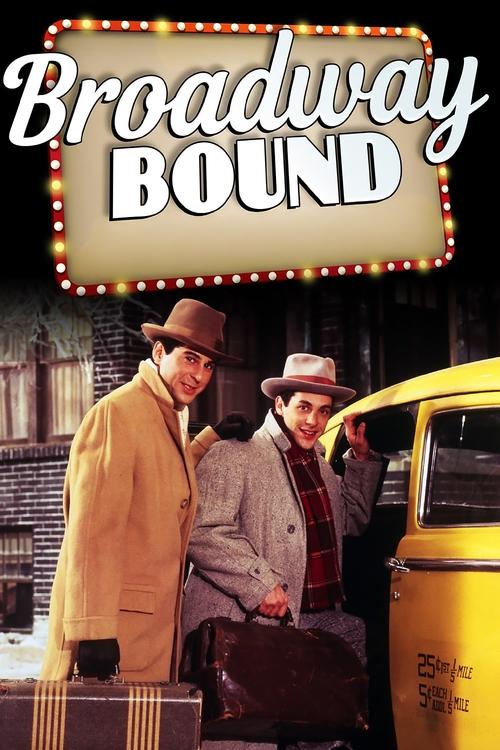
Winter settles hard over Brighton Beach, Brooklyn, in 1949, and the Jerome house feels as if it is holding its breath. The front porch is snowbound, the rooms are underheated, and the whole family lives in that cramped, fraught tension that comes when everyone can feel a breakup coming before anyone says it aloud. Eugene Morris Jerome, about twenty-three now, comes and goes with the guarded energy of a young man who has already seen war and returned home with his sense of humor sharpened into armor. He is not simply observing life anymore; he is trying to turn it into work. Alongside his older brother Stanley Jerome, he is chasing a future in comedy writing, even as the home they share with their parents is beginning to come apart at the seams.
At the center of the house is Kate Jerome, the mother, moving through dinner preparations and household rituals with the strained steadiness of someone trying to keep a family alive by force of habit. She has the look of a woman who has sacrificed too much for too long, and the audience can feel how tightly she is holding herself together. Her husband, Jack Jerome, is increasingly absent in every sense that matters. He does not even appear for dinner at the opening, and that absence hangs over the table like another place setting no one dares to remove. Living with them, and adding both warmth and friction to the household, is Kate's father Ben Epstein, an elderly Jewish man with socialist leanings, a combative sense of humor, and the weary, resigned intelligence of someone who has already survived one failed marriage of his own. The atmosphere is domestic, but barely; everyone is too aware that the real story is the one no one is saying directly.
Stanley arrives with the sort of news that can briefly lift a family's spirits before sharpening their nerves: he has won the opportunity to submit or audition material for CBS, and he believes this is the opening the brothers have been waiting for. Stanley is the force behind the partnership, the practical wheeler-dealer who pushes when Eugene hesitates. Eugene writes, watches, and worries; Stanley sells, hustles, and insists. Their collaboration is affectionate but not equal, and that imbalance gives their scenes their rhythm. Stanley is driven by ambition and impatience, while Eugene is more reflective, already half-narrator and half-participant in his own life.
The pressure of the audition draws the brothers upstairs, where they begin to brainstorm comedy material under a deadline. What first feels like a creative exercise slowly becomes something more dangerous: the raw material of their own home is right there in front of them. The boys start looking at the family not just as family but as content, and that shift is one of the story's central ironies. They need a sketch, and the very thing they are trying to escape is exactly what proves funniest, most truthful, and most painful.
As the house fills with the smaller stresses of daily life, the larger emotional crisis continues to darken the edges. Kate and Jack's marriage is visibly failing, and the reason is not abstract. Kate already suspects that Jack is having an affair, and the suspicion has been turning their home into a field of silences and side glances. The truth does not arrive as a shocking surprise so much as a confirmation of what everyone can already feel. When Kate finally confronts Jack, she is not asking a hypothetical question; she is trying to stop the collapse from becoming official. Jack does admit the infidelity, and the admission lands like a wound reopening. In one account of the story, he says the woman he has been seeing is dying, which adds a layer of pitiful complexity to the betrayal without excusing it.
That revelation does not resolve anything. If anything, it only makes the household more brittle. Kate has to absorb not only the fact that Jack has been unfaithful but also the humiliation of finding out that her marriage has been dissolving in private while the rest of the family has been forced to live inside its wreckage. Ben, who knows more than he says and says more than most men would, understands marital misery too well to be surprised. His own wife has not been living with him for some time, and he recognizes the signs of permanent separation with grim familiarity. When Kate's sister Blanche comes by and tries to persuade Ben to give up New York and move to Miami to join his estranged wife, Ben refuses with stubborn affection for the life he still wants to inhabit. Blanche, now wealthy because she married into comfort, becomes an irritant in the room, a symbol of the family's resentments and social humiliations. Kate resents her wealth even as Blanche attempts practical solutions, but Ben will not be moved. He is stubborn, wounded, and oddly loyal to the old apartment, the old city, and the old arguments.
The boys, meanwhile, keep working. The future of their careers is moving closer, but not in the clean, heroic way they might have imagined. Their material is funny, but their humor is scavenged from pain. They recognize that the best comedy is sitting right inside the family drama around them, and they exploit that truth because they are ambitious and because they are boys on the cusp of adulthood, still not fully understanding what it means to extract laughter from the people who love them. The line between observation and betrayal is thin, and the brothers cross it without fully realizing the consequences until it is too late.
The turning point comes when the family gathers around the radio to hear the brothers' work broadcast for the first time. This is the moment they have been working toward, the moment that should validate Eugene and Stanley's talent and mark the beginning of their professional lives. Instead, it becomes a public exposure of the private wounds they have been circling all along. The sketch is technically fictional, but it is so obviously built out of the Jerome household that the resemblance is impossible to miss. The voices, the emotional rhythms, the household dynamic, even the contours of the family tension all seem to mirror the people listening in the room. What the brothers hear as clever comedy, the rest of the family hears as a thinly disguised portrait of their suffering played for laughs.
Jack is the first to feel the humiliation as an attack. He recognizes himself in the fictional father, and the realization ignites his anger. The broadcast does not simply embarrass him; it strips him. He is already insecure because of his affair, and now his own sons have unintentionally turned that insecurity into public ridicule. The outrage that follows is immediate and explosive. Jack turns on Stanley in a major confrontation that quickly expands beyond the radio sketch itself. What begins as a fight about taste, judgment, and embarrassment becomes a fight about loyalty, betrayal, and the failure of the father-son relationship to remain intact under pressure.
Stanley, who has always been the more aggressive and confrontational of the brothers, does not back away. He has pushed the partnership forward from the start, and now he has to absorb the damage from that push. The argument escalates until it reaches the real source of the family's pain: Jack's affair. In effect, the sketch has done what years of caution and silence could not do. It has blown open the hidden crisis at the center of the house. The family's anger, long dispersed through small resentments and evasions, now focuses in one room, on one man, and on one truth nobody can ignore anymore.
The emotional pressure of the confrontation sends the story into its quieter but devastating middle movement. After the shouting, after the humiliation, there is an intimate scene between Eugene and Kate that changes the emotional balance of the story. Kate, who has spent so much of the play carrying everybody else's burdens, finally allows herself to speak from inside her own long history. She tells Eugene how, when she was younger, she worked hard to win Jack's heart. It is a revelation full of tenderness and ache, because it reminds Eugene--and the audience--that this marriage was not always a failure waiting to happen. It began in hope, effort, and desire. Kate's memory of courtship carries all the weight of what has been lost. Her voice, in this moment, is not just angry or wounded; it is nostalgic, exposed, and sad in a way that makes the betrayal even deeper. The mother who has seemed practical and unsentimental reveals the romantic labor that underpinned her life, and Eugene sees her not just as a parent but as a woman whose dreams were narrowed into domestic endurance.
This is also the moment when Eugene's position in the story becomes clearer. He is not only a writer and observer; he is the witness who has to absorb the family's truths and turn them into memory. His narration in the stage version frames the events with a mix of affection, irony, and regret, and the emotional intelligence he brings to the material is part of what makes the story resonate as a semi-autobiographical recollection rather than a simple domestic comedy. He sees the comedy, but he also sees the cost.
Jack's fate now becomes unavoidable. The marriage has been publicly and privately shattered, and his place in the house cannot survive the aftermath of that broadcast and confrontation. Eventually, Jack leaves. The departure is less a single dramatic exit than the final acknowledgment that the marriage has ended in practice, even if the emotional consequences continue to unfold inside the family. He does not restore the family; he abandons the structure that has already ceased to hold. His leaving confirms that the home the story began in is no longer a whole unit but a place of temporary overlap before permanent separation.
The boys' professional lives, however, are just beginning to open. After the painful fallout, Eugene and Stanley get the kind of career offers they have been chasing. The exact shape of the offers varies in different accounts, but the result is consistent: they are finally given the chance to move forward and leave the Brighton Beach house behind. Their success is real, but it arrives with the bitter irony that their first major material came from the family disintegration they are now escaping. They move out, carrying with them the ambitions that once seemed foolish and now look like the beginning of a life in show business. The transition is not triumphant in a simple sense; it is a coming-of-age rupture. They are leaving home because home has become impossible to remain in, and because their art has finally begun to replace their dependence on it.
Ben remains after the sons are gone, giving the final stretch of the story a quieter, more elegiac shape. He stays with Kate in the Brighton Beach house, a stubborn old man sharing space with a daughter who has been left behind by her marriage and her sons' departure. The house that once contained an entire family now holds only the remnants of one. Ben's presence keeps the place from becoming completely empty, and his humor and warmth soften what would otherwise be pure desolation. But even he cannot remain forever. His own domestic story finally resolves in movement, not reconciliation: he goes to follow his wife to Miami. That departure leaves Kate behind in the house, the last fixed point in a family geography that has now scattered in all directions.
What makes the ending of Broadway Bound feel complete is not that everyone finds peace, but that every major truth has finally surfaced. Jack's infidelity is exposed and confessed. The emotional cost of the boys' comedy is paid in full. Kate's endurance is given its history. Stanley and Eugene win the future they want, but only by leaving the place that shaped them. Ben, who offered warmth and wit throughout the domestic storm, is also pulled away by his own unresolved marriage. The final image is not of reunion but of dispersion: sons moving into their careers, father gone, grandfather gone, and Kate left in the old Brighton Beach house as the last keeper of the family's memory.
There are no deaths shown in the action of the story. No character dies on screen or in the central narrative, and the only death-related detail is Jack's revelation that the woman he has been seeing is dying, which complicates his affair without undoing its betrayal. The emotional deaths are elsewhere: the death of the marriage, the death of the illusion that the family can stay together, and the death of innocence that comes when Eugene and Stanley realize that turning life into comedy means exposing the people who made that life possible.
By the final scene, the story has moved from a snowbound Brooklyn home full of tense dinners and unfinished sentences to a set of separate futures. Eugene and Stanley have stepped into their careers, Kate is left holding the emotional center of the family's collapse, and Ben heads south to follow the wife who has been absent from his daily life for so long that the move feels like the closing of a second marriage rather than the repairing of the first. The house in Brighton Beach remains, but the family that filled it at the start is gone, divided by betrayal, ambition, and time into the lives they were always moving toward.







What is the ending?
In the ending of "Broadway Bound," the two brothers, Eugene and Stanley, face the reality of their family's disintegration as they prepare to leave for New York City. Their mother, Kate, is emotionally distraught over the impending changes, and their father, Jack, is increasingly distant. The film concludes with Eugene reflecting on his family's struggles and the bittersweet nature of their dreams.
As the film approaches its conclusion, the atmosphere in the Jerome household grows increasingly tense. Eugene and Stanley, now on the cusp of adulthood, are filled with excitement and trepidation about their future in New York City. They have been accepted into a summer program that could launch their careers in writing and acting, a dream they have nurtured throughout their youth.
Scene by scene, the emotional weight of their family dynamics becomes palpable. In the living room, Eugene and Stanley share a moment of camaraderie, discussing their aspirations and the stories they want to tell. Their laughter is tinged with an undercurrent of sadness, as they both know that leaving home means leaving behind the familiar, even if it is fraught with conflict.
Meanwhile, their mother, Kate, is in the kitchen, preparing a meal. She is visibly upset, grappling with the reality that her sons are about to embark on a journey that will take them away from her. Her worries about their future and the instability of their family life weigh heavily on her. She confronts Jack about his emotional distance, revealing the cracks in their marriage. Jack, who has been increasingly withdrawn, struggles to communicate his feelings, leading to a confrontation that highlights the deep-seated issues in their relationship.
As the brothers prepare to leave, the tension in the household reaches a breaking point. Kate expresses her fears about losing her sons, while Jack attempts to maintain a facade of indifference. The emotional turmoil culminates in a heated argument, where Kate's frustrations boil over, and she lashes out at Jack, revealing her feelings of abandonment and despair. The boys stand by, caught in the crossfire, feeling the weight of their parents' unresolved issues.
In a poignant moment, Eugene takes a step back and reflects on the family's struggles. He understands that while they are leaving for a new adventure, they are also leaving behind a family that is fractured and in pain. This realization brings a sense of melancholy to the excitement of their departure.
As the final scenes unfold, Eugene and Stanley pack their bags, their faces a mix of hope and uncertainty. They share a heartfelt goodbye with their mother, who, despite her fears, encourages them to pursue their dreams. The emotional farewell is bittersweet, filled with unspoken words and lingering doubts about what the future holds.
The film closes with Eugene's voiceover, where he contemplates the complexities of family, dreams, and the inevitable changes that come with growing up. He acknowledges the pain of leaving but also the necessity of moving forward. The screen fades to black, leaving the audience with a sense of both loss and the promise of new beginnings.
In the end, Eugene and Stanley step into the unknown, ready to face the challenges of their aspirations, while Kate and Jack are left to confront the reality of their fractured relationship, symbolizing the broader themes of family, ambition, and the bittersweet nature of change.
Is there a post-credit scene?
The movie "Broadway Bound," produced in 1992, does not have a post-credit scene. The film concludes its narrative without any additional scenes after the credits roll. The story wraps up with the emotional culmination of the characters' journeys, focusing on the themes of family, ambition, and the struggles of growing up in a changing world. The ending leaves viewers with a sense of closure regarding the characters' aspirations and relationships, particularly the bond between the two brothers, Eugene and Stanley, as they navigate their dreams of becoming successful writers in the face of familial challenges.
What are the main character's aspirations in Broadway Bound?
The main characters, brothers Eugene and Stanley Morris, aspire to become successful writers and performers. Eugene, the older brother, is particularly passionate about writing and dreams of making it big in the world of Broadway, while Stanley supports his brother's ambitions and shares a desire to succeed in the entertainment industry.
How does the family dynamic affect Eugene and Stanley's pursuit of their dreams?
The family dynamic is complex and often tumultuous, with their mother, Kate, being a strong-willed and often critical figure. She has high expectations for her sons, which adds pressure to their aspirations. Their father, Jack, is more passive and struggles with his own issues, creating a contrast that influences the brothers' motivations and emotional states as they navigate their dreams.
What role does the setting of 1940s New York play in the story?
The setting of 1940s New York is crucial as it represents a vibrant and challenging backdrop for Eugene and Stanley's ambitions. The post-war era is filled with opportunities in the arts, but it also reflects the struggles of the working class, particularly through the Morris family's experiences. The city serves as both a source of inspiration and a reminder of the harsh realities they face.
How do Eugene and Stanley's relationships with their parents evolve throughout the film?
Eugene and Stanley's relationships with their parents evolve significantly as the story progresses. Initially, there is tension, particularly with their mother, who is often critical and demanding. However, as the brothers pursue their dreams, they begin to assert their independence, leading to moments of conflict but also deeper understanding and connection with their parents, especially as they confront family struggles together.
What challenges do Eugene and Stanley face in their journey to becoming writers?
Eugene and Stanley face numerous challenges in their journey, including financial struggles, the pressure of familial expectations, and the competitive nature of the entertainment industry. They also deal with personal insecurities and the fear of failure, which are exacerbated by their mother's critical nature and their father's emotional distance, making their pursuit of success both a source of motivation and anxiety.
Is this family friendly?
"Broadway Bound," produced in 1992, is a coming-of-age film that explores the lives of two brothers, Eugene and Stanley Morris, as they navigate their aspirations of becoming successful writers in the backdrop of a changing family dynamic. While the film is rich in humor and heartfelt moments, it does contain some themes and scenes that may be considered objectionable or upsetting for children or sensitive viewers.
-
Family Conflict: The film portrays significant family strife, particularly between the parents, which includes arguments and emotional distress. This can be intense and may be upsetting for younger viewers.
-
Divorce and Separation: The parents' relationship deteriorates, leading to discussions about divorce. The emotional impact of this situation is explored, which may resonate deeply with children from similar backgrounds.
-
Financial Struggles: The family's financial difficulties are a recurring theme, leading to stress and tension within the household. This may be distressing for viewers who are sensitive to issues of poverty and instability.
-
Death and Loss: There are references to death and the impact it has on the family, which can evoke feelings of sadness and loss.
-
Mature Themes: The film touches on themes of ambition, disappointment, and the harsh realities of pursuing dreams, which may be complex for younger audiences to fully grasp.
Overall, while "Broadway Bound" has comedic elements and moments of warmth, its exploration of serious family issues and emotional struggles may not be suitable for all children or sensitive viewers.









