
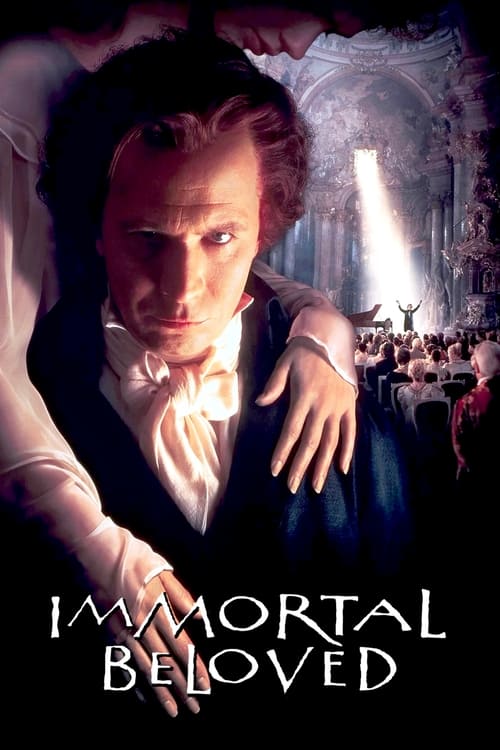
























Popular
Who is the mysterious woman that Beethoven refers to as his 'Immortal Beloved'?
What role does Beethoven's deafness play in the film?
How does the film depict Beethoven's relationship with his nephew, Karl?
What is the significance of the letters Beethoven wrote to his 'Immortal Beloved'?
How does the film explore Beethoven's relationships with women?
Should I watch it?
Ask Your Own Question

What is the plot?
Sorry, we aren't able to watch and write up a full detailed plot yet. Check back in a few days.




What is the ending?
In the ending of "Immortal Beloved," Beethoven's true love remains a mystery as he reflects on his life and the impact of his music. The film concludes with a poignant scene where he plays a piece that encapsulates his feelings of loss and longing, leaving the audience with a sense of unresolved emotion regarding his relationships.
As the film approaches its conclusion, we find ourselves in the dimly lit room of Beethoven's apartment, filled with the remnants of his life and the echoes of his music. The camera pans over the scattered sheets of music, revealing the chaos of his genius and the turmoil of his heart. The atmosphere is heavy with a sense of nostalgia and melancholy, as Beethoven grapples with the memories of his past loves.
In a series of flashbacks, we see glimpses of his relationships with various women, particularly with the enigmatic "Immortal Beloved." The film has taken us through a labyrinth of emotions, showcasing Beethoven's struggles with his deafness, his passion for music, and his tumultuous romantic entanglements. Each woman he loved brought a different shade to his life, yet none could fill the void left by the one he truly adored.
As the narrative unfolds, we witness Beethoven's confrontation with his own mortality. He is aware that time is slipping away, and he is haunted by the question of who the "Immortal Beloved" truly is. The film presents a poignant moment where he sits at the piano, his fingers dancing over the keys, pouring his soul into the music. The notes resonate with a deep sense of longing, reflecting his internal struggle and the unresolved nature of his love.
In the final scenes, we see Anton Felix Schindler, Beethoven's friend and confidant, who has been on a quest to uncover the identity of the "Immortal Beloved." Schindler's journey has been one of loyalty and dedication, yet he too is left with unanswered questions. As he stands in the shadows, watching Beethoven play, he realizes that some mysteries may never be solved. The camera captures the bittersweet expression on Schindler's face, a mix of admiration and sorrow for his friend.
The film closes with Beethoven's music filling the air, a haunting melody that lingers long after the final notes fade. The audience is left with a profound sense of the complexity of love, the pain of loss, and the enduring power of music. Each character's fate is intertwined with Beethoven's legacy, as they all grapple with their own emotions and the impact of his genius on their lives.
In the end, Beethoven remains a solitary figure, a man whose heart was filled with love yet burdened by the weight of his own genius. The "Immortal Beloved" remains an elusive figure, a symbol of the love that transcends time and space, leaving the audience to ponder the depths of human emotion and the mysteries of the heart.
Is there a post-credit scene?
The movie "Immortal Beloved," produced in 1994, does not have a post-credit scene. The film concludes with a poignant and reflective ending that encapsulates the themes of love, loss, and the enduring legacy of Ludwig van Beethoven. After the main narrative unfolds, the audience is left with a sense of closure regarding Beethoven's relationships and the mystery of his "Immortal Beloved." The final moments focus on the emotional weight of Beethoven's life and music, leaving viewers to ponder the complexities of his character and the impact of his work.
Who is the mysterious woman that Beethoven refers to as his 'Immortal Beloved'?
The 'Immortal Beloved' is a woman named Antonie Brentano, who is revealed through letters and flashbacks to have had a deep and passionate relationship with Beethoven. Her identity is central to the narrative as it drives the exploration of Beethoven's emotional life.
What role does Beethoven's deafness play in the film?
Beethoven's deafness is a significant plot element that shapes his character's emotional struggles and creative genius. It isolates him from the world, intensifying his internal conflicts and driving his passion for music, while also complicating his relationships with others, including his romantic interests.
How does the film depict Beethoven's relationship with his nephew, Karl?
The film portrays a tumultuous relationship between Beethoven and his nephew Karl, who is introduced as a troubled young man. Beethoven's attempts to guide and support Karl are often met with resistance, reflecting Beethoven's own struggles with familial bonds and the weight of his legacy.
What is the significance of the letters Beethoven wrote to his 'Immortal Beloved'?
The letters serve as a poignant narrative device that reveals Beethoven's innermost thoughts and feelings. They express his longing, passion, and despair, providing insight into his character and the depth of his love, while also driving the plot as various characters seek to uncover the identity of the beloved.
How does the film explore Beethoven's relationships with women?
The film intricately explores Beethoven's relationships with several women, including Antonie Brentano and his early love, Giulietta Guicciardi. These relationships are depicted as complex and often fraught with emotional turmoil, reflecting Beethoven's struggles with intimacy, love, and the impact of his music on his personal life.
Is this family friendly?
"Immortal Beloved," produced in 1994, is not considered family-friendly due to several potentially objectionable or upsetting scenes and themes. Here are some aspects that may be concerning for children or sensitive viewers:
-
Depictions of Death: The film explores themes of mortality and loss, including scenes that depict death and mourning, which may be distressing.
-
Substance Abuse: There are instances of characters engaging in heavy drinking and drug use, reflecting the struggles of the protagonist and those around him.
-
Sexual Content: The film includes scenes of sexual relationships and innuendos that may not be suitable for younger audiences.
-
Emotional Turmoil: Characters experience intense emotional struggles, including depression and existential crises, which may be heavy for sensitive viewers.
-
Historical Context of Abuse: The film touches on themes of manipulation and emotional abuse within relationships, which could be upsetting.
These elements contribute to a mature narrative that may not be appropriate for children or those who are sensitive to such topics.









