












Popular
What is the main character's profession before becoming Chairman of the Board?
How does Arnie become the Chairman of the Board?
What challenges does Arnie face in his new role as Chairman?
Who are the key supporting characters that help or hinder Arnie?
What is the significance of the company's product that Arnie tries to promote?
Should I watch it?
Ask Your Own Question

What is the plot?
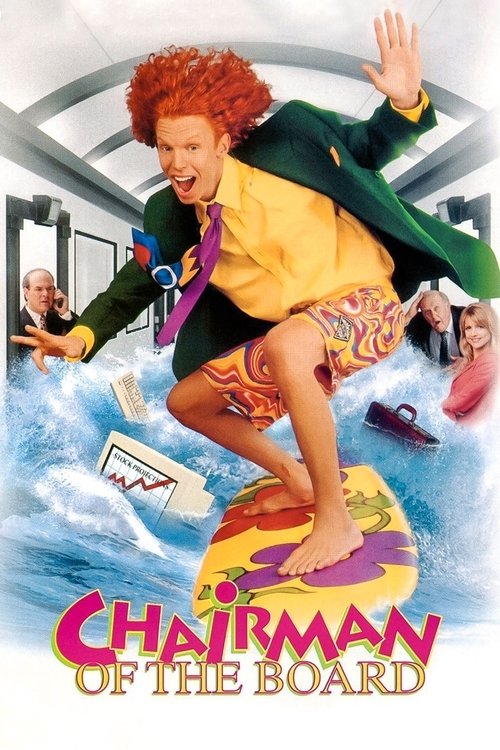
Chairman of the Board (1998): Complete Plot Narrative
Edison is a perpetually broke inventor and surf bum living in a shabby Southern California cottage with two unnamed surfer friends, constantly pouring what little money he has into harebrained inventions that never work. His creations are absurd failures--a bug-zapper hat that serves no practical purpose, an anatomically correct fanny-pack that looks disturbingly like exposed buttocks. He bounces from job to job, unable to make ends meet, his lifestyle a chaotic blend of failed entrepreneurship and beach culture.
One afternoon, while cruising despite his deadbeat status, Edison encounters a broken-down car on the roadside. Behind the wheel sits Armand McMillan, a wealthy business magnate and inventor at heart. Edison attempts to "repair" the vehicle using his inventive contraptions, and somehow, against all odds, his bumbling genius impresses the elderly billionaire. Rather than dismissing the scruffy surfer, Armand sees something in Edison--a spark of genuine creativity and dreamlike optimism that corporate life has long since extinguished from his own soul.
The two men bond over Edison's scrapbook of invention sketches, crude two-dimensional drawings that look like a baby might have drawn them, yet Armand studies them with genuine fascination. "You've got a good head on your shoulders," Armand tells Edison, and he means it. They go surfing together, and an unlikely friendship blooms between the elderly tycoon and the young drifter. Armand sees in Edison the embodiment of the inventor's spirit he once possessed--unburdened by corporate responsibility, driven purely by imagination and the desire to create.
But Armand's time is limited. Shortly after meeting Edison, the billionaire passes away. His death is natural, unmarked by drama or violence, yet it sets the entire plot in motion. At the funeral home, during the will reading, Edison makes an appearance that becomes instantly memorable for all the wrong reasons. Desperate for appropriate funeral attire, Edison attempts to borrow clothes from an embalmed corpse, grappling with the body in a way that a passing mourner mistakes for something far more intimate. The stranger sighs philosophically, "We all have our different ways of saying goodbye," and moves on, seemingly unbothered by what he believes he has witnessed.
The will reading reveals Armand's final wishes, and they shock everyone present. Armand has left Edison 45% of the controlling shares in McMillan Industries, his massive invention corporation. In a posthumous video diary, Armand explains his reasoning: the company "needs to stay in the hands of a dreamer," someone who understands that innovation requires imagination, not just profit margins. Edison is now the Chairman of the Board.
This inheritance devastates Bradford McMillan, Armand's jealous nephew and only living relative. Bradford had expected to inherit the company--he had, after all, worked tirelessly to make it a success, building it into a job-creating enterprise. Instead, he receives only Armand's prized surfboard, a humiliating consolation prize that transforms his resentment into cold fury. Bradford becomes consumed with a singular goal: to destroy Edison and reclaim what he believes should have been his.
Edison arrives at McMillan Industries as chairman, a fish-out-of-water among the stuffy, corporate board members who view him with barely concealed disdain. He is assisted by Natalie Stockwell, Armand's sexy and efficient secretary, who becomes both his guide through the corporate maze and, eventually, his romantic interest. Together, they navigate the company's operations, with Edison bringing an unconventional approach that initially seems destined for disaster.
Yet Edison's unorthodox methods begin to work. He wins over the stodgy board of directors by inviting them to play Twister in the boardroom, breaking down their corporate rigidity through childlike play. When union workers threaten to strike, Edison doesn't negotiate in traditional ways--instead, he declares that every Wednesday will be a Luau Beach Party, transforming labor relations through celebration rather than confrontation. His most significant business success comes through his latest invention: a portable TV dinner combo with a built-in microwave and television set, priced at just $2.19 more than competitors. The product is genuinely innovative, practical, and profitable.
Edison's business acumen and worker-friendly policies win over not just the board but the entire company culture. Natalie, impressed by his authenticity and success, becomes his girlfriend. The company thrives under his leadership, and it seems that Armand's faith in the dreamer has been vindicated.
But Bradford has been plotting in the shadows. He teams up with Grace Kosik, a ruthless corporate raider played by Raquel Welch, who sees an opportunity to acquire McMillan Industries at a bargain price. Together, they devise a scheme to drive down the company's stock price, triggering a clause in Armand's will: if the stock drops below $20 per share, Bradford automatically becomes Chairman of the Board.
Their weapon is Edison's own glow-in-the-dark gel formula--a formula that doesn't actually exist in the world of the film. Bradford steals the formula from Edison's research, then applies the gel to an unsuspecting man and orchestrates a class action lawsuit. The man appears on a newscast claiming that Edison's portable TV dinner caused him to glow in the dark like a walking night light, and he's suing for $500 million in damages. The lawsuit is a fabrication designed to terrify investors and tank the stock price.
Edison is baffled by the accusation. He knows with certainty that the TV dinners couldn't possibly cause the level of radiation necessary to make someone glow. He attempts to explain that radiation causes sickness and death, not luminescence, but the damage to the company's reputation is immediate and severe. Stock prices plummet as investors panic, and Bradford sees his opportunity approaching.
Bradford manipulates the employees' stock holdings and works out a corporate takeover with Grace Kosik. The endgame is in sight--Edison's chairmanship is about to be stripped away, and the company will fall into Bradford's hands.
But Edison has a moment of clarity. He realizes that Bradford must have stolen his glow-in-the-dark gel and faked the entire lawsuit. The pieces fall into place: the formula that doesn't exist, the man glowing impossibly bright, the convenient timing of the lawsuit. Bradford's desperation has revealed his guilt.
Edison launches into a wild race through rush-hour traffic, speeding toward the boardroom where a final confrontation is about to unfold. He arrives at the climactic moment when Bradford is poised to take control of the company. In front of the entire board of directors, Edison exposes Bradford's fraud using his latest invention: a "Bull Shirt," a fart-shirt or radioactive shirt that publicly exposes its wearer as a liar and fraud, emitting gas or light that marks the wearer as dishonest. The invention is absurd, ridiculous, and utterly effective--it sells itself, as Grace will later observe.
Bradford is arrested for his crimes. Grace Kosik, witnessing Edison's ingenuity and recognizing a profitable opportunity, switches sides. She makes a deal with the company to testify against Bradford in exchange for a stake in Edison's invention empire. She sees the potential in Edison's creations and wants to be part of his success rather than his destruction.
The company is saved. Edison's truth about radiation--that it causes sickness and death, not glowing--is vindicated. The lawsuit collapses, the stock recovers, and McMillan Industries emerges from the crisis stronger than before.
In the film's final moments, Edison appoints his girlfriend Natalie Stockwell to run McMillan Industries as the new operational leader. Edison steps back from the day-to-day management, returning to his true calling as a dreamer and inventor. The company remains in the hands of someone who understands Armand's original vision--not a corporate raider or a resentful nephew, but someone who shares Edison's creative spirit and values.
The ending affirms Armand's final wisdom: corporate greed is no match for undisciplined creativity and bumbling dumb luck. Edison's triumph is not one of cunning or ruthlessness, but of authenticity, imagination, and the power of genuine innovation. The surfer-inventor who couldn't make rent money has become the unlikely savior of a Fortune 500 corporation, proving that sometimes the most unconventional paths lead to the most meaningful success.



What is the ending?
In the ending of "Chairman of the Board," the main character, a laid-back inventor named Arnie, successfully saves the company from financial ruin. He manages to outsmart the villainous character, who has been trying to take over the company. Arnie's innovative ideas and carefree attitude ultimately win over the board members, and he is accepted as the new chairman. The film concludes with Arnie embracing his new role, surrounded by friends and supporters.
Now, let's delve into the ending in a more detailed narrative fashion.
As the climax of "Chairman of the Board" unfolds, the tension in the boardroom is palpable. Arnie, played by Carrot Top, stands before the stern-faced board members, who are skeptical of his unconventional methods and laid-back demeanor. The villain, a slick businessman named Jack, has been scheming to take control of the company, and the stakes are high. The board is on the verge of making a decision that could lead to Arnie's ousting.
In a pivotal moment, Arnie presents his latest invention, a revolutionary product that he believes can save the company. The room is filled with a mix of disbelief and curiosity as he demonstrates the product's capabilities. His passion and enthusiasm begin to sway some of the board members, who start to see the potential in his ideas. Arnie's friend and love interest, a strong-willed woman named Kelly, stands by him, offering her support and encouragement.
As the meeting progresses, Jack attempts to undermine Arnie, launching a series of personal attacks and trying to discredit his inventions. However, Arnie remains composed, drawing on his creativity and charm to counter Jack's accusations. The tension escalates as Jack reveals his own plans to take over the company, but Arnie's quick thinking and resourcefulness shine through. He cleverly turns the tables on Jack, exposing his unethical practices and revealing the truth about his intentions.
The board members, now fully engaged, begin to rally behind Arnie. They see not only his innovative spirit but also his genuine care for the company and its employees. The atmosphere shifts from one of skepticism to one of support, as Arnie's vision for the future resonates with them. In a dramatic turn, the board votes to keep Arnie as the chairman, rejecting Jack's hostile takeover.
In the final scenes, Arnie is celebrated by his friends and colleagues. The once laid-back inventor is now embraced as a leader, and he takes on his new role with a mix of excitement and humility. Kelly, who has been a steadfast supporter throughout the film, shares a tender moment with Arnie, acknowledging their bond and the journey they have taken together.
As the credits roll, the film leaves viewers with a sense of hope and the message that creativity, authenticity, and teamwork can triumph over greed and deceit. Arnie's fate is one of newfound responsibility and leadership, while Jack faces the consequences of his actions, having been ousted from the company. The film concludes on a high note, celebrating the power of innovation and the importance of staying true to oneself.
Is there a post-credit scene?
In the movie "Chairman of the Board," there is no post-credit scene. The film concludes without any additional scenes or content after the credits roll. The story wraps up with the main character, a laid-back inventor named Arnie, having successfully navigated the challenges of running a company and finding a balance between his carefree lifestyle and the responsibilities of leadership. The film ends on a light-hearted note, emphasizing themes of friendship and personal growth, but does not include any further scenes or surprises after the credits.
What is the main character's profession before becoming Chairman of the Board?
The main character, a laid-back inventor named Arnie, is a surfboard designer and a carefree beach bum before he unexpectedly becomes the Chairman of the Board of a failing company.
How does Arnie become the Chairman of the Board?
Arnie becomes the Chairman of the Board after the original chairman, who is his friend, dies in a surfing accident and leaves the company to him in his will, despite Arnie's lack of business experience.
What challenges does Arnie face in his new role as Chairman?
As Chairman, Arnie faces numerous challenges, including dealing with the scheming vice president, who wants to take control of the company, and the pressure to turn the failing business around while staying true to his laid-back nature.
Who are the key supporting characters that help or hinder Arnie?
Key supporting characters include the ambitious vice president, who is determined to undermine Arnie, and Arnie's loyal friends, who support him in navigating the corporate world, including his love interest, who helps him realize his potential.
What is the significance of the company's product that Arnie tries to promote?
The company produces a line of innovative products, including a new type of surfboard, which Arnie tries to promote as he believes in the importance of creativity and fun, contrasting with the corporate greed surrounding him.
Is this family friendly?
"Chairman of the Board," produced in 1998, is generally considered a family-friendly film, but it does contain some elements that may be objectionable or upsetting for children or sensitive viewers. Here are a few aspects to consider:
-
Mild Language: The film includes some instances of mild profanity and suggestive language that may not be suitable for younger audiences.
-
Romantic Situations: There are scenes that involve romantic tension and innuendo, which may be inappropriate for younger viewers.
-
Physical Comedy: The film features slapstick humor and physical comedy that could be perceived as violent or reckless, though it is presented in a lighthearted manner.
-
Business Rivalry: The plot involves corporate competition and some scenes of deception and manipulation that might be confusing or unsettling for younger children.
-
Character Flaws: Some characters display selfish or irresponsible behavior, which could serve as a poor example for impressionable viewers.
Overall, while the film is designed to be comedic and entertaining, parents may want to preview it to determine its appropriateness for their children.