










Popular
What causes the catastrophic weather events in Category 6: Day of Destruction?
How does the character of Dr. Jennifer Vasquez contribute to the story?
What role does the character of Tom and his family play in the narrative?
How do the characters respond to the destruction caused by the storms?
What is the significance of the storm chasers in the film?
Should I watch it?
Ask Your Own Question

What is the plot?
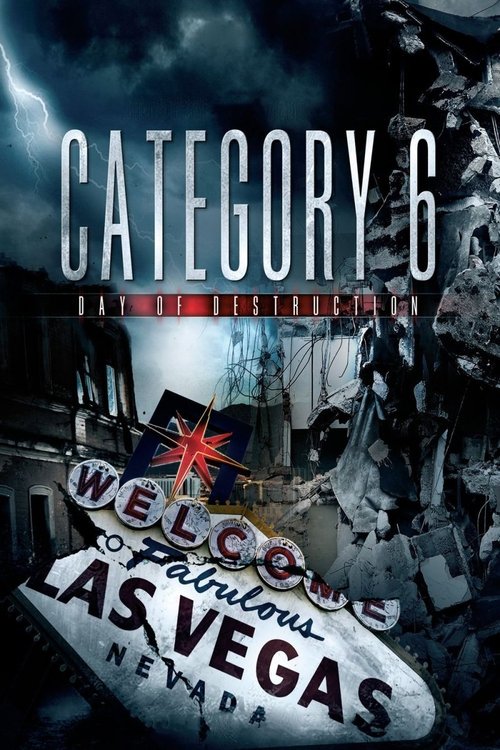
A tornado tears through Las Vegas, ripping across the Strip while tourists continue gambling, drinking, and sightseeing under skies that have given almost no warning. The destruction is so abrupt that the opening catastrophe feels less like an ordinary weather event than a violation of nature's rules. Elsewhere, cyclones batter the Florida coast, fires flare beneath violent lightning, the South is struck by severe storms, and an unprecedented heat wave settles over the Northeast and Midwest. Across the country, weather systems are behaving in ways that existing forecasts cannot explain.
At the National Weather Service's Severe Weather Center in Oklahoma, veteran meteorologist Andy Goodman and his staff study the strange patterns. Goodman is only about a week away from mandatory retirement as chief meteorologist, but retirement becomes irrelevant as the data grow more alarming. A powerful tornado-producing system is moving through the Midwest, a second system is developing around Lake Michigan, and another severe front is approaching from the south. Goodman and his former colleague eventually realize that the three systems are on converging paths. Their destination is Chicago.
The city is already suffering through a six-week heat wave. Temperatures remain dangerously high, air conditioners run continuously, and the demand for electricity threatens to overwhelm the regional grid. Mitch Benson, chief of operations at Midwest Electric, spends his days trying to keep the city supplied. He must balance public demand against dwindling reserves while storms begin damaging power plants and transmission facilities. Every decision is made against the possibility that one failure will trigger others.
Mitch's work is complicated by his personal life. He has a wife, Shirley Benson, and children, including his daughter Jane Benson, but he is having an affair with Rebecca Kerns, a public-relations consultant connected to Lexer Energy Corporation. Mitch's divided loyalties mirror the larger moral conflict surrounding the power crisis: he presents himself as a man responsible for protecting Chicago while privately betraying the people closest to him.
Lexer is the company that supplies or controls crucial energy resources for the region, including nuclear-reactor operations and the computer systems used to manage power distribution. Its senior executive, Craig Shilts, is determined to protect the corporation's interests and maximize its profits. The emergency creates an opportunity for Lexer to exploit the shortage, and the company's cost-cutting has already weakened the technological infrastructure on which the grid depends. Rather than maintaining robust, redundant systems, Lexer has downsized its information-technology operation and left its computer network dangerously exposed.
Dan London, a programmer employed by Lexer, understands the danger. He warns Amy Harkin, a Chicago television reporter attempting to establish herself as an anchorwoman, that Lexer's systems are vulnerable to hackers. London explains that a successful intrusion could disrupt the controls governing the regional power supply and set off a cascading failure. Amy recognizes that his warning is more than a technical complaint; it could explain the blackouts already troubling the city and could become the story that defines her career.
Amy presses Mitch and other power officials for answers, but the company does not respond with the urgency London believes necessary. The executives treat the warning as an inconvenience. The grid is already strained by heat-driven demand, the weather is growing more dangerous, and the corporation continues operating as though ordinary safeguards are enough.
At the Oklahoma weather center, Goodman's staff follows the storms as they intensify. The western system produces tornadoes, the northern system gathers power over the Great Lakes, and the southern disturbance adds another massive source of energy. The meteorologists see the three fronts moving toward the same region, but their models are not designed for what is forming. They eventually calculate that the systems may merge over Chicago and create a storm larger and more destructive than anything previously recorded.
The developing phenomenon will eventually be described as a Category 6 storm--not a conventional hurricane category, but a terrifying shorthand for a superstorm beyond the existing scale. Goodman and his staff attempt to warn Chicago, yet the communications infrastructure is deteriorating at the same time as the weather. The public is about to face a storm that authorities can barely understand, let alone describe.
London becomes convinced that waiting for Lexer's executives to act will cost lives. He decides to demonstrate the vulnerability himself. His intention is to force management to acknowledge that the company's network can be attacked, but he does not understand how his intervention will interact with the already overloaded system. London hacks into Lexer's computers and initiates a chain reaction that disrupts power distribution across Chicago.
The result is immediate and catastrophic. Electricity fails throughout the city. Homes, businesses, elevators, transportation systems, communications centers, and emergency facilities lose power. The blackout is not caused by London alone: the heat wave has pushed the grid to the edge, the storms have damaged generation and transmission, and Lexer's negligent design has left the network unable to absorb another shock. Nevertheless, London's attempt to expose the danger becomes the event that turns a fragile system into a citywide emergency.
Mitch struggles to restore service. He needs energy from Lexer, but Lexer's systems are compromised and its facilities are threatened by the approaching storms. The normal channels of communication fail, and Mitch cannot reliably determine which plants are still operating or which sections of the grid can safely accept more power. Every attempt to bring electricity back risks overloading another part of the network.
Amy realizes that the blackout may be connected to London's warning. She begins trying to locate him, while also attempting to report what is happening to a public whose televisions, telephones, and radios are increasingly useless. Goodman's team faces the same obstacle from another direction: the meteorologists know that Chicago is in the path of an unprecedented convergence, but their warnings cannot move through the broken communications system.
The storm reaches the Great Lakes. Wind tears through the region, lightning flashes over the darkened city, and tornadoes form within the larger circulation. The three systems fold into one another over Chicago, generating hurricane-force winds and violent rotating storms. The distinction between tornado, hurricane, and thunderstorm disappears. Buildings are damaged, roads become impassable, and the city's remaining power facilities begin to fail.
The blackout creates danger in places that would normally be safe. Amy's pregnant sister becomes trapped inside an elevator when the power goes out. The car hangs in a dark shaft, cut off from normal rescue systems while the storm rages outside. The trapped woman is frightened and vulnerable, but the crisis eventually becomes one of the film's strongest images of survival: despite the failed power network and the catastrophe above ground, she gives birth safely.
Mitch's family faces a different threat. Jane Benson's former boyfriend cannot accept that she has ended their relationship. During the blackout, he takes hostages inside a bank and carries a handgun. Shirley Benson is among those trapped. The bank becomes a sealed chamber of fear, with the storm outside making police intervention and communication difficult.
The gunman's behavior grows increasingly unstable. He does not merely want Jane back; he wants to punish her for leaving him, and his rage endangers everyone around him. Jane is caught in the crisis as the storm cuts the city apart. At some point during the confrontation, the former boyfriend accidentally shoots her. The gunshot transforms the hostage situation into a medical emergency, while Mitch is still attempting to keep the regional grid alive.
Mitch's public and private responsibilities now collide. He has been working to save Chicago's power system, but his wife is trapped in the bank and his daughter is wounded. He is also forced to confront the consequences of his affair with Rebecca. The man who has been presenting himself as a guardian of the city has failed to protect the trust of his own family.
At Lexer, Craig Shilts and the corporate leadership attempt to preserve control as the company's systems break down. The computer failure exposes the consequences of their policies. London warned that the network was unprotected, but the company ignored him. Its pursuit of profit and its reduction of technical safeguards have left the power system incapable of coping with either the hack or the weather.
Amy follows the trail connecting London, Lexer, and the blackout. Her investigation makes clear that Chicago is not merely the victim of an unavoidable natural disaster. The heat wave and converging storms create the conditions, but corporate negligence and technological dependence make the consequences vastly worse. Lexer has helped turn a weather emergency into a civilization-threatening grid failure.
As the storm grows, Mitch and Secretary Shirley Abbott attempt to obtain electricity from multiple outside companies. They gather energy from other sources in an effort to bypass Lexer's failing network and restore enough power to stabilize the region. Their plan is desperate but necessary: without additional electricity, Chicago cannot maintain emergency services, transportation, communications, or basic shelter.
At the same time, London tries to reverse the hack. He now understands that the chain reaction is much more dangerous than the demonstration he intended. He attempts to undo the damage just as power begins flowing into the system from other companies. London does not know that Mitch and Abbott are restoring outside supply, and the people restoring the power do not know that London is reversing his intrusion.
The two actions collide.
Energy surges into a network that is still being manipulated and is already damaged by the storm. Instead of recovering, the system overloads. The failure expands beyond Chicago and knocks out the entire Midwest power grid as the Category 6 storm strikes the city head-on. Power plants shut down, transmission lines fail, and the region is plunged into darkness beneath a gigantic rotating storm.
Dan London is killed in the resulting grid disaster. His death completes the tragic contradiction at the center of his story. He is responsible for initiating the blackout, but he was also the first person to recognize the vulnerability that made the catastrophe possible. He acts out of a desire to force Lexer to protect the public, then dies while trying to undo the consequences of his own intervention. His sacrifice does not erase his mistake, but it helps expose the truth about the company's negligence.
Craig Shilts also dies as the disaster destroys the corporate world he represents. The available accounts do not consistently specify the exact on-screen mechanism of his death, but the corporate leadership is destroyed or exposed by the catastrophe. Shilts's fate functions as the film's judgment on Lexer's profiteering: the people who treated the power crisis as a commercial opportunity are ultimately consumed by the failure they helped create.
The hostage crisis reaches its violent conclusion as well. Jane's former boyfriend dies during the confrontation or its aftermath, ending his threat. His actions have caused Jane to be shot, trapped Shirley and other civilians in the bank, and turned a private breakup into a deadly public emergency. Jane survives the immediate crisis despite her wound, and Mitch's family is rescued.
Mitch finally abandons the collapsing grid operation when he receives word that his family is trapped and Jane has been shot. He has spent the crisis trying to save the infrastructure, but he now chooses his family. His decision is both practical and emotional: by this stage, the grid is beyond his ability to control, while his wife and daughter still need him directly. He rushes through the devastated city to reach them.
The storm continues to tear through Chicago. The streets are dark, the skyline is obscured by rain and debris, and the usual machinery of the city has stopped. Yet the disaster does not end with the storm alone. The survivors must endure the aftermath of the blackout, the damaged buildings, the loss of communications, and the realization that the catastrophe was intensified by human decisions.
Amy's sister is rescued from the elevator, and the baby is delivered safely. The birth offers a stark contrast to the destruction outside: in a powerless, storm-battered city, new life arrives. Amy's professional struggle also reaches its resolution. Her investigation helps establish the connection among London's warning, Lexer's insecure systems, the blackout, and the company's profit-driven decisions. The corporation's role can no longer be hidden behind the language of technical failure or unavoidable weather.
Mitch returns to Shirley and his family. His survival is not presented as a simple victory, because he must confront the damage he has done to his marriage. The disaster forces him to abandon Rebecca Kerns and return to his wife and children. His reconciliation is part of his redemption: he has nearly lost his family while trying to manage a public crisis, and he finally recognizes that his private betrayal is another form of irresponsibility.
Andy Goodman's professional story also acquires new meaning. He is still close to retirement, but his knowledge and persistence have been essential in identifying the threat. The institutional system may have failed to communicate the warning, but Goodman and his team are vindicated in recognizing that the storms were converging into something beyond ordinary forecasting categories.
In the aftermath, the government agrees to change power regulations and strengthen protections intended to prevent another failure of this kind. The reforms acknowledge that the blackout was not simply an act of nature. A fragile grid, inadequate computer security, corporate cost-cutting, extreme weather, and poor coordination combined to produce the catastrophe. Future systems will need stronger safeguards, greater redundancy, and more responsible oversight.
The final movement of the miniseries is therefore one of destruction followed by accountability. Unnamed civilians die in the tornadoes and the Chicago superstorm, while Dan London, Craig Shilts, and the armed former boyfriend meet fatal ends tied to the choices they make. Mitch's daughter survives her accidental shooting, Shirley survives the bank siege, Amy's sister and her newborn child live, and the principal surviving characters emerge from the crisis changed.
Chicago is left devastated, but not morally unchanged. The storm exposes the weakness of institutions that value profit over safety, the danger of relying on vulnerable technology, and the human cost of ignoring warnings. London dies after trying to correct the failure he helped trigger; Shilts dies as the corporate system collapses; the gunman dies after turning heartbreak into violence; and Mitch gives up his affair to return to his family.
The last impression is not that the catastrophe has been undone. The city has suffered enormous losses, and the power grid cannot simply be restored by sunrise. But amid the wreckage, a child has been born, families have been reunited, wrongdoing has been exposed, and reforms have been promised. The Category 6 storm passes, leaving Chicago and the Midwest to rebuild--but also leaving behind a warning that the next disaster will be made far worse if weather, greed, fragile infrastructure, and human irresponsibility are allowed to converge again.


What is the ending?
In the ending of "Category 6: Day of Destruction," a massive hurricane strikes Chicago, leading to widespread devastation. The main characters, including meteorologist Dr. Sam Lanford, his estranged wife, and their daughter, work together to survive the storm. As the hurricane wreaks havoc, they face personal and external challenges. Ultimately, they manage to find safety, but not without significant loss and destruction around them.
As the storm approaches, the tension escalates. Dr. Sam Lanford, portrayed as a dedicated meteorologist, is deeply invested in his work and the safety of the city. He is determined to warn the public about the impending disaster, driven by a sense of responsibility and urgency. His estranged wife, who has been struggling with their relationship, is forced to confront their past as they navigate the chaos together. Their daughter, caught in the middle, represents hope and the future they must protect.
As the hurricane makes landfall, the city is engulfed in chaos. Buildings crumble, and the streets flood. The family, along with other characters, including a local news anchor and a group of emergency responders, face life-threatening situations. The emotional stakes are high as they fight to stay together and survive the storm.
In the climax, the family finds refuge in a sturdy building, but the storm's ferocity tests their resolve. They witness the destruction outside, feeling the weight of their choices and the fragility of life. The characters confront their fears and regrets, leading to moments of reconciliation and understanding.
As the storm finally begins to subside, the aftermath reveals a city in ruins. The characters emerge from their shelter, witnessing the devastation around them. Dr. Lanford's commitment to his work is reaffirmed as he surveys the damage, realizing the importance of his role in protecting the community. His wife, having faced the storm together, finds a renewed sense of connection with him, suggesting a path toward healing their relationship.
In the end, the family stands together, united by their shared experience. They look out over the wreckage, embodying resilience and hope for rebuilding. The film closes on a note of survival, emphasizing the strength of human spirit in the face of overwhelming odds. Each character's journey culminates in a deeper understanding of their priorities and relationships, leaving the audience with a sense of both loss and hope for the future.
Is there a post-credit scene?
The movie "Category 6: Day of Destruction" does not have a post-credit scene. The film concludes with the resolution of the main storyline, focusing on the aftermath of the catastrophic storms and the characters' survival. The narrative wraps up without any additional scenes or hints at future events after the credits roll.
What causes the catastrophic weather events in Category 6: Day of Destruction?
In the movie, a series of catastrophic weather events are triggered by a combination of climate change and a powerful storm system that develops over the Midwest. The film depicts how these extreme weather conditions escalate, leading to devastating tornadoes and hurricanes.
How does the character of Dr. Jennifer Vasquez contribute to the story?
Dr. Jennifer Vasquez, played by a prominent actress, is a meteorologist who is deeply invested in understanding the storm patterns. Her character is driven by a desire to save lives and prevent disaster, leading her to work tirelessly to warn the public and coordinate emergency responses as the storms intensify.
What role does the character of Tom and his family play in the narrative?
Tom, a father and husband, represents the everyday person caught in the chaos of the storms. His character arc revolves around his struggle to protect his family amidst the destruction, showcasing his determination and emotional turmoil as he faces the threat of losing everything.
How do the characters respond to the destruction caused by the storms?
The characters exhibit a range of emotional responses to the destruction, from fear and panic to bravery and resilience. As the storms wreak havoc, they band together, showcasing their determination to survive and help one another, highlighting themes of community and human spirit in the face of disaster.
What is the significance of the storm chasers in the film?
The storm chasers in Category 6 serve as a critical element in the narrative, representing the thrill-seekers and scientists who study severe weather. Their pursuit of the storms not only adds tension and excitement but also emphasizes the dangers of underestimating nature's power, as they often find themselves in life-threatening situations.
Is this family friendly?
"Category 6: Day of Destruction" is a disaster film that contains several elements that may not be suitable for children or sensitive viewers. Here are some potentially objectionable or upsetting aspects:
-
Natural Disasters: The film features intense scenes of hurricanes and tornadoes, showcasing destruction of property and the environment, which may be frightening for younger viewers.
-
Human Suffering: There are depictions of characters experiencing fear, panic, and distress as they face life-threatening situations, which can be emotionally intense.
-
Injury and Death: The film includes scenes where characters are injured or killed due to the disasters, which may be upsetting for sensitive viewers.
-
Family Struggles: The emotional turmoil within families as they deal with the crisis can be heavy, highlighting themes of loss and survival.
-
Tense Situations: The film builds suspense through various perilous scenarios, which may create anxiety for some viewers.
Overall, while the film is centered around a thrilling disaster narrative, its intense themes and scenes may not be appropriate for all audiences, particularly children.