
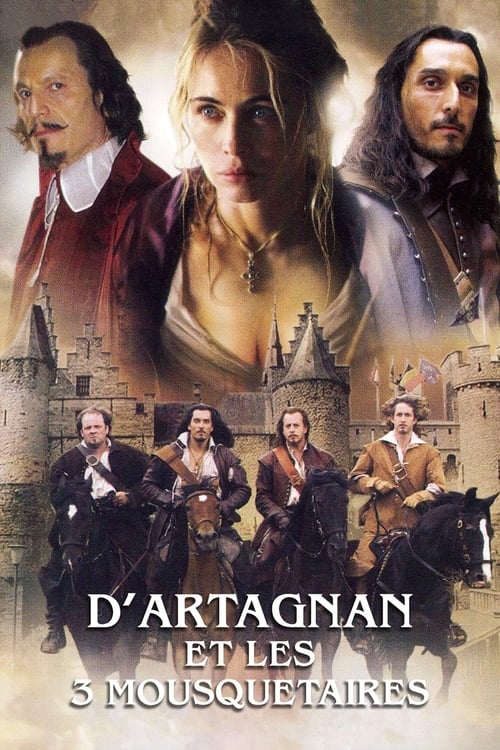

















Popular
What motivates D'Artagnan to join the Musketeers?
How does D'Artagnan first meet the Three Musketeers?
What role does Milady de Winter play in the story?
What is the significance of the conflict between the Musketeers and Cardinal Richelieu?
How does D'Artagnan's relationship with Constance evolve throughout the film?
Should I watch it?
Ask Your Own Question

What is the plot?
Sorry, we aren't able to watch and write up a full detailed plot yet. Check back in a few days.






What is the ending?
In the ending of "D'Artagnan and the Three Musketeers," D'Artagnan and the three musketeers confront the villainous Cardinal Richelieu and his forces. After a series of intense battles, they manage to thwart Richelieu's plans. D'Artagnan earns his place among the musketeers, and the bonds of friendship and loyalty are solidified. The film concludes with a sense of triumph and camaraderie among the characters.
As the climax of the film unfolds, the scene shifts to the grand palace of Cardinal Richelieu. The atmosphere is tense, filled with the anticipation of conflict. D'Artagnan, now fully embraced as a musketeer, stands alongside Athos, Porthos, and Aramis. Each of them is aware that the stakes are high; the fate of France hangs in the balance. The musketeers are determined to protect the honor of the queen and thwart Richelieu's treacherous schemes.
The first confrontation occurs in the opulent halls of the palace, where Richelieu's guards are stationed. D'Artagnan leads the charge, his heart pounding with a mix of fear and determination. He recalls the lessons learned from his comrades, channeling their bravery as he engages in combat. The clang of swords echoes through the corridors, and the musketeers fight with a fierce loyalty to one another, their movements synchronized as if they are one entity.
As the battle rages on, the musketeers face overwhelming odds. Richelieu's forces are numerous, but the musketeers' resolve is unyielding. Athos, with his stoic demeanor, fights valiantly, his past weighing heavily on him but fueling his desire to protect his friends. Porthos, ever the larger-than-life character, uses his strength to overpower enemies, his laughter ringing out even in the heat of battle. Aramis, with his agility and finesse, dances through the fray, his mind focused on the mission at hand.
In a pivotal moment, D'Artagnan confronts Richelieu directly. The tension is palpable as they exchange words, revealing Richelieu's cunning and ambition. D'Artagnan's determination shines through as he stands firm against the cardinal's manipulations. The duel that ensues is a clash of ideals as much as it is a physical battle. D'Artagnan's skill and bravery are put to the test, and he fights not just for himself but for the honor of the musketeers and the safety of the queen.
As the dust settles, the musketeers emerge victorious, having thwarted Richelieu's plans. The cardinal, realizing his defeat, retreats, vowing to return. The musketeers stand together, battered but unbroken, their bond stronger than ever. D'Artagnan, now fully accepted as one of them, feels a profound sense of belonging. The camaraderie they share is palpable, and they celebrate their victory with a newfound appreciation for each other.
In the final scenes, the musketeers gather in a tavern, laughter and joy filling the air. D'Artagnan reflects on his journey, the friendships he has forged, and the battles they have fought together. Each musketeer has found a sense of purpose and belonging, and they toast to their future adventures. The film closes with a sense of hope and unity, emphasizing the themes of friendship, loyalty, and the fight for justice. The fate of each character is intertwined, with D'Artagnan now a true musketeer, Athos, Porthos, and Aramis standing by his side, ready to face whatever challenges lie ahead.
Is there a post-credit scene?
In the movie "D'Artagnan and the Three Musketeers" produced in 2005, there is no post-credit scene. The film concludes with the resolution of the main plot, focusing on D'Artagnan's journey and his bond with the three musketeers--Athos, Porthos, and Aramis. The story wraps up with a sense of camaraderie and adventure, leaving the audience with a feeling of closure regarding the characters' arcs and their fight against the schemes of Cardinal Richelieu and Milady de Winter. The absence of a post-credit scene allows the film to end on a definitive note, emphasizing the themes of friendship and loyalty that are central to the narrative.
What motivates D'Artagnan to join the Musketeers?
D'Artagnan, a young and ambitious Gascon, is driven by a desire for adventure and a longing to prove himself. He dreams of becoming a Musketeer, inspired by tales of their bravery and camaraderie. His determination is fueled by a personal vendetta against the man who wronged his family, which adds a layer of urgency to his quest.
How does D'Artagnan first meet the Three Musketeers?
D'Artagnan's first encounter with Athos, Porthos, and Aramis occurs in a bustling Parisian street. He inadvertently challenges each of them to a duel, believing they are mere ruffians. This chaotic meeting, filled with misunderstandings and bravado, ultimately leads to a bond of friendship as they unite against a common enemy.
What role does Milady de Winter play in the story?
Milady de Winter is a cunning and manipulative antagonist who uses her beauty and intelligence to achieve her goals. She is deeply involved in the political machinations of the time, working against the Musketeers and attempting to seduce D'Artagnan. Her complex character embodies both charm and treachery, making her a formidable foe.
What is the significance of the conflict between the Musketeers and Cardinal Richelieu?
The conflict with Cardinal Richelieu represents the struggle between loyalty and power. Richelieu, as the chief minister, seeks to undermine the Musketeers and consolidate his control over France. This tension drives much of the plot, as the Musketeers must navigate political intrigue while remaining true to their ideals of honor and friendship.
How does D'Artagnan's relationship with Constance evolve throughout the film?
D'Artagnan's relationship with Constance evolves from a chance encounter to a deep romantic connection. Initially, Constance is a lady-in-waiting to Queen Anne, and D'Artagnan is smitten by her beauty and spirit. As they face danger together, their bond strengthens, revealing D'Artagnan's vulnerability and Constance's bravery, culminating in a poignant love story amidst the chaos.
Is this family friendly?
"D'Artagnan and the Three Musketeers" (2005) is generally considered family-friendly, but it does contain some scenes that may be potentially objectionable or upsetting for children or sensitive viewers. Here are a few aspects to consider:
-
Violence: The film features sword fights and duels, which, while choreographed and stylized, may be intense for younger viewers. There are moments of physical conflict that could be alarming.
-
Death and Injury: There are scenes that depict characters being injured or facing peril, which could be distressing, especially for sensitive children.
-
Romantic Tensions: The film includes romantic subplots that may involve jealousy and betrayal, which could be confusing for younger audiences.
-
Themes of Betrayal and Loyalty: The narrative explores complex themes of loyalty and betrayal among friends, which might be emotionally heavy for some viewers.
-
Mild Language: There are instances of mild language that may not be suitable for very young children.
Overall, while the film is adventurous and entertaining, parents may want to consider these elements when deciding if it is appropriate for their children.







