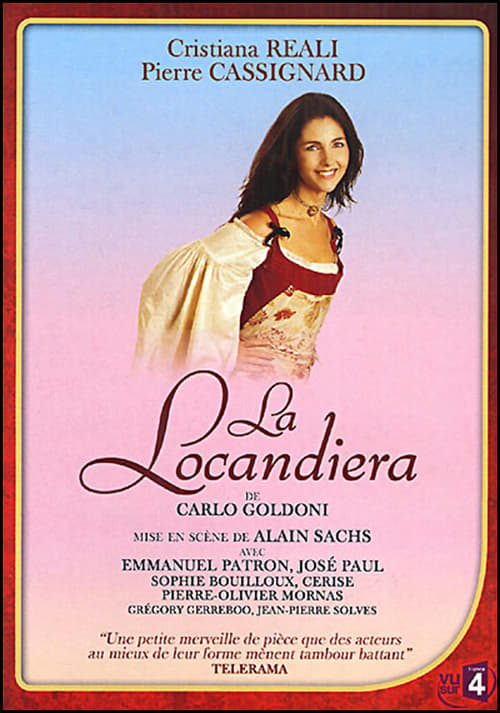








Popular
What is the significance of Mirandolina's character in La Locandiera?
How does the Count's attitude towards women change throughout the film?
What role does the inn play in the interactions between characters?
How does Mirandolina manipulate the men who are interested in her?
What is the relationship between Mirandolina and the Marquess, and how does it evolve?
Should I watch it?
Ask Your Own Question

What is the plot?
Sorry, we aren't able to watch and write up a full detailed plot yet. Check back in a few days.








What is the ending?
In the ending of "La Locandiera," the main character, Mirandolina, ultimately chooses to remain independent rather than succumb to the affections of either of her suitors, the Count and the Cavaliere. She asserts her autonomy and decides to continue running her inn, embracing her freedom.
As the film draws to a close, we find ourselves back in the bustling atmosphere of Mirandolina's inn. The scene is vibrant, filled with the sounds of laughter and conversation, as patrons enjoy their time. Mirandolina, played with charm and wit, is at the center of this lively environment, showcasing her ability to manage the inn with grace and confidence.
The Count, who has been infatuated with Mirandolina throughout the film, makes a final attempt to win her heart. He expresses his deep feelings for her, hoping to convince her to leave her life as an innkeeper and join him in a more traditional romantic relationship. His desperation is palpable, and he presents himself as a man willing to change for her. However, Mirandolina, with a knowing smile, gently rebuffs his advances. She appreciates his affection but is resolute in her decision to maintain her independence.
Meanwhile, the Cavaliere, who initially prided himself on his disdain for women, has undergone a transformation. He has developed genuine feelings for Mirandolina, and in this final scene, he too confesses his love. Yet, Mirandolina recognizes that his feelings are rooted in a newfound vulnerability rather than a true understanding of her as an individual. She sees through the facade of his bravado and understands that he, like the Count, is seeking to possess her rather than appreciate her autonomy.
In a moment of clarity, Mirandolina addresses both men, articulating her desire to remain true to herself. She explains that her happiness does not depend on being with either of them, but rather in being her own person. This declaration is a powerful moment, as it encapsulates her journey throughout the film--one of self-discovery and empowerment.
As the scene unfolds, the Count and the Cavaliere are left in a state of confusion and disappointment. They realize that their attempts to win Mirandolina's heart have been in vain. Mirandolina, however, stands tall, embodying strength and independence. She chooses to continue running her inn, a symbol of her freedom and self-sufficiency.
The film concludes with Mirandolina surrounded by her loyal patrons, who admire her for her wit and charm. The inn remains a place of joy and laughter, a testament to her success as a businesswoman. The final shot lingers on her face, a blend of contentment and determination, as she embraces her role as the innkeeper, fully aware of her worth and the choices she has made.
In summary, the fates of the main characters are as follows: Mirandolina remains the independent innkeeper, choosing her freedom over romantic entanglements. The Count and the Cavaliere, while still enamored with her, must confront the reality of their unrequited love and the realization that Mirandolina will not be defined by their desires. The film closes on a note of empowerment, celebrating the strength of a woman who knows her own value.
Is there a post-credit scene?
The movie "La Locandiera," produced in 2006, does not feature a post-credit scene. The film concludes its narrative without any additional scenes or content after the credits roll. The story wraps up with the resolution of the main characters' arcs, focusing on themes of love, deception, and the complexities of human relationships, leaving the audience with a sense of closure.
What is the significance of Mirandolina's character in La Locandiera?
Mirandolina is a strong-willed innkeeper who embodies independence and charm. Her character is significant as she navigates the affections of various suitors, showcasing her intelligence and wit. She uses her allure to manipulate the men around her, particularly the wealthy Count, who initially dismisses her. This dynamic highlights her role as a woman in control of her own destiny.
How does the Count's attitude towards women change throughout the film?
Initially, the Count is portrayed as a misogynist who believes he is above the charms of women, particularly Mirandolina. However, as the story progresses and he becomes more entangled in her web of seduction, his attitude shifts. He finds himself captivated by her, leading to a transformation where he begins to respect her intelligence and strength, ultimately revealing his vulnerability.
What role does the inn play in the interactions between characters?
The inn serves as a microcosm of society where various social classes interact. It is a setting for the unfolding drama and romantic entanglements. The physical space of the inn allows for intimate encounters and confrontations, highlighting the characters' desires and conflicts. The inn's atmosphere, filled with tension and humor, amplifies the emotional stakes of the characters' relationships.
How does Mirandolina manipulate the men who are interested in her?
Mirandolina skillfully uses her charm and intelligence to manipulate her suitors, particularly the Count and the Marquess. She plays with their emotions, feigning interest and then withdrawing it, which keeps them vying for her attention. Her manipulation is not malicious; rather, it reflects her desire for autonomy and respect in a male-dominated society, showcasing her strategic thinking and emotional intelligence.
What is the relationship between Mirandolina and the Marquess, and how does it evolve?
The relationship between Mirandolina and the Marquess begins with him being infatuated with her, viewing her as an object of desire. However, as Mirandolina asserts her independence and refuses to be merely a prize, the Marquess's feelings evolve. He becomes more aware of her strength and intelligence, leading to a complex dynamic where admiration and frustration coexist, ultimately challenging his perceptions of love and attraction.
Is this family friendly?
"La Locandiera," produced in 2006, is a film that revolves around themes of love, deception, and social class, set in 18th-century Italy. While it is a comedic adaptation of Carlo Goldoni's play, there are elements that may not be suitable for all audiences, particularly children or sensitive viewers.
-
Romantic Tensions: The film features romantic entanglements and flirtations that may include suggestive dialogue and situations, which could be confusing or uncomfortable for younger viewers.
-
Deception and Manipulation: The main character, Mirandolina, engages in schemes and manipulations to assert her independence and control over her suitors. This theme of deceit may be unsettling for some.
-
Class Disparities: The film explores social class differences, which may lead to discussions about wealth, power, and inequality that could be heavy for younger audiences.
-
Emotional Conflicts: Characters experience jealousy, heartbreak, and rivalry, which may evoke strong emotions and could be distressing for sensitive viewers.
-
Mature Themes: The overarching themes of love and desire are treated with a level of sophistication that may not resonate with younger audiences, as they may not fully grasp the nuances of adult relationships.
Overall, while "La Locandiera" is a comedic film, its themes and some content may not be entirely family-friendly, particularly for younger children or those who are sensitive to romantic and emotional complexities.